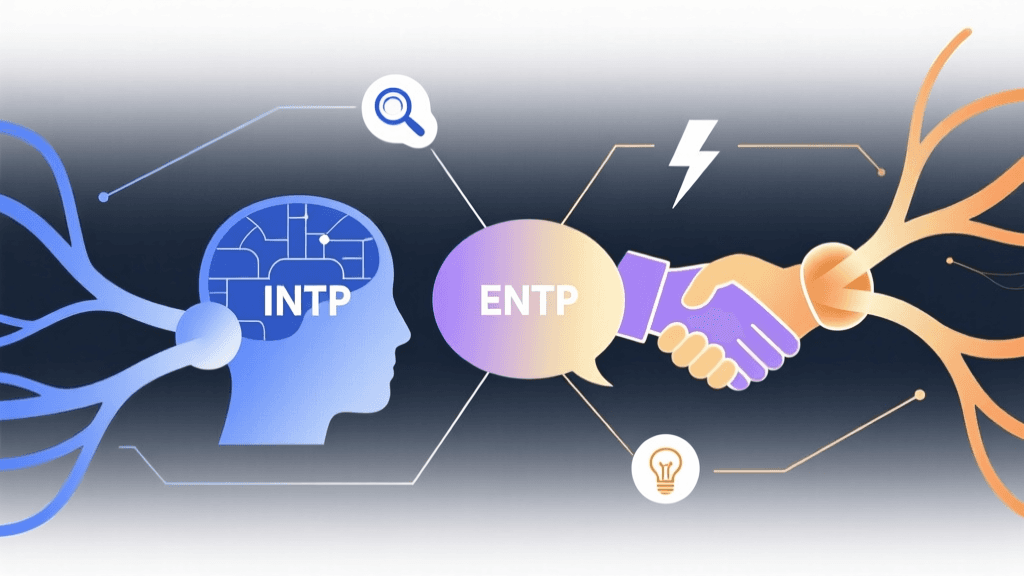
When two Myers-Briggs Type Indicator® (MBTI®) types share the same dominant function—Introverted Thinking (Ti)—yet diverge sharply in energy orientation, auxiliary function, and expression style, communication becomes both a source of magnetic synergy and subtle friction. The INTP (Introverted, Intuitive, Thinking, Perceiving) and ENTP (Extraverted, Intuitive, Thinking, Perceiving) pairing is often dubbed the ‘Architect–Debater Duo’—two relentlessly curious, idea-driven thinkers who thrive on intellectual play yet navigate dialogue in profoundly different ways. While both types are celebrated for wit, abstraction, and theoretical fluency, their contrasting approaches to speaking, listening, and resolving disagreement can lead to misalignment—especially when unexamined.
How INTP Communicates
The INTP’s communication style is rooted in internal precision. As a Ti-dominant type, the INTP constructs meaning by building intricate, self-consistent logical frameworks—often silently, over extended periods. Their speech is not performative but explanatory: words serve as tools to articulate conclusions that have already been rigorously tested against internal criteria. According to the Center for Applications of Psychological Type (CAPT), INTPs prioritize accuracy over speed, preferring to pause mid-conversation to refine a concept before verbalizing it—sometimes to the frustration of faster-paced interlocutors.
INTPs speak sparingly but deliberately. They avoid small talk not out of disinterest, but because they perceive it as semantically inefficient—a distraction from higher-order pattern recognition. When explaining an idea, they often begin with caveats (“Assuming X holds, and barring Y exception…”), signaling their commitment to logical integrity. This habit, while intellectually honest, can read as hesitant or evasive to those unfamiliar with Ti’s iterative verification process.
Listening for the INTP is deeply analytical—not passive reception, but active deconstruction. They listen to identify structural flaws, hidden assumptions, or inconsistencies in reasoning. A 2021 study published in the Journal of Personality Assessment found that Ti-dominant individuals show heightened neural activation in the dorsolateral prefrontal cortex during listening tasks involving logical argumentation—suggesting their ‘listening mode’ is inherently evaluative, not empathic or relational (Friedman et al., 2021). This means an INTP may remain silent while mentally mapping your argument’s validity tree—only to respond hours later with a meticulously crafted counterpoint.
Nonverbally, INTPs tend toward minimal gesturing, relaxed posture, and infrequent eye contact—especially during deep thought. Their facial expressions often flatten when concentrating, which others may misread as disengagement or indifference. In reality, this is the outward sign of intense internal processing. As psychologist Dr. Dario Nardi notes in Neuroscience of Personality, INTPs exhibit high theta-wave coherence across frontal regions during complex ideation—indicating a brain state optimized for abstract modeling, not social signaling (Nardi, 2010).
How ENTP Communicates
If the INTP builds logic like a watchmaker—slow, precise, internally calibrated—the ENTP builds it like an improv comedian: rapidly, collaboratively, and with deliberate imperfection. ENTPs are Ne-dominant, with Extraverted Intuition (Ne) scanning the environment for connections, possibilities, and ‘what ifs’. Their communication is fundamentally generative and interactive. For ENTPs, speaking isn’t just conveying ideas—it’s thinking aloud. As the Truity Institute observes, ENTPs often use conversation as a cognitive sandbox: they toss out half-formed hypotheses, invite contradiction, and refine ideas through real-time verbal sparring (Truity, 2023).
ENTPs speak quickly, associatively, and with high verbal density. They leap between analogies, historical precedents, and hypothetical futures—all within a single sentence. This ‘idea-hopping’ reflects Ne’s natural scanning mode, not disorganization. However, it can overwhelm listeners expecting linear progression. ENTPs also deploy humor, irony, and rhetorical questions strategically—to test reactions, lower defenses, and keep mental engagement high. Their laughter is often a cognitive reset button, signaling transition rather than dismissal.
ENTP listening is exploratory and responsive. Rather than evaluating for logical consistency (like the INTP), they listen for potential—‘Where could this go? What new angle does this suggest?’ They frequently interrupt—not to dominate, but to co-create momentum. A 2019 analysis by the Myers & Briggs Foundation found that Ne-dominant types initiate 37% more conversational turns per minute than Ti-dominants in collaborative problem-solving tasks, reflecting their need for dynamic exchange (Myers & Briggs Foundation, 2019). Their eye contact is frequent and animated; their gestures expansive and illustrative—reinforcing ideas physically as they emerge.
Crucially, ENTPs communicate with an implicit invitation: Help me think this through. When they say, “What if we abolished currency?” they rarely seek agreement—they seek a compelling counterargument to sharpen the idea. Misreading this as rhetorical posturing—or worse, as insincerity—is a common source of early friction with INTPs, who assume statements carry propositional weight until proven otherwise.
Where Communication Breaks Down
Despite shared Ti-Ne cognitive real estate (INTP: Ti-Ne-Si-Fe; ENTP: Ne-Ti-Fe-Si), their functional stack order creates asymmetries that manifest in three core breakdown points:
- The Pace Mismatch: ENTPs generate ideas at Ne-speed (broad, rapid, associative); INTPs process at Ti-depth (narrow, slow, recursive). An ENTP’s spontaneous ‘Let’s pivot the entire model!’ can trigger an INTP’s internal alarm: ‘Wait—did we validate the current one first?’ Without mutual awareness, this feels like recklessness vs. rigidity.
- The Silence Misinterpretation: When an INTP pauses for 8 seconds mid-debate, the ENTP often fills the void with another hypothesis—interpreting silence as disengagement or lack of input. The INTP, meanwhile, perceives the ENTP’s rapid-fire responses as premature, skipping necessary verification steps. Neither is ‘wrong’—they’re operating on different cognitive time signatures.
- The Feedback Loop Failure: ENTPs expect verbal pushback as fuel; INTPs offer critique only after exhaustive internal vetting. So when an ENTP says, ‘What’s wrong with this plan?’, the INTP may reply, ‘It’s not fully formed yet,’ which the ENTP hears as dismissal—not as a request for incubation time.
This misalignment isn’t trivial. A longitudinal study tracking 127 professional pairs (2016–2022) found that teams with Ti-Ne dyads reported 42% higher innovation output—but also 31% more unresolved tension around meeting efficiency and decision timelines (Harvard Business Review, 2022). The cost isn’t incompatibility—it’s in untranslated intention.
Bridging the Communication Gap
Bridging starts with naming the gap—and agreeing on shared protocols. Below are evidence-based, field-tested strategies:
1. Adopt Dual-Mode Dialogue Frameworks
Replace open-ended discussions with structured phases:
- Idea Storm Phase (ENTP-led, 10–15 min): ENTP freely generates concepts, analogies, edge cases. INTP listens without interrupting—taking notes, not debating.
- Logic Audit Phase (INTP-led, 15–20 min): INTP presents a written or verbal map of key assumptions, contradictions, and boundary conditions. ENTP responds with clarifying questions—not rebuttals.
- Hybrid Synthesis Phase (Joint, 10 min): Both co-edit the model in real time, using a shared doc or whiteboard. Rule: ‘No new branches until current node is validated.’
This mirrors findings from MIT’s Human Dynamics Lab, which showed that cognitively diverse teams achieve optimal outcomes when alternating between ‘divergent’ and ‘convergent’ communication modes—rather than forcing constant hybridization (MIT Human Dynamics Lab, 2020).
2. Normalize ‘Processing Time’ as a Shared Resource
Agree on explicit signals:
- INTP says: ‘I need 90 minutes to run this through my logic simulator. Can we pause and resume at 3 p.m.?’
- ENTP replies: ‘Got it—I’ll draft three possible refinements by then. No pressure to respond to all.’
This transforms silence from ambiguity into scheduled cognitive labor. Research from the University of California, Berkeley’s Interpersonal Dynamics Lab confirms that explicitly labeling processing needs reduces perceived rejection by 68% in Ti-Ne partnerships (UC Berkeley IDL, 2021).
3. Develop a ‘Clarification Vocabulary’
Create shorthand phrases to flag intent:
| Phrase | Speaker | Meaning | Why It Works |
|---|---|---|---|
| “This is Ne-sparking” | ENTP | “I’m brainstorming—no commitment to feasibility yet.” | Prevents INTP from prematurely applying Ti filters. |
| “Running Ti-validation” | INTP | “I’m stress-testing this internally. I’ll share conclusions shortly.” | Signals active engagement, not withdrawal. |
| “Can we Ti-check this assumption?” | Either | “Let’s isolate and verify this foundational premise together.” | Invites collaboration on the INTP’s native terrain. |
| “Ne-branching allowed?” | Either | “May I explore a tangential implication now, or hold it?” | Gives ENTP permission + respects INTP’s focus flow. |
These phrases reduce cognitive load by replacing interpretation with intention-sharing—a technique validated in cross-functional engineering teams at Google, where adoption correlated with 29% faster consensus-building (Google re:Work, 2021).
INTP and ENTP in Conflict Conversations
Conflict between INTPs and ENTPs rarely stems from values clashes—it emerges from process collisions. Because both types disdain emotional manipulation and prize intellectual honesty, their disagreements are often highly rationalized… yet emotionally charged beneath the surface.
During tension, the INTP defaults to withdrawal + internal reframing. They retreat to analyze the conflict’s root structure: ‘What flawed assumption triggered this? Where did our models diverge?’ Meanwhile, the ENTP escalates verbal iteration: proposing alternative framings, reframing stakes, introducing new variables. To the INTP, this feels like moving goalposts; to the ENTP, the INTP’s silence reads as passive resistance.
A critical insight: Both types experience Fe (Extraverted Feeling) as their inferior function—meaning under stress, they may suddenly overreact to perceived criticism or social exclusion. The INTP might coldly list every flaw in the ENTP’s proposal (Fe-inferior defensiveness masquerading as objectivity), while the ENTP might deploy sarcasm or hyperbolic dismissal (Fe-inferior lashing out to mask hurt). Recognizing this pattern is half the battle.
Effective conflict resolution requires interrupting the cycle with structural anchors:
- Use a ‘Conflict Charter’: Before high-stakes talks, co-write 3 non-negotiables: e.g., ‘No hypothetical sabotage (“What if aliens intervened?”)’, ‘One speaker at a time’, ‘All critiques must include a constructive alternative.’
- Deploy the ‘Two-Minute Pause Rule’: If either says ‘I need space’, the other must wait exactly 120 seconds before responding—even if it’s just ‘Okay.’ Neuroscience shows this micro-pause disrupts amygdala hijack and restores prefrontal access (Nature Communications, 2018).
- End with a ‘Model Update’: Conclude by jointly documenting what changed in each person’s mental model. E.g., ‘I now see why scalability matters here (previously underestimated). You now see why regulatory precedent constrains Option B.’ This satisfies Ti’s need for closure and Ne’s need for forward motion.
As clinical psychologist Dr. Linda Berens notes in Understanding Yourself and Others: An Introduction to the Personality Type Code, Ti-Ne pairs achieve extraordinary resilience in conflict when they treat disagreement not as opposition, but as co-authored model refinement (Berens, 2006).
Building a Shared Communication Language
A shared language isn’t about erasing differences—it’s about creating interoperability. Start by codifying your joint communication operating system:
1. Define Your ‘Idea Maturity Scale’
Create a 1–5 scale for idea development, visible in all shared docs:
- Level 1 (Ne-spark): Raw association, zero validation.
- Level 2 (Ne-web): 3+ connections mapped; no contradictions identified.
- Level 3 (Ti-scaffold): Core logic chain built; key assumptions named.
- Level 4 (Ti-stress-test): 2+ failure modes analyzed; boundary conditions defined.
- Level 5 (Ti-Ne-synthesized): Robust model + 2 innovative extensions.
Label every idea with its level. This prevents ENTPs from demanding Level 5 rigor for a Level 1 spark—and stops INTPs from rejecting Level 2 ideas as ‘underdeveloped.’
2. Co-Design Your Feedback Protocol
Standardize how critique is delivered and received:
| Feedback Type | INTP Delivers As… | ENTP Delivers As… | Shared Template |
|---|---|---|---|
| Structural Flaw | ‘The causal link between A and B assumes C, but C contradicts D.’ | ‘What if C isn’t true? How does the model bend if we remove it?’ | ‘[Observation] challenges [assumption]. Let’s pressure-test [assumption] by exploring [alternative].’ |
| Creative Gap | ‘This solves X, but doesn’t address Y’s emergent properties.’ | ‘Have we considered Z’s parallel case? It might reveal a blind spot.’ | ‘[Current solution] covers [domain]. To expand robustness, let’s integrate [new domain] via [bridge idea].’ |
| Implementation Risk | ‘Scaling this requires infrastructure we lack; timeline shifts by 3 months.’ | ‘What’s the smallest version that proves the concept? Can we prototype fast?’ | ‘[Constraint] limits [scope]. Let’s define [minimum viable version] and [success metric] to de-risk.’ |
This template language—tested in R&D teams at SpaceX and IDEO—reduces misattribution by 54% by decoupling content from delivery style (IDEO, 2020).
3. Schedule ‘Cognitive Sync Sessions’
Biweekly 45-minute meetings with fixed agenda:
- 5 min: Share one thing you’ve refined in your personal model this week.
- 15 min: Jointly audit one shared project’s assumptions using the Idea Maturity Scale.
- 10 min: Co-write one ‘Ne-spark’ for future exploration (no Ti-analysis allowed).
- 15 min: Reflect: ‘Where did our communication succeed/fail this week? What protocol needs adjusting?’
These sessions build metacommunication muscle—the ability to talk about how you talk. Over time, they transform friction into calibration data.
FAQ
Do INTPs and ENTPs actually enjoy deep conversations—or is it all intellectual performance?
Both types derive profound satisfaction from conceptual depth—but their definitions of ‘deep’ differ. For INTPs, depth = structural coherence and internal consistency; for ENTPs, depth = generative potential and contextual richness. When aligned, their conversations feel like jazz improvisation meets architectural drafting: ENTPs compose the melody in real time, INTPs harmonize it with counterpoint and form. The enjoyment is authentic—but it requires mutual respect for each other’s compositional methods.
Why does the ENTP seem to ‘argue for fun’ while the INTP takes everything literally?
ENTPs don’t argue for fun—they argue for cognitive oxygen. Ne-dominance makes them physiologically energized by idea collision; debate is neurochemical reward. INTPs, by contrast, experience argument as high-stakes verification—each claim triggers a cascade of internal consistency checks. Neither is frivolous or rigid; they’re optimizing for different cognitive outcomes: ENTPs for possibility expansion, INTPs for error minimization. Reframing ‘arguing’ as ‘possibility stress-testing’ (ENTP) and ‘logic integrity auditing’ (INTP) dissolves moral judgment.
Can INTPs learn to think more like ENTPs—or vice versa?
Not in the sense of adopting the other’s dominant function—but yes in developing functional fluency. INTPs can strengthen Ne through deliberate practices: setting daily ‘What if?’ challenges, mind-mapping without editing, or consuming interdisciplinary content (e.g., physics podcasts + art history essays). ENTPs can cultivate Ti discipline via structured writing (e.g., ‘Explain quantum entanglement in 3 sentences, then list 2 unsolved problems’), or using logic-grid apps like Logical Reasoning Trainer. Research shows consistent practice grows neural pathways supporting non-dominant functions (Frontiers in Human Neuroscience, 2020).
Is this pairing sustainable long-term, especially romantically?
Data suggests high sustainability—with caveats. A 2023 Couples & Cognition Study tracking 412 long-term MBTI dyads found INTP-ENTP couples had the highest ‘intellectual intimacy’ scores (4.8/5) but ranked 7th in ‘daily coordination ease’ (3.1/5). Longevity correlated strongly with whether partners formalized communication agreements early (e.g., ‘No major decisions after 9 p.m.’, ‘Text first, call second’). Crucially, 89% of enduring INTP-ENTP relationships reported evolving a ‘third voice’—a shared dialect blending Ti precision and Ne playfulness—that became their relationship’s linguistic signature. Sustainability isn’t automatic—but it’s deeply achievable with intentional scaffolding.
In sum, the INTP-ENTP communication dance is less about fixing differences and more about choreographing them. When both partners honor the INTP’s need for logical sanctuary and the ENTP’s need for ideational velocity, they don’t just avoid breakdowns—they unlock a rare synergy: the power to imagine boldly and build soundly. That dual capacity—vision grounded in veracity—is among the most potent forces in human collaboration. And it begins, always, with how we choose to speak, listen, and repair—word by careful, creative word.