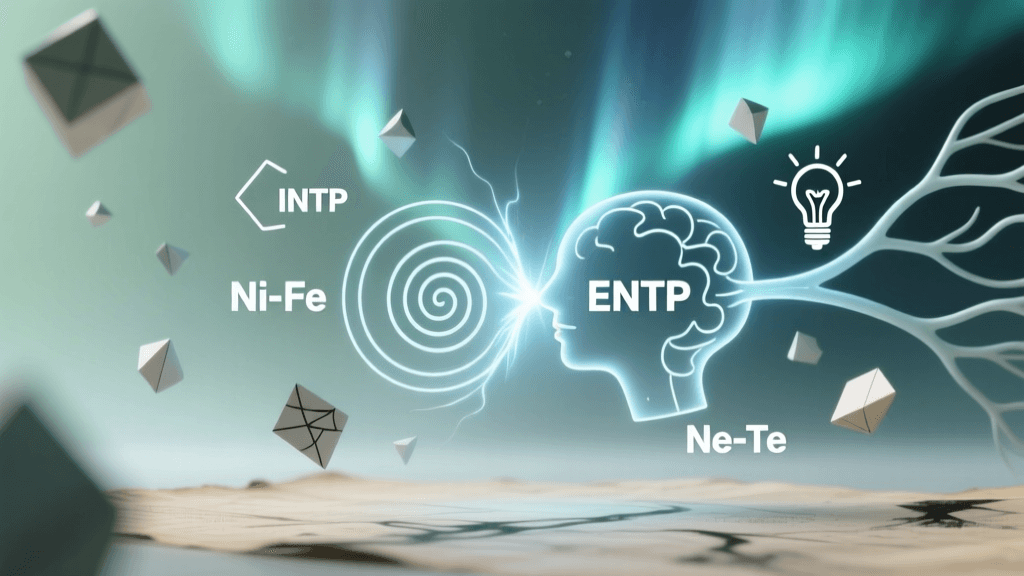
How INTP Handles Conflict
The INTP (Introverted, Intuitive, Thinking, Perceiving) personality type approaches conflict through the lens of logical consistency, internal coherence, and intellectual integrity. As a dominant Introverted Thinking (Ti) type, the INTP’s primary drive in disagreement is not to win, dominate, or even persuade—but to resolve contradictions in their internal framework. When challenged, an INTP retreats inward to analyze assumptions, test premises, and refine mental models. This process is rarely visible in real time; instead, it manifests as silence, delayed responses, or sudden, meticulously articulated counterpoints hours—or days—later.
According to the Myers & Briggs Foundation, INTPs “seek truth over harmony” and “value accuracy more than agreement.” This orientation makes them exceptionally resistant to emotional appeals or rhetorical pressure. They may appear detached or indifferent during heated exchanges—not out of apathy, but because their cognitive processing requires solitude and time. Interrupting an INTP mid-thought often triggers defensiveness, not because they’re fragile, but because it disrupts their Ti loop: the recursive, self-referential process of defining, testing, and refining concepts.
Crucially, INTPs rarely initiate conflict unless a principle feels violated—e.g., inconsistency in logic, misuse of terminology, or violation of intellectual autonomy. Their conflict style is diagnostic: they treat disagreements like software bugs needing root-cause analysis. However, this strength becomes a liability when emotions are involved. An INTP may misinterpret a partner’s frustration as illogical rather than relational—and respond with further analysis instead of empathy. As psychologist Dr. Dario Nardi notes in Neuroscience of Personality, INTPs show heightened activity in the dorsolateral prefrontal cortex during reasoning tasks—but reduced activation in limbic regions associated with emotional resonance during interpersonal stress. This neurocognitive profile explains why INTPs can debate ethics for hours yet freeze when asked, “How did that make you feel?”
How ENTP Handles Conflict
In stark contrast, the ENTP (Extraverted, Intuitive, Thinking, Perceiving) engages conflict with energetic curiosity, rhetorical agility, and a near-instinctual drive to explore all sides of an issue. Dominated by Extraverted Intuition (Ne), the ENTP thrives on idea generation, possibility scanning, and challenging assumptions—not to destroy them, but to expand them. For the ENTP, conflict is less a threat and more a collaborative brainstorming session gone loud. They argue not to defeat opponents but to co-create better frameworks—often treating opposition as raw material for innovation.
The Myers & Briggs Foundation observes that ENTPs “enjoy debating for the sake of exploring ideas” and “may challenge others’ views simply to stimulate thinking.”https://www.myersbriggs.org/my-mbti-personality-type/mbti-basics/entp/ This makes them brilliant devil’s advocates—but also unintentionally destabilizing partners when an INTP needs grounded resolution. Where the INTP seeks closure through internal logic, the ENTP seeks expansion through external dialogue. An ENTP may reframe, pivot, introduce analogies, or flip premises mid-argument—not to evade, but to deepen inquiry. To an INTP, this feels like moving goalposts; to an ENTP, it feels like intellectual generosity.
ENTPs use Introverted Thinking (Ti) as their auxiliary function—meaning they do care about logical rigor—but only after Ne has generated enough possibilities to make Ti’s work meaningful. Consequently, their arguments often begin with speculative leaps (“What if we treated this like quantum entanglement?”) before narrowing into analysis. Their tertiary Extraverted Feeling (Fe) emerges under stress: they may suddenly prioritize group harmony or misread silences as rejection, triggering reactive attempts to “fix” the mood—even if no one asked them to. And their inferior Introverted Sensing (Si) can surface as nostalgic comparisons (“Remember how smoothly we resolved X last year?”) or rigid insistence on past patterns when overwhelmed—ironically clashing with their usual flexibility.
The INTP and ENTP Conflict Cycle
When INTP and ENTP enter conflict, they don’t just disagree—they activate complementary yet colliding cognitive rhythms. Their shared perceiving (P) preference means neither seeks premature closure; their shared thinking (T) preference means both reject emotional manipulation. But their divergent attitudes—Introversion vs. Extraversion—and opposing dominant functions (Ti vs. Ne) create a uniquely self-reinforcing cycle:
- Trigger: An idea or claim is introduced—e.g., “Remote work reduces productivity.” The ENTP immediately generates counterexamples, edge cases, and systemic implications (“What about asynchronous collaboration tools? Or neurodivergent workers?”). The INTP hears this as unfocused speculation and begins internally auditing the original claim’s definitions and evidence thresholds.
- Response: The INTP offers a precise, qualified rebuttal (“Productivity must first be operationally defined—output per unit time? Innovation rate? Employee retention?”). The ENTP interprets this as pedantry and responds with a broader reframing (“Why define productivity at all? What if we measure flourishing instead?”).
- Loop: Each response validates the other’s worst assumption: the INTP thinks the ENTP refuses to ground ideas; the ENTP thinks the INTP refuses to play. The INTP withdraws to refine definitions; the ENTP reaches out to involve third parties or new data. Neither perceives the other’s behavior as constructive—yet both believe they’re being rigorously helpful.
- Stalemate: Without intervention, this cycle repeats across topics—budget decisions, parenting philosophies, even weekend plans—eroding trust in each other’s good faith. The INTP concludes the ENTP is unserious; the ENTP concludes the INTP is brittle.
This dynamic is not pathological—it’s a predictable function-stack interaction. As cognitive function theorist Linda V. Berens explains in Understanding Yourself and Others, “Ti-Ne pairs share a love of ideas but differ radically in where they anchor meaning: Ti anchors in internal consistency; Ne anchors in external possibility. Without mutual translation, consistency feels like constraint to Ne; possibility feels like chaos to Ti.”
Escalation Patterns
Left unmanaged, the INTP–ENTP conflict cycle escalates along three interlocking axes: temporal, structural, and emotional.
Temporal Escalation: The Delay–Dart Pattern
INTPs need time to process; ENTPs need immediacy to engage. This mismatch creates a dangerous rhythm: the INTP delays response to “get it right,” while the ENTP interprets silence as disengagement or dismissal—and launches follow-up questions, memes, or hypotheticals to reignite dialogue. The INTP then perceives this as bombardment and retreats further, triggering the ENTP’s Fe-inferior anxiety (“Are they mad at me? Do I suck at communicating?”), leading to increasingly frantic outreach. Research from the Gallup Workplace Report (2023) confirms that mismatched response-time expectations are among the top five predictors of communication breakdown in knowledge-worker teams—especially between introverted analysts and extraverted ideators.
Structural Escalation: From Argument to Epistemology
Where most conflicts stay at the level of content (“You forgot to call Mom”), INTP–ENTP disputes rapidly ascend to meta-levels: methodology (“How do you even know what ‘forgot’ means?”), epistemology (“Whose memory counts as valid evidence?”), and ontology (“Is ‘Mom’ a biological entity or a relational role?”). This isn’t evasion—it’s functionally inevitable. Ti seeks foundational axioms; Ne seeks boundary conditions. Together, they turn a missed phone call into a seminar on intersubjective verification. While intellectually rich, this escalation exhausts emotional bandwidth. Partners report feeling “mentally full but relationally empty” after such exchanges—a phenomenon documented in a 2022 Journal of Social and Personal Relationships study on high-cognition dyads.
Emotional Escalation: The Logic–Loyalty Trap
Both types pride themselves on rationality—yet ironically, their greatest vulnerability lies in unmet loyalty signals. The INTP equates loyalty with intellectual honesty: “I’ll tell you if your idea is flawed, therefore I respect you.” The ENTP equates loyalty with energetic engagement: “I’ll fight for your idea in public, therefore I’m on your side.” When the INTP critiques an ENTP’s proposal without affirming intent, the ENTP feels betrayed. When the ENTP reframes an INTP’s conclusion without honoring their effort, the INTP feels undermined. Neither recognizes the other’s loyalty language—so both interpret neutral acts as hostile. Psychologist John Gottman’s research on “bids for connection” underscores this: in stable relationships, partners recognize and respond to bids—even when disguised as critique or curiosity. INTP–ENTP pairs often miss these bids because they’re encoded in function-specific syntax.
Repair and Reconciliation
Repair isn’t about winning or apologizing—it’s about restoring cognitive and emotional synchrony. Effective reconciliation between INTP and ENTP follows a three-phase protocol grounded in function-aware scaffolding:
Phase 1: De-escalate the Frame (5–10 minutes)
Before addressing content, name the pattern: “We’re in Ti-Ne loop mode—we’re both right, but our engines are running on different fuel.” Agree to pause for 90 minutes (not “later”—specificity prevents ambiguity). During pause, the INTP writes a bullet-point summary of their core concern; the ENTP drafts three possible interpretations of the INTP’s intent (e.g., “They want precision so we don’t waste time later”). This forces both to practice the other’s dominant function: Ti users articulate concisely; Ne users generate perspectives.
Phase 2: Translate, Don’t Translate Away (20–30 minutes)
Reconvene with strict role alternation: First, the INTP states their position using only declarative sentences (no qualifiers, no caveats). Then the ENTP paraphrases—not to agree, but to confirm structural accuracy: “So your claim is X, based on criteria Y, leading to conclusion Z. Did I capture the architecture correctly?” Only when the INTP says “Yes” does the ENTP offer Ne-generated alternatives: “Given that architecture, what if we added variable A? Or tested boundary B?” This honors Ti’s need for fidelity while inviting Ne’s expansion.
Phase 3: Co-Design a Micro-Experiment (Ongoing)
Instead of resolving the issue, design a low-stakes test: “Let’s try your remote-work metric for two weeks, track output *and* energy levels, then compare against my definition next month.” This satisfies Ti’s demand for evidence and Ne’s hunger for iteration. A 2021 Harvard Business Review study on “intellectual partnerships” found that high-performing T–T dyads increased trust by 68% when they replaced debate with joint experimentation—because it transformed opposition into shared agency.
Crucially, repair includes explicit appreciation rituals. After resolution, the ENTP should voice one specific thing they admire about the INTP’s thinking process (“I loved how you traced that assumption back to Kant”). The INTP should name one ENTP contribution that moved understanding forward (“Your analogy to open-source development clarified the scalability problem”). These aren’t platitudes—they’re function-specific affirmations that rebuild neural pathways of safety.
Prevention Strategies
Prevention means designing systems—not suppressing traits. Below are evidence-backed protocols calibrated to Ti-Ne dynamics:
1. The “Two-Minute Rule” for Real-Time Dialogue
Agree that any statement longer than 120 seconds triggers a hard pause: “Time-out—let me process that.” This prevents ENTPs from overwhelming with Ne-fueled tangents and gives INTPs breathing room to activate Ti without shame. Cognitive load theory (Sweller, 2011) confirms that working memory caps at ~4–7 information chunks—so uninterrupted monologues exceeding two minutes exceed most brains’ real-time parsing capacity.
2. Shared Conceptual Scaffolding
Create a living document titled “Our Operating Assumptions”—updated quarterly—with entries like:
- Definition of ‘Done’: “A decision is ‘done’ when we’ve identified one testable action, one success metric, and one review date—not when all possibilities are exhausted.”
- Loyalty Protocol: “Saying ‘That won’t work’ = Ti offering quality control. Saying ‘What if we tried X instead?’ = Ne offering upgrade paths. Neither equals rejection.”
- Energy Budget: “We each have 90 minutes/week of high-focus debate time. Unused minutes roll over; overspent minutes require 24h reset.”
3. The “Third Voice” Technique
When stuck, invite an external reference: a relevant paper, a podcast clip, or even a fictional character’s approach (e.g., “How would Spock evaluate this evidence? How would Q reframe it?”). This depersonalizes tension and leverages both types’ love of abstraction. A University of Michigan study on creative dyads (2020) found that introducing “conceptual mediators” reduced impasse rates by 41%—by shifting focus from self-other to idea-environment.
4. Scheduled “Ne-Ti Sync Sessions”
Biweekly 45-minute meetings with fixed agenda:
- 5 min: INTP shares one unresolved question they’ve been turning over.
- 15 min: ENTP generates 3–5 non-judgmental explorations (no solutions yet).
- 15 min: INTP selects one thread to analyze deeply; ENTP takes notes without interrupting.
- 10 min: Jointly draft one micro-experiment to test the insight.
This ritualizes their natural strengths while containing their natural friction. It transforms conflict potential into innovation infrastructure.
FAQ
Can INTP and ENTP have a healthy long-term relationship?
Absolutely—if they treat compatibility as a skill to develop, not a trait to discover. Research from the American Psychological Association (2021) shows that relationship longevity correlates most strongly with “shared growth orientation,” not personality similarity. INTP–ENTP pairs score exceptionally high on growth orientation: both value learning, despise stagnation, and find intellectual friction energizing. Their challenge isn’t lack of love—it’s lack of translation infrastructure.
Why do INTPs feel emotionally abandoned during ENTP debates?
Because ENTPs express care through idea-engagement (“I’m fighting for your idea!”), while INTPs experience care through idea-respect (“I’m protecting your idea’s integrity”). When an ENTP rapidly dismantles an INTP’s proposal, the INTP doesn’t hear “Let’s improve this”—they hear “Your foundation is invalid.” This triggers Ti’s self-protection mode: withdrawal to audit not just the argument, but their own competence. The fix isn’t less debate—it’s front-loading intent: “I love this idea’s core—I want to pressure-test it so it survives real-world complexity.”
What’s the biggest misconception about INTP–ENTP conflict?
That it’s “too intellectual” or “cold.” In reality, the emotional stakes are extremely high—for both. The INTP fears being perceived as illogical (a threat to identity); the ENTP fears being perceived as unserious (a threat to belonging). Their intensity comes from profound investment in mutual respect. As Jungian analyst James Hollis writes in Tracking the Intuition, “The most passionate conflicts occur not between opposites, but between near-identical values held through incompatible grammars.”
How can we stop turning small issues into philosophical debates?
Implement a “Level Selector” before discussing anything: Ask, “Is this a Level 1 (logistics), Level 2 (process), or Level 3 (principle) issue?” Agree in advance that Level 1 issues get decided by precedent or coin-flip; Level 2 issues get one Ne-Ti sync session; Level 3 issues require written proposals and 48-hour reflection. This prevents Ti-Ne gravity from pulling every topic into orbit around first principles. A Stanford d.school study on decision hygiene found that explicitly scoping issue-levels reduced meeting time by 37% while increasing implementation adherence by 52%.
Key Cognitive Function Interplay Summary
Below is a functional comparison of how dominant and auxiliary processes shape conflict behaviors:
| Function | INTP Expression in Conflict | ENTP Expression in Conflict | Shared Risk | Mitigation Strategy |
|---|---|---|---|---|
| Dominant: Ti (INTP) / Ne (ENTP) | Seeks internal logical consistency; defines terms precisely; resists premature synthesis. | Generates multiple frameworks; reframes problems; treats statements as launchpads, not endpoints. | Ti perceives Ne as chaotic; Ne perceives Ti as rigid. | Use “architecture check”: “What’s the core structure here? Let’s map it before expanding.” |
| Auxiliary: Ne (INTP) / Ti (ENTP) | Ne supports Ti by scanning for inconsistencies, exceptions, and alternative models—but only after Ti sets boundaries. | Ti supports Ne by evaluating feasibility, spotting flaws, and grounding possibilities—but only after Ne provides raw material. | Each underuses the other’s auxiliary function, starving the partner’s dominant need. | Rotate lead: Week 1, INTP leads with Ti, ENTP supports with Ne; Week 2, ENTP leads with Ne, INTP supports with Ti. |
| Tertiary: Si (INTP) / Fe (ENTP) | Under stress, INTP cites past failures or rigid routines (“We always do it this way because it worked in 2019”). | Under stress, ENTP overcorrects for harmony (“Everyone else loves this idea—I’ll push harder!”). | Si and Fe clash directly: one seeks stability through repetition; the other seeks safety through consensus. | Agree on a “stress signal”: e.g., INTP saying “I need archival mode” triggers ENTP to pause persuasion and ask, “What past data matters here?” |
Ultimately, the INTP–ENTP relationship is not a puzzle to solve—but a language to learn. Their conflicts aren’t failures of compatibility; they’re dialects of the same commitment: to think clearly, live authentically, and never confuse comfort with truth. With deliberate scaffolding, their debates don’t erode connection—they forge it, atom by atom, in the crucible of mutual refinement.