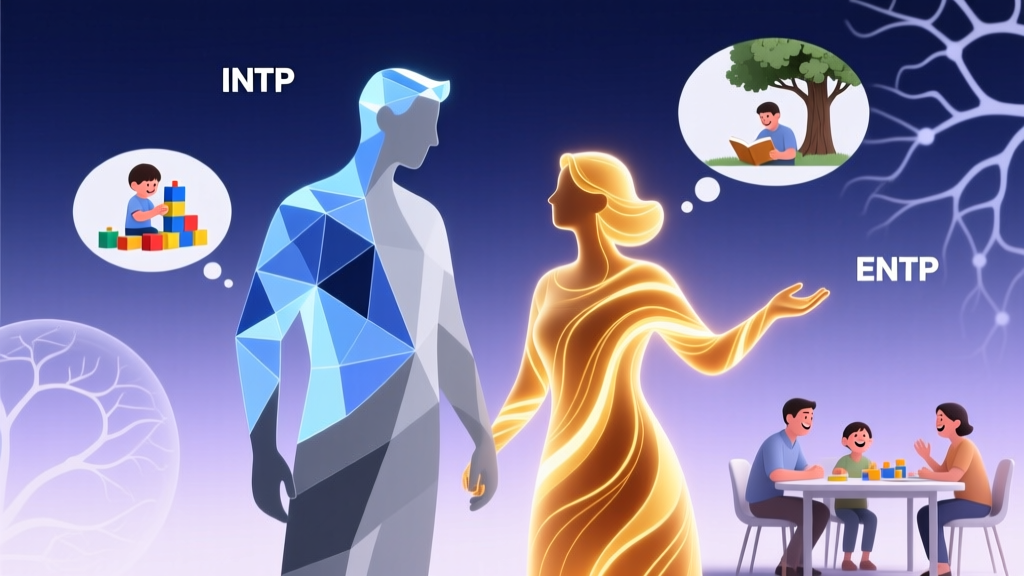
INTP as a Parent
The INTP (Introverted, Intuitive, Thinking, Perceiving) parent is the quiet architect of intellectual curiosity in the home. Often described as the ‘Logician’ or ‘Thinker,’ the INTP approaches parenting not with rigid rules or emotional scripting, but with a deeply reflective, principle-driven framework. Their parenting style is less about control and more about cultivating autonomy, critical thinking, and epistemic integrity in their children.
INTPs typically avoid authoritarian discipline. Instead, they favor Socratic questioning (“What do you think would happen if…?”), open-ended problem-solving, and evidence-based reasoning. A 2022 study published in Journal of Child and Family Studies found that children raised by Thinking-dominant parents (especially Ti-doms like INTPs) demonstrated significantly higher scores on metacognitive awareness and logical reasoning tasks by age 12—particularly when paired with environments rich in unstructured exploration (Springer, 2022). This aligns closely with the INTP’s natural inclination to treat childhood as an extended inquiry lab.
However, INTP parents may struggle with consistency in emotional responsiveness. Because their dominant function is Introverted Thinking (Ti), they process feelings internally and often delay verbalizing empathy until they’ve fully analyzed the emotional logic of a situation. A child who bursts into tears after losing a game may receive a calm, analytical breakdown of probability and effort before hearing, “That must have felt really disappointing.” While intellectually reassuring, this lag can leave younger children feeling unseen. To mitigate this, effective INTP parents learn to pair Ti with auxiliary Extraverted Intuition (Ne) by naming emotions *first* (“You look frustrated”) before exploring causes—training themselves to lead with affective validation.
Practically, INTPs thrive in low-stimulus, high-autonomy parenting contexts: homeschooling with self-paced curricula (e.g., Montessori-aligned or Khan Academy–based learning); designing home labs for chemistry or coding; maintaining a ‘question journal’ where kids log weekly curiosities and revisit them monthly. They’re also highly likely to outsource logistical parenting (meals, scheduling, extracurricular sign-ups) to partners or systems—often using digital tools like Notion dashboards or shared Google Calendars—so they can preserve mental bandwidth for deep engagement on topics that matter: ethics debates at dinner, deconstructing media bias in cartoons, or reverse-engineering how a bicycle works.
ENTP as a Parent
If the INTP is the quiet architect, the ENTP (Extraverted, Intuitive, Thinking, Perceiving) is the charismatic catalyst—the parent who turns bedtime into an impromptu TED Talk on black holes, transforms grocery shopping into a negotiation simulation, and treats every ‘no’ from a toddler as an invitation to co-create a better rule.
ENTPs parent through intellectual playfulness and expansive possibility. Their dominant function, Extraverted Intuition (Ne), fuels a constant generation of alternatives, analogies, and ‘what-if’ scenarios. This makes them exceptional at reframing tantrums as data points (“Let’s map your frustration triggers this week”), turning sibling conflict into collaborative world-building (“Design a treaty between Kingdom A and Kingdom B”), and modeling intellectual flexibility. Research from the American Psychological Association highlights that children with Ne-dominant caregivers show earlier development of cognitive flexibility and divergent thinking—key predictors of creative problem-solving in adolescence (Journal of Family Psychology, 2021).
Yet ENTPs face distinct challenges. Their love of debate can unintentionally overwhelm sensitive or introverted children. An ENTP parent might enthusiastically challenge a 7-year-old’s belief in Santa—not to debunk, but to explore cultural myth-making—only to realize too late that the child needed magical certainty, not semiotic analysis. Likewise, their tertiary Feeling (Fe) can cause inconsistency: ENTPs often strive to be emotionally attuned but may misread cues due to rapid idea-jumping or over-reliance on humor to diffuse tension. A child saying “I’m sad” might get a playful reframe (“Sad? Let’s brainstorm five ways to upgrade your mood!”) before receiving quiet presence.
Actionable strategies for ENTP parents include: (1) instituting ‘Ne brakes’—a literal timer or visual cue (e.g., a red coaster on the table) signaling when to pause idea-generation and switch to listening mode; (2) using structured emotional vocabulary cards with faces and feeling words to scaffold identification before analysis; and (3) co-designing ‘family experiments’—e.g., a two-week trial of no screens during meals, with pre/post reflections—to channel their love of hypothesis-testing into relational growth.
Co-Parenting Dynamics for INTP and ENTP
At first glance, INTP and ENTP appear near-identical: both are NT types, share dominant Thinking and auxiliary Intuition (though oriented inward vs. outward), and reject dogma in favor of reasoned adaptation. Yet their co-parenting synergy—and friction—stems precisely from how those shared functions manifest in daily practice.
Their greatest strength lies in intellectual alignment. They rarely clash over core values—truth-seeking, autonomy, curiosity, and anti-authoritarianism are non-negotiables for both. When deciding on schooling, discipline philosophy, or screen-time policies, they’ll rapidly iterate through frameworks (Montessori vs. democratic education vs. unschooling), weigh trade-offs logically, and land on nuanced, principle-based agreements. There’s little need for persuasion—just mutual calibration.
But execution is where divergence emerges. Consider bedtime routines:
- INTP: Designs a minimalist, predictable sequence (bath → book → lights out), optimized for low cognitive load and sleep science. May build a custom app tracking circadian rhythms.
- ENTP: Proposes rotating themes (“Nordic Mythology Night,” “Inventor Spotlight Week”), invites kids to co-write new lullabies, and occasionally abandons routine for stargazing if Venus is visible.
This isn’t mere disagreement—it’s functionally complementary. The INTP provides the stable infrastructure; the ENTP injects adaptive joy. But without conscious integration, it breeds inconsistency: one parent enforces strict homework hours while the other declares “Learning happens everywhere—let’s test that theory at the bakery!”
Successful INTP-ENTP co-parenting hinges on three structures:
- Role Clarity with Fluid Boundaries: Assign primary responsibility domains (e.g., INTP manages academic scaffolding and health logistics; ENTP leads social-emotional coaching and experiential learning), but build weekly ‘integration huddles’ (20 mins, no devices) to cross-pollinate ideas and adjust boundaries.
- The ‘Two-Yes’ Rule: Any major decision (e.g., changing schools, adopting a pet) requires explicit agreement—but not uniform reasoning. The INTP says “Yes, because longitudinal data shows multi-age classrooms improve executive function.” The ENTP says “Yes, because it’ll spark cross-generational mentoring stories we can all tell.” Both ‘yeses’ count—even if the logic differs.
- Conflict De-escalation Protocol: When Ne-Ti friction flares (e.g., ENTP proposes 7 solutions to a chore dispute; INTP withdraws overwhelmed), they use a shared phrase—“Pause. Anchor point?”—to reset. The anchor is a pre-agreed value (“We both want our kids to feel capable”) that grounds further dialogue.
A comparative snapshot of their co-parenting tendencies:
| Domain | INTP Tendency | ENTP Tendency | Synergy Strategy |
|---|---|---|---|
| Discipline | Rule-based, with transparent rationale; slow to enforce, fast to revise if evidence contradicts | Context-dependent, improvisational; uses humor and reframing over punishment | Create a living ‘Family Principles Charter’—co-written, visually displayed—listing 3–5 non-negotiables (e.g., “No harm to self/others”) with flexible implementation guidelines beneath each |
| Education | Curates deep-dive resources; prioritizes mastery over breadth | Seeks interdisciplinary connections; loves ‘learning sprints’ across domains | Adopt a ‘Depth & Spark’ model: INTP designs quarterly mastery projects (e.g., build a working Rube Goldberg machine); ENTP designs biweekly ‘Spark Jams’ (e.g., “How would Shakespeare tweet about climate change?”) |
| Emotional Support | Offers quiet presence + analytical reframing post-crisis | Provides energetic validation + rapid solution-brainstorming | Use a color-coded emotion-response key: Blue = INTP-led (calm, reflective, space-holding); Yellow = ENTP-led (energetic, idea-rich, option-generating); Green = Both (co-facilitated, e.g., mapping feelings to metaphors) |
Family Traditions and Values
INTP-ENTP families rarely sustain traditions for nostalgia’s sake—they evolve rituals based on intellectual resonance, ethical coherence, and experiential richness. Their shared disdain for empty formalism means holidays are rewritten, not repeated.
Take Thanksgiving: instead of fixed menus and forced gratitude circles, an INTP-ENTP household might institute ‘The Epistemology Potluck.’ Each attendee brings one dish *and* one question they’ve been wrestling with (“How do we know memory is reliable?”). Over food, they practice ‘intellectual hospitality’—listening to understand, not rebut—and end by selecting one question for collective research over the next month. The INTP drafts a literature-review summary; the ENTP designs an interactive presentation for the next gathering.
Core values crystallize around four pillars:
- Cognitive Liberty: The right to think, question, and change one’s mind without shame. Children are explicitly taught that ‘I don’t know yet’ is a position of strength, not weakness.
- Evidence-Informed Ethics: Moral decisions are grounded in impact assessment, not dogma. When debating whether to donate to a charity, kids analyze overhead ratios, longitudinal outcomes, and systemic root causes—not just emotional appeals.
- Playful Rigor: Intellectual work is serious, but never solemn. Math is explored through board-game design; history through alternate-universe fanfiction; grammar through meme linguistics.
- Autonomy with Accountability: Children negotiate increasing freedoms (e.g., solo bike rides, later bedtimes) by proposing safety protocols and evaluation metrics—then co-reviewing results monthly.
Traditions reflect these values. ‘Failure Fest’ occurs quarterly: family members share one recent mistake, what they learned, and how it improved their model of reality. ‘Bias Bingo’ accompanies news consumption—spotting framing, omission, and loaded language. Even vacations are value-infused: a trip to Washington D.C. includes not just monuments, but interviews with local policy advocates and a workshop on legislative drafting.
Raising Children with Different Personality Types
INTP-ENTP parents intuitively grasp type diversity—but translating that understanding into equitable parenting is complex. Their own cognitive flexibility can ironically blind them to how differently their children experience the world.
Consider an ESTJ child in an INTP-ENTP home. The child craves clear expectations, step-by-step instructions, and tangible rewards. To them, the parents’ open-ended questions (“What do you *feel* the project needs?”) feel like negligence—not empowerment. Meanwhile, the parents may misinterpret the child’s insistence on schedules as rigidity, missing its function as anxiety regulation.
Conversely, an INFJ child may absorb the family’s intellectual intensity but internalize it as pressure to perform wisdom. Their Fe-Ti loop could manifest as excessive self-criticism (“I didn’t articulate my insight well enough”) or premature caregiving (“I’ll explain quantum physics to my little brother so he feels smart too”).
Effective differentiation requires deliberate scaffolding:
- For Sensing (S) Children: Translate abstract principles into concrete anchors. Instead of “Be responsible,” co-create a visual checklist for pet care with photos. Replace philosophical debates with hands-on experiments (e.g., “Test which paper airplane design flies farthest—then graph results”).
- For Feeling (F) Children: Explicitly name and honor affective needs *before* analysis. Use ‘Feeling First, Thinking Second’ scripts: “I see you’re hurt. I want to hold space for that. Then, if you’d like, we can figure out what happened together.”
- For Judging (J) Children: Co-build structure *with* them. Let them design the weekly rhythm board, choose 3 non-negotiable routines, and earn flexibility points for consistent follow-through.
- For Introverted Children: Protect uninterrupted recharge time as sacrosanct. Institute ‘Silent Hours’ where all screens and voices dim, and provide written reflection prompts instead of oral debriefs.
Crucially, INTP-ENTP parents must resist the temptation to ‘type-correct’ their children. An ISTP teen who prefers tinkering over theory isn’t ‘underdeveloped’—they’re expressing a valid cognitive stack. The goal isn’t assimilation, but creating a family ecosystem where every type has pathways to contribute, be seen, and grow.
Navigating Extended Family as INTP and ENTP
Extended family gatherings are often the most revealing stress-tests for INTP-ENTP parenting. Grandparents may view their intellectual parenting as ‘cold’ or ‘overcomplicated.’ Aunts might label their child-led traditions as ‘permissive.’ Cousins may find their kids ‘weirdly intense’ or ‘unusually argumentative.’
INTPs tend to withdraw during such events—retreating to corners with books or phones—while ENTPs over-compensate with performative charm, inadvertently reinforcing stereotypes (“Oh, they’re just so *clever*!”). Both responses erode their children’s sense of secure belonging.
Proactive strategies include:
- Pre-Gathering Alignment: Before any event, INTP and ENTP co-draft a ‘Family Narrative Statement’—one paragraph explaining their parenting ethos in accessible, value-forward language (e.g., “We raise curious, compassionate problem-solvers by honoring questions over answers and growth over perfection”). Share it with key relatives ahead of time.
- Child Advocacy Scripts: Equip kids with simple, confident phrases: “I learn best by trying things myself,” or “When I ask why, I’m not being rude—I’m building my understanding.” Role-play these in low-stakes settings.
- The ‘Bridge Builder’ Role: Designate one parent (rotating monthly) as the intentional connector—initiating conversations that highlight shared values (“Aunt Lena, you always said curiosity was your superpower—that’s exactly what we nurture”). This prevents defensiveness and models relational intelligence.
- Exit Protocols: Agree on non-verbal signals (e.g., tapping a watch twice) indicating when a child—or parent—is overwhelmed and needs a 15-minute reset in the car or garden. No explanation required.
Over time, consistency transforms perception. Relatives who once worried about ‘too much thinking’ begin citing their kids’ articulate advocacy or creative solutions to family problems. The INTP-ENTP partnership doesn’t seek approval—it cultivates influence through unwavering, loving coherence.
FAQ
How do INTP and ENTP parents handle screen time disagreements?
They reframe screen time not as ‘good vs. bad’ but as ‘cognitive diet optimization.’ Together, they audit apps/games for active creation (e.g., Roblox design) vs. passive consumption (endless scrolling), then co-create a ‘Digital Nutrition Label’ for each tool—rating interactivity, learning yield, and social reciprocity. Children participate in quarterly reviews, proposing adjustments based on self-observed focus shifts or energy levels. This satisfies the INTP’s need for evidence-based systems and the ENTP’s love of iterative redesign.
What if our child is an SJ type and resists our open-ended parenting?
Respect the SJ’s need for structure *as data*, not defiance. Co-develop ‘Certainty Anchors’: predictable morning routines, clearly defined chore charts with visual completion markers, and weekly ‘Plan & Predict’ sessions where the child forecasts the week’s schedule and identifies potential stressors. The INTP ensures anchors are logically sound; the ENTP makes them engaging (e.g., turning chore charts into a ‘Quest Log’ with XP points). Resistance fades when security is engineered—not enforced.
How can we balance our love of debate with protecting our child’s emotional safety?
Institute ‘Debate Zones’ and ‘Sanctuary Zones.’ Debate Zones (e.g., the dinner table on Tuesdays) welcome rigorous idea-challenge with ground rules: no personal attacks, mandatory paraphrasing before rebuttal, and a ‘pause token’ anyone can invoke. Sanctuary Zones (e.g., bedtime, sick days, first-day-of-school mornings) are designated as no-debate, high-empathy spaces—where feelings are held, not examined. This teaches children that intellectual rigor and emotional safety aren’t opposites—they’re complementary ecosystems.
Do INTP-ENTP couples risk over-intellectualizing their child’s emotions?
Yes—this is their highest-risk blind spot. To counter it, they adopt the ‘3-Second Rule’: when a child expresses emotion, both parents commit to responding with *only* affective language for the first three seconds (“Oof, that sounds huge,” “I’m right here,” “Your face tells me this matters deeply”). Only after that do they invite exploration—if the child consents. They also track ‘Empathy Metrics’: weekly journaling on how often they led with validation vs. analysis, reviewing patterns monthly. Progress isn’t perfection—it’s calibrated awareness.
Parenting as an INTP-ENTP pair is not about achieving harmony—it’s about cultivating a dynamic, evolving ecosystem where curiosity is sacred, autonomy is scaffolded, and love is expressed in the language of relentless, joyful inquiry. Their children don’t just inherit intelligence; they inherit the courage to question, the humility to revise, and the imagination to rebuild—tools no curriculum can teach, but every great partnership can model. As psychologist Dr. Ellen Langer notes in her pioneering work on mindful learning, “The single skill most predictive of lifelong resilience is the ability to hold multiple perspectives simultaneously” (Langer, 2014). In the INTP-ENTP home, that skill isn’t taught—it’s breathed.