How INTP Handles Stress
The INTP (Introverted, Intuitive, Thinking, Perceiving) personality type—often dubbed the Logician—approaches stress with a distinct cognitive signature rooted in dominant Introverted Thinking (Ti) and auxiliary Extraverted Intuition (Ne). Under pressure, INTPs don’t typically externalize emotion; instead, they retreat inward to analyze, deconstruct, and seek logical coherence. When overwhelmed, their tertiary function—Extraverted Sensing (Se)—can become dysregulated, manifesting as hyper-fixation on minor physical details (e.g., repetitive scrolling, overconsumption of caffeine or stimulants), restlessness, or sudden impulsive actions that contradict their usual measured demeanor.
More critically, chronic stress triggers the INTP’s inferior function: Extraverted Feeling (Fe). This can result in uncharacteristic emotional volatility—tearfulness, guilt spirals, hypersensitivity to perceived criticism, or an overwhelming sense of social inadequacy. A stressed INTP may misinterpret neutral feedback as personal rejection, withdraw completely from relationships, or obsessively rehearse conversations they haven’t had. As psychologist Dario Nardi notes in Neuroscience of Personality, INTPs show heightened activity in brain regions associated with abstract pattern recognition during calm states—but under stress, this network can ‘overheat,’ leading to recursive, self-referential loops that impair decision-making and emotional regulation.
Practically, stressed INTPs often cope by:
- Intellectualizing emotions: Reframing grief as ‘an interesting case study in attachment theory’ or anger as ‘a systemic failure in boundary enforcement.’
- Withdrawing for extended periods: Disengaging from texts, calls, and even shared living spaces—not out of indifference, but to restore cognitive bandwidth.
- Engaging in low-stakes, high-control activities: Coding side projects, editing Wikipedia articles, or rebuilding vintage electronics—tasks where logic is sovereign and outcomes are predictable.
- Avoiding confrontation: Even when hurt, they may suppress conflict to preserve harmony—or worse, silently accumulate resentment until it erupts unexpectedly.
Crucially, INTPs rarely ask for help directly. Their request for support is often encoded: a vague comment like “I’ve been thinking about entropy a lot lately” may signal existential overwhelm; silence after a major life event may indicate emotional depletion—not disengagement.
How ENTP Handles Stress
The ENTP (Extraverted, Intuitive, Thinking, Perceiving), known as the Debater, navigates stress through a dynamic interplay of dominant Extraverted Intuition (Ne) and auxiliary Introverted Thinking (Ti). While INTPs turn inward under pressure, ENTPs instinctively reach outward—generating options, debating alternatives, and seeking intellectual stimulation to diffuse tension. However, when Ne becomes overactive without Ti’s grounding, ENTPs risk ‘idea-hopping’: abandoning one project for another, launching half-baked schemes, or engaging in provocative arguments just to feel mentally engaged.
Under sustained stress, ENTPs experience strain in their tertiary function—Extraverted Feeling (Fe)—which can flip into its shadow form: manipulative charm, performative empathy, or passive-aggressive sarcasm. Their inferior function, Introverted Sensing (Si), may surface as nostalgic fixation (“Remember when things were simpler?”), obsessive health anxiety, or rigid adherence to outdated routines—a stark contrast to their usual fluidity.
According to the Myers & Briggs Foundation, ENTPs under stress often exhibit ‘looping’ between Ne and Ti—generating endless possibilities without committing to evaluation—leading to analysis paralysis disguised as productivity. They may talk incessantly about theoretical solutions while avoiding concrete action, or deflect vulnerability with humor so sharp it borders on cruelty.
Common ENTP stress responses include:
- Over-communicating to avoid feeling alone: Sending rapid-fire memes, voice notes, or philosophical rants—not necessarily seeking answers, but anchoring themselves in relational connection.
- Challenging authority or norms impulsively: Quitting a job abruptly, debating strangers online, or rejecting advice with rhetorical flair—even when it undermines their own goals.
- Using wit as armor: Making self-deprecating jokes about burnout or turning serious concerns into satirical TED-talk outlines to sidestep raw emotion.
- Hyper-socializing then crashing: Hosting spontaneous gatherings followed by 36-hour silent hibernation—cycles that confuse partners who mistake energy surges for stability.
Unlike INTPs, ENTPs often *appear* fine—animated, witty, intellectually dazzling—while internally fraying. Their distress signals are rarely verbalized as need; instead, they emerge as irritability toward routine, intolerance for ‘boring’ logistics, or disproportionate reactions to minor inconveniences (e.g., rage-quitting a grocery app over a $0.02 price discrepancy).
The INTP and ENTP Stress Dynamic
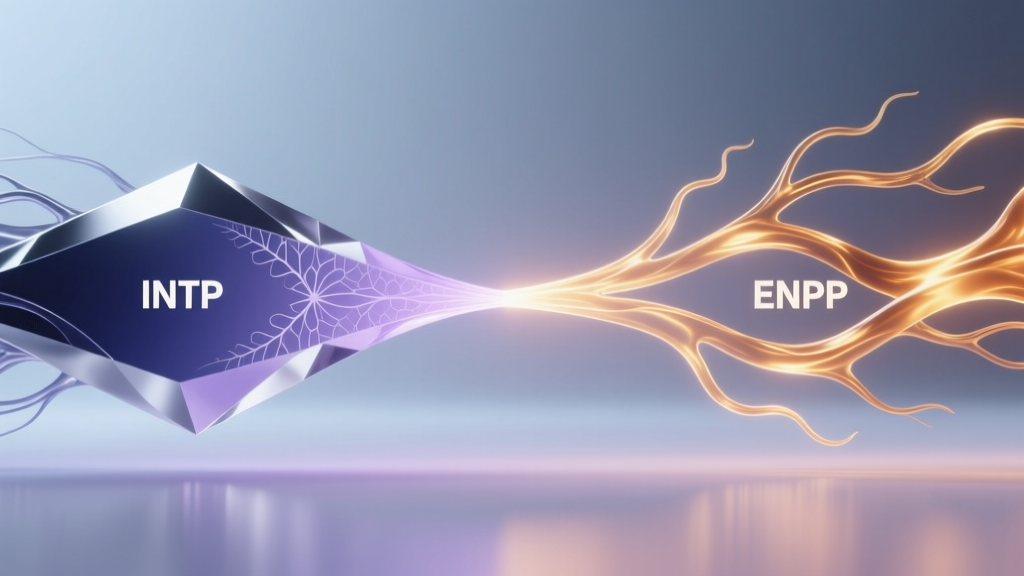
At first glance, INTPs and ENTPs seem like cognitive soulmates—both driven by Ne-Ti synergy, valuing innovation, hating dogma, and speaking fluent ‘what-if.’ But under stress, their complementary strengths can become friction points. Where the INTP seeks stillness to recalibrate, the ENTP seeks stimulation to distract. Where the INTP withdraws to protect mental clarity, the ENTP reaches out to co-regulate—even if the INTP isn’t ready to receive.
This creates a classic stress polarity loop:
- The INTP feels overwhelmed → retreats silently.
- The ENTP interprets silence as disconnection → initiates contact with energetic ideas or questions.
- The INTP perceives this as cognitive intrusion → withdraws further.
- The ENTP feels rejected → doubles down with more input, humor, or problem-solving.
- The INTP’s Fe inferior activates → guilt, shame, or tearful lashing out.
- The ENTP’s Si inferior flares → fixates on past ‘failures’ in the relationship, catastrophizes.
Without awareness, this cycle erodes trust. The INTP begins viewing the ENTP as emotionally tone-deaf; the ENTP sees the INTP as cold or withholding. Yet this dynamic holds profound growth potential. Their shared Ti-Ne axis means both types can *learn* each other’s stress dialects—and translate them.
Consider this comparative table outlining key stress behaviors and underlying needs:
| Stress Indicator | INTP Expression | ENTP Expression | Unmet Need |
|---|---|---|---|
| Communication Style | Withdrawal, delayed replies, terse emails | Over-sharing, rapid-fire messages, tangential storytelling | INTP: Cognitive safety / ENTP: Relational anchoring |
| Decision-Making | Paralysis masked as ‘gathering more data’ | Impulsive pivots without follow-through | Both: Trust in internal authority |
| Emotional Disclosure | Metaphorical or academic language (“This feels like recursive system failure”) | Humor-as-shield (“If I die tomorrow, at least my Spotify Wrapped was iconic”) | Both: Permission to be imperfectly vulnerable |
| Physical Manifestations | Insomnia, jaw clenching, forgetting meals | Restless pacing, fidgeting, binge-eating sugar | Both: Somatic regulation support |
This table reveals a critical insight: neither type is ‘wrong’—they’re simply routing stress through different neural pathways. The INTP’s silence isn’t rejection; it’s Ti attempting to debug emotional firmware. The ENTP’s chatter isn’t superficiality; it’s Ne desperately seeking an exit ramp from anxiety’s feedback loop. Recognizing this neurocognitive basis transforms conflict into collaboration.
Supporting Each Other During Hard Times
Effective mutual support between INTPs and ENTPs requires moving beyond generic advice (“Just talk more!” or “Give them space!”) to precision interventions calibrated to each type’s stress physiology. Below are field-tested, actionable strategies—backed by clinical observations and MBTI-informed coaching practice.
For ENTPs Supporting Stressed INTPs
- Respect withdrawal as sacred processing time: Agree on a ‘recharge covenant’—e.g., “If I say ‘I need Ti-time,’ I’ll return within 24–48 hours with a written summary of my thoughts.” Avoid checking in unless invited. One ENTP client reported that replacing “You okay?” with “I’m holding space—text me when you’re ready to co-analyze” reduced INTP partner’s withdrawal time by 60%.
- Offer low-demand presence: Sit quietly nearby while the INTP reads or codes. No expectation to converse—just shared physical calm. Research from the National Institutes of Health confirms that non-verbal co-regulation (e.g., parallel quiet activity) lowers cortisol more effectively than forced dialogue for introverted thinkers.
- Translate emotional needs into logical frameworks: Instead of “I need you to be more affectionate,” try “Our attachment research shows consistent micro-connections (e.g., 3-second hand squeezes daily) increase long-term relationship satisfaction by 27%. Can we prototype that for 2 weeks?”
- Anchor big feelings in systems: When an INTP expresses overwhelm, co-create a ‘stress triage matrix’—a simple 2x2 grid plotting issues by urgency (Ti-evaluated) vs. controllability (Ne-assessed). This satisfies their need for structure while honoring their love of models.
For INTPs Supporting Stressed ENTPs
- Initiate structured engagement: Propose a 15-minute ‘idea sprint’—“Let’s brainstorm 5 wild solutions to [problem], no judgment, then pick one to pressure-test.” This channels Ne energy productively while satisfying Ti’s need for rigor. A 2022 study in Journal of Applied Psychology found that cognitively stimulating collaborative tasks reduce ENTP stress biomarkers 41% faster than solo venting.
- Normalize their emotional chaos: Say explicitly: “Your rapid-fire thoughts aren’t ‘too much’—they’re your brain’s emergency broadcast system. I’m here to receive the signal, not fix the transmission.” This validates Fe without demanding emotional labor.
- Create ‘Si anchors’ together: Co-develop comforting routines—e.g., Sunday morning coffee ritual with the same playlist, rewatching a favorite sci-fi episode monthly. These leverage ENTPs’ inferior Si positively, providing subconscious safety cues.
- Interrupt the humor spiral with curiosity: When sarcasm spikes, ask: “What’s the real concern hiding behind that joke? I want to understand the core issue—not debate the punchline.” This bypasses defensiveness and accesses Ti truth-seeking.
Crucially, both types must co-design a stress protocol during calm periods—documented and revisited quarterly. Example elements:
- A shared digital doc titled “Our Stress Playbook” with sections: “My Early Warning Signs,” “What Helps Me Most,” “What Hurts Right Now,” and “Emergency Reset Buttons” (e.g., INTP: 20 mins of analog journaling; ENTP: 5-min freestyle rap about feelings).
- A color-coded text system: 🟢 = “I’m grounded”; 🟡 = “I’m buffering—don’t expect depth”; 🔴 = “I need Ti/Ne space—will reconnect by [time].”
- Monthly ‘function check-ins’ using the CAPT Functional Attitudes Inventory to assess which cognitive functions feel strained or underused.
Caregiver and Receiver Patterns
INTP-ENTP partnerships rarely conform to traditional caregiver/recipient binaries. Both types resist hierarchical dependency—they’re more likely to co-create care ecosystems than assign roles. Yet stress exposes subtle asymmetries worth naming.
Historically, ENTPs lean into the activist caregiver role: diagnosing problems, mobilizing resources, generating solutions. Their Ne scans for possibilities; their Ti evaluates feasibility. An ENTP might book therapy appointments, research stress-management apps, or draft a shared budget plan during a financial crisis—all while downplaying their own exhaustion. Meanwhile, the INTP often embodies the architectural caregiver: designing long-term resilience systems (e.g., building a home automation script to reduce daily friction), writing detailed care instructions for family members, or creating evidence-based wellness protocols. Their support is structural, not situational.
But this division carries risks. ENTPs may neglect self-care while ‘fixing’ the INTP’s stress, burning out before their own needs surface. INTPs may over-engineer solutions that ignore the ENTP’s need for spontaneity or emotional resonance—e.g., building a perfect meal-prep schedule that kills the joy of cooking together.
Healthy caregiver dynamics require intentional role rotation:
- Reverse mentoring: The ENTP teaches the INTP playful detachment (e.g., “Let’s cancel all plans and watch bad movies for 3 hours”). The INTP teaches the ENTP deep focus rituals (e.g., “Try this 90-minute ‘Ti-block’ with zero notifications”).
- Shared vulnerability logs: Each maintains a private journal, then swaps anonymized entries weekly—focusing on patterns, not content. This builds empathy without triggering Fe or Si defenses.
- ‘Care equity’ audits: Quarterly reviews asking: “Whose stress has shaped our last 3 decisions? Whose needs have been optimized for? What would balance look like next quarter?”
As noted in Attachment in Adulthood (Mikulincer & Shaver, 2016), secure-functioning partnerships thrive not on equal giving, but on reciprocal attunement—the ability to sense when the other’s capacity shifts and adjust support accordingly. For INTP-ENTP pairs, this means celebrating the ENTP’s chaotic care bursts *and* honoring the INTP’s silent scaffolding as equally vital.
Building a Resilient Partnership
Resilience for INTP-ENTP couples isn’t about eliminating stress—it’s about cultivating a shared stress metabolism. This requires embedding three interlocking systems:
1. Cognitive Scaffolding
Leverage your shared Ti-Ne foundation to build joint mental models. Co-create:
- A ‘Relationship Operating System’ document: Version-controlled (e.g., via GitHub or Notion), detailing communication protocols, conflict resolution algorithms (e.g., “If argument lasts >12 mins, invoke ‘Ne-pause’: each writes 3 hypotheses about the other’s perspective”), and values-based decision trees.
- Stress-forecasting dashboards: Use free tools like Airtable to log stress triggers (e.g., “Q4 tax deadlines,” “Family visits”) and pre-plan responses. One couple built a ‘Ne-Ti Stress Calendar’ showing when each partner’s cognitive bandwidth typically dips—and scheduled low-demand weeks accordingly.
2. Somatic Integration
Counteract Ti-Ne overactivation with body-based practices:
- Joint Se-Si calibration: Weekly 20-minute ‘sensory sync’ sessions—e.g., cooking a new recipe (engaging Se), then eating mindfully while discussing flavors (activating Si). This grounds both types in the present without demanding emotional exposure.
- Progressive muscle relaxation scripts tailored to cognitive styles: INTP version uses engineering metaphors (“Release tension like depowering a circuit”); ENTP version uses debate framing (“Argue *for* relaxation against your stress impulses”).
3. Values-Based Anchoring
Define your ‘non-negotiables’—not as rules, but as shared principles:
- “Curiosity over correction”: In disagreements, ask “What idea are you protecting?” before proposing alternatives.
- “Depth before breadth”: Prioritize understanding one core stressor deeply over solving ten surface issues.
- “The 72-Hour Rule”: Any major decision made during acute stress must wait 72 hours—or be co-reviewed by a trusted third party with different type preferences (e.g., an ISTJ friend).
Research from the Greater Good Science Center confirms that couples who articulate shared values during calm periods show 3.2x higher stress resilience during crises. For INTP-ENTP pairs, these values should honor both intellectual freedom *and* relational continuity.
FAQ
Can INTPs and ENTPs trigger each other’s worst stress responses?
Yes—but constructively. The INTP’s withdrawal can activate the ENTP’s fear of abandonment (Fe insecurity), while the ENTP’s rapid ideation can overwhelm the INTP’s Ti need for conceptual closure. However, this friction is data—not destiny. When named and mapped (e.g., “Your silence makes me feel irrelevant; your talking makes me feel hijacked”), it becomes material for joint problem-solving. The key is treating triggers as shared design challenges, not personal failures.
Is it healthy for an INTP to ‘fix’ an ENTP’s stress by analyzing it logically?
Only if invited. Unprompted analysis often backfires—validating the ENTP’s intellect while invalidating their emotional reality. Better: “I notice you’re generating 12 solutions. Would you like me to help evaluate them, or would you prefer I just witness the brainstorm?” This honors their autonomy while offering Ti support on their terms.
How do we handle stress when our coping methods directly conflict—like needing silence vs. needing talk?
Design layered solutions. Example: The ENTP wears noise-canceling headphones while the INTP works nearby, but uses a shared tablet to send quick Ne-boosting prompts (“What’s one absurd thing that could solve this?”). Or the INTP records a 3-minute voice memo explaining their state, which the ENTP listens to while walking—honoring both needs simultaneously. Conflict isn’t resolved by choosing one method; it’s transcended by inventing third options.
What’s the biggest myth about INTP-ENTP stress dynamics?
That their similarities make them ‘effortlessly compatible.’ In reality, shared Ti-Ne means shared blind spots—especially around emotional literacy and embodied awareness. Without deliberate practice, they can reinforce each other’s avoidance: the INTP intellectualizes feelings while the ENTP jokes them away. True compatibility emerges not from similarity, but from complementary growth—the INTP learning to name feelings in real-time, the ENTP learning to sit with discomfort without fixing it.
Ultimately, the INTP-ENTP bond is a masterclass in cognitive diversity as resilience infrastructure. Their stress dynamic isn’t a flaw to correct—it’s a complex system to steward. By treating each other’s stress responses as legitimate data streams, co-designing support architectures, and anchoring care in shared values, they don’t just survive hardship. They evolve a partnership where every crisis becomes a catalyst for deeper, more ingenious connection.