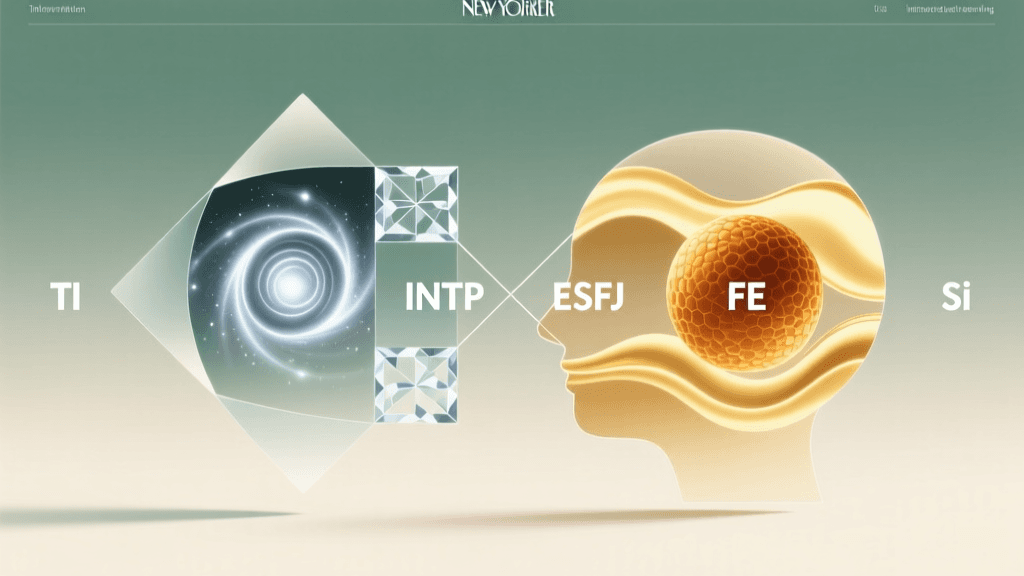
INTP Cognitive Stack Overview
The INTP personality type—often dubbed the Logician—is defined by a unique hierarchy of cognitive functions that shape how they perceive, process, and respond to the world. According to Jungian theory as operationalized by Myers-Briggs practitioners and refined by cognitive function theorists like Linda V. Berens and Dario Nardi, the INTP’s functional stack is:
- Dominant: Introverted Thinking (Ti)
- Auxiliary: Extraverted Intuition (Ne)
- Tertiary: Introverted Sensing (Si)
- Inferior: Extraverted Feeling (Fe)
Ti serves as the INTP’s internal compass—a relentless drive to construct precise, logically consistent frameworks. It operates like a recursive compiler: breaking down ideas into axioms, testing assumptions, eliminating contradictions, and refining models until they achieve internal coherence. This isn’t about winning arguments; it’s about intellectual integrity. As Dario Nardi explains in Neuroscience of Personality, INTPs show heightened activity in the anterior cingulate cortex during abstract problem-solving—consistent with Ti’s role in error detection and logical calibration.
Their auxiliary Ne scans the external environment for patterns, possibilities, and conceptual connections. Where Ti builds the engine, Ne supplies the fuel: generating alternative hypotheses, linking disparate domains (e.g., quantum physics to linguistics), and reframing problems from multiple angles. This makes INTPs exceptionally creative in ideation—but can also lead to analysis paralysis when too many ‘what ifs’ compete for attention.
Tertiary Si provides quiet grounding: recalling past experiences, noticing sensory details (especially when stressed), and anchoring abstract thinking in embodied memory. However, Si remains underdeveloped in youth—often surfacing only in midlife or under pressure as nostalgia, routine-seeking, or physical self-neglect.
Finally, inferior Fe represents the INTP’s developmental frontier—their least conscious, most emotionally charged function. When healthy, Fe allows INTPs to attune to group harmony, express care through thoughtful gestures, and validate others’ feelings without compromising logic. But under stress, inferior Fe erupts as emotional volatility, people-pleasing overcorrection, or sudden withdrawal after perceived social missteps. As psychologist Lenore Thomson notes in Personality Types, inferior Fe in INTPs often manifests as either hyper-rational dismissal of emotion (“That’s illogical”) or disproportionate guilt after minor interpersonal friction.
ESFJ Cognitive Stack Overview
The ESFJ—commonly known as the Consul—operates from an entirely different functional architecture, one optimized for social cohesion, practical care, and shared values. Their cognitive stack, per the same Jungian–Myers–Briggs framework, is:
- Dominant: Extraverted Feeling (Fe)
- Auxiliary: Introverted Sensing (Si)
- Tertiary: Extraverted Intuition (Ne)
- Inferior: Introverted Thinking (Ti)
Fe is the ESFJ’s engine and steering wheel—it orients them outward toward collective values, relational harmony, and ethical responsiveness. Unlike Fi (Introverted Feeling), which prioritizes authenticity to inner values, Fe seeks consensus, reads emotional atmospheres intuitively, and adjusts behavior to maintain group comfort. In practice, this means ESFJs often notice unspoken tensions before others, remember birthdays without reminders, and instinctively mediate conflicts—not to control, but to preserve connection. Research from the Center for Applications of Psychological Type (CAPT) confirms that ESFJs score highest among all 16 types on measures of interpersonal sensitivity and communal responsibility.
Their auxiliary Si grounds Fe in lived experience: drawing on tradition, proven methods, and concrete memories to uphold stability. ESFJs rely on routines (weekly family dinners, holiday rituals), value factual accuracy (“I wrote it down in my planner”), and prefer solutions tested over time—not theoretical ideals. This Si support gives Fe staying power: it transforms goodwill into sustained action.
Tertiary Ne emerges later in development—often in adulthood—as a playful, exploratory counterpoint to Si’s conservatism. ESFJs may begin brainstorming ‘what if’ scenarios around logistics (“What if we host Thanksgiving at the lake house next year?”) or experiment with small lifestyle changes (new recipes, redecorating a corner of the living room). But Ne remains subordinate: ideas are evaluated for social feasibility first, not abstract elegance.
Inferior Ti is the ESFJ’s blind spot—their least trusted, most defensively triggered function. Under stress, Ti can surface as rigid dogmatism (“This is just *how things are done*”), nitpicking logic in others (“You’re contradicting yourself”), or sudden bursts of hyper-critical analysis directed inward (“Why did I say that? That made no sense”). Healthy integration of Ti, however, enables ESFJs to question assumptions, refine personal ethics beyond convention, and engage in respectful intellectual debate without threat to relational safety.
Where Functions Align
At first glance, INTP and ESFJ appear diametrically opposed—yet their cognitive stacks contain two powerful points of alignment: auxiliary Ne ↔ tertiary Ne and tertiary Si ↔ auxiliary Si. These are not identical expressions—but they create bridges of mutual intelligibility.
Consider Ne alignment. While INTP leads with Ne and ESFJ accesses it third, both types enjoy idea generation, pattern recognition, and future-oriented curiosity—provided the context feels safe. An INTP might propose five interpretations of a poem; an ESFJ, listening attentively, may respond with, “That reminds me of Aunt Clara’s garden—she always said roses bloom best when you talk to them. Do you think plants respond to intention?” That’s Ne in action: connecting abstract insight to lived metaphor. The difference lies in priority—INTPs explore possibilities for truth’s sake; ESFJs explore them for relational resonance. When honored, this shared Ne energy fuels collaborative problem-solving, creative planning (e.g., designing a community event), and joyful intellectual play.
Si alignment is subtler but equally vital. INTP’s tertiary Si stores sensory impressions, procedural knowledge, and nostalgic anchors—often activated during stress or reflection. ESFJ’s dominant-supported Si thrives on continuity, detail fidelity, and embodied tradition. They may both appreciate the weight of a well-worn book, the reliability of a favorite coffee mug, or the comfort of a familiar walk. In practice, this manifests as shared appreciation for craftsmanship, historical context, or ritual—even if expressed differently. An INTP might geek out over the metallurgical evolution of pocket watches; an ESFJ might cherish the same watch because Grandpa wore it to every Sunday dinner. Both honor Si’s reverence for tangible continuity.
Crucially, these alignments don’t require agreement—they require recognition. When an ESFJ notices an INTP pausing to savor the texture of rain on pavement (Si), or when an INTP observes an ESFJ quietly adjusting seating to ease a guest’s back pain (Fe + Si), mutual respect deepens. These micro-moments build what relationship researcher Dr. John Gottman calls “bids for connection”—small invitations to co-create meaning.
Where Functions Clash
Clashes between INTP and ESFJ are rarely malicious—but they are structurally inevitable due to opposing function priorities. The most consequential tensions arise from three pairings:
- Ti (INTP dominant) vs. Fe (ESFJ dominant)
- Fe (ESFJ dominant) vs. Ti (INTP inferior)
- Ne (INTP auxiliary) vs. Si (ESFJ auxiliary)
Ti vs. Fe is the core polarity. Ti asks: Is this internally consistent? Does it hold up to scrutiny? Fe asks: How does this affect the people involved? Does it sustain belonging? A classic flashpoint: planning a vacation. The INTP drafts a spreadsheet comparing flight times, carbon footprints, and local library access—then proposes skipping the group beach day to visit a geological survey site. The ESFJ feels blindsided: “Everyone was excited about the beach. Maria hasn’t swum since her surgery—this matters to her.” Neither is wrong. But Ti’s truth-focus and Fe’s harmony-focus operate on incompatible metrics. Without translation, this becomes “You’re selfish” vs. “You’re irrational.”
Fe vs. Ti (inferior) intensifies under stress. When an ESFJ expresses disappointment (“I felt hurt when you canceled our call last minute”), the INTP’s inferior Ti may hijack the response—not with empathy, but with defensive logic: “Statistically, 73% of rescheduled calls happen within 48 hours. My calendar sync failed—blame the software, not me.” That’s Ti defending against Fe’s emotional demand by retreating into abstraction. Conversely, an overwhelmed ESFJ may weaponize Ti—suddenly critiquing the INTP’s argument structure mid-conversation (“You contradicted yourself on page 3 of your email”)—not to engage intellectually, but to regain control amid Fe overload.
Ne vs. Si creates friction in daily rhythm. INTPs use Ne to pivot rapidly between topics, revise plans, and treat schedules as provisional hypotheses. ESFJs use Si to stabilize commitments, honor prior agreements, and treat plans as relational contracts. An INTP suggesting, “Let’s ditch brunch and go stargazing instead!” may thrill some—but land as betrayal to an ESFJ who already texted cousins, prepped muffins, and cleared her afternoon for connection. Si needs predictability to feel secure; Ne needs novelty to feel alive.
The following table summarizes key functional clashes and their behavioral signatures:
| Cognitive Clash | INTP Expression | ESFJ Expression | Real-World Example | De-escalation Strategy |
|---|---|---|---|---|
| Ti (dom) vs. Fe (dom) | “Let’s fact-check the charity’s overhead ratio before donating.” | “Mrs. Chen from church runs it—her son recovered because of them.” | Disagreement over charitable giving | INTP names logic need; ESFJ names relational value. Agree on dual criteria: “Let’s review finances and talk to Mrs. Chen.” |
| Fe (dom) vs. Ti (inf) | Withdraws silently after Fe criticism; later sends a 3-page rationalization | Sends 3 follow-up texts asking “Are you mad?” then “Did I ruin everything?” | Post-conflict silence spiral | Agree on a 90-minute “cool-down + re-engage” window. Use timed check-ins: “I need 45 mins to process. Can we talk at 4:30?” |
| Ne (aux) vs. Si (aux) | Changes dinner reservation last-minute to try a pop-up ramen bar | Feels disrespected; cancels plans, citing “broken trust” | Scheduling whiplash | Co-create a “Flex Tier”: 2 weekly plans are fixed (Si); 1 is open to Ne-inspired change (with 4-hr notice). |
The Hidden Resonances (Tertiary/Inferior Function Connections)
Beneath the surface tension lies a profound, often overlooked synergy: the INTP’s inferior Fe ↔ ESFJ’s dominant Fe and ESFJ’s inferior Ti ↔ INTP’s dominant Ti. These aren’t symmetrical matches—but they form a developmental mirror.
For the INTP, the ESFJ is a living textbook on Fe mastery. Watching an ESFJ navigate a tense family gathering—reading micro-expressions, diffusing blame with humor, remembering Uncle Leo’s medication schedule—offers visceral, embodied lessons in emotional intelligence that no self-help book provides. This isn’t about becoming “more feeling”; it’s about learning Fe’s grammar: how validation sounds (“I see this matters to you”), how boundaries feel (“I care, and I also need quiet tonight”), how care is enacted (“I brought soup because you sounded tired”). As clinical psychologist Dr. Dan Siegel writes in The Developing Mind, neural pathways for empathy strengthen most through repeated, safe co-regulation—not theory. The ESFJ, intentionally or not, provides that scaffold.
Conversely, the ESFJ gains rare access to Ti’s clarifying power. Where ESFJs may absorb societal norms uncritically (“We’ve always done it this way”), the INTP’s Ti invites gentle, non-shaming inquiry: “What problem does this tradition solve? What would happen if we changed X?” This isn’t rejection—it’s evolutionary refinement. A study published in the Journal of Personality and Social Psychology found that individuals paired with high-Ti partners showed increased critical thinking in moral reasoning tasks—particularly when the Ti partner framed questions collaboratively (“Help me understand…” vs. “That’s flawed because…”).
These resonances peak when both types consciously engage their lower functions. An INTP practicing Fe might initiate a weekly “gratitude check-in” with their ESFJ partner—not to perform positivity, but to train attunement: “What made you feel seen this week?” An ESFJ integrating Ti might journal one “question I’m allowed to doubt this month” (“Is ‘busy’ always virtuous?”), then discuss it with their INTP—not seeking answers, but witnessing intellectual courage.
This dynamic mirrors Carl Rogers’ concept of unconditional positive regard: the ESFJ offers the INTP acceptance without demanding emotional performance; the INTP offers the ESFJ intellectual safety without demanding ideological conformity. Together, they stretch each other’s psychological range—not by erasing differences, but by making the unfamiliar feel survivable.
Leveraging Cognitive Diversity
Compatibility isn’t about minimizing differences—it’s about designing systems that turn cognitive divergence into strategic advantage. Here’s how INTP-ESFJ pairs can do that, function by function:
1. Ti + Fe: Build a “Truth-and-Tenderness” Feedback Loop
Create a shared language for delivering hard truths with care. Example protocol:
- INTP says: “I need to flag something logically inconsistent. Can I share it using your ‘care-first’ framework?”
- ESFJ responds: “Yes—and please name one thing I did well first.”
- INTP delivers critique anchored in shared goals (“Our goal is team cohesion. This policy creates ambiguity about accountability.”)
- ESFJ reflects: “I hear the logic gap. Help me brainstorm how to communicate this change so people feel supported.”
This satisfies Ti’s need for precision and Fe’s need for relational safety. Over time, it trains both brains: INTPs learn emotional framing; ESFJs learn to separate critique from rejection.
2. Ne + Si: Co-Design “Stable Innovation” Routines
Replace binary choices (“plan vs. spontaneity”) with layered structures. Try this weekly template:
- Si Anchor (ESFJ-led): Fixed meals, recurring rituals, shared digital calendar with color-coded priorities (green = non-negotiable, yellow = flexible, red = experimental)
- Ne Spark (INTP-led): One “curiosity hour” weekly where the INTP introduces a novel idea (e.g., “Let’s try silent breakfasts for mindfulness”)—ESFJ commits to trying it once, no judgment
- Integration Ritual: Sunday evening 15-min debrief: “What Si anchor felt nourishing? What Ne spark surprised us?”
This honors Si’s need for security while feeding Ne’s hunger for novelty—transforming potential conflict into co-creation.
3. Si + Si: Deepen Shared Sensory Grounding
INTP’s tertiary Si and ESFJ’s auxiliary Si can bond through intentional sensory practices that bypass verbal abstraction:
- Shared Archives: Digitize old photos together. INTP organizes metadata (dates, locations); ESFJ narrates stories behind images. Si meets Si in tactile memory.
- Embodied Rituals: Walk the same neighborhood path monthly, noting seasonal shifts. INTP sketches geological layers; ESFJ collects fallen leaves. No analysis required—just presence.
- Meal Alchemy: Cook a dish from childhood. INTP researches food science (why searing locks in juices); ESFJ recreates Grandma’s timing. Si becomes love language.
4. Fe + Ti Integration: Launch a “Dual-Audit” Project
Choose one shared value (e.g., sustainability, education access) and conduct parallel audits:
- INTP’s Ti Audit: Maps systemic causes, evaluates interventions via cost/benefit, identifies logical gaps
- ESFJ’s Fe Audit: Interviews stakeholders, documents emotional impacts, assesses community readiness
- Joint Output: A report blending data + narrative—e.g., “Solar panels reduce emissions (Ti) AND restore dignity to elders who can’t afford winter heating (Fe)”
This transforms Ti/Fe tension into complementary superpowers—proving that rigor and compassion aren’t opposites, but necessary coordinates on the same map.
FAQ
Can INTP and ESFJ have a successful long-term romantic relationship?
Yes—but success hinges on conscious function development, not chemistry alone. Research from the Gottman Institute shows that lasting relationships depend less on similarity and more on repair skills: the ability to de-escalate, take responsibility, and rebuild after rupture. INTP-ESFJ pairs excel here when they leverage their natural strengths: INTPs bring analytical clarity to conflict root causes; ESFJs bring relational tenacity to reconciliation. Key predictor of success? Both partners commit to growing their inferior functions—INTPs practicing Fe expression, ESFJs strengthening Ti autonomy—over 2+ years.
Why do INTPs often feel “emotionally suffocated” by ESFJs?
This stems from Fe dominance overwhelming Ti’s need for cognitive breathing room. ESFJs naturally monitor group emotion—asking “How are you *really*?” or initiating hugs—while INTPs interpret such acts as demands for emotional labor they haven’t consented to. It’s not personal rejection; it’s Ti protecting its processing bandwidth. Solution: Negotiate “Fe thresholds.” Example: ESFJ agrees to replace “How are you?” with “Want to sit quietly?” unless INTP initiates deeper talk. This honors Fe’s care intent while respecting Ti’s autonomy.
How can ESFJs stop taking INTP’s logical critiques personally?
Reframe Ti as a tool, not a verdict. When an INTP says, “Your budget spreadsheet has inconsistent formulas,” hear: “I want our shared goals to succeed.” Practice separating content (“the math is off”) from delivery (“you’re careless”). A useful mantra: “Their Ti is editing the document—not me.” Therapist Esther Perel recommends writing down the INTP’s critique, then rewriting it in Fe-language: “They’re showing care by ensuring our resources are protected.” This neural repatterning reduces shame and builds resilience.
What’s the #1 thing INTP-ESFJ pairs should do in their first 3 months together?
Co-create a Function Contract: a one-page living document outlining how each will support the other’s growth edges. Sample clauses:
- “INTP will initiate one Fe-based gesture weekly (e.g., text ‘Saw this and thought of you’) without waiting for cues.”
- “ESFJ will ask one Ti-question monthly (e.g., ‘What’s one assumption behind our vacation plan I haven’t questioned?’) and listen without fixing.”
- “Both agree to pause conversations where Ti/Fe clash, name the function activating (‘I’m in Ti-overdrive’), and resume in 20 mins.”
This transforms abstract theory into actionable partnership infrastructure—turning cognitive diversity from a challenge into your operating system.