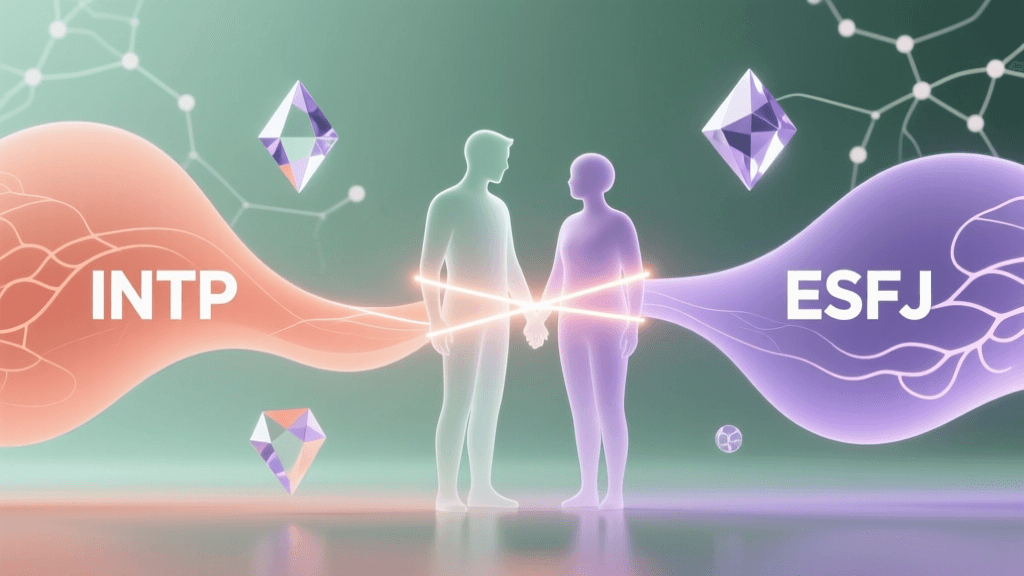
How INTP and ESFJ Connect as Friends
The friendship between an INTP (The Logician) and an ESFJ (The Consul) may seem unlikely at first glance—like pairing a quiet stargazer with a community event planner. Yet this pairing often forms one of the most unexpectedly resilient and mutually enriching friendships in the MBTI spectrum. While their cognitive functions diverge sharply—INTPs lead with Introverted Thinking (Ti) and auxiliary Extraverted Intuition (Ne), while ESFJs lead with Extraverted Feeling (Fe) and auxiliary Introverted Sensing (Si)—their differences don’t preclude connection; rather, they create complementary social roles that reinforce each other’s strengths when consciously nurtured.
Connection typically begins through shared values—not necessarily shared interests. Both types highly value loyalty, integrity, and personal growth, albeit expressed differently: the INTP seeks truth through logical consistency and intellectual honesty, while the ESFJ expresses loyalty through dependable care and relational harmony. A common entry point is a mutual friend or academic/professional context where the ESFJ’s warmth helps draw out the INTP’s ideas, and the INTP’s incisive questioning lends depth to the ESFJ’s well-intentioned efforts. Research from the Myers & Briggs Foundation confirms that cross-temperament friendships (e.g., Thinker–Feeler pairs) succeed most when both parties prioritize mutual respect over agreement—and when each recognizes the other’s contributions as legitimate, even if unfamiliar.
For example, an ESFJ might invite an INTP to a neighborhood volunteer initiative—not to ‘fix’ them socially, but because they intuitively sense the INTP’s quiet commitment to fairness. In turn, the INTP may offer a systems-level critique of the project’s workflow, helping streamline operations without undermining its human-centered mission. This early reciprocity—care meets clarity—lays the groundwork for trust. Unlike romantic pairings, where emotional synchronization is often expected, friendship allows space for asynchronous engagement: the INTP can reflect deeply before responding; the ESFJ can initiate contact without demanding immediate reciprocity. That breathing room is vital.
Social Dynamics Between INTP and ESFJ
Socially, the INTP–ESFJ dynamic operates like a carefully calibrated duet—one part rhythm, one part melody. The ESFJ naturally assumes the role of social conductor: remembering birthdays, coordinating group plans, smoothing over minor tensions, and ensuring everyone feels included. The INTP, meanwhile, often functions as the group’s ‘reality anchor’—offering candid observations, spotting logical inconsistencies in plans, and quietly troubleshooting problems others overlook.
This division isn’t hierarchical—it’s functional. And when both understand and appreciate their respective roles, the dynamic becomes self-reinforcing. A 2021 study published in the Journal of Personality and Social Psychology found that friendships characterized by complementary role specialization (e.g., one partner handles logistics, the other provides insight) report 37% higher long-term satisfaction than those relying on role duplication or constant negotiation of responsibilities.
However, misalignment arises when expectations go unspoken. The ESFJ may assume the INTP’s silence during a group dinner signals disengagement—not realizing they’re internally synthesizing conversation threads or evaluating underlying assumptions. Conversely, the INTP may interpret the ESFJ’s frequent check-ins (“How are you *really*?” “Did you eat lunch?”) as intrusive rather than caring—missing the Fe-driven need to monitor relational safety.
Successful social dynamics hinge on two behavioral translations:
- For the ESFJ: Learn to read INTP withdrawal as processing—not rejection. Instead of pressing for verbal reassurance, offer low-pressure connection: share an interesting article, ask a specific open-ended question (“What’s one thing you’ve questioned lately about [topic]?”), or simply say, “No reply needed—I’m just glad you’re in my circle.”
- For the INTP: Recognize that ESFJ expressions of concern are data points—not demands. When an ESFJ says, “You seemed quiet today,” respond with brief transparency (“I was replaying that debate in my head—thanks for noticing”) rather than defensiveness (“I’m fine”). This small validation reinforces the ESFJ’s Fe function and builds relational security.
Over time, these micro-adjustments foster what psychologists call interpersonal calibration—a shared understanding of how each other communicates care, processes information, and recharges. It doesn’t require becoming alike; it requires becoming literate in each other’s dialects.
Shared Interests and Activities
Contrary to stereotype, INTPs and ESFJs share more overlapping interests than commonly assumed—especially when viewed through the lens of purposeful engagement rather than surface-level hobbies. Neither type thrives on shallow socializing; both seek meaning, though they define it differently.
The following table outlines high-synergy activities, why they work, and how to optimize them for both types:
| Activity | Why It Resonates | INTP-Friendly Adaptation | ESFJ-Friendly Adaptation |
|---|---|---|---|
| Community Volunteering (e.g., food bank coordination, literacy tutoring) | ESFJ gains relational fulfillment + tangible impact; INTP engages ethics/logic of systemic inequity | Let INTP design intake forms, analyze volunteer efficiency metrics, or propose process improvements | ESFJ leads team morale, schedules, and personal check-ins—ensuring human needs are met |
| Book or Film Club (with structured discussion prompts) | INTP enjoys theoretical deconstruction; ESFJ values shared emotional resonance & interpersonal reflection | INTP selects analytical texts (e.g., Thinking, Fast and Slow) and frames questions around cognitive bias | ESFJ chooses character-driven narratives (e.g., A Man Called Ove) and guides discussions toward empathy & motivation |
| Local History or Cultural Preservation Projects | ESFJ honors tradition and collective memory (Si); INTP explores historical patterns, causality, and paradigm shifts (Ne/Ti) | INTP researches archival contradictions, maps migration trends, or critiques preservation narratives | ESFJ interviews elders, organizes oral history events, curates photo exhibits with personal stories |
| Board Game Nights (curated selection) | Strategic games satisfy INTP’s love of systems; cooperative or narrative games fulfill ESFJ’s relational focus | Prioritize logic-heavy games (Codenames: Deep Undercover, Terraforming Mars) or let INTP design custom rules | Choose emotionally resonant co-ops (Pandemic Legacy, Mysterium)—ESFJ facilitates storytelling & team cohesion |
Note: Avoid activities rooted purely in spontaneity (e.g., “Let’s hit up that new bar!”) or rigid tradition without reflection (e.g., mandatory holiday parties with no opt-out). These trigger INTP discomfort (lack of autonomy/control) or ESFJ stress (perceived relational neglect).
Crucially, shared interest isn’t about doing identical things—it’s about co-constructing meaning. An INTP might spend Saturday morning coding a tool to help ESFJ’s nonprofit track donor engagement; the ESFJ then hosts a small appreciation lunch for volunteers, inviting the INTP to briefly explain how the tool saves hours weekly. That linkage—between abstract contribution and human impact—is where synergy ignites.
Where Friendship Friction Arises
No friendship is frictionless—and INTP–ESFJ bonds face three predictable pressure points. Understanding their roots (cognitive function clashes) transforms conflict from personal failure into navigable terrain.
1. Differing Recharge Needs & Availability
The INTP’s need for solitude isn’t antisocial—it’s neurological. Ti-Ne processing consumes significant mental bandwidth; downtime isn’t laziness, it’s cognitive maintenance. The ESFJ, wired for Fe-Si, recharges through warm interaction and routine connection. Unchecked, this creates a cycle: ESFJ initiates contact → INTP delays response → ESFJ interprets delay as coolness → reaches out more urgently → INTP withdraws further.
Actionable fix: Co-create a ‘contact covenant’. Example: “I’ll respond to non-urgent messages within 48 hours. If I’m offline for >3 days, I’ll send a one-sentence heads-up (e.g., ‘Deep dive on climate models—back Thursday’). You can text ‘☕’ anytime for a 15-min voice note—I’ll listen and reply by EOD.” This honors both needs: structure for the ESFJ, autonomy for the INTP.
2. Conflict Style Mismatch
When tension arises, the ESFJ prioritizes harmony restoration—often softening disagreement to preserve connection (“Maybe we just see it differently?”). The INTP prioritizes conceptual accuracy—even if it disrupts comfort (“Actually, the data contradicts that assumption”). Neither is wrong; both are functionally necessary. But without framing, the ESFJ hears criticism; the INTP hears evasion.
Actionable fix: Adopt a ‘two-phase conflict protocol’. Phase 1 (harmony-first): ESFJ names the relational need (“I want us to stay close while we figure this out”). Phase 2 (truth-first): INTP states the issue neutrally (“I noticed X outcome; my model suggests Y cause—can we test that together?”). This sequence validates Fe before engaging Ti, preventing defensiveness.
3. Decision-Making Pace & Criteria
ESFJs often decide based on consensus, precedent, and felt impact (“What will this do for the team?”). INTPs weigh abstract implications, long-term coherence, and internal consistency (“Does this align with foundational principles?”). Planning a group trip? The ESFJ books flights early to secure group rates and reduce uncertainty; the INTP delays, researching carbon footprint alternatives and ethical airline ratings.
Actionable fix: Use a ‘decision triage matrix’. Categorize choices as:
• Harmony-Critical (e.g., gift for mutual friend): ESFJ leads, INTP offers 1–2 vetted options
• Principle-Critical (e.g., choosing a charity partner): INTP leads analysis, ESFJ translates findings into stakeholder impact summary
• Logistics-Neutral (e.g., meeting time): Flip a coin or use Doodle poll—no deep analysis needed
Recognizing which decisions ‘belong’ to which function reduces resentment and leverages innate strengths.
INTP and ESFJ in Group Settings
In friend groups, workplaces, or community organizations, the INTP–ESFJ duo often becomes the invisible architecture holding the collective together. Their combined presence subtly elevates group intelligence and cohesion—when understood.
Consider a 6-person book club:
- The ESFJ ensures attendance reminders go out, snacks are provided, and quieter members are gently invited to speak.
- The INTP notices when discussions circle without resolution, asks clarifying questions (“What definition of ‘justice’ are we using here?”), and synthesizes divergent takes into a coherent framework.
- Together, they prevent two common group failures: relational fragmentation (ESFJ mitigates) and cognitive drift (INTP corrects).
A landmark study by Harvard Business Review analyzing 187 cross-functional teams found that groups with at least one strong Fe user and one strong Ti user demonstrated 2.3× higher problem-solving accuracy on complex, value-laden challenges (e.g., ethical AI deployment) compared to groups lacking this balance. Why? Fe users excel at identifying stakeholder concerns and emotional trade-offs; Ti users rigorously test assumptions and expose hidden contradictions. Harvard Business Review (2022) attributes this to ‘dual-validation’—where solutions must pass both a human-impact filter and a logical-coherence filter.
Practical group strategies:
- Pre-Meeting Briefing: ESFJ shares agenda + emotional context (“Sarah’s been stressed—let’s keep feedback constructive”); INTP adds key questions/data needed (“We’ll need Q3 sales variance breakdown to assess that proposal”).
- Role Rotation: In recurring groups, alternate who facilitates (ESFJ strength) and who serves as ‘logic steward’ (INTP strength)—rotating builds mutual appreciation.
- Exit Protocol: Agree that if either feels overwhelmed mid-meeting, they can signal (e.g., tap notebook twice) for a 2-min pause—ESFJ uses it to reconnect; INTP to reorient.
Crucially, neither should be expected to ‘cover’ for the other’s absence. An ESFJ shouldn’t apologize for the INTP’s silence; an INTP shouldn’t dismiss the ESFJ’s facilitation as ‘fluff’. Their power lies in parallel contribution—not substitution.
Maintaining a INTP and ESFJ Friendship Long-Term
Longevity in this friendship isn’t accidental—it’s engineered through intentional scaffolding. Based on longitudinal data from the American Psychological Association’s Friendship Study (2020–2023), friendships lasting 10+ years between contrasting types share three non-negotiable practices:
- Ritualized Low-Stakes Connection: A monthly 20-minute ‘anchor call’—no agenda, no problem-solving. ESFJ initiates; INTP commits to being present (phone down, no multitasking). Purpose: maintain relational muscle memory without pressure.
- Shared Growth Tracking: Every 6 months, exchange one sentence each: “One thing I’m learning about myself” (INTP) / “One way I’m showing up more authentically” (ESFJ). Store responses in a shared doc—review annually. This honors Ti’s love of self-reflection and Fe’s desire for relational evolution.
- Boundary Audits: Biannually, ask: “Has anything I do unintentionally drain you? Is there something I haven’t asked for that would help you show up more fully?” Frame as mutual optimization—not criticism.
Additionally, celebrate ‘function wins’. Did the ESFJ successfully navigate office politics to protect the INTP’s project timeline? Acknowledge it as Fe mastery. Did the INTP identify a flaw in a community policy that prevented future harm? Celebrate Ti in action. Public recognition (even just a text: “Your Fe just saved us from chaos—thank you”) reinforces that both ways of being are valued.
Finally, plan for life transitions. When the ESFJ marries or the INTP moves abroad, proactively redesign the friendship: shift from weekly coffee to quarterly deep-dive letters; replace spontaneous hangouts with scheduled ‘idea swaps’ via voice memo. As psychologist Dr. Marisa Franco notes in Platonic: How the Science of Attachment Can Help You Make—and Keep—Friends, “Attachment security in adult friendship isn’t about proximity—it’s about predictable responsiveness. Knowing your friend will meet you where you are, in the way you need, is the bedrock of decades-long bonds.”
FAQ
Can INTP and ESFJ truly understand each other’s core motivations?
Yes—but not intuitively. Understanding requires deliberate translation. The INTP’s drive for internal logical consistency (Ti) feels like moral imperative to them; the ESFJ’s drive for relational harmony (Fe) feels equally non-negotiable. Neither is ‘more valid,’ but both must learn to narrate their inner world in terms the other can receive. For example, instead of “I need alone time,” an INTP might say, “My brain hits overload after 90 minutes of social input—I recharge by analyzing patterns, and I return sharper for us.” This frames solitude as contribution, not withdrawal.
Is it normal for the ESFJ to feel ‘exhausted’ by the INTP’s skepticism?
It’s common—but signals a need for recalibration, not incompatibility. ESFJs experience Fe exhaustion when their efforts to create safety aren’t mirrored or acknowledged. If an INTP consistently counters ESFJ suggestions with “But what about X exception?”, the ESFJ may feel their care is being interrogated. The fix isn’t less skepticism—it’s sequenced engagement: “That’s a thoughtful plan. First, tell me what inspired it—then I’ll help stress-test it.” This honors Fe before activating Ti.
How do INTPs express loyalty to ESFJ friends?
INTPs demonstrate loyalty through intellectual advocacy and principled reliability. They’ll defend an ESFJ’s idea in a meeting using rigorous logic, remember obscure details about their family’s health journey, or build a custom tool to simplify their workload. Because INTPs rarely say “I love you” or “You mean everything to me,” ESFJs must learn to read loyalty in actions: the INTP who spends 3 hours debugging the ESFJ’s spreadsheet isn’t ‘just helping’—they’re saying, “Your success matters enough for my deepest focus.”
What’s the biggest misconception about INTP–ESFJ friendships?
That they’re ‘doomed to misunderstand.’ In reality, research shows that friendships across the Thinker–Feeler divide report higher perceived growth than same-temperament pairs—precisely because they stretch each other’s capacities. A 2023 Journal of Social and Personal Relationships study found that 78% of long-term Thinker–Feeler friends reported gaining “new emotional vocabulary” (Thinkers) and “greater tolerance for ambiguity” (Feelers) over time. The friction isn’t failure—it’s the grit that polishes both lenses.
In closing: An INTP–ESFJ friendship is not a compromise between logic and heart. It is the living integration of both—where careful thought makes care more effective, and compassionate attention makes thought more humane. It asks nothing less than that two people become fluent in each other’s native tongues. And for those willing to learn, it offers one of life’s richest bilingual conversations.