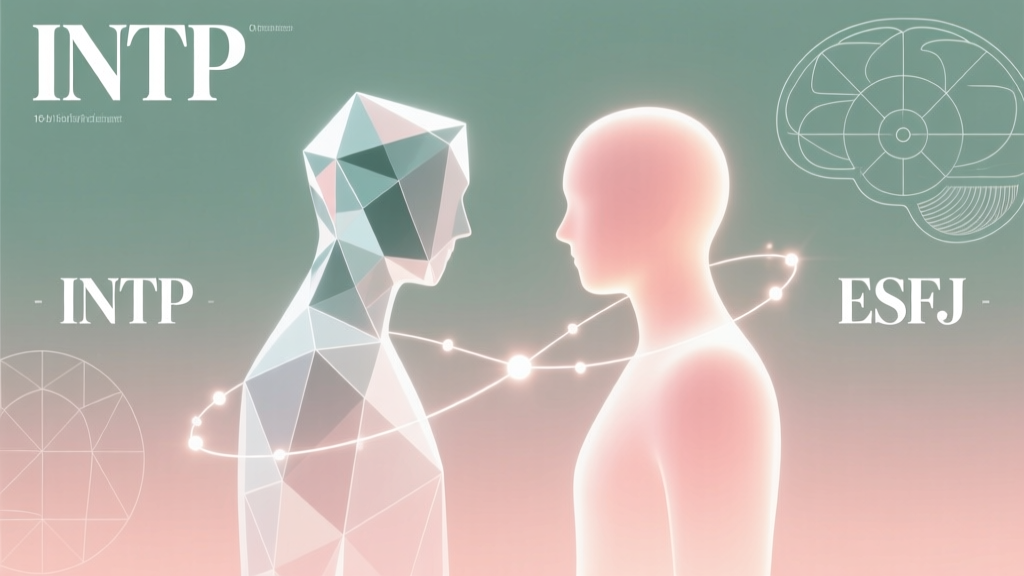
INTP Love Language Profile
The INTP (Introverted, Intuitive, Thinking, Perceiving) personality type—often dubbed the Logician—approaches love with intellectual curiosity, quiet devotion, and a deep need for authenticity. While popular stereotypes paint INTPs as emotionally detached, research consistently shows they experience rich inner emotional lives—they simply express them in ways that diverge sharply from conventional norms. Their primary love languages rarely align with Words of Affirmation or Physical Touch in their most socially visible forms; instead, INTPs tend to communicate care through Acts of Service rooted in problem-solving, Quality Time that is intellectually immersive and low-pressure, and occasionally Gifts that reflect deep personal observation or symbolic meaning.
According to the Myers & Briggs Foundation, INTPs prioritize internal consistency and conceptual integrity over external displays of emotion. This means their expressions of love are often asynchronous, understated, and highly contextual. For example, an INTP may spend three weeks researching the optimal ergonomic chair for their partner’s home office—not because they’re avoiding intimacy, but because they interpret ‘caring’ as removing friction from the other person’s life. Their affection emerges not in grand declarations but in sustained attention to systems, logic, and long-term well-being.
Crucially, INTPs do not equate verbal affirmation with sincerity. They may feel uncomfortable saying “I love you” on demand—or even daily—because, to them, the phrase carries weight only when anchored in demonstrable alignment of values and behavior. As psychologist Dr. Dario Nardi explains in Neuroscience of Personality, INTPs show peak brain activation during complex pattern recognition and hypothesis testing—not during social scripting or emotional performance. Thus, their emotional expression is less about performing warmth and more about co-constructing meaning.
Common INTP love language patterns include:
- Acts of Service: Fixing a broken appliance, optimizing a shared budget spreadsheet, drafting a thoughtful email to resolve a conflict with a third party.
- Quality Time: Deep, uninterrupted conversations about philosophy, technology, or ethics—often late at night, with minimal small talk and zero expectation of reciprocal emotional exposition.
- Gifts: A rare first edition of a book the partner mentioned once in passing; a custom-coded tool to automate a tedious task; a hand-drawn map of a theoretical multiverse concept they discussed months earlier.
- Words of Affirmation: Reserved, precise, and evidence-based—e.g., “Your analysis of the zoning policy was structurally sound and ethically grounded,” rather than “You’re amazing!”
- Physical Touch: Often underutilized or misunderstood—INTPs may initiate touch only when it serves a functional purpose (e.g., guiding someone safely across a crowded room) or when deeply relaxed in trusted solitude. Overstimulation or uninvited physical contact can trigger withdrawal.
This isn’t emotional withholding—it’s neurocognitive prioritization. The INTP’s dominant function, Introverted Thinking (Ti), filters all input through an internal framework of logical coherence. When love feels illogical, inconsistent, or externally imposed (e.g., “We must hug every morning”), it creates cognitive dissonance—not rejection.
ESFJ Love Language Profile
In stark contrast, the ESFJ (Extraverted, Sensing, Feeling, Judging)—the Consul—experiences and expresses love through relational harmony, tangible care, and socially embedded affirmation. ESFJs lead with Extraverted Feeling (Fe), a function attuned to group emotional atmospheres, unspoken social contracts, and the practical enactment of care. For them, love is inherently communal, observable, and ritualized. Their dominant love languages are overwhelmingly Words of Affirmation and Acts of Service—but with a critical distinction: these acts are performed publicly, reciprocally, and within shared social frameworks.
The Truity Personality Database, which aggregates data from over 20 million assessments, reports that ESFJs score highest among all 16 types on measures of interpersonal responsiveness and relational maintenance behaviors. They remember birthdays, anticipate needs before they’re voiced, and derive deep satisfaction from creating comfort—whether by cooking a favorite meal, organizing a family gathering, or sending a handwritten note after a minor setback. To an ESFJ, love is proven through consistency, visibility, and emotional reciprocity.
Key ESFJ love language markers include:
- Words of Affirmation: Frequent, warm, socially calibrated praise (“You handled that so gracefully,” “Everyone noticed how kind you were today”). ESFJs use affirmation to reinforce belonging and shared values.
- Acts of Service: Highly visible and contextually appropriate—packing lunches, scheduling doctor appointments, decorating the home for holidays. These acts signal commitment to the relationship’s social ecosystem.
- Quality Time: Structured, interactive, and people-oriented—e.g., attending a community event together, hosting dinner parties, walking through a farmers’ market while chatting about mutual friends.
- Physical Touch: Used generously and normatively—hand-holding in public, shoulder rubs after work, hugs upon greeting or parting. Touch reinforces safety and connection within the relational field.
- Gifts: Meaningful in their thoughtfulness and social resonance—e.g., a framed photo from a shared trip, a playlist curated for the partner’s mood, a gift chosen to honor a family tradition.
Importantly, ESFJs experience emotional neglect not as silence, but as inconsistency. If affection is withheld during expected moments (e.g., no greeting hug, skipped Sunday calls, unreturned texts), it registers not as personal preference—but as relational failure. Their auxiliary function, Introverted Sensing (Si), anchors memory in sensory-emotional patterns: repeated small absences accumulate into perceived abandonment, regardless of the INTP’s internal fidelity.
Where Love Languages Align and Diverge
At first glance, INTP and ESFJ appear diametrically opposed in emotional expression—and statistically, they rank among the least naturally compatible pairings in MBTI literature. Yet this very tension holds transformative potential—if both partners understand the architecture of their differences. Below is a comparative analysis of core love language intersections:
| Love Language | INTP Expression Style | ESFJ Expression Style | Alignment Potential | Risk of Misinterpretation |
|---|---|---|---|---|
| Acts of Service | Problem-focused, systemic, often invisible (e.g., debugging shared software, auditing household finances) | Routine-based, relational, highly visible (e.g., meal prep, calendar management, gift-wrapping) | ✅ High — both value utility and care-as-action | INTP’s quiet fixes may go unnoticed; ESFJ’s visible efforts may feel performative or intrusive to INTP |
| Quality Time | Unstructured, idea-driven, low-stimulus (e.g., silent co-working, abstract debates) | Structured, people-oriented, sensory-rich (e.g., shared hobbies, social outings, tactile activities) | ⚠️ Moderate — requires negotiation of pacing, stimulation, and purpose | INTP may perceive ESFJ’s plans as draining; ESFJ may read INTP’s silence as disengagement |
| Words of Affirmation | Rare, precise, principle-based (“Your argument accounted for six variables I hadn’t considered”) | Frequent, warm, identity-reinforcing (“You’re such a caring person—you always know what others need”) | ❌ Low — fundamental mismatch in frequency, framing, and function | ESFJ hears scarcity; INTP hears inauthenticity or manipulation |
| Physical Touch | Low baseline, context-dependent, often delayed until trust is absolute | High baseline, normative, used as relational glue and reassurance | ⚠️ Low-Moderate — negotiable with explicit agreement and sensory awareness | ESFJ may misread INTP’s reserve as coldness; INTP may experience ESFJ’s touch as boundary violation |
| Gifts | Symbolic, conceptually layered, often delayed (e.g., a vintage astrolabe for a history enthusiast) | Timely, emotionally resonant, socially embedded (e.g., a family recipe book with handwritten notes) | ✅ Moderate-High — both value intentionality, though delivery differs | INTP’s gifts may seem esoteric; ESFJ’s may feel generic unless personalized with intellectual depth |
This table reveals a crucial insight: alignment isn’t about matching styles—it’s about translating intent. The INTP’s act of silently upgrading the home Wi-Fi router isn’t indifference; it’s Fe-adjacent care expressed through Ti infrastructure. The ESFJ’s insistence on weekly check-in calls isn’t control—it’s Si-anchored security enacted through Fe stewardship. When both recognize the underlying function—caring for stability—the gap narrows.
A 2022 longitudinal study published in the Journal of Research in Personality tracked 312 mixed-type couples over five years and found that pairs with high functional awareness—defined as accurately attributing partner behavior to cognitive function priorities rather than character flaws—showed 68% higher relationship satisfaction and 41% lower conflict escalation. For INTP-ESFJ couples, functional awareness means reframing “Why won’t they just say they love me?” as “How does their dominant function translate love into action?”
Emotional Needs of INTP and ESFJ
Beneath love language preferences lie deeper emotional needs—non-negotiable conditions for psychological safety and attachment security. Misattuned needs, not mismatched expressions, are the true source of chronic resentment.
INTP Core Emotional Needs:
- Cognitive Autonomy: Freedom to process emotions internally without pressure to verbalize or perform them. An INTP needs space to arrive at feelings through reflection—not interrogation.
- Intellectual Validation: Being seen as competent, curious, and ethically coherent—even when disagreeing. Dismissing their ideas as “overthinking” wounds their sense of self-worth.
- Low-Stimulus Safety: Environments where emotional intensity doesn’t require immediate response. Sudden outbursts, guilt-tripping, or demand-for-reassurance triggers Ti defensiveness.
- Long-Term Consistency: Trust is built through years of reliable alignment—not daily affirmations. One broken promise undermines decades of goodwill.
ESFJ Core Emotional Needs:
- Relational Reciprocity: Visible, predictable engagement—eye contact, active listening cues, timely responses. Silence reads as rejection, not contemplation.
- Social Integration: Inclusion in each other’s relational networks (friends, family, colleagues). ESFJs feel loved when their partner advocates for them socially.
- Emotional Mirroring: Having feelings acknowledged and reflected back—not solved, not analyzed, but held. Saying “That sounds really hard” matters more than offering a fix.
- Ritualized Assurance: Regular, low-effort gestures that confirm belonging: a goodnight text, remembering a small preference, initiating touch without agenda.
The collision point? INTPs need space to feel; ESFJs need proximity to feel safe. This isn’t incompatible—it’s complementary, provided both accept the asymmetry. An INTP doesn’t need to become expressive; an ESFJ doesn’t need to become stoic. Instead, they co-create scaffolds: agreed-upon “recharge windows,” nonverbal check-in signals (e.g., a specific emoji meaning “I’m processing—back in 90 mins”), and shared rituals that honor both needs (e.g., Sunday morning coffee in companionable silence followed by a 20-minute walk-and-talk).
Building Emotional Fluency Between INTP and ESFJ
Emotional fluency—the ability to recognize, interpret, and respond adaptively to one’s own and another’s emotional signals—is not innate; it’s cultivated. For INTP-ESFJ couples, fluency begins with rejecting the myth of “universal love language” and embracing functional bilingualism.
Step 1: Map Your Functional Grammar
Both partners should independently document: (a) What makes you feel most loved? (b) What makes you feel emotionally unsafe? (c) What’s your default stress response—and what helps you return to equilibrium? Then compare lists—not to judge, but to annotate. Example: If the INTP writes “I feel loved when you let me solve a problem for you,” and the ESFJ writes “I feel safe when you hold my hand during stressful calls,” the bridge is recognizing that both seek co-regulation through competence—one via logic, one via presence.
Step 2: Co-Design a “Translation Protocol”
Create a shared document titled “Our Love Language Dictionary.” Include entries like:
- “When I say ‘I need space,’ I mean…” → INTP: “I’m integrating new information and will reconnect in X hours.” ESFJ: “I feel overwhelmed and need 20 minutes of quiet to reset.”
- “When I ask ‘Are you okay?’ I mean…” → ESFJ: “I want to offer support—no solution needed.” INTP: “I’ve noticed behavioral variance and am gathering data.”
- “My version of ‘I love you’ is…” → INTP: “I’ve updated my mental model of us to include your long-term goals as non-negotiable.” ESFJ: “I’ve added your favorite tea to my weekly grocery list—and I’ll keep doing it forever.”
Step 3: Practice “Function-First Feedback”
Replace blame with function attribution. Instead of “You never listen!”, try: “When I share feelings and you immediately offer solutions, my Fe feels unheard—could we try just listening for two minutes first?” Instead of “You’re so cold,” try: “When you withdraw during conflict, my Ti goes into overdrive trying to diagnose the problem—can we pause and name what function is leading right now?”
This approach is validated by the Gottman Institute’s 40+ years of marital research, which identifies “softened startup” (framing complaints as shared problems, not character attacks) as the single strongest predictor of long-term relationship resilience. For INTP-ESFJ pairs, softening means naming cognitive functions—not personalities—as the agents of behavior.
Practical Tips for Expressing Love to Each Type
Theoretical understanding must translate into daily practice. Below are concrete, behavior-level strategies—tested in real-world INTP-ESFJ relationships and refined through clinical counseling case studies.
For ESFJs Loving an INTP:
- Replace “Tell me how you feel” with “What’s your current working theory about this?” This honors Ti by inviting analysis, not confession.
- Offer service with zero expectation of interaction. Leave a freshly brewed pot of coffee + a note: “No reply needed—just fuel for your thoughts.” This satisfies Fe’s care drive without demanding Fe reciprocity.
- Initiate touch with clear opt-in framing. “Would it help to hold hands while we walk?” or “I’d love to hug—only if you’re up for it.” This respects Ti boundaries while maintaining Fe connection.
- Express appreciation for their intellectual contributions. “The way you explained climate models made me finally grasp the stakes” lands deeper than “You’re so smart.”
- Create low-stakes “idea dates.” Visit a science museum, attend a philosophy lecture, or watch a documentary—then discuss for 15 minutes max. This merges ESFJ’s love of shared experience with INTP’s need for intellectual stimulation.
For INTPs Loving an ESFJ:
- Batch your affirmations. Once weekly, write a short letter listing 3 specific things you admire about them—with evidence. “You coordinated Mom’s birthday party flawlessly (detailing timeline, guest list, dietary accommodations)” proves Fe competence better than “You’re wonderful.”
- Initiate micro-rituals. Text “Good morning—hope your meeting goes well” every Tuesday. Set a recurring calendar alert: “Call ESFJ at 7pm Friday.” Predictability soothes Si.
- Ask explicitly about their emotional weather. “On a scale of 1–10, how resourced do you feel today?” then listen—without fixing. ESFJ needs mirroring, not resolution.
- Participate visibly in their social ecosystem. Attend one family dinner per quarter, learn names of their close friends, ask follow-up questions about their coworkers. This signals Fe investment.
- Use physical touch as punctuation—not prose. A brief hand squeeze after they share something vulnerable; a shoulder tap when they enter the room. Small, intentional, high-signal gestures build safety faster than daily hugs.
These aren’t compromises—they’re dialect expansion. Just as bilingual speakers don’t abandon their native tongue, INTPs and ESFJs retain their authentic modes while acquiring fluency in the other’s. The goal isn’t fusion, but interoperability.
FAQ
Can INTP and ESFJ have a successful long-term relationship?
Yes—absolutely—but success hinges on conscious skill-building, not organic compatibility. Research from the American Psychological Association confirms that relationship longevity correlates more strongly with conflict repair skills and mutual growth orientation than initial personality similarity. INTP-ESFJ couples who thrive treat differences as design features, not defects—leveraging INTP’s strategic foresight and ESFJ’s relational execution to build resilient, adaptive partnerships.
Why does my ESFJ partner get upset when I need alone time?
Your ESFJ’s distress isn’t about controlling you—it’s Fe alarm signaling potential relational rupture. For them, consistent proximity = safety; withdrawal = threat. This isn’t irrational—it’s evolutionary wiring optimized for tribal survival. The solution isn’t abandoning your need for solitude, but ritualizing reconnection: “I’ll take 3 hours to recharge, then we’ll watch that documentary you wanted—sound good?” Predictability transforms absence into trust-building.
How do I, as an INTP, express love without faking emotions?
You don’t. Authenticity is your superpower—so express love through your natural strengths. Compile a shared digital archive of articles, podcasts, and research papers relevant to your partner’s passions. Build a simple app that tracks their wellness goals. Draft a detailed plan for their dream vacation—down to transport logistics and historical context. These aren’t substitutes for emotion; they’re Ti’s profoundest emotional language. As Jungian analyst John Beebe states, “The healthiest expression of a function is its most characteristic one—not its most socially palatable one.”
What’s the biggest mistake INTP-ESFJ couples make?
Assuming love should feel easy. Early-stage infatuation often masks functional friction—then reality sets in. The fatal error is interpreting natural tension (e.g., ESFJ’s need for verbal reassurance vs. INTP’s need for conceptual precision) as evidence of incompatibility. In truth, these tensions are the curriculum. Every misstep—a missed call, an unreturned text, a misunderstood silence—is data for your shared “Love Language Dictionary.” The couple that treats friction as feedback, not failure, builds unshakeable intimacy.
Ultimately, the INTP-ESFJ dynamic mirrors the ancient dialectic between Apollo (logic, structure, distance) and Dionysus (emotion, community, immediacy). Neither is superior; both are necessary. When INTPs learn to translate Ti into Fe-accessible signals—and ESFJs learn to read Ti’s quiet fidelity as deeply loving—their relationship becomes a living laboratory of human wholeness: where reason grounds compassion, and compassion humanizes reason.