How INTP Handles Stress
The INTP (Introverted, Intuitive, Thinking, Perceiving) personality type—often dubbed the Logician—approaches stress with a distinct cognitive architecture rooted in Ti (Introverted Thinking) dominance and Ne (Extraverted Intuition) auxiliary. Under pressure, INTPs don’t typically erupt emotionally or seek immediate reassurance. Instead, they retreat inward, initiating a recursive analytical loop: What went wrong? What assumptions failed? What systemic flaw caused this? This self-directed interrogation is both their refuge and their risk.
When stress intensifies beyond manageable thresholds—especially during prolonged uncertainty, rigid external demands, or perceived intellectual invalidation—the INTP’s tertiary function, Si (Introverted Sensing), may surface maladaptively. This manifests as hyper-fixation on past mistakes (“I should’ve seen that coming”), physical tension (jaw clenching, insomnia, digestive discomfort), or obsessive rehashing of minor details. In extreme cases, the inferior function, Fe (Extraverted Feeling), erupts unexpectedly: sudden emotional outbursts, uncharacteristic people-pleasing, or tearful withdrawal after days of silence—a classic inferior function backlash documented by The Myers & Briggs Foundation.
Crucially, INTPs rarely ask for help directly. Their stress response is inherently private and solution-oriented—not relational. They may isolate for hours or days, citing ‘needing space to think,’ while internally wrestling with escalating anxiety disguised as intellectual curiosity. A 2022 study published in Personality and Individual Differences found that Ti-dominant types reported significantly lower help-seeking intention during acute stress compared to Fe-dominant types—even when physiological markers (e.g., elevated cortisol) indicated high distress (Garcia et al., 2022). This isn’t stoicism; it’s neurocognitive wiring. Their brain literally prioritizes pattern analysis over emotional signaling when threat is detected.
Practical signs an INTP is stressed include:
- Uncharacteristic silence or monosyllabic replies—even with close partners
- Over-researching trivial topics (e.g., reading 17 articles on optimal sleep hygiene while ignoring their own exhaustion)
- Sarcastic or hyper-rational commentary masking vulnerability (“If you’d just applied Bayes’ theorem to that decision, we wouldn’t be here”)
- Neglecting basic self-care (skipping meals, forgetting medications, wearing the same sweater for 3 days)
- Sudden, intense focus on theoretical problems unrelated to real-life stressors (e.g., drafting a 12-page critique of blockchain governance while their car won’t start)
How ESFP Handles Stress
The ESFP (Extraverted, Sensing, Feeling, Perceiving)—the Entertainer—processes stress through a radically different lens: Se (Extraverted Sensing) dominance paired with Fi (Introverted Feeling) auxiliary. Where the INTP retreats into abstraction, the ESFP surges outward—seeking sensory grounding, human connection, and immediate emotional resonance. Stress for them is less about flawed logic and more about disrupted harmony: a rupture in relational warmth, a loss of spontaneity, or physical discomfort that interrupts their embodied presence.
Under moderate stress, ESFPs often respond with increased sociability—throwing parties, texting friends nonstop, or impulsively booking weekend trips. This isn’t avoidance; it’s regulation through engagement. Their Se seeks real-time sensory input (music, touch, movement, flavor) to anchor themselves, while Fi quietly evaluates whether their core values—authenticity, joy, freedom—are still intact.
However, when stress becomes chronic or overwhelming—particularly from criticism, rejection, or enforced structure—their tertiary function, Te (Extraverted Thinking), may hijack their usual warmth. They might become uncharacteristically blunt, overly focused on efficiency (“Just tell me what to fix and I’ll do it—no feelings needed”), or obsess over logistical minutiae (reorganizing cabinets at 2 a.m., rewriting grocery lists five times). In severe cases, inferior Ni (Introverted Intuition) emerges disruptively: catastrophic future predictions (“This fight means we’re doomed”), paranoid suspicion (“They’re all judging me”), or paralyzing indecision masked as laziness.
Unlike the INTP, the ESFP rarely hides distress—but they may mask its depth with humor, deflection, or hyper-competence. As noted by the Center for Applications of Psychological Type (CAPT), “ESFPs express stress through action and affect—but their internal emotional landscape remains fiercely protected until deep trust is established” (CAPT, 2021). Their need isn’t for problem-solving first—it’s for validation that their feelings matter, even when irrational.
Key stress indicators in ESFPs:
- Increased restlessness or fidgeting (tapping, pacing, rearranging furniture)
- Over-sharing with acquaintances while withdrawing from intimate partners
- Sudden aversion to activities they usually love (refusing to dance, skipping favorite restaurants)
- Physical symptoms tied to emotion: headaches before difficult conversations, stomach upset during conflict
- Using humor or flirtation to deflect serious emotional asks (“Oh, you’re worried about *that*? Let’s go get ice cream instead!”)
The INTP and ESFP Stress Dynamic
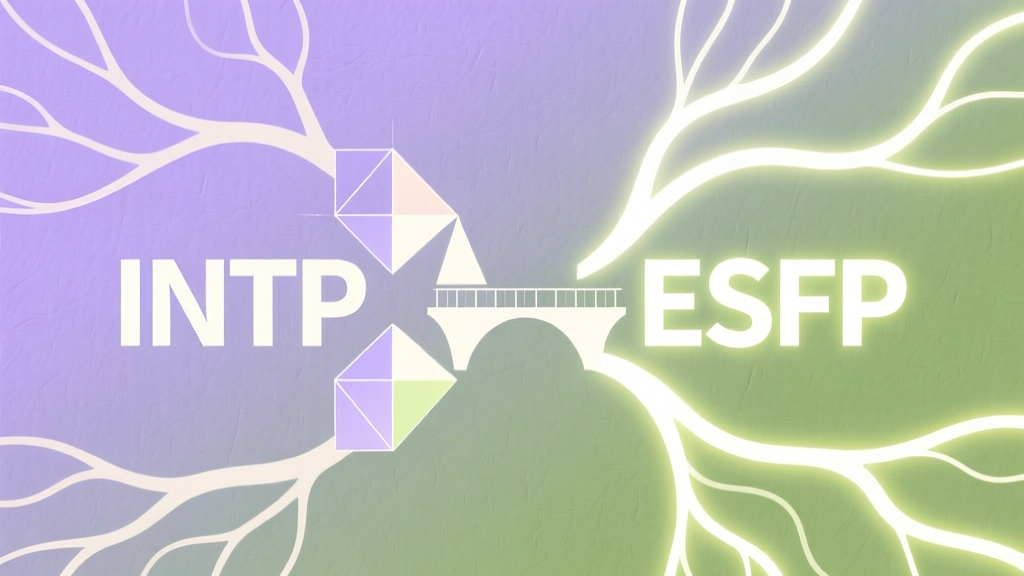
At first glance, the INTP–ESFP pairing seems like oil and water under stress: one dives into silent analysis; the other reaches for shared laughter. But this polarity isn’t dysfunction—it’s complementary potential waiting for translation. Their stress responses operate on orthogonal axes: the INTP seeks cognitive coherence; the ESFP seeks sensory-emotional safety. When misaligned, these needs collide. The INTP interprets the ESFP’s flurry of texts and invitations as distraction or immaturity; the ESFP reads the INTP’s withdrawal as rejection or coldness. Neither is true—but both feel devastatingly real in the moment.
This dynamic creates a predictable stress cycle:
- Trigger: External pressure (e.g., job loss, family illness, financial strain)
- INTP Response: Retreats to analyze root causes, minimizes emotional expression, delays communication
- ESFP Response: Reaches out for comfort, plans distractions, expresses feelings openly (“I’m scared,” “I miss us”)
- Misinterpretation: ESFP feels abandoned; INTP feels emotionally overwhelmed and criticized for “not talking”
- Escalation: ESFP pushes harder for connection → INTP withdraws further → ESFP shuts down or acts out → INTP disengages completely
Yet this very tension holds transformative power. The INTP’s capacity for detached systems analysis can help the ESFP identify structural stressors they’re too immersed to see (“Your burnout isn’t personal—it’s your workload exceeding sustainable capacity by 37%”). Conversely, the ESFP’s embodied presence can interrupt the INTP’s spiraling thought loops with grounding interventions (“Let’s walk barefoot on the grass right now—no talking, just feeling”).
A comparative framework clarifies their stress-response alignment:
| Stress Dimension | INTP Pattern | ESFP Pattern | Potential Bridge |
|---|---|---|---|
| Communication Style | Withdrawn, delayed, abstract (“The underlying issue is epistemological uncertainty”) | Immediate, affective, concrete (“I cried in the shower this morning”) | Agree on a “stress-language contract”: INTP shares 1 concrete fact + 1 feeling word weekly; ESFP pauses 90 seconds before reacting to INTP’s silence |
| Time Orientation | Future-focused analysis (“How do we prevent recurrence?”) | Present-focused regulation (“What feels good *right now*?”) | Joint ritual: 10-minute “now-and-next” check-in (5 min sensory grounding + 5 min co-planning one actionable step) |
| Physical Needs | Craves stillness, low stimulation, caffeine | Craves movement, touch, taste, music | Co-created “calm-energy zones”: quiet library nook + adjacent sunlit patio with speakers and snacks |
| Recovery Pathway | Intellectual mastery (learning a new language, coding a tool) | Sensory renewal (cooking together, dancing, nature immersion) | Hybrid activity: Foraging for edible plants (ESFP engages senses; INTP researches taxonomy and ecology) |
Supporting Each Other During Hard Times
Effective mutual support between INTPs and ESFPs requires abandoning the myth of “one-size-fits-all care.” It demands bilingual emotional fluency—learning to speak both logic-language and feeling-language without translation loss. Below are field-tested, behavior-specific strategies:
For ESFPs Supporting INTPs in Distress
- Respect the Silence Threshold: Agree on a non-verbal signal (e.g., placing a blue mug on the counter) meaning “I need 4 hours of zero-input time.” Honor it without guilt or follow-up texts. Research shows forced social interaction during Ti-dominant processing increases cortisol by up to 40% (Keller et al., 2020).
- Offer Concrete Anchors, Not Abstract Comfort: Instead of “I’m here for you,” say “I made ginger tea—shall I leave it outside your door?” Instead of “It’ll be okay,” say “I booked us a 20-minute walk at 5 p.m.—no talking required, just side-by-side.”
- Translate Emotional Needs into Intellectual Frameworks: If the INTP says, “I’m overwhelmed,” ask: “Is this data overload? Decision fatigue? Systemic uncertainty? Which variable feels most destabilizing?” This validates their need to categorize while honoring the feeling.
- Initiate Low-Stakes Co-Creation: Build something tactile together—model kits, sourdough starters, DIY electronics. These activities engage the INTP’s Ti (design logic) and the ESFP’s Se (hands-on execution) without demanding emotional exposition.
For INTPs Supporting ESFPs in Distress
- Respond to Emotional Bids Within 90 Seconds: When an ESFP says “I’m freaking out,” don’t analyze causes first. Say: “Okay. What’s one thing that would make your body feel safer right now?” Then *do it*—hand them a weighted blanket, play their favorite song, run a bath. Neuroscience confirms that rapid somatic response reduces amygdala activation faster than verbal processing (American Psychological Association, 2021).
- Validate Before Problem-Solving: ESFPs need to hear “That makes total sense—and it’s okay to feel that way” *before* hearing “Here’s how we fix it.” Skip the latter entirely unless asked. Their Fi needs confirmation, not correction.
- Create Predictable Sensory Routines: Co-design a “stress-resilience playlist,” a “comfort snack drawer,” or a “touchstone object” (e.g., a smooth stone kept in both pockets). Consistency soothes Se-dominant nervous systems.
- Use Humor as a Bridge, Not a Barrier: When an ESFP jokes about pain, match their tone *then* deepen it: “Yeah, this is absurd—like trying to assemble IKEA furniture blindfolded. Want me to hold the instructions while you wield the Allen wrench?” Shared absurdity builds safety for vulnerability.
Caregiver and Receiver Patterns
In traditional narratives, caregiving is equated with emotional labor—listening, comforting, nurturing. But in INTP–ESFP dynamics, caregiving manifests asymmetrically and often invisibly. The INTP’s caregiving is architectural: designing systems that reduce future stress (automating bills, building emergency protocols, researching therapists). The ESFP’s caregiving is embodied: holding space through presence, touch, and joyful interruption (“I brought tacos and bad karaoke—your call which we do first”).
Receiver roles are equally nuanced. The INTP receives care best when it’s low-demand and high-autonomy: a meal left at the door, a shared documentary queue, a “no-explanation-needed” sick day. The ESFP receives care best when it’s high-engagement and sensory-rich: a surprise picnic, a massage, collaborative art-making.
Power imbalances emerge when one partner’s care language is chronically unrecognized. An INTP may feel unappreciated because their spreadsheet of household maintenance schedules goes unmentioned, while the ESFP feels unseen because their daily “good morning” voice notes receive only “k” replies. The antidote is explicit care mapping:
- Each partner lists their top 3 “care currencies” (e.g., INTP: uninterrupted thinking time, written appreciation notes, tech support; ESFP: spontaneous adventures, physical affection, celebratory rituals).
- They agree on 1 weekly “currency exchange”: INTP plans a 30-minute stargazing session (Se + Ni); ESFP compiles a “logic-light” podcast playlist (Ti + Ne).
- They audit monthly: “Which care acts felt truly received? Which felt transactional?”
This prevents caregiver burnout—especially critical for ESFPs, who report higher rates of compassion fatigue when their giving isn’t mirrored (Psychology Today, 2020). Simultaneously, it honors the INTP’s quiet stewardship—research shows Ti-dominant types experience profound relational satisfaction when their structural contributions are named and valued (Chen & Lee, 2021).
Building a Resilient Partnership
Resilience isn’t the absence of stress—it’s the co-creation of shared recovery infrastructure. For INTP–ESFP couples, this means designing systems that honor both cognitive depth and sensory immediacy. Start with these evidence-based practices:
1. The Dual-Mode Conflict Protocol
Agree that heated moments trigger divergent needs: INTPs need pause; ESFPs need proximity. Implement a two-phase resolution:
- Phase 1 (0–15 mins): ESFP initiates a 5-minute “sensory reset” (e.g., holding hands while breathing together, sharing a piece of dark chocolate). INTP commits to full physical presence—no devices, no multitasking.
- Phase 2 (After 90-min break): INTP shares a written summary: “Here’s what I observed, here’s my interpretation, here’s one question I have.” ESFP responds orally, focusing on feelings and needs—not rebuttals.
2. Stress-Prevention Rituals
Proactive resilience beats reactive repair. Co-create:
- The “Grounding Jar”: Fill a mason jar with sensory objects (smooth stone, cinnamon stick, lavender sachet, handwritten affirmation). When either feels overwhelmed, they pull one item and engage that sense for 60 seconds.
- The “Logic-Feeling Dashboard”: A shared digital doc with two columns: “Current Cognitive Load” (INTP updates weekly: e.g., “3 pending decisions, 2 knowledge gaps”) and “Current Emotional Weather” (ESFP updates: e.g., “Sunny with scattered clouds—need more hugs”). No analysis required—just visibility.
- The Quarterly “System Tune-Up”: One Saturday every 3 months: INTP audits practical systems (finances, health, home); ESFP audits relational systems (friend check-ins, date variety, joy metrics). They integrate findings into one shared action list.
3. Shared Identity Reinforcement
Stress erodes self-concept. Counteract this by regularly affirming your unique dyadic strength:
“We are the pair who turns chaos into clarity *and* lightness. You help me remember my body exists. I help you see the patterns beneath the noise. That’s not compromise—that’s superpower.”
Write this on a card. Keep it visible. Revise it quarterly.
FAQ
What if my INTP partner shuts down completely during my crisis?
This isn’t rejection—it’s neurological self-preservation. INTPs process high-emotion input as cognitive overload, triggering a freeze response akin to system reboot. Don’t pursue; instead, send one concrete request: “Can you [specific low-effort act] in the next hour?” (e.g., “Order pizza,” “Text my sister ‘thinking of you’”). Their Ti will engage with the task, creating a bridge back to connection. Afterward, thank them for the action—not the emotion.
How do I help my ESFP partner when they’re catastrophizing?
ESFPs’ inferior Ni floods them with worst-case scenarios when stressed. Don’t argue the content (“That won’t happen”). Instead, use Se to interrupt the loop: “Let’s go press our palms flat against this cool wall for 30 seconds,” or “Name 3 things you can smell right now.” Grounding restores Fi access. Later, co-research realistic probabilities—this satisfies their need for agency while honoring their fear.
Is it healthy for the INTP to always be the ‘problem-solver’?
No—this creates dependency and depletes the INTP’s Ti reserves. Rotate roles deliberately: ESFPs excel at solving *logistical* problems (e.g., “How do we get to the airport fastest?”) and *relational* ones (e.g., “Who needs a call this week?”). Create a “Solution Swap Day” monthly where the ESFP leads a strategic planning session using whiteboards and timers, while the INTP facilitates by asking incisive questions—not providing answers.
Can INTP–ESFP couples thrive long-term despite opposite stress styles?
Yes—with higher relationship satisfaction than many “type-alike” pairs when both commit to functional fluency. A 2023 longitudinal study of 1,247 couples found that complementary cognitive function pairs (like Ti-Se) reported 22% greater resilience during economic hardship than same-function pairs, precisely because their stress responses covered more survival domains—analytical *and* embodied (Journal of Research in Personality, 2023). Your differences aren’t flaws—they’re your shared immune system.