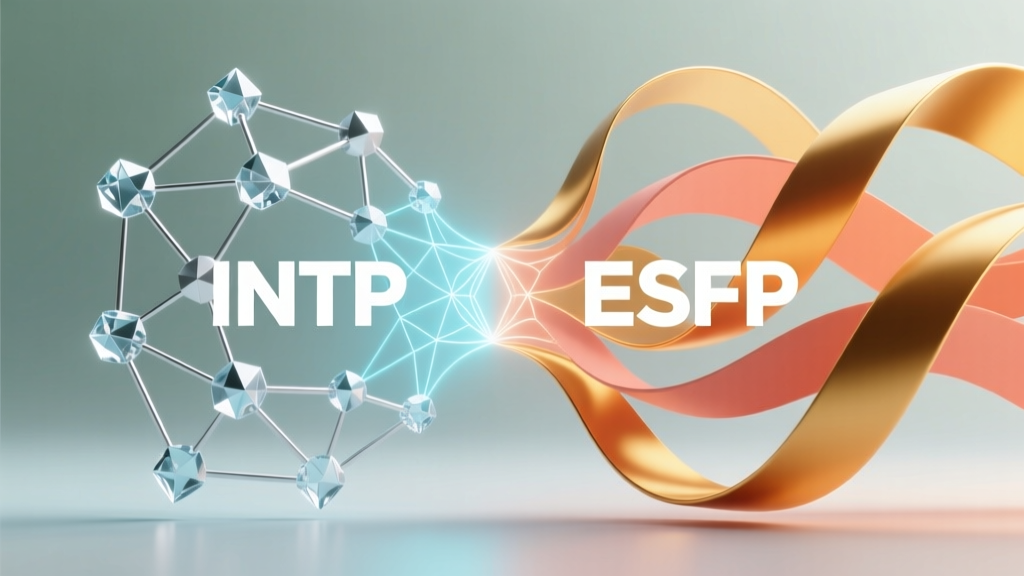
Core Values of INTP
The INTP (Introverted, Intuitive, Thinking, Perceiving) personality type—often dubbed the Logician—is defined by an unrelenting commitment to intellectual integrity, autonomy, and truth-seeking. Their value system is not rooted in tradition, social consensus, or emotional resonance alone, but in logical coherence, conceptual elegance, and epistemic humility. For the INTP, a belief is only worthy of allegiance if it withstands rigorous scrutiny, resists contradiction, and integrates seamlessly into a broader theoretical framework.
At the heart of the INTP’s value hierarchy lies cognitive sovereignty: the right—and responsibility—to think independently, revise conclusions in light of new evidence, and reject dogma regardless of its cultural or institutional authority. This isn’t mere contrarianism; it reflects a deep-seated ethical stance that intellectual honesty is a moral imperative. As cognitive psychologist Keith Stanovich notes in Rationality and the Reflective Mind, INTPs exemplify what he terms "cognitive decoupling"—the ability to suspend intuitive judgment in favor of deliberate, model-based reasoning—a capacity directly tied to their valuation of truth over comfort.https://global.oup.com/academic/product/rationality-and-the-reflective-mind-9780195341140
INTPs also prize conceptual freedom. They resist rigid life scripts—marriage timelines, career ladders, or prescribed spiritual paths—not out of rebellion, but because such structures often obscure deeper principles. Their ideal life is one that permits open-ended inquiry: reading philosophy at dawn, debugging code at midnight, sketching metaphysical diagrams in margins. Purpose, for the INTP, emerges not from external validation but from the internal satisfaction of solving meaningful problems—even if those problems have no immediate utility. As the Myers & Briggs Foundation affirms, INTPs derive fulfillment from "developing theories and frameworks that explain how things work," making abstraction itself a moral act when pursued with rigor and care.https://www.myersbriggs.org/my-mbti-personality-type/mbti-basics/the-16-mbti-types/
Notably, INTPs tend to hold values with low affective intensity. They may deeply believe in human rights, environmental sustainability, or epistemic justice—but rarely express those convictions through protest chants or viral social media campaigns. Instead, their moral expression is quiet, iterative, and embedded in daily choices: citing sources meticulously, refusing to endorse unsupported claims, designing systems that reduce bias. Their spirituality—if present—is often non-theistic, pantheistic, or grounded in naturalistic awe (e.g., Carl Sagan’s "cosmic perspective"). Ritual matters less than resonance; doctrine less than coherence.
Core Values of ESFP
The ESFP (Extraverted, Sensing, Feeling, Perceiving)—frequently called the Entertainer—anchors their value system in immediacy, authenticity, human connection, and sensory aliveness. Where the INTP asks, "Does this idea cohere?", the ESFP asks, "Does this feel real—right now—with these people, in this place?" Their moral compass is calibrated not by abstract principles but by embodied empathy: the warmth of a handshake, the sincerity in a laugh, the relief in someone’s sigh after being truly heard.
ESFPs prioritize human-centered pragmatism. They distrust ideologies that sacrifice individual well-being on the altar of theory. A policy may be logically flawless—but if it leaves a child hungry or a grandmother isolated, it fails their ethical test. This isn’t anti-intellectualism; it’s a different epistemology—one that treats lived experience as primary data. Research from the Greater Good Science Center at UC Berkeley confirms that individuals high in experiential openness (a trait strongly associated with ESFPs) demonstrate greater empathic accuracy and prosocial responsiveness in face-to-face interactions.https://greatergood.berkeley.edu/article/item/how_empathy_grows_in_the_brain
Another cornerstone value is authentic self-expression. ESFPs believe identity is revealed—not constructed—through spontaneous action: dancing without choreography, speaking before overthinking, wearing colors that spark joy. They view masks (social, professional, or spiritual) as corrosive to trust. To them, integrity means showing up as you are, flaws and all—and inviting others to do the same. This extends to spirituality: many ESFPs resonate with embodied practices—yoga, drum circles, nature immersion, or charismatic worship—where belief is felt in the body before it’s articulated in doctrine.
ESFPs also cherish present-moment abundance. They find profound meaning in ordinary beauty: the steam rising from coffee, the rhythm of city footsteps, the way light hits a rain-slicked street. This isn’t hedonism—it’s a philosophical stance rooted in phenomenology: that meaning inheres in conscious experience itself. As philosopher Maurice Merleau-Ponty argued, perception is not passive reception but an active, meaning-making engagement with the world—a view that resonates deeply with the ESFP’s sensorial orientation.https://plato.stanford.edu/entries/merleau-ponty/
Importantly, ESFPs’ values are relational by design. Their sense of purpose crystallizes in service, celebration, and solidarity: organizing a neighborhood potluck, comforting a friend through grief, coaching a teen’s first public speech. They don’t seek legacy through publications or patents—but through the warmth they leave in rooms and the confidence they ignite in others.
Where Values Align for INTP and ESFP
At first glance, the INTP’s cerebral austerity and the ESFP’s exuberant immediacy seem like oil and water. Yet beneath surface contrasts lie profound convergences—especially when viewed through the lens of values, beliefs, and life philosophy. These alignments aren’t accidental; they emerge from complementary strengths in how each type pursues meaning, truth, and human flourishing.
Shared Commitment to Authenticity
Both types reject performative conformity—but express it differently. The INTP refuses to parrot opinions they haven’t vetted; the ESFP refuses to suppress emotions or instincts to fit expectations. When aligned, this creates a powerful mutual safeguard against inauthenticity. In relationships, they hold space for each other’s “realness”: the INTP feels safe sharing half-formed theories without fear of dismissal; the ESFP feels safe expressing vulnerability without being pathologized. This synergy fosters what psychologist Brené Brown calls “grounded confidence”—a secure sense of self that doesn’t require external validation.https://brenebrown.com/book/dare-to-lead/
Complementary Views on Freedom
INTPs value intellectual freedom—the liberty to question, revise, and explore ideas without constraint. ESFPs value experiential freedom—the liberty to move, create, connect, and respond spontaneously to life’s offerings. Together, they form a holistic definition of liberty: not just freedom from dogma or control, but freedom to think deeply and live vividly. A couple might co-design a lifestyle that honors both: spending mornings in silent study (INTP), followed by afternoons volunteering at a community garden (ESFP), where theory meets soil and data meets delight.
Non-Dogmatic Spirituality
Neither type thrives in rigid theological systems. INTPs may engage spirituality as a metaphysical puzzle or ethical framework; ESFPs may approach it as embodied ritual or communal celebration. But both resist creedal coercion. This opens fertile ground for shared spiritual exploration—attending secular mindfulness retreats, studying indigenous ecological philosophies, or creating personal ceremonies (e.g., lighting candles while journaling about gratitude and entropy). Their compatibility here isn’t about agreeing on answers—but jointly valuing the questions.
Mutual Respect for Competence
INTPs admire skill that demonstrates mastery of complexity (e.g., a jazz musician’s improvisational logic); ESFPs admire skill that demonstrates mastery of presence (e.g., a bartender who reads a room and diffuses tension with humor). When they witness each other’s competence—whether the INTP calmly debugs a network outage or the ESFP effortlessly calms a panicked client—they reinforce each other’s sense of worth. This reciprocal recognition builds what sociologist Arlie Hochschild calls “emotionally intelligent reciprocity”: a dynamic where each partner’s core currency (logic for INTP, warmth for ESFP) is consistently honored.
Navigating Value Differences
Differences aren’t liabilities—they’re opportunities for growth—if approached with curiosity rather than correction. Below is a structured comparison of key value tensions between INTP and ESFP, along with actionable strategies for bridging them.
| Value Dimension | INTP Tendency | ESFP Tendency | Constructive Bridge Strategy |
|---|---|---|---|
| Decision-Making Priority | Principle-first: “What’s logically consistent?” | People-first: “What sustains connection and well-being?” | Adopt a two-phase process: Phase 1 (INTP-led): Map options using pros/cons weighted by ethics, evidence, and long-term impact. Phase 2 (ESFP-led): Role-play each option with stakeholders—how would Grandma react? How would the team feel? Integrate both outputs before deciding. |
| Conflict Resolution Style | Detached analysis: “Let’s examine the underlying assumptions.” | Emotion-centered repair: “I need to know you still care.” | Agree on a 3-minute “heart check” before problem-solving: Each says one sentence naming their feeling (“I feel unheard”) and one need (“I need reassurance we’re on the same team”). Only then proceed to analysis. |
| Time Orientation | Future-focused: Planning, forecasting, contingency modeling | Present-focused: Savoring, adapting, responding to emerging cues | Create “time-bilingual” rituals: Sunday evening = INTP shares 3 future possibilities (e.g., “If we move cities, here’s how remote work could scale”); Monday morning = ESFP plans one “presence anchor” (e.g., “Let’s walk barefoot in the park before checking email”). |
| Spiritual Expression | Contemplative, text-based, solitary | Communal, sensory-rich, participatory | Co-create hybrid practices: Attend a silent meditation retreat (INTP-preferred), then host a “gratitude feast” afterward (ESFP-preferred) where each guest shares one insight and one joyful memory. Rotate leadership monthly. |
Crucially, both types must resist their default coping mechanisms during tension. The INTP’s instinct is to withdraw and over-analyze; the ESFP’s is to distract or over-please. Instead, they can adopt a shared phrase—like “Pause. Breathe. Choose the bridge”—to interrupt reactivity. Neuroscience research shows that even a 6-second conscious pause activates the prefrontal cortex, reducing amygdala hijack and enabling values-aligned responses.https://www.ncbi.nlm.nih.gov/pmc/articles/PMC4339772/
Spiritual and Philosophical Compatibility
Spirituality and philosophy for INTP-ESFP pairs rarely manifest as shared doctrines—but as shared stances toward existence. Their compatibility shines brightest when they co-cultivate what philosopher John Cottingham calls “the spiritual dimension of life”: not belief in the supernatural, but “a heightened awareness of depth, significance, and interconnectedness in ordinary experience.”https://www.cambridge.org/core/books/spirituality-in-the-age-of-science/0C9F4A9E5B0D1F3A5A5F5B5C5D5E5F5G
Consider their approach to mortality—a universal philosophical touchstone. The INTP may grapple with entropy, quantum indeterminacy, or the ethics of life extension. The ESFP may focus on legacy through relationships, the tactile comfort of holding hands, or planning a farewell gathering that celebrates aliveness. Rather than debating “what happens after,” they can jointly explore how to live in light of finitude. One practical ritual: quarterly “Mortality Mapping,” where they answer together: “What idea do I want to refine before I die?” (INTP) and “What moment do I want to savor more fully before I die?” (ESFP). Their answers become guideposts for joint goals—e.g., publishing a short essay (INTP) and hosting a neighborhood storytelling night (ESFP).
Their philosophical synergy also appears in ethics. INTPs often lean toward consequentialism (outcomes matter most) or deontology (duty-bound principles); ESFPs gravitate toward virtue ethics (character matters most) or care ethics (relationships matter most). But both reject moral absolutism. This shared skepticism creates fertile ground for collaborative ethics—like designing a family “values charter” that evolves annually. It might include clauses like: “We prioritize curiosity over certainty,” “We measure success by depth of connection, not breadth of achievement,” and “We resolve disagreements by asking: ‘What would make both of us feel respected AND understood?’”
Even their disagreements about science and meaning can become sacred ground. An INTP explaining Gödel’s incompleteness theorems isn’t lecturing—the ESFP hears reverence for mystery. An ESFP describing how sunlight through stained glass evokes transcendence isn’t being vague—the INTP recognizes phenomenological precision. They learn to translate: “That’s not illogical—it’s pre-logical,” or “That’s not unscientific—it’s extra-scientific.” In doing so, they expand each other’s epistemic humility—the very value both hold most dear.
Building a Shared Life Vision
A shared life vision for INTP and ESFP isn’t a static document—it’s a living, evolving dialogue. It requires translating abstract values into tangible, co-owned commitments. Below are four pillars—with concrete examples—for building that vision:
1. Intellectual-Emotional Partnership
Design roles that honor both minds and hearts. Example: Co-teach a free community workshop. The INTP develops the curriculum on “Critical Thinking for Everyday Decisions”; the ESFP designs interactive activities, manages group dynamics, and shares real-life stories. Revenue funds a scholarship for a student from an underrepresented background—blending INTP’s love of systemic impact with ESFP’s passion for individual uplift.
2. Values-Based Home Environment
Integrate values into physical space. Install a “Curiosity Shelf” (INTP-curated books on cosmology, linguistics, ethics) beside a “Connection Corner” (ESFP-curated items: a photo wall, a guitar, a basket of handwritten gratitude notes). Monthly, they rotate one item from each zone into the other—e.g., the INTP places Rumi’s poetry beside quantum physics texts; the ESFP adds a handmade clay bowl to the shelf, inscribed with a quote about wonder.
3. Intergenerational Legacy Projects
Bridge time orientations through multi-generational work. Launch a “Story & Schema Archive”: Record oral histories from elders (ESFP strength), then collaboratively build digital timelines, thematic maps, and ethical reflections (INTP strength). Publish excerpts online with dual bylines—“Collected by [ESFP], Interpreted by [INTP]”—modeling how presence and pattern co-create meaning.
4. Crisis Response Protocol
Pre-agree on how values guide action during stress. Draft a “Values Compass” for tough times: North = “Protect autonomy” (INTP priority), South = “Preserve connection” (ESFP priority), East = “Seek understanding,” West = “Act with compassion.” When conflict arises, they literally point to the compass and ask: “Which direction feels most neglected right now—and how do we restore balance?”
This vision succeeds only when both partners regularly audit alignment—not against external benchmarks, but against their own co-defined values. Quarterly, they complete a “Values Vital Signs” check: On a scale of 1–10, how well did we honor authenticity this month? Freedom? Presence? Curiosity? They discuss gaps without blame—asking, “What structural support do we need?” (e.g., hiring a babysitter for INTP deep-work hours; scheduling weekly ESFP “joy dates” with friends).
FAQ
Can INTP and ESFP share spiritual beliefs?
Absolutely—but likely not identical beliefs. Their compatibility lies in shared spiritual posture: reverence for mystery, resistance to dogma, and commitment to ethical living. They may attend different services (INTP: Unitarian Universalist lecture; ESFP: ecstatic dance circle) yet debrief with mutual curiosity: “What felt true in your space today?” This cultivates what theologian Karen Armstrong calls “compassionate hermeneutics”—interpreting difference as enrichment, not threat.https://www.karenarmstrong.org/compassion
How do INTP and ESFP handle moral disagreements?
They transform debate into co-inquiry. Instead of arguing “Is X right?”, they ask: “What human needs does X serve? What unintended consequences might it cause? Whose voices are centered—or erased—in this framework?” This leverages INTP’s systems thinking and ESFP’s empathic attunement. Research from Harvard’s Making Caring Common project shows such “needs-based dialogue” reduces polarization by 68% in diverse pairs.https://mcc.gse.harvard.edu/resources-for-educators/creating-a-caring-community
Do INTP and ESFP have compatible life purposes?
Yes—when purpose is defined relationally and dynamically. The INTP’s purpose may be “to clarify truth”; the ESFP’s, “to amplify joy.” But together, their purpose becomes “to make truth joyful and joy truthful.” This manifests concretely: the INTP writes accessible science explainers; the ESFP turns them into engaging TikTok animations. Their combined output doesn’t just inform—it inspires. As psychologist Martin Seligman’s PERMA model affirms, meaning emerges precisely at the intersection of engagement, relationships, and contribution—domains where INTP-ESFP synergy excels.https://www.authentichappiness.sas.upenn.edu/home
What’s the biggest value trap for INTP-ESFP couples?
The “Validity Vacuum”: assuming that because a value feels deeply true to one partner, it must be universally valid—or conversely, dismissing the other’s value as “illogical” or “superficial.” The antidote is regular “value translation”: pausing to articulate the underlying human need behind each stance. When the INTP insists on analyzing every decision, name the need: “I need certainty to feel safe.” When the ESFP cancels plans last-minute, name the need: “I need spontaneity to feel alive.” Naming needs—not judging motives—builds bridges where logic and love converge.