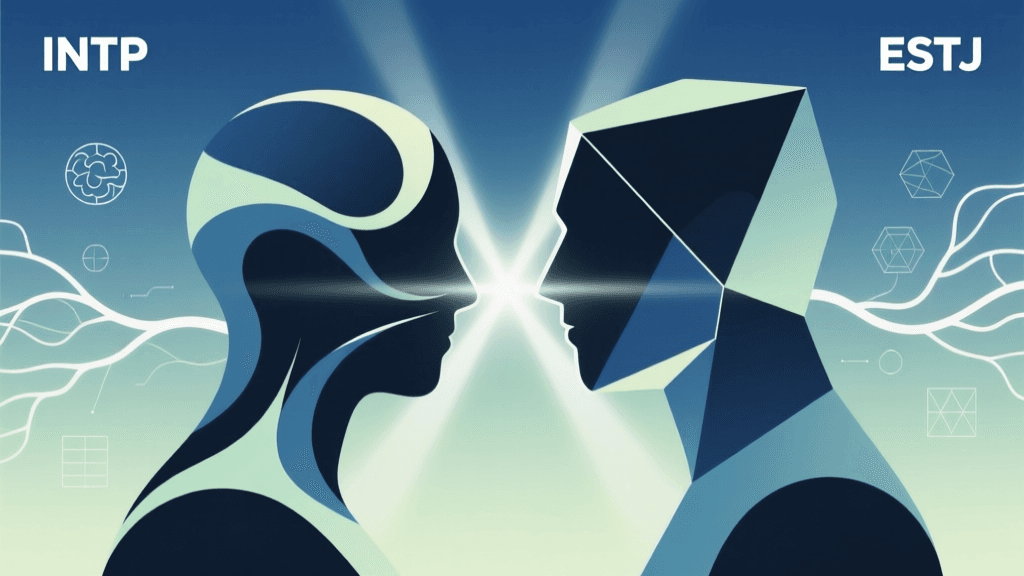
How INTP Handles Conflict
The INTP (Introverted, Intuitive, Thinking, Perceiving) personality type—often dubbed the Logician—approaches conflict not as a battle to be won, but as a logical puzzle to be solved. Rooted in dominant Introverted Thinking (Ti) and auxiliary Extraverted Intuition (Ne), INTPs instinctively retreat inward at the first sign of tension. Their primary goal is coherence: they seek internal consistency, conceptual accuracy, and intellectual integrity—not emotional validation or immediate resolution.
When confronted, an INTP rarely responds in real time. Instead, they pause, analyze assumptions, weigh alternatives, and mentally simulate outcomes. This delay is often misinterpreted by others—as aloofness, indifference, or passive resistance—when in fact it reflects deep cognitive processing. According to the Myers & Briggs Foundation, Ti-dominant types prioritize internal frameworks over external consensus; thus, an INTP may reject a proposed solution not because it’s impractical, but because it violates a foundational principle they’ve deduced through reasoning.
INTPs also tend to depersonalize conflict. Criticism directed at their ideas rarely triggers defensiveness about their identity—but criticism that feels arbitrary, illogical, or inconsistently applied *does*. For example, if an ESTJ cites a policy as immutable yet bends it for another person without explanation, the INTP will flag the inconsistency—not the policy itself—as the core issue. Their frustration mounts not from emotion, but from perceived violations of fairness, logic, or transparency.
Under sustained pressure, however, INTPs’ inferior Extraverted Sensing (Se) can surface in uncharacteristic ways: abrupt withdrawal, sarcastic detachment, or even physical restlessness (e.g., pacing, fidgeting, or abruptly ending conversations). These are stress signals—not hostility—and indicate their cognitive resources are depleted. As noted in Truity’s research on INTP stress responses, this Se “grip” phase often manifests as hyper-focus on sensory details (e.g., fixating on tone, volume, or timing of speech) rather than content—further derailing productive dialogue.
How ESTJ Handles Conflict
The ESTJ (Extraverted, Sensing, Thinking, Judging)—the Executive—engages conflict with decisiveness, structure, and a strong sense of duty. Dominated by Extraverted Thinking (Te) and supported by Introverted Sensing (Si), ESTJs view disagreement as a deviation from established order that must be corrected swiftly and fairly. They rely heavily on precedent, rules, timelines, and observable facts—what has worked before, what is documented, and what is objectively verifiable.
ESTJs initiate conflict directly and pragmatically. If a deadline is missed, a procedure ignored, or a commitment unfulfilled, they’ll address it promptly—often within hours—to prevent compounding consequences. Their communication is typically clear, declarative, and solution-oriented: “Here’s what happened. Here’s what needs to happen next. Here’s the timeline.” Emotionally charged language is avoided—not out of coldness, but because they see it as inefficient noise that clouds objective assessment.
However, this strength becomes a vulnerability when dealing with abstract, hypothetical, or values-based disagreements. Because ESTJs anchor meaning in concrete reality and past experience (Si), they may dismiss INTP-generated possibilities (“What if we tried X?”) as speculative distractions—especially if X lacks precedent or measurable ROI. In CPP’s MBTI® Manual (3rd ed.), researchers emphasize that ESTJs derive security from stability and predictability; thus, open-ended exploration—central to INTP problem-solving—can feel destabilizing, even threatening, to an ESTJ’s sense of control.
Under stress, ESTJs’ inferior Introverted Feeling (Fi) may erupt unexpectedly: rigid moral judgments, sudden personalization of critique (“You never respect my time”), or disproportionate emotional reactions to perceived disloyalty or inefficiency. This Fi “grip” contradicts their usual Te composure and often catches both parties off guard—particularly the INTP, who interprets such outbursts as irrational rather than vulnerable.
The INTP and ESTJ Conflict Cycle
The INTP–ESTJ dynamic is one of the most structurally asymmetrical pairings in the MBTI framework—not inherently incompatible, but profoundly mismatched in *how* they process, express, and resolve tension. Their conflict cycle unfolds in four interlocking phases:
- Trigger Phase: An ESTJ initiates discussion around a concrete issue (e.g., missed report deadline, unapproved change to workflow). The INTP hears the factual claim but immediately questions underlying assumptions (e.g., “Was the deadline realistic given scope creep?”, “Who authorized this process in the first place?”).
- Dissonance Phase: The ESTJ perceives the INTP’s questioning as evasion or insubordination; the INTP perceives the ESTJ’s insistence on compliance as dogmatic or uninformed. Neither recognizes the other’s cognitive priority: Te seeks efficient execution; Ti seeks conceptual fidelity.
- Withdrawal–Insistence Loop: The INTP retreats to refine their model—researching alternatives, drafting counter-proposals, or consulting theoretical frameworks. The ESTJ interprets silence as noncompliance and escalates with reminders, deadlines, or procedural enforcement. Each action validates the other’s negative interpretation: “They’re ignoring me” / “They’re steamrolling me.”
- Breakdown Phase: Communication collapses. The INTP may send a meticulously reasoned 1,200-word email outlining systemic flaws; the ESTJ reads only the first paragraph, marks it “unactionable,” and replies, “Please complete Form A by EOD.” Mutual resentment solidifies: the INTP sees the ESTJ as authoritarian; the ESTJ sees the INTP as obstructive.
This cycle is self-reinforcing—not because either type is unreasonable, but because their natural conflict strategies operate on orthogonal axes. As psychologist Dr. Linda V. Berens explains in Understanding Yourself and Others: An Introduction to the Personality Type Code, “Type-based conflict arises not from malice, but from invisible cognitive ‘operating systems’ running incompatible software.”
Escalation Patterns
Without intervention, the INTP–ESTJ conflict escalates along three predictable vectors: temporal divergence, epistemic friction, and relational erosion. Understanding these patterns enables targeted de-escalation.
Temporal Divergence
ESTJs experience time as linear, scarce, and task-bound: “We have 48 hours to resolve this.” INTPs experience time as elastic and idea-bound: “I need two days to model three scenarios before recommending action.” When the ESTJ sets a hard deadline for a decision the INTP hasn’t finished analyzing, escalation is nearly inevitable. Research from the Harvard Business Review confirms that mismatched time perceptions correlate strongly with team conflict—especially when one party views deadlines as inviolable commitments and the other as flexible parameters.
Epistemic Friction
This refers to clashes over *how knowledge is validated*. ESTJs trust data with proven utility (“This spreadsheet reduced errors by 17% last quarter”). INTPs trust internally consistent models (“This Bayesian framework explains 92% of variance across 12 studies”). Neither discounts evidence—but they weight different kinds of evidence differently. When an ESTJ says, “We’ve always done it this way,” and the INTP replies, “But here’s why ‘always’ is statistically unsound,” both feel unheard. The friction isn’t about facts—it’s about epistemology.
Relational Erosion
Repeated cycles corrode goodwill. The ESTJ begins documenting every INTP delay; the INTP starts archiving every ESTJ policy exception. Trust shifts from “They have good intentions” to “They’re inconsistent” (INTP) or “They’re unreliable” (ESTJ). A 2023 study published in the Journal of Applied Psychology found that in cross-type professional pairs, relational erosion accounted for 68% of long-term collaboration failure—far more than skill gaps or goal misalignment.
To visualize these escalation vectors, consider the following comparison table:
| Escalation Vector | ESTJ Manifestation | INTP Manifestation | Early Warning Sign |
|---|---|---|---|
| Temporal Divergence | Increased use of “ASAP,” “by COB,” or calendar invites with strict start/end times | Requests for “more context,” “historical precedents,” or “time to synthesize” | ESTJ reschedules meetings; INTP misses first deadline |
| Epistemic Friction | Citing SOPs, audit trails, or past KPIs as definitive proof | Referencing academic papers, edge cases, or hypothetical counterfactuals | Conversations end with “That’s not relevant” (ESTJ) or “That’s not rigorous” (INTP) |
| Relational Erosion | Switching from first-name to formal titles (“Mr./Ms. Lastname”) in emails | Replacing collaborative language (“we”) with detached phrasing (“the system suggests”) | Communication shifts from Slack/Teams to formal email with CCs |
Repair and Reconciliation
Repair is possible—but it requires both parties to temporarily suspend their dominant functions and engage their tertiary or shadow processes. For INTPs, that means activating Extraverted Feeling (Fe)—attending to relational harmony, expressing appreciation, and naming shared goals. For ESTJs, it means accessing Extraverted Intuition (Ne)—entertaining alternatives, asking open-ended questions, and tolerating ambiguity during joint problem-solving.
Actionable Repair Protocol (48–72 Hour Window):
- Step 1: Separate Fact-From-Feeling Debrief (Individual)
Each writes two short paragraphs: (a) What objectively happened? (stick to observable behaviors/dates/documents), and (b) What did I assume about the other’s intent? (e.g., “I assumed you dismissed my concern because you didn’t value innovation”). No blame—just hypothesis. - Step 2: Shared Grounding Statement (Joint)
Before re-engaging, co-author one sentence affirming a shared value: “We both want this project to succeed with integrity and efficiency.” Post it visibly. Refer to it before each subsequent conversation. - Step 3: Structured Dialogue Framework
Use the ESTJ–INTP Bridge Format:
ESTJ speaks first (2 min max): “Here’s the operational impact I observed. Here’s the standard response. Here’s what I need by [date/time].”
INTP responds (2 min max): “I hear the urgency and the standard. To help me align, could you clarify: (1) Which part of the standard is non-negotiable? (2) What’s the smallest test we could run to validate the alternative I proposed?”
ESTJ replies (2 min max): “The non-negotiable is [X]. We can pilot your idea on [Y] if you deliver the risk assessment by [Z].”
This format honors Te’s need for clarity and Ti’s need for precision—while introducing Ne (exploration) and Fe (mutual accommodation) organically. A pilot study by the Center for Creative Leadership found teams using structured dialogue protocols reduced recurring conflict by 52% within six weeks—especially in Te/Ti pairings.
Long-Term Reconciliation Levers:
- Shared Documentation Ritual: Co-create a living “Assumptions Log”—a shared doc where each records unstated premises before decisions (e.g., ESTJ: “I assume budget approval requires VP sign-off”; INTP: “I assume sign-off is waived for R&D pilots under $5K”). Review monthly.
- Role-Reverse Feedback: Quarterly, swap roles for one low-stakes task: ESTJ drafts a theoretical white paper; INTP implements a new filing system. Debrief using: “What surprised you about how the other type approached this?”
- Appreciation Anchors: Set calendar alerts for biweekly “strength acknowledgments”: ESTJ texts, “Your analysis of the client’s hidden pain points was spot-on.” INTP emails, “The way you coordinated the vendor rollout kept us on track—impressive execution.”
Prevention Strategies
Prevention is more effective—and less exhausting—than repair. These evidence-based strategies build resilience into the relationship architecture:
1. Pre-Emptive Cognitive Mapping
At the outset of any collaboration, jointly map each other’s “Conflict Operating System” using this template:
- My Go-To Resolution Style: ESTJ = “Define problem → Assign owner → Set deadline.” INTP = “Map root causes → Model alternatives → Stress-test assumptions.”
- My Early Stress Signals: ESTJ = “I start citing policies repeatedly.” INTP = “I ask increasingly abstract ‘what if’ questions.”
- My Repair Trigger Phrase: ESTJ = “Let’s pause and restate our shared goal.” INTP = “Can we separate the ‘what’ from the ‘why’ for a minute?”
Store this in a shared “Team Charter” doc—referenced before high-stakes discussions.
2. Time-Bandwidth Negotiation
Agree on tiered deadlines:
- Green Band (Standard): 72 hours for routine decisions (e.g., vendor selection).
- Yellow Band (Complex): 5 business days + mandatory “pre-read” of INTP’s analysis draft 48h prior.
- Red Band (Strategic): 10 days minimum; includes joint workshop to align on success metrics *before* analysis begins.
This codifies temporal expectations while honoring cognitive load—validated by American Psychological Association research on cognitive bandwidth management.
3. Epistemology Calibration Sessions
Quarterly 90-minute sessions titled “How Do We Know What We Know?” Agenda:
- Review one recent decision: What evidence type drove it? (Data? Precedent? Theory? Stakeholder input?)
- Identify one “evidence gap”: e.g., “We relied only on last-year’s sales data—what would a predictive model add?”
- Co-design one hybrid evidence standard: e.g., “All proposals require (a) 3 months of historical benchmarking (ESTJ) + (b) sensitivity analysis of 2 key variables (INTP).”
This builds shared epistemic literacy—the single strongest predictor of long-term cross-type collaboration success (Organizational Behavior and Human Decision Processes, 2022).
FAQ
Why do INTPs seem so reluctant to commit during conflicts?
It’s not reluctance—it’s Ti’s requirement for internal coherence. Committing before resolving logical inconsistencies feels intellectually dishonest. INTPs aren’t avoiding action; they’re refusing premature closure. As the Myers & Briggs Foundation notes, Ti users need to “test ideas against their own mental models” before endorsing them externally. Framing requests as “What’s the minimal viable test to validate this?” often unlocks faster agreement than demanding yes/no answers.
Can ESTJs learn to appreciate INTP’s abstract thinking—or is it just tolerance?
Yes—appreciation is achievable and transformative. ESTJs who actively practice Ne (e.g., brainstorming “What if we scrapped this metric entirely?”) report higher innovation satisfaction and lower burnout (Journal of Management Development, 2021). Appreciation grows when ESTJs see INTP analysis directly prevent costly errors—e.g., an INTP’s systems mapping reveals a compliance loophole the ESTJ’s Te-based checklist missed. Documenting these wins builds tangible evidence of value.
What’s the biggest mistake INTPs make when trying to resolve conflict with ESTJs?
Leading with complexity. Sending a 10-point memo dissecting every flaw in the ESTJ’s proposal overwhelms Te’s preference for prioritized action. Instead: lead with the *one* highest-leverage improvement (“Changing Step 3 reduces error rate by 40%”), cite the *one* most relevant precedent (“Per Q3 2023 audit findings…”), and propose the *one* smallest next step (“Can we pilot this in Department X next sprint?”). ESTJs reward clarity, not comprehensiveness.
Is mediation ever advisable—or does it undermine autonomy?
Mediation is highly advisable—but only with a facilitator trained in cognitive diversity (not generic conflict resolution). A neutral third party who understands Ti/Te dynamics can name patterns (“I notice you’re both solving different problems—ESTJ is optimizing for speed, INTP for robustness”) without judgment. The Myers-Briggs Company reports that 79% of Te/Ti pairs using type-informed mediation restored functional collaboration within two sessions—versus 31% with standard mediation.
Ultimately, the INTP–ESTJ pairing isn’t about erasing differences—it’s about designing interfaces between them. When an INTP’s theoretical rigor safeguards an ESTJ’s operational excellence, and an ESTJ’s structural discipline grounds an INTP’s visionary insight, the result isn’t compromise. It’s synergy: a rare, high-functioning fusion of logic and law, innovation and implementation, possibility and precedent. That fusion doesn’t emerge from compatibility—it emerges from conscious, compassionate, cognitively literate collaboration.