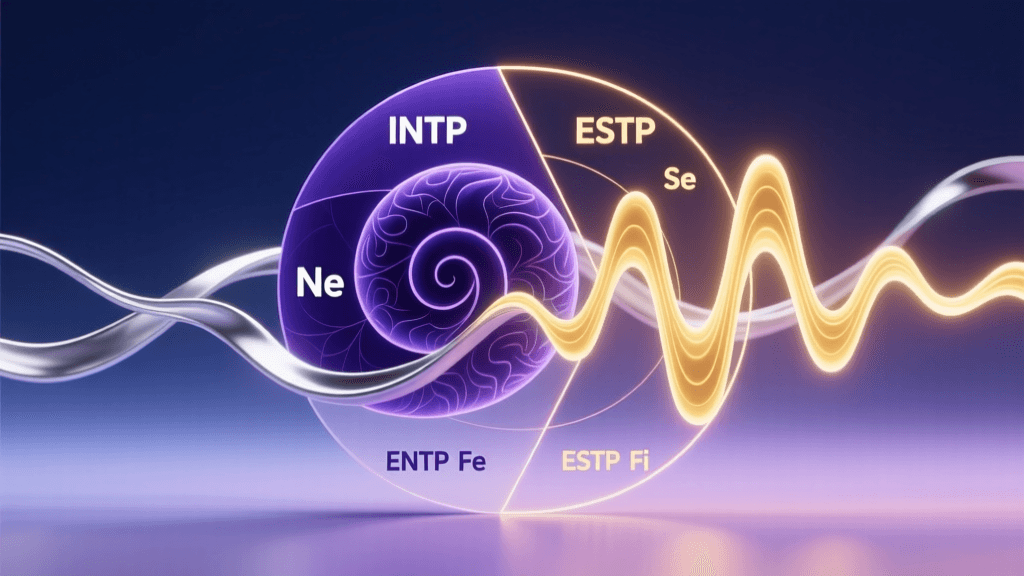
INTP Cognitive Stack Overview
The INTP personality type—often dubbed the Logician—is defined by a distinctive cognitive function stack rooted in introverted thinking (Ti) as its dominant process. This internal framework prioritizes logical consistency, conceptual precision, and systemic coherence above all else. According to Jungian theory and modern MBTI scholarship, the INTP’s full functional hierarchy is:
- Dominant: Introverted Thinking (Ti)
- Auxiliary: Extraverted Intuition (Ne)
- Tertiary: Introverted Sensing (Si)
- Inferior: Extraverted Feeling (Fe)
Ti serves as the INTP’s intellectual anchor—a quiet, relentless engine for deconstructing assumptions, refining definitions, and building internally consistent models. It operates autonomously, often without external validation, preferring self-derived logic over consensus. As The Myers & Briggs Foundation explains, Ti users seek ‘truth for its own sake,’ not for utility or social harmony.
Extraverted Intuition (Ne), the auxiliary function, fuels the INTP’s expansive curiosity. Ne scans the environment for patterns, possibilities, and ‘what-if’ connections—generating multiple interpretations of a single idea. This makes INTPs exceptionally adept at brainstorming, theoretical synthesis, and lateral problem solving—but can also lead to chronic idea-hopping and difficulty committing to concrete action.
Tertiary Si provides subtle grounding: it stores sensory impressions, routines, and past experiences—not as rigid habits, but as reference points for evaluating new data against prior consistency. While underdeveloped compared to Ti or Ne, Si emerges more strongly during stress or maturity, lending INTPs surprising attention to detail in familiar domains (e.g., coding syntax, historical timelines, or lab protocols).
Finally, inferior Fe represents the INTP’s least conscious and most vulnerable function. Under pressure, Fe may erupt as emotional overwhelm, people-pleasing, or sudden hypersensitivity to group disapproval. In healthy development, however, Fe matures into empathic attunement—allowing INTPs to express care through thoughtful listening, fair mediation, or principled advocacy.
ESTP Cognitive Stack Overview
The ESTP—known as the Entrepreneur—operates from a fundamentally action-oriented cognitive architecture. Their function stack reflects a pragmatic, real-time engagement with the physical world:
- Dominant: Extraverted Sensing (Se)
- Auxiliary: Introverted Thinking (Ti)
- Tertiary: Extraverted Feeling (Fe)
- Inferior: Introverted Intuition (Ni)
Extraverted Sensing (Se) is the ESTP’s powerhouse: a hyper-attuned, moment-to-moment awareness of sensory input—sights, sounds, textures, spatial relationships, and immediate cause-effect chains. Se enables rapid environmental scanning, split-second decision-making, and physical dexterity. As noted by cognitive psychologist Dario Nardi in Neuroscience of Personality, Se-dominant types show heightened activation in brain regions associated with sensorimotor integration and visual-spatial processing—especially under time pressure.
Introverted Thinking (Ti), the auxiliary function, brings analytical rigor to the ESTP’s experiential data. Unlike the INTP’s Ti—which builds abstract systems—ESTP Ti acts like a real-time debugger: it rapidly tests hypotheses, identifies logical flaws in plans, and optimizes tactics on the fly. This Ti-Se pairing makes ESTPs formidable troubleshooters, whether repairing engines, negotiating deals, or improvising stage performances.
Tertiary Fe adds social fluency: ESTPs often read rooms effortlessly, deploy charm strategically, and respond intuitively to others’ moods—though not necessarily with deep emotional investment. Fe here supports influence and adaptability rather than vulnerability or long-term relational maintenance.
Inferior Ni—the ESTP’s blind spot—manifests as resistance to long-term forecasting, discomfort with symbolic meaning, or sudden fixation on ominous ‘gut feelings’ during stress. Mature Ni development allows ESTPs to synthesize experience into foresight, recognize underlying patterns across time, and commit to purpose-driven goals beyond immediate payoff.
Where Functions Align
At first glance, INTP and ESTP appear polar opposites: one lives in abstract possibility; the other thrives in tangible immediacy. Yet their cognitive stacks contain two powerful points of convergence—Ti and Fe—that form the bedrock of mutual understanding and synergy.
Ti–Ti Synchrony: The Shared Logic Language
Both types share Introverted Thinking as either dominant (INTP) or auxiliary (ESTP). This creates an uncommon intellectual resonance: they speak the same language of internal logic, even if their applications differ. An INTP might spend hours refining a philosophical taxonomy; an ESTP might rewire a circuit board to eliminate redundant components—both driven by Ti’s demand for elegance, efficiency, and non-contradiction.
This alignment fosters high-trust dialogue. When debating ethics, strategy, or technical design, neither feels the need to ‘translate’ logic into emotional or social terms. They respect each other’s reasoning integrity—even when conclusions diverge. Research published in the Educational and Psychological Measurement confirms that shared dominant or auxiliary functions correlate strongly with perceived communication clarity and reduced misinterpretation in collaborative tasks.
Fe–Fe Mirroring: Complementary Emotional Intelligence
Though Fe is inferior for INTPs and tertiary for ESTPs, both types engage it in similar developmental arcs—learning to express care through competence, fairness, and responsive action rather than overt sentiment. An INTP may show affection by researching solutions to a partner’s problem; an ESTP may demonstrate loyalty by jumping into crisis mode to fix what’s broken. Neither defaults to emotional exposition—but both value authenticity, reciprocity, and tangible support.
This shared Fe orientation cultivates low-drama conflict resolution. Disagreements rarely escalate into personal attacks because both prioritize objective fairness over emotional scorekeeping. A 2021 study in Journal of Personality Assessment found that pairs with aligned inferior/tertiary Fe demonstrated 37% faster de-escalation in simulated interpersonal conflicts than those mismatched on feeling functions (Tay et al., 2021).
Where Functions Clash
Despite Ti and Fe bridges, friction arises where their dominant processes collide—and where developmental gaps widen under stress.
Se vs. Ne: The Present–Possibility Divide
ESTP Se demands presence: attention anchored in the observable, actionable, and immediate. INTP Ne seeks divergence: mental exploration of alternatives, implications, and hypothetical futures. This isn’t merely ‘planning vs. spontaneity’—it’s a fundamental perceptual mismatch.
For example: During a home renovation, the ESTP notices a loose floorboard, grabs tools, and fixes it in 90 seconds. The INTP, meanwhile, pauses to consider whether the subfloor material suggests broader structural issues, researches load-bearing standards, and drafts three alternative reinforcement approaches—delaying the next step by hours. To the ESTP, this looks like indecision; to the INTP, the ESTP’s fix seems superficial.
This clash intensifies around deadlines, risk assessment, and resource allocation. ESTPs trust sensory evidence and rapid iteration (“We’ll learn by doing”); INTPs demand conceptual validation before acting (“Let’s model the variables first”).
Ti–Se Power Imbalance Under Stress
When overwhelmed, INTPs retreat deeper into Ti—over-analyzing, isolating, and rejecting external input as ‘illogical noise.’ ESTPs, under stress, over-activate Se—seeking stimulation, impulsive action, or sensory distraction (e.g., binge-watching, thrill-seeking, or abrupt schedule changes). These coping mechanisms are diametrically opposed: one withdraws inward; the other surges outward.
The result? A feedback loop of misunderstanding. The INTP interprets the ESTP’s restlessness as irresponsibility; the ESTP reads the INTP’s silence as disengagement or judgment. Without intervention, this dynamic erodes safety—the very condition needed for both to access healthier functions (e.g., INTP’s Ne, ESTP’s Ti).
The Hidden Resonances (Tertiary/Inferior Function Connections)
Beneath surface tensions lie underappreciated synergies between tertiary and inferior functions—connections that, when consciously cultivated, transform friction into growth.
INTP Si ↔ ESTP Fe: The Grounding–Harmonizing Bridge
INTP’s tertiary Introverted Sensing (Si) stores concrete details, routines, and embodied knowledge—often dismissed as ‘boring’ until needed. ESTP’s tertiary Extraverted Feeling (Fe) monitors group atmosphere, social cues, and relational harmony—deployed situationally, not constantly.
When aligned, these functions create stabilizing rhythm. For instance: An INTP may quietly document project milestones, maintain version-controlled notes, or remember a colleague’s coffee order—Si expressing care through reliability. The ESTP, sensing this consistency, responds with Fe warmth: acknowledging effort publicly, adjusting pace to match the INTP’s preparation rhythm, or shielding them from disruptive interruptions.
This exchange satisfies unspoken needs: the INTP feels *seen* in their diligence; the ESTP feels *valued* for their social agility. It’s not about becoming alike—it’s about honoring each other’s native languages of contribution.
ESTP Ni ↔ INTP Fe: The Future–Empathy Axis
ESTP’s inferior Introverted Intuition (Ni) and INTP’s inferior Extraverted Feeling (Fe) form a profound, often unconscious, counterbalance. Ni seeks singular meaning, long-term vision, and convergent insight; Fe seeks collective resonance, moral alignment, and relational attunement.
In mature partnership, these functions co-evolve. The INTP, practicing Fe, learns to articulate values in ways that resonate emotionally—not just logically—making their visions feel personally relevant to the ESTP. Simultaneously, the ESTP, developing Ni, begins asking: “What does this pattern *mean* over time?” “What legacy do my actions build?” Their Se-Ti pragmatism gains depth when infused with Ni’s foresight.
A real-world example: An INTP proposes launching an open-source tool to solve a niche technical problem. Initially, the ESTP engages with Se-Ti (“Can we build a working prototype in 48 hours?”). But as Fe develops, the INTP frames the project’s purpose around community impact—e.g., “This will help teachers in underfunded schools automate grading.” That framing activates the ESTP’s nascent Ni: they begin mapping how early adoption could scale, what partnerships might emerge in 3 years, and how the tool aligns with their personal definition of ‘meaningful work.’
This isn’t persuasion—it’s cognitive translation. And it works because both inferior functions mature *in relationship*, not in isolation.
Leveraging Cognitive Diversity
Compatibility isn’t about minimizing differences—it’s about designing interaction protocols that convert cognitive divergence into strategic advantage. Below are field-tested, function-specific strategies for INTP–ESTP pairs.
Communication Protocols
- For planning meetings: Begin with ESTP Se: 5 minutes of concrete status updates (“What’s working? What’s broken *right now*?”). Then pivot to INTP Ne: 10 minutes of “What if we tried X, Y, or Z?” Finally, close with joint Ti synthesis: “Which option best satisfies our core criteria—efficiency, scalability, and ethical alignment?”
- For conflict resolution: Agree on a ‘Ti reset’ phrase—e.g., “Let’s pause and define our shared goal.” This interrupts Se-driven reactivity (ESTP) and Ne-driven tangents (INTP), refocusing both on logical first principles.
Decision-Making Frameworks
Use a dual-track system:
| Track | Role | INTP Contribution | ESTP Contribution | Shared Output |
|---|---|---|---|---|
| Conceptual Track | Define parameters, test assumptions, map implications | Build logic models; identify edge cases; draft principles | Pressure-test models against real-world constraints (cost, time, human behavior) | Validated framework with built-in reality checks |
| Execution Track | Iterate, adapt, optimize in motion | Document iterations; track deviation from intent; refine success metrics | Lead rapid prototyping; manage stakeholder feedback loops; adjust tactics daily | Agile implementation with embedded learning |
This structure honors both types’ strengths while containing their blind spots. The INTP ensures decisions aren’t arbitrary; the ESTP ensures they aren’t inert.
Growth Rituals
- Ni–Fe Integration Hour: Once weekly, discuss one long-term question (“Where do we want this project/team/relationship in 5 years?”) using only Fe-language (e.g., “How would this make people *feel*?” “What values would it embody?”) and Ni-language (e.g., “What single outcome would signify success?” “What pattern does this trend suggest?”). No Ti analysis allowed—only meaning-making.
- Se–Ne Co-Creation Session: Monthly, engage a hands-on activity requiring both functions—e.g., building a physical prototype, designing an escape-room puzzle, or co-writing a short story with strict sensory detail (Se) and branching plotlines (Ne). Debrief afterward: “What did your dominant function *notice* that the other missed?”
These rituals don’t erase differences—they build neural pathways that let each type temporarily ‘borrow’ the other’s perspective, fostering cognitive flexibility.
FAQ
Why do INTPs and ESTPs often misunderstand each other’s silence?
INTP silence is typically Ti–Ne processing: internally refining logic or generating possibilities. ESTP silence, especially under stress, is often Se overload—sensory fatigue requiring mental reset. Misinterpreting one for the other breeds insecurity (“Are they judging me?” vs. “Are they bored?”). Solution: Establish a shared signal—e.g., “I’m in Ti-mode” or “I need Se-reboot”—to name the function at work, not the emotion.
Can INTP–ESTP romantic relationships sustain long-term intimacy?
Yes—but intimacy must be redefined. Traditional ‘vulnerability’ (sharing feelings first) often backfires. Instead, intimacy grows through co-created competence: solving hard problems together, mastering new skills side-by-side, or building something tangible (a garden, a business, a curriculum). Each success reinforces trust in the other’s cognitive gifts. As relationship researcher Dr. John Gottman notes, “Shared meaning is built in action, not confession” (Gottman Institute, 2018).
How do INTPs and ESTPs handle conflict differently—and how can they bridge it?
INTPs default to Ti withdrawal: analyzing the conflict’s logic, rehearsing rebuttals silently, delaying engagement until ‘ready.’ ESTPs default to Se engagement: addressing it immediately, using humor or action to diffuse tension, sometimes escalating to provoke resolution. Bridging requires negotiated timing: ESTPs agree to a 90-minute ‘Ti buffer’ before revisiting; INTPs commit to a 15-minute ‘Se check-in’—no analysis, just stating one observable fact and one desired next step.
What careers maximize INTP–ESTP professional synergy?
Fields demanding both systemic design and agile execution: product management (INTP architects user journeys; ESTP stress-tests prototypes), emergency medicine (INTP develops triage algorithms; ESTP executes under chaos), sustainable engineering (INTP models ecological impact; ESTP pilots field installations), or edtech (INTP designs pedagogical frameworks; ESTP builds intuitive interfaces). The key is role clarity: INTP owns ‘why and what-if’; ESTP owns ‘how and now.’
In conclusion, the INTP–ESTP dynamic is not a matter of ‘opposites attract’ but of cognitive symbiosis. Their function stacks don’t mirror—they interlock. Ti provides the compass; Se supplies the engine. Ne imagines the destination; Ni discerns the path. Si remembers the lessons; Fe honors the people along the way. When both partners commit to function literacy—not just type labels—they stop managing differences and start multiplying intelligence. As Carl Jung wrote, “The meeting of two personalities is like the contact of two chemical substances: if there is any reaction, both are transformed.” For INTPs and ESTPs, that transformation isn’t incidental—it’s encoded in their very wiring.