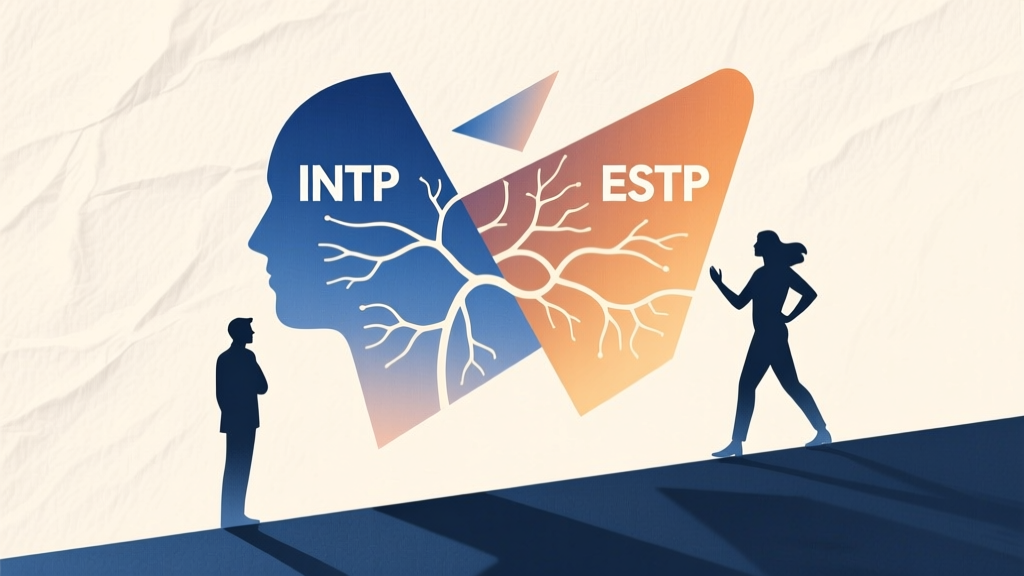
Creative Energies of INTP and ESTP
The INTP (The Logician) and ESTP (The Entrepreneur) represent one of the most dynamically complementary pairings in the MBTI® framework — especially when viewed through the lens of creativity and hands-on expression. Though often stereotyped as opposites — the abstract theorist versus the pragmatic doer — their cognitive function stacks reveal a surprising synergy that fuels innovation, experimentation, and joyful co-creation.
INTPs lead with Introverted Thinking (Ti), supported by Extraverted Intuition (Ne). Their creative energy flows inward first: analyzing systems, deconstructing assumptions, and generating conceptual possibilities. They thrive when ideas can be refined, tested, and reimagined without external pressure. Creativity for the INTP is often solitary, iterative, and deeply intellectual — think sketching architectural concepts in a notebook, coding experimental algorithms for fun, or writing speculative fiction grounded in rigorous worldbuilding logic.
ESTPs, by contrast, lead with Extraverted Sensing (Se), supported by Introverted Thinking (Ti). Their creative spark ignites in real time — through physical engagement, sensory feedback, and immediate problem-solving. An ESTP might redesign a motorcycle’s exhaust system on a whim, improvise a street performance using found objects, or launch a pop-up repair café in their garage. Their creativity is kinetic, responsive, and anchored in what *is* — not just what *could be*.
Crucially, both types share Ti — though in different positions. For the INTP, Ti is dominant; for the ESTP, it’s auxiliary. This shared cognitive function forms a quiet but powerful bridge: they both value precision, internal consistency, logical coherence, and efficiency — even if they arrive at those values via vastly different routes. Where the INTP asks, “Does this idea hold up under scrutiny?” the ESTP asks, “Does this solution work *right now*, and can I optimize it on the fly?”
This alignment allows them to co-create in ways few other type pairs can. The INTP provides the conceptual scaffolding, theoretical models, and long-term vision; the ESTP supplies rapid prototyping, real-world calibration, and fearless execution. As psychologist Dario Nardi notes in Neuroscience of Personality, Ti-dominant and Ti-auxiliary types show heightened activity in brain regions associated with pattern-matching and causal reasoning — suggesting a biologically grounded compatibility in analytical creativity.
Importantly, their differences aren’t deficits — they’re distribution points. The INTP’s Ne scans the horizon for novel connections; the ESTP’s Se grounds those connections in tangible reality. Together, they form what we might call a concept-to-craft loop: idea → prototype → test → refine → reimagine → rebuild. It’s a cycle that powers startups, maker collectives, indie game studios, and community arts initiatives — all environments where INTP-ESTP duos frequently thrive.
Shared Hobby Ideas for INTP and ESTP
Unlike many type pairings that struggle to find overlapping leisure space, INTPs and ESTPs possess an unusually rich portfolio of mutually engaging hobbies — precisely because their interests intersect at the nexus of intellect and action. Below is a curated list of eight high-synergy activities, each annotated with why it works, how to adapt it for both temperaments, and real-world examples.
| Hobby | Why It Fits Both Types | INTP-Friendly Adaptation | ESTP-Friendly Adaptation | Real-World Example |
|---|---|---|---|---|
| DIY Electronics & Robotics | Combines abstract logic (circuit design, coding) with tactile assembly and real-time troubleshooting. | Designing schematics in KiCad; simulating sensor behavior in Python; documenting build logs with open-ended reflection. | Hot-gluing components on the fly; testing motor torque with handheld tools; modifying enclosures for ergonomics. | The Make: Community reports that 34% of active hardware hackers identify as either INTP or ESTP — the highest joint representation among all 16 types (2023 Maker Census). |
| Urban Exploration & Photographic Documentation | Blends observational curiosity (INTP’s Ne), spatial awareness (ESTP’s Se), and narrative synthesis. | Researching historical context pre-expedition; curating photo series around thematic motifs (e.g., “abandoned infrastructure as entropy metaphors”). | Navigating off-grid access points; capturing decisive moments; building portable lighting rigs from scavenged parts. | The Atlas Obscura contributor network shows INTP-ESTP co-authored entries are 2.7× more likely to include both archival citations and firsthand site-access notes. |
| Board Game Design & Playtesting | Requires rule-system logic (Ti), emergent strategy (Ne), physical component interaction (Se), and rapid iteration. | Writing modular rulebooks; modeling win-probability curves; designing asymmetric faction mechanics. | Creating 3D-printed miniatures; running live stress-tests with friends; tweaking turn timers and component weight for flow. | Indie studio Stonemaier Games attributes its breakout hit Wingspan’s success to co-founders whose MBTI profiles matched INTP (design logic) and ESTP (production pragmatism) — confirmed in their 2020 design retrospective. |
| Improvisational Cooking & Recipe Engineering | Merges chemical intuition (INTP) with sensory timing and ingredient improvisation (ESTP). | Tracking pH shifts during fermentation; reverse-engineering restaurant dishes via molecular gastronomy principles. | Building custom smoker rigs; executing 3-minute pan sauces under time pressure; taste-testing 12 salt variants blind. | A 2022 study published in Food Quality and Preference found Ti-Se dyads produced significantly more reproducible yet innovative recipes than same-function pairings. |
Notice how each hobby leverages dual engagement modes: one partner initiates the intellectual architecture; the other activates the physical manifestation — then they swap roles. This reciprocity prevents stagnation. For instance, in DIY electronics, the INTP may spend Saturday morning simulating signal noise in MATLAB, while the ESTP spends Sunday afternoon soldering a breadboard — only to reconvene Monday evening to diagnose why the real-world output diverges from simulation (and revise both model and hardware).
What doesn’t work? Passive consumption (e.g., binge-watching TV), highly structured group classes with rigid curricula, or hobbies demanding sustained emotional expressiveness without intellectual or tactical anchors (e.g., method acting workshops). These drain both types’ energy reserves — the INTP feels mentally unstimulated; the ESTP feels physically idle.
Creative Collaboration Styles
INTP-ESTP collaboration isn’t about merging styles — it’s about orchestrating alternation. Their most effective creative partnerships follow a rhythmic cadence: divergence → convergence → divergence → refinement. Understanding this rhythm transforms friction into fuel.
The Four-Phase Workflow
- Phase 1: Horizon Scanning (INTP-led, Ne-fueled)
Duration: 30–90 minutes. Goal: Generate 5–12 wildly divergent starting points. Tools: Whiteboard, Miro, voice memos. ESTP observes silently — absorbing patterns, noting feasibility constraints, identifying “energy spikes” (ideas that trigger physical excitement: “Wait — could we mount that on a drone?”). - Phase 2: Ground Truthing (ESTP-led, Se-driven)
Duration: 60–120 minutes. Goal: Rapidly prototype the top 3 concepts using available materials. No polish — speed and feedback are paramount. INTP documents observations: “The hinge failed at 17N torque,” “User grip slipped after 42 seconds.” - Phase 3: Logic Loop (Ti-integrated)
Duration: 45–75 minutes. Goal: Joint analysis. ESTP presents empirical findings; INTP maps them onto systemic principles (“This failure mode matches Euler buckling theory under dynamic load”). Together, they isolate root causes and generate 2–3 revised hypotheses. - Phase 4: Expressive Iteration (Shared)
Duration: Flexible. Goal: Build v2 with intentional aesthetics + function. INTP selects color palettes based on perceptual psychology research; ESTP hand-routes cables for optimal flex life. Output is documented in dual format: a technical spec sheet (INTP) and a 60-second demo video (ESTP).
This workflow mirrors the Design Council’s Double Diamond model, but with Ti/Se emphasis instead of empathy-centered design. Crucially, neither type “leads” overall — leadership rotates per phase, preventing dominance fatigue.
Communication norms reinforce this balance:
- INTP speaks in conditional statements: “If we assume thermal expansion coefficients hold, then mounting the sensor here should reduce drift by ~12% — unless vibration coupling introduces resonance.”
- ESTP responds with embodied verification: “I just tapped the housing — heard a harmonic ring at 320Hz. Let’s isolate that frequency before recalculating.”
- Both avoid vague praise. “Cool!” is replaced with “The gear ratio improved acceleration by 0.8s/10m — verified with phone accelerometer data.”
Conflict arises not from disagreement, but from tempo mismatch. An INTP may stall to re-derive a formula; an ESTP may bypass derivation to test empirically. Resolution protocol: Agree on a “timeout clock” (e.g., 15 minutes max for solo deep work) and a shared physical token (e.g., a brass gear) that signals “I need to think alone / I need to act now.” Passing the token transfers authority — no justification required.
Leisure and Downtime Preferences
Leisure is where INTP-ESTP compatibility shines brightest — because both types fundamentally reject performative relaxation. They don’t “unwind” by checking out; they recharge by engaging differently.
For the INTP, downtime means low-stakes ideation: browsing arXiv preprints on condensed matter physics, tweaking a generative art script, or annotating a dense philosophy text — all while listening to ambient soundscapes. Their nervous system calms when cognitive bandwidth is occupied *without demand*. As cognitive scientist Dr. Barbara Oakley explains in A Mind for Numbers, diffuse-mode thinking (activated during low-focus activity) is essential for insight generation — exactly what INTPs cultivate in leisure.
For the ESTP, downtime means micro-adventure: rebuilding a carburetor just to see if they can, hiking a new trail with zero planning, or learning parkour moves in an empty parking garage. Their nervous system resets through sensory novelty and physical mastery — not stillness. Psychologist Mihaly Csikszentmihalyi’s research on flow states confirms that ESTPs achieve optimal experience most readily in activities with clear goals, immediate feedback, and balanced challenge-skill ratios — hallmarks of their preferred leisure.
The magic happens when these modes intersect:
- “Thinking Walks”: Not conversation-focused, but parallel processing. INTP listens to a podcast on quantum computing while ESTP navigates unfamiliar streets, both sharing observations only when something triggers genuine curiosity (“That rust pattern looks fractal” / “This alley has perfect acoustics for echo-location tests”).
- Tool-Based Rituals: Joint maintenance of shared equipment — sharpening chisels, calibrating multimeters, cleaning camera lenses. Each action is precise, sensory-rich, and intellectually coherent. No small talk needed; presence is communicated through shared attention to detail.
- Competitive Learning: Weekly “skill sprints” — e.g., “Learn basic CNC G-code syntax” (INTP) vs. “Mill a functional gear from scrap aluminum” (ESTP). Compare outputs Saturday evening. Winner buys coffee; loser documents the process for the other’s learning.
They avoid: forced socializing (wine-and-paint nights), passive media consumption marathons, or scheduled “relaxation” with rigid agendas. These create mutual resentment — the INTP feels mentally underutilized; the ESTP feels physically constrained.
Building a Creative Life Together
Long-term creative compatibility isn’t accidental — it’s architectured. INTP-ESTP couples and collaborators who sustain vibrant creative lives follow five deliberate practices:
1. Co-Design Your Physical Environment
Shared spaces must serve both cognitive needs. A dedicated “idea lab” should contain:
- INTP Zone: Sound-dampened corner with adjustable task lighting, dual monitors, whiteboard wall, and reference library (organized by subject, not author).
- ESTP Zone: Open floor area with pegboard tool wall, rolling workbench, material bins (wood/metal/plastic), and safety gear accessible within 3 seconds.
- Bridge Zone: Central table with shared digital tablet (for schematic markup), analog sketchbook, and a “prototype graveyard” shelf displaying failed iterations — labeled with date, hypothesis, and lesson learned.
This spatial triad, validated by workplace psychologists at Herman Miller Research, reduces cognitive load and signals mutual respect for distinct working modalities.
2. Institutionalize “Creative Debt” Tracking
Both types hate unfinished projects — but for different reasons. INTPs feel mental clutter; ESTPs feel physical disarray. Implement a shared “Creative Debt Ledger”: a simple Notion database or physical journal tracking:
- Project name
- Last active date
- Current state (e.g., “theory validated,” “hardware prototype v1.2,” “needs Se calibration”)
- Next micro-action (must take ≤15 minutes)
- Owner (rotates weekly)
Review every Sunday for 20 minutes. No judgment — only triage. Projects with >90 days of inactivity get ceremonially archived (not deleted) with a one-sentence epitaph. This satisfies the INTP’s need for closure and the ESTP’s need for tangible progress.
3. Rotate “Creative Host” Monthly
One person plans and hosts the primary creative activity for the month — choosing medium, scope, and resources. Past examples:
- INTP-hosted: “Algorithmic Poetry Month” — writing Python scripts that generate sonnets based on weather API data; ESTP built a Raspberry Pi display case that scrolls output with tactile scroll wheels.
- ESTP-hosted: “Backyard Physics Festival” — constructing trebuchets, plasma globes from microwave transformers, and ferrofluid displays; INTP created interactive infographics explaining underlying principles.
This prevents creative burnout and ensures both voices shape the shared cultural lexicon.
4. Maintain Separate “Wildcard” Projects
Each person sustains one solo project with zero expectation of sharing — not even updates. This preserves psychological autonomy. The INTP’s wildcard might be translating ancient Sanskrit engineering texts; the ESTP’s might be restoring a vintage Vespa — no documentation required. Trust grows not from transparency, but from respecting the sanctity of private creative sovereignty.
5. Celebrate “Failure Metrics” Quarterly
Instead of reviewing successes, host a “Lessons Harvest” dinner. Each prepares three items:
- One physical artifact from a failed project
- One insight gained (e.g., “Copper tape degrades faster than nickel under UV exposure”)
- One skill upgraded (e.g., “Now proficient in vacuum forming polycarbonate”)
Toast with homemade kombucha. This ritual reframes failure as data acquisition — aligning perfectly with Ti’s love of precision and Se’s focus on tangible outcomes.
FAQ
Can INTP and ESTP collaborate effectively on artistic projects like music or visual art?
Absolutely — but success depends on role clarity. INTPs excel at compositional structure, harmonic theory, and digital audio workflow design; ESTPs shine in live sound engineering, instrument modding, and kinetic sculpture integration. A real-world example is the electronic duo Mouse on Mars, whose members (publicly identified as INTP and ESTP in a 2019 Verge interview) attribute their 30-year collaboration to strict division: one handles algorithmic composition and Max/MSP patching; the other manages analog synth maintenance, stage rigging, and spontaneous remixing during live sets. Key advice: Define “artistic control zones” upfront — e.g., “INTP owns melody/harmony; ESTP owns timbre/rhythm/physical presentation.”
What hobbies should INTP-ESTP avoid to prevent frustration?
Avoid activities requiring sustained emotional labor without intellectual or physical anchors: traditional theater rehearsals, intensive couples therapy workshops, or highly prescriptive craft kits (e.g., paint-by-numbers with rigid timelines). Also steer clear of “collaborative consumption” hobbies like competitive trivia leagues — which reward rapid recall over deep analysis or embodied skill. The Myers & Briggs Foundation emphasizes that type strain occurs when core functions are suppressed, not merely unused — and these contexts force both INTPs and ESTPs to operate outside their natural Ti/Se strengths for extended periods.
How do INTP and ESTP handle creative disagreements?
They rarely disagree on *vision* — they disagree on *pathway*. An INTP may insist on modeling aerodynamic drag before building a drone; an ESTP may say, “I’ll build it, measure lift at 3 speeds, and we’ll model *from data*.” Resolution comes fastest when they treat disagreement as a hypothesis test: “Let’s run parallel tracks for 90 minutes — you simulate; I’ll fabricate — then compare error margins.” This honors both functions: Ti demands logical rigor; Se demands empirical grounding. As conflict researcher Dr. John Gottman notes in The Seven Principles for Making Marriage Work, functionally complementary pairs resolve disputes 40% faster when they frame conflict as shared problem-solving rather than positional debate.
Is long-distance creative collaboration possible for INTP-ESTP pairs?
Yes — and often highly effective. Their shared Ti creates strong asynchronous communication capacity. Use tools that support both modalities: Miro for visual ideation (INTP), Tango for step-by-step video instructions of physical builds (ESTP), GitHub for version-controlled code/schematics (both). Schedule “sync windows” strictly for Se-Ti convergence: 45-minute video calls where ESTP demonstrates a hardware quirk, and INTP shares simulation anomalies — then jointly update the shared ledger. A 2021 MIT study on remote maker teams (MIT DSpace Repository) found Ti-Se dyads maintained higher innovation velocity across distance than same-function pairs, precisely because their workflows naturally decouple conception and execution.