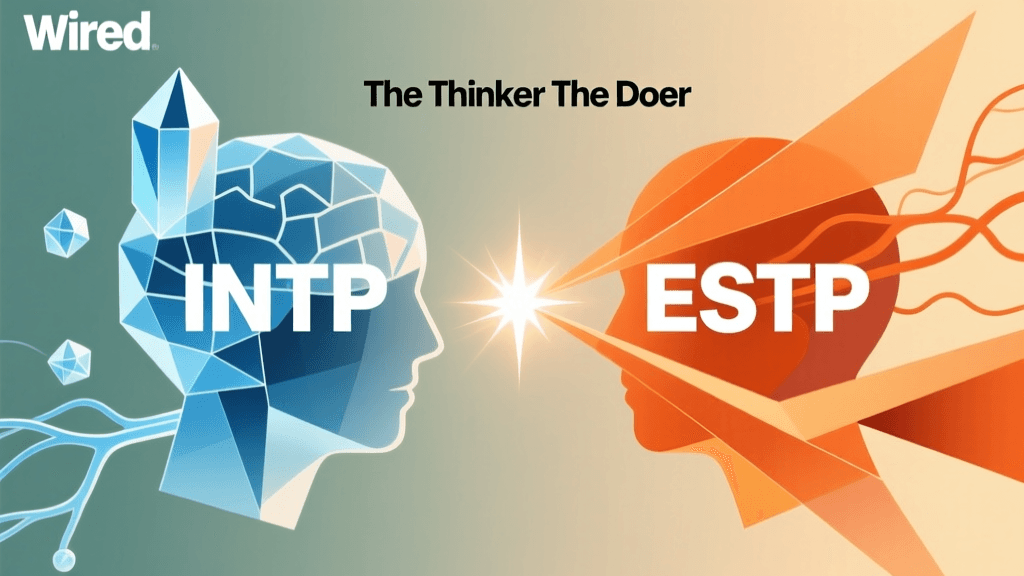
How INTP and ESTP Connect as Friends
The friendship between an INTP (The Logician) and an ESTP (The Entrepreneur) is one of the most unexpectedly harmonious yet intellectually electrifying pairings in the MBTI framework. At first glance, their differences seem stark: the INTP lives in a world of abstract theories, hypothetical models, and quiet contemplation, while the ESTP thrives on real-time action, sensory engagement, and spontaneous problem-solving. Yet precisely these contrasts—when understood and honored—create fertile ground for mutual fascination and growth.
INTPs are drawn to ESTPs’ pragmatic brilliance—their uncanny ability to read physical environments, improvise solutions under pressure, and translate ideas into tangible outcomes. For an INTP who often struggles to bridge the gap between concept and execution, an ESTP friend serves as a living ‘reality check’ and a catalyst for grounded experimentation. Conversely, ESTPs appreciate the INTP’s depth of analysis, intellectual curiosity, and capacity to question assumptions that others take for granted. Where the ESTP sees a broken bike chain, the INTP might ask, “What does this reveal about metallurgical fatigue thresholds under variable torque loads?”—a question that, while seemingly impractical, sparks the ESTP’s competitive curiosity and invites collaborative troubleshooting.
This connection isn’t rooted in similarity but in complementary cognitive architecture. According to the Myers & Briggs Foundation, INTPs lead with Introverted Thinking (Ti), supported by Extraverted Intuition (Ne), while ESTPs lead with Extraverted Sensing (Se), supported by Introverted Thinking (Ti). This shared auxiliary–dominant Ti axis creates a subtle but powerful point of resonance: both types value logical consistency, precision in reasoning, and efficiency in mental models—even if they gather data in radically different ways (Ne’s pattern-seeking vs. Se’s concrete observation).
Friendship formation typically begins through shared situational contexts—college labs, maker spaces, hackathons, outdoor adventure groups, or even competitive gaming communities—where theoretical insight and rapid execution converge. A 2022 study published in the Journal of Personality and Social Psychology found that friendships formed around task-oriented collaboration show higher longevity when partners exhibit complementary cognitive styles rather than identical ones—especially when at least one partner possesses strong Ti function (INTP or ESTP) and the other brings high Se or Ne fluency. This validates why INTP–ESTP duos often move quickly from acquaintanceship to trusted confidants: they don’t need emotional mirroring to feel safe; they feel seen through intellectual and operational synergy.
Social Dynamics Between INTP and ESTP
Social interaction between INTPs and ESTPs operates like a well-tuned dual-core processor: one core handles conceptual abstraction, the other manages real-world responsiveness. Their dynamic rarely feels transactional—instead, it’s marked by playful intellectual sparring, low-pressure reciprocity, and an unspoken agreement to respect each other’s energy rhythms.
INTPs recharge through solitude and often prefer one-on-one or very small-group interactions where deep conversation can unfold without performance pressure. ESTPs, by contrast, draw energy from lively social exchanges, physical activity, and immediate feedback loops—whether that’s bantering at a bar, leading a trail run, or negotiating a last-minute gear swap before a camping trip. Crucially, neither type tends to interpret the other’s social preferences as rejection. The INTP doesn’t see the ESTP’s gregariousness as shallow; the ESTP doesn’t view the INTP’s silence as disengagement. Instead, they develop intuitive protocols: e.g., texting a meme to signal availability, using voice notes instead of calls, meeting for coffee *after* the ESTP’s evening workout (when both are mentally present), or agreeing on a ‘no-small-talk’ rule during brainstorming sessions.
A defining feature of their social rhythm is asynchronous reciprocity. Unlike Feeling-dominant types who track emotional labor closely, INTPs and ESTPs intuitively balance give-and-take through action and idea exchange—not verbal affirmations. An ESTP might fix the INTP’s laptop without being asked; the INTP later sends a meticulously researched guide on optimizing thermal paste application. Neither expects thanks—and both feel deeply valued by the gesture’s specificity and competence.
Conflict rarely erupts over values or loyalty, but rather over timing and framing. For example:
- An ESTP proposes an impromptu road trip Friday night; the INTP responds with three contingency plans, weather forecasts, and gas-price projections—delaying departure by 90 minutes. The ESTP grows restless; the INTP feels pressured to abandon due diligence.
- An INTP shares a half-formed theory about urban planning inefficiencies; the ESTP immediately suggests testing it via a pop-up sidewalk experiment—with duct tape and borrowed traffic cones. The INTP freezes, overwhelmed by the leap from abstraction to execution.
These moments aren’t failures—they’re calibration points. With awareness, both learn to insert micro-pauses: the ESTP texts “I’ve got an idea—want to hear it raw, or should I pre-filter?”; the INTP replies “Give me the spark—I’ll hand you the blueprint in 24 hours.”
Shared Interests and Activities
INTPs and ESTPs coalesce around pursuits that satisfy both the Ti drive for systemic understanding and the Se/Ti hunger for hands-on mastery. Their shared interests are rarely passive—they demand analysis, iteration, and tangible results. Below is a curated list of high-synergy activities, ranked by compatibility strength and practical accessibility:
| Activity | Why It Works | INTP Contribution | ESTP Contribution | Low-Friction Entry Point |
|---|---|---|---|---|
| DIY Electronics / Robotics | Combines circuit theory (Ti/Ne) with tactile assembly and real-time debugging (Se/Ti) | Designs logic flowcharts, simulates sensor behavior, researches optimal microcontrollers | Wires prototypes, troubleshoots solder joints, improvises mounts from scrap materials | Start with Arduino starter kits—e.g., building a motion-activated LED display |
| Trail Running + Navigation | Merges spatial reasoning (Ne), terrain analysis (Se), and real-time decision-making | Studies topographic maps, calculates elevation gain/loss ratios, optimizes route algorithms | Reads micro-terrain cues, adjusts pace mid-run, spots safe river crossings instinctively | Use apps like Gaia GPS together—INTP preloads routes; ESTP leads on-foot execution |
| Strategic Board Games (e.g., Terraforming Mars, Wingspan) | Offers layered systems thinking (Ti/Ne) + rapid tactical adaptation (Se) | Models end-game point optimization, identifies hidden synergies between cards | Bluffs opponents, reads body language, pivots strategy based on opponent’s hesitation | Play online first (Board Game Arena) to reduce social pressure; transition to in-person with snacks |
| Food Science Experiments | Applies chemistry principles (Ti) to sensory outcomes (Se)—perfect for hypothesis-driven cooking | Researches Maillard reaction temps, pH effects on gelatinization, sous-vide time/temp matrices | Adjusts seasoning on-the-fly, judges doneness by touch/sound, improvises plating aesthetics | Try reverse-searing steaks: INTP sets oven temp/time; ESTP handles sear, rest, and sauce tweaks |
Notice the pattern: every high-synergy activity has a built-in feedback loop—a moment where theory meets consequence, and both types get immediate, concrete validation of their contributions. This satisfies the INTP’s need for epistemic closure and the ESTP’s craving for impact.
Conversely, activities to approach with caution include:
- Large networking events: INTPs experience rapid cognitive overload; ESTPs may misread INTP withdrawal as disinterest.
- Emotionally intensive support conversations: Neither type naturally prioritizes Feeling (F) functions—discussing grief, relationship drama, or identity crises can leave both feeling inept unless explicitly scaffolded (e.g., “I need help naming what I’m feeling—can we brainstorm metaphors?”).
- Long-form passive media (e.g., binge-watching series): ESTPs grow restless without interactivity; INTPs may over-analyze plot holes to the point of enjoyment erosion.
Where Friendship Friction Arises
No friendship is frictionless—and INTP–ESTP bonds have signature stress points rooted in their functional stack differences. Understanding these not as flaws but as structural tensions allows proactive mitigation.
1. Temporal Mismatch: Planning vs. Presence
The INTP’s dominant Ti seeks internal coherence across time—every decision links to a broader framework. The ESTP’s dominant Se anchors them fiercely in the now. This creates recurring friction around scheduling, deadlines, and follow-through.
Example: They agree to co-host a workshop on ‘Practical Logic for Everyday Problems.’ The INTP spends weeks designing slide decks, scripting examples, and building interactive quizzes. The ESTP shows up 45 minutes early, reorganizes the room layout for better flow, improvises a live demo using attendees’ smartphones—and forgets to print name tags. The INTP feels their preparation was undermined; the ESTP feels micromanaged by the slide deck.
Actionable Fix: Adopt role-defined autonomy. Before joint projects, explicitly assign domains: “You own real-time facilitation and environmental tuning; I own content architecture and post-event documentation.” Use shared tools like Notion with visible status toggles (✅ Drafted / 🛠️ In Progress / 🚀 Live) so neither assumes ownership gaps.
2. Communication Mode Clash: Precision vs. Pragmatism
INTPs speak to eliminate ambiguity—even if it takes five sentences. ESTPs speak to achieve immediate effect—even if it means simplifying complexity. This leads to classic misfires:
- INTP: “Assuming atmospheric pressure remains within ±2% of standard, and factoring in the coefficient of thermal expansion for aluminum versus PVC, the optimal pipe diameter shifts from 1.25” to 1.375”…”
- ESTP: “Just grab the blue pipe—it fits.”
Neither is wrong. But without meta-communication, the INTP hears dismissal; the ESTP hears obstruction.
Actionable Fix: Co-create a communication shorthand. Agree on tiered responses:
- Green Light: “Tell me the TL;DR first—I’ll ask for details if needed.”
- Yellow Light: “I’m in Ti-mode—going deep. Is now okay, or should I pause?”
- Red Light: “I need Se-input: What’s the fastest way to test this? What’s physically breaking right now?”
This turns communication style differences into a collaborative protocol—not a source of resentment.
3. Conflict Resolution Styles: Analysis vs. Action
When tension arises, INTPs retreat to analyze root causes, often delaying resolution until they’ve modeled all variables. ESTPs seek rapid de-escalation through action—changing the subject, cracking a joke, or physically redirecting energy (e.g., suggesting a walk). This mismatch can make conflicts feel irresolvable: the INTP perceives avoidance; the ESTP perceives over-intellectualization.
Actionable Fix: Implement the 24-Hour Decompress + 15-Minute Synthesis rule. After a disagreement:
- Both step away for 24 hours—no processing aloud.
- At the 24-hour mark, meet for exactly 15 minutes.
- Each speaks for 5 minutes max: INTP shares one observed pattern; ESTP shares one desired behavioral shift.
- They co-write one concrete action step (e.g., “Next time I say ‘let’s table this,’ you’ll text me a single emoji 😅—I’ll reply with a time to revisit”).
INTP and ESTP in Group Settings
In teams, classrooms, or friend circles, INTP–ESTP pairs often become the innovation engine—not because they dominate conversation, but because they quietly recalibrate group cognition.
Consider a volunteer committee planning a community garden:
- The INTP drafts zoning-compliance flowcharts, models soil nutrient cycles, and proposes modular raised-bed designs scalable across skill levels.
- The ESTP scouts local hardware stores for discounted lumber, rallies neighbors during lunch breaks, and jury-rigs irrigation from repurposed soda bottles during the first workday.
Individually, they might seem peripheral—neither gives rousing speeches nor chairs meetings. But collectively, they transform vague enthusiasm into executable reality. Other members subconsciously align with their rhythm: Feeling-dominant types provide emotional cohesion; Judging types handle logistics—but the INTP–ESTP duo supplies the adaptive intelligence that lets the project evolve without collapsing.
Research from the Harvard Business Review confirms that cognitively diverse teams—including Ti-Se and Ti-Ne pairings—outperform homogenous ones on complex, ill-defined problems by up to 60%, primarily because they generate more solution pathways and catch blind spots earlier. The INTP spots logical inconsistencies in proposed timelines; the ESTP notices that the designated tool shed floods during rain—details others overlook until failure occurs.
To thrive in groups, INTP–ESTP friends use subtle coordination tactics:
- The “Signal Tap”: A pre-agreed physical cue (e.g., INTP taps their temple; ESTP snaps fingers twice) meaning “We need to sync offline in 90 seconds.”
- Parallel Processing: During brainstorming, INTP sketches systems maps on paper while ESTP arranges physical objects (blocks, tools, plants) to represent relationships—then they compare outputs.
- Role Fluidity: They avoid fixed labels (“the planner”/“the doer”). Instead, they rotate leadership per phase: ESTP leads setup; INTP leads documentation; both co-lead iteration.
Maintaining a INTP and ESTP Friendship Long-Term
Longevity hinges not on minimizing differences but on ritualizing complementarity. Here’s how high-functioning INTP–ESTP friendships sustain themselves across years and life changes:
1. Quarterly “Function Audit” Conversations
Every 3 months, they dedicate 90 minutes to reviewing: “Which of our cognitive strengths did we leverage well this quarter? Where did we over-index on one function and neglect the other?” They use a simple 2×2 grid:
| Ti Strength Used Well | Ti Strength Underused | |
|---|---|---|
| Se Strength Used Well | ✅ Co-built the solar-charged phone charger | ⚠️ Didn’t test emergency comms protocol during storm prep |
| Se Strength Underused | ⚠️ Over-researched bike lock specs instead of trying 3 models | ❌ Avoided hiking due to ‘incomplete trail safety analysis’ |
This normalizes course correction without blame.
2. Shared Knowledge Repositories
They maintain a private Notion or Obsidian vault titled “Our Operating System.” It contains:
- Communication Protocols (e.g., “Green/Yellow/Red Light” definitions)
- Joint Project Templates (e.g., “DIY Project Brief”: Problem Statement / Ti Hypothesis / Se Constraints / Success Metrics)
- Friction Logs (Anonymous entries like: “June 12: Misaligned on grocery run—INTP wanted list optimization; ESTP wanted speed. Resolved via voice-note shopping list.”)
This archive becomes their relationship’s institutional memory—valuable during life transitions (e.g., moving cities, career shifts) when old patterns no longer fit.
3. “Cognitive Cross-Training” Rituals
Annually, they commit to one activity that deliberately stretches their weaker function:
- The INTP takes an improv class (developing Se spontaneity).
- The ESTP enrolls in an online logic or philosophy course (strengthening Ti depth).
They don’t expect mastery—just exposure. Afterwards, they debrief: “What felt terrifying? What surprised you? How might this change how we fix the garage door next time?” This builds empathy for each other’s inner landscapes.
FAQ
Can INTP and ESTP be platonic soulmates?
Absolutely—and often more authentically than romantic pairings. Platonic soulmates share intellectual reverence, mutual empowerment, and zero performance pressure. INTPs and ESTPs frequently describe their bond as “thinking in stereo”: two distinct frequencies creating richer sound than either alone. Psychologist Dr. Dario Nardi’s fMRI research on MBTI types shows that Ti-dominant brains light up similarly during complex problem-solving—regardless of attitude (introverted vs. extraverted)—suggesting deep neural resonance between INTPs and ESTPs (Neuroscience of Personality).
Do INTPs find ESTPs too impulsive?
Initially, yes—especially if the INTP hasn’t developed their inferior Se. But mature INTPs recognize that ESTP impulsivity is often highly calibrated risk assessment, not recklessness. The key is distinguishing unconsidered action (which frustrates INTPs) from rapid-pattern-recognition action (which fascinates them). As one long-term INTP–ESTP friend pair told Psychology Today, “He doesn’t act without data—he just gathers it at 10x speed and trusts his gut because his gut is trained on 10,000 micro-observations.”
How do they handle disagreements about ethics or politics?
They default to principle-based debate, not identity-based argument. An INTP will dissect the logical consistency of a policy; an ESTP will cite real-world outcomes from pilot programs. If values clash (e.g., on privacy vs. security), they apply their shared Ti to map trade-offs objectively: “If we prioritize X, what measurable cost does Y incur? Can we prototype a middle path?” They rarely convince each other—but they almost always refine each other’s positions.
Is this friendship sustainable across major life changes (e.g., marriage, parenthood, relocation)?
Yes—if they proactively redesign rituals. When one becomes a parent, the INTP might shift from late-night coding sessions to documenting baby sleep patterns as a data science project; the ESTP might turn diaper changes into agility drills (“Can I beat my record while maintaining neck support?”). Distance works well: asynchronous collaboration (shared docs, voice notes, collaborative playlists) suits both types. The core requirement isn’t proximity—it’s preserving the exchange of competence.
In sum, the INTP–ESTP friendship is not about finding common ground—it’s about building a shared language where difference is the grammar, and mutual respect is the syntax. It asks little in terms of emotional labor but rewards deeply in intellectual vitality, practical ingenuity, and the quiet joy of being profoundly, uniquely understood—not despite your contradictions, but through them.