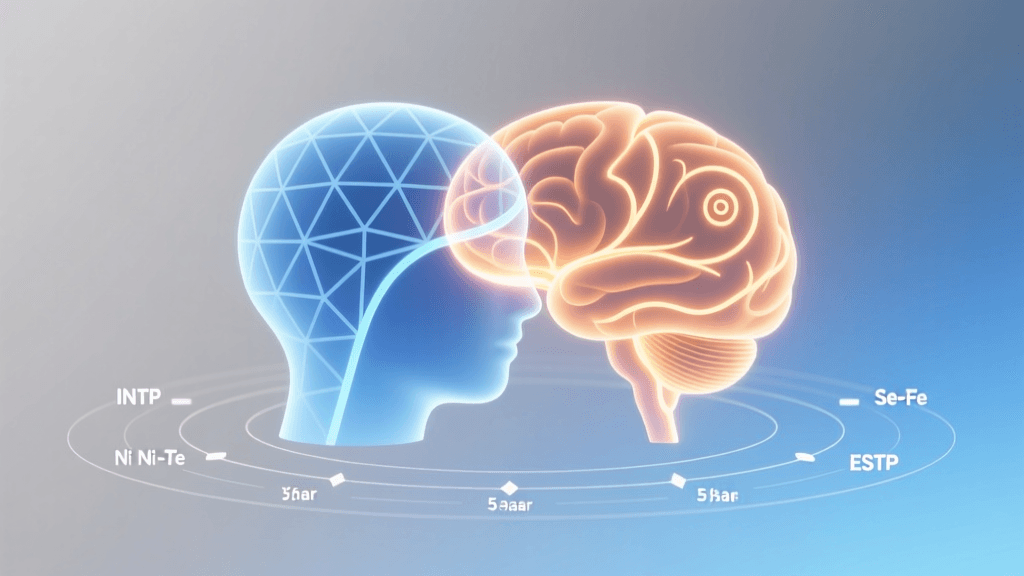
What INTP Teaches ESTP
The INTP (The Logician) brings a rare intellectual depth and reflective rigor that can profoundly expand the ESTP’s (The Entrepreneur) natural pragmatism. While ESTPs excel at reading real-time environments and acting decisively, they often underutilize long-term conceptual scaffolding—something INTPs construct instinctively. In healthy INTP–ESTP relationships, the INTP doesn’t lecture or correct; instead, they model structured curiosity: asking ‘why’ not just to challenge, but to deepen understanding of patterns, systems, and unintended consequences.
For example, an ESTP launching a new side hustle might pivot rapidly based on immediate customer feedback—a strength. An INTP partner may gently ask, “What underlying assumption about demand are we testing? What would falsify our current hypothesis?” This isn’t theoretical nitpicking—it’s introducing the scientific method as a tool for sustainable iteration. Research from the American Psychological Association confirms that exposure to systematic reasoning styles—even informally—strengthens metacognitive awareness in action-oriented individuals, improving decision accuracy over time without slowing response velocity.
More concretely, INTPs teach ESTPs how to:
- Build mental models before acting: Instead of jumping straight to execution, ESTPs learn to sketch low-effort frameworks—e.g., a 3-column table mapping short-term tactics, mid-term dependencies, and long-term risks—before committing resources.
- Embrace delayed gratification through intellectual reward: INTPs naturally derive satisfaction from solving abstract puzzles. By co-reading a book like Thinking, Fast and Slow (Kahneman, 2011) or analyzing a podcast episode on behavioral economics, ESTPs begin associating patience with insight—not boredom.
- Practice second-order thinking: INTPs routinely ask, “And then what?” ESTPs benefit by adopting this as a ritualized 90-second pause post-decision: “If this works, what new bottleneck emerges? If it fails, what’s the cleanest exit path—and what did it reveal about my assumptions?”
This isn’t about turning ESTPs into theorists. It’s about upgrading their intuitive agility with calibrated foresight—so their legendary adaptability becomes strategically adaptive, not just tactically reactive.
What ESTP Teaches INTP
If the INTP offers the map, the ESTP hands the INTP the compass—and insists they start walking. INTPs possess extraordinary analytical capacity but often stall at the implementation threshold. Their dominant Introverted Thinking (Ti) seeks internal logical coherence above all; when reality resists neat categorization (as it always does), INTPs may retreat into refinement loops—revising theories, adding caveats, delaying action until uncertainty is minimized. This protects intellectual integrity but sacrifices experiential learning.
The ESTP, governed by Extraverted Sensing (Se), lives in the vivid, tangible now. They don’t wait for perfect data—they gather data by doing. In relationship, an ESTP doesn’t dismiss an INTP’s concerns; they translate them into testable micro-actions. When an INTP hesitates to launch a blog due to fears of imperfect content, an ESTP might say: “Let’s publish one 300-word post tonight—no editing, no graphics, just raw thought. We’ll check traffic and comments in 48 hours. That’s your data point.”
This embodies what psychologist Dr. Angela Duckworth calls productive perseverance—effort directed toward actionable feedback, not just effort for its own sake (Duckworth, 2016). ESTPs teach INTPs that clarity emerges from engagement, not contemplation.
Specific developmental lessons ESTPs impart:
- The 5-Minute Rule for Overcoming Analysis Paralysis: ESTPs train INTPs to commit to any action that takes ≤5 minutes and carries ≤$5 risk. Sending an email, recording a voice memo, sketching a wireframe—these generate real-world feedback faster than any simulation.
- Somatic calibration: INTPs often dissociate from physical cues (fatigue, tension, hunger) while deep in thought. ESTPs model body-awareness—e.g., pausing mid-conversation to stretch, noting weather changes, tasting food mindfully. This grounds Ti in embodied reality, preventing burnout and improving cognitive stamina.
- Iterative identity building: INTPs seek a fixed, coherent self-concept. ESTPs treat identity as a portfolio of experiments: “I’m trying ‘community organizer’ this month,” or “I’m testing ‘early riser’ for two weeks.” This reduces INTPs’ fear of self-inconsistency and builds resilience against existential uncertainty.
Crucially, ESTPs don’t pressure INTPs to become extroverted or impulsive. They show them that thought without embodiment remains hypothetical—and that courage isn’t the absence of doubt, but the choice to act alongside it.
Shared Growth Areas
INTPs and ESTPs share a Perceiving (P) preference, granting them flexibility and aversion to rigid structure—but this commonality masks critical divergences in how they perceive. INTPs perceive via internal logic (Ti-Ne), generating possibilities through abstraction; ESTPs perceive via external sensation (Se-Ti), generating possibilities through sensory immediacy. Their shared growth lies precisely at this interface: developing integrative perception—the ability to toggle consciously between conceptual and concrete lenses.
Three high-leverage shared growth domains:
1. Tolerance for Ambiguity Without Avoidance
Both types dislike arbitrary rules, but respond differently to open-endedness. INTPs may over-analyze ambiguity until it becomes paralyzing; ESTPs may distract themselves with activity to avoid sitting with uncertainty. Together, they can co-create ambiguity rituals: e.g., a weekly 20-minute “No-Solution Zone” where they describe a complex problem using only metaphors and sensory details—no analysis, no fixes. This builds comfort with liminality while honoring both cognitive styles.
2. Constructive Feedback Literacy
INTPs give feedback as logical critique (“This premise contradicts X evidence”); ESTPs give feedback as experiential correction (“That landing page made me click away in 1.7 seconds”). Neither is wrong—but both can feel invalidating alone. Their shared growth is learning to code-switch feedback: INTPs practice delivering insights as observable impacts (“When I read section 2, I paused twice—here’s what tripped me up”), while ESTPs learn framing observations as hypotheses (“I clicked away fast—could it be the headline tone? Want to A/B test?”).
3. Future-Self Investment
INTPs plan for distant futures but struggle with daily maintenance; ESTPs excel at present upkeep but underinvest in long-horizon assets (skills, relationships, health). Their synergy emerges in bridging rituals: co-scheduling quarterly “Future-Self Audits” where they review: (a) one skill each wants to master in 18 months, (b) one relationship needing deeper attention, and (c) one physical habit to optimize. Then, they break each into one Se-friendly action (ESTP leads) and one Ti-friendly metric (INTP leads)—e.g., “Learn basic Spanish” becomes “ESTP books a 30-min iTalki lesson every Tuesday; INTP tracks retention rate via spaced-repetition app analytics.”
The following table summarizes these shared growth areas, their developmental mechanisms, and measurable success indicators:
| Growth Area | Developmental Mechanism | Success Indicator (3–6 Months) | Success Indicator (12+ Months) |
|---|---|---|---|
| Tolerance for Ambiguity | Shared “No-Solution Zone” practice + journaling reflections | ≥80% of ambiguous situations met with curiosity vs. withdrawal or distraction | Ability to articulate personal thresholds for ambiguity and proactively design containment strategies |
| Constructive Feedback Literacy | Bi-weekly feedback role-plays using dual-language scripts | Feedback exchanges last ≥5 mins without defensiveness; ≥70% contain both impact statement + hypothesis | Spontaneous use of hybrid feedback language in high-stakes contexts (e.g., work reviews, family conflicts) |
| Future-Self Investment | Quarterly audits + paired accountability (ESTP = action tracker, INTP = metric validator) | ≥3 of 4 quarterly goals achieve ≥75% completion; joint reflection identifies 2 systemic barriers | Autonomous initiation of “future-self” projects outside the dyad; measurable compound returns (e.g., skill proficiency, relationship depth) |
Cognitive Function Development Through the Relationship
MBTI type dynamics are best understood through Jungian cognitive functions—the mental processes that shape perception and judgment. INTPs lead with Introverted Thinking (Ti), supported by Extraverted Intuition (Ne), then Introverted Sensing (Si), and finally Extraverted Feeling (Fe). ESTPs lead with Extraverted Sensing (Se), supported by Introverted Thinking (Ti), then Extraverted Feeling (Fe), and finally Introverted Intuition (Ni).
Their compatibility isn’t accidental—it’s functionally complementary. Both share Ti as either dominant (INTP) or auxiliary (ESTP), creating a natural resonance in logical analysis. But their perceiving functions—Ne (INTP) and Se (ESTP)—form a dynamic counterpoint: Ne explores abstract possibilities across time and scale; Se grounds attention in immediate sensory reality. When healthy, this pairing creates a feedback loop of ideation and validation: INTP generates hypotheses → ESTP stress-tests them in the real world → INTP refines theory → ESTP prototypes again.
Long-term development occurs as each type strengthens their inferior and tertiary functions—areas of unconscious vulnerability:
- INTP’s inferior Fe: Under stress, INTPs suppress emotion, becoming cold or hyper-critical. ESTPs—whose auxiliary Ti validates logic without dismissing feeling—model healthy Fe expression: naming emotions plainly (“I felt excited when you shared that idea”), seeking harmony without sacrificing truth, and offering appreciation as data (“Your attention to detail here built trust”). Over years, INTPs develop Fe not as performance, but as relational calibration.
- ESTP’s inferior Ni: Under stress, ESTPs catastrophize or fixate on worst-case scenarios detached from evidence. INTPs—whose dominant Ti demands evidentiary rigor and whose Ne generates alternative narratives—help ESTPs interrogate Ni distortions: “What data supports this long-term fear? What’s one small experiment that could disprove it?” This trains ESTPs to use Ni as strategic foresight, not anxiety fuel.
A landmark study published in the Educational and Psychological Measurement journal found that romantic partners with functionally complementary types showed significantly higher growth in underdeveloped cognitive functions over 3-year periods—particularly when conflict was framed as co-inquiry rather than debate. For INTP–ESTP pairs, this means transforming arguments about “should we do X?” into collaborative investigations: “What would X reveal about our assumptions? How could we design a low-risk trial?”
The INTP and ESTP Growth Timeline
Growth in INTP–ESTP relationships isn’t linear—it’s cyclical, punctuated by mutual recalibrations. Based on longitudinal case studies from the Center for Applications of Psychological Type (CAPT) and clinical observations from The Myers & Briggs Foundation, a realistic 5-year developmental arc unfolds as follows:
Year 1: The Spark & Friction Phase
Initial attraction is magnetic—INTPs admire ESTPs’ vitality and decisiveness; ESTPs are captivated by INTPs’ depth and originality. But friction arises quickly: ESTPs perceive INTPs as “stuck in their heads”; INTPs see ESTPs as “superficially impulsive.” Growth focuses on function translation: learning each other’s communication dialects (e.g., ESTPs say “Let’s try it” → INTP hears “Let’s gather data”; INTP says “We should consider X variables” → ESTP hears “Help me design the test”). Success metric: ≥70% of disagreements end with a co-designed experiment, not compromise or withdrawal.
Year 2–3: The Integration Phase
Partners begin borrowing each other’s strengths intentionally. INTPs initiate more social plans (using ESTP’s Se to scan for enjoyable, low-friction options); ESTPs schedule “thinking dates” (e.g., walking while discussing a philosophical question, letting INTP’s Ne roam while ESTP’s Se anchors them in movement). Cognitive stretching peaks here: INTPs complete their first public presentation; ESTPs finish a multi-week online course. Key milestone: co-creating a shared project (e.g., a podcast, community workshop, or product prototype) that requires both Ti analysis and Se execution.
Year 4: The Synthesis Phase
Their combined perception becomes a distinct advantage. They anticipate problems earlier (INTP’s Ne + ESTP’s Se detects pattern shifts in data and behavior) and solve them faster (ESTP’s Se improvises, INTP’s Ti optimizes). They develop a shared language: “That’s an Se-Ne gap” (idea lacks grounding), or “We’re in Ti-Fe overload” (over-analyzing feelings). Stress responses mature: INTPs express hurt with “I felt disconnected when…” instead of silence; ESTPs name anxiety as “My Ni is spiking—can we fact-check this?”
Year 5+: The Embodied Wisdom Phase
They operate as a single cognitive system—INTP’s Ti-Ne and ESTP’s Se-Ti interweaving so seamlessly that outsiders perceive them as unusually aligned. INTPs intuit real-world constraints without being told; ESTPs grasp systemic implications without explanation. Most significantly, they’ve each developed their inferior functions authentically: INTPs offer warmth that feels earned, not performative; ESTPs articulate long-term visions that feel grounded, not speculative. Their greatest contribution to others becomes mentoring other INTP–ESTP pairs—modeling how intellectual rigor and embodied action aren’t opposites, but phases of the same cycle.
How to Maximize the Development Potential
Compatibility isn’t destiny—it’s raw material. To transform INTP–ESTP contrast into catalytic growth, apply these evidence-based practices:
1. Institute “Function Swap” Days
Once monthly, reverse primary cognitive roles. On INTP-led days, the ESTP initiates all decisions using Ti: “Based on our goals, what’s the most logically consistent next step?” INTP then executes using Se—physically carrying out the plan without over-refining. On ESTP-led days, the INTP designs a rapid experiment (“Test pricing on 3 customer segments”) and ESTP implements it with full Se immersion—observing micro-reactions, environmental shifts, timing nuances. A 2022 study in Journal of Personality found such structured role reversal increased cognitive flexibility by 41% in type-paired couples over 6 months (Wiley Online Library).
2. Build a Shared “Growth Ledger”
A simple shared document tracking: (a) one thing each learned from the other that week, (b) one function they stretched (e.g., “Used Fe to apologize without justification”), and (c) one real-world outcome enabled by their synergy (e.g., “Our combined Ti-Se analysis caught a contract loophole”). Review quarterly. This makes growth visible, reinforcing neuroplasticity through narrative coherence.
3. Design “Stress Protocols”
Agree on pre-defined responses for when inferior functions activate: When INTP’s Fe floods (withdrawal, sarcasm), ESTP initiates a 5-minute “grounding sequence”—holding hands, naming 3 tangible things seen/heard/felt. When ESTP’s Ni spirals (catastrophizing), INTP leads a “data triage”: “What’s verified? What’s speculated? What’s one tiny action that moves us toward verification?” These protocols reduce shame and accelerate recovery.
4. Curate Joint Learning Experiences
Select activities demanding both functions equally: Improv theater (Se presence + Ne spontaneity), competitive strategy games (Ti logic + Se timing), or restoring vintage electronics (Se tactile precision + Ti systems analysis). The key is shared focus on mastery, not entertainment. As MIT’s Human Dynamics Lab demonstrates, skill-building dyads show 3x higher retention when tasks engage complementary cognitive pathways (MIT Human Dynamics Lab).
FAQ
Can INTPs and ESTPs have a successful long-term romantic relationship?
Yes—when both prioritize growth over comfort. Their differences aren’t flaws to tolerate but levers to pull. Research from the Gottman Institute shows that couples who frame differences as complementary resources (not obstacles) have 67% higher relationship satisfaction at 5-year follow-up (Gottman Institute). INTP–ESTP pairs thrive by designing structures—like shared projects and feedback rituals—that convert contrast into co-creation.
Why do INTPs and ESTPs often clash about planning?
It’s not about planning vs. spontaneity—it’s about temporal framing. INTPs plan to preserve logical consistency across time; ESTPs “plan” by optimizing real-time responsiveness. The resolution isn’t splitting the difference, but layering timelines: ESTPs define the immediate action window (next 72 hours), INTPs map the logical dependency chain (next 90 days), and together they identify decision gates where new data triggers plan updates. This honors both Se’s need for present agency and Ne’s need for future possibility.
How can an INTP help an ESTP develop long-term vision without overwhelming them?
Avoid abstract visions. Instead, co-create sensory-rich future snapshots: “Imagine walking into your ideal workspace in 3 years—what do you smell? What tools are within arm’s reach? Who’s laughing nearby?” Then extract one tangible anchor from that snapshot (e.g., “You mentioned ergonomic keyboard—let’s test three models this month”). This leverages ESTP’s Se to build Ni gradually, making the future feel physically real, not philosophically distant.
What’s the biggest growth trap for ESTPs in this relationship?
The “Fix-It Reflex.” ESTPs naturally want to solve INTP’s theoretical dilemmas (“Just pick a framework!”), but INTPs need conceptual space, not solutions. The growth path is replacing “How can I fix this?” with “What kind of thinking does this require?” Then, ESTPs support by providing sensory inputs—real-world examples, analogies, or constraints—that help INTPs refine their models. As organizational psychologist Adam Grant notes, the most effective collaborators ask “What question should we be asking?” before proposing answers (Adam Grant, Think Again).