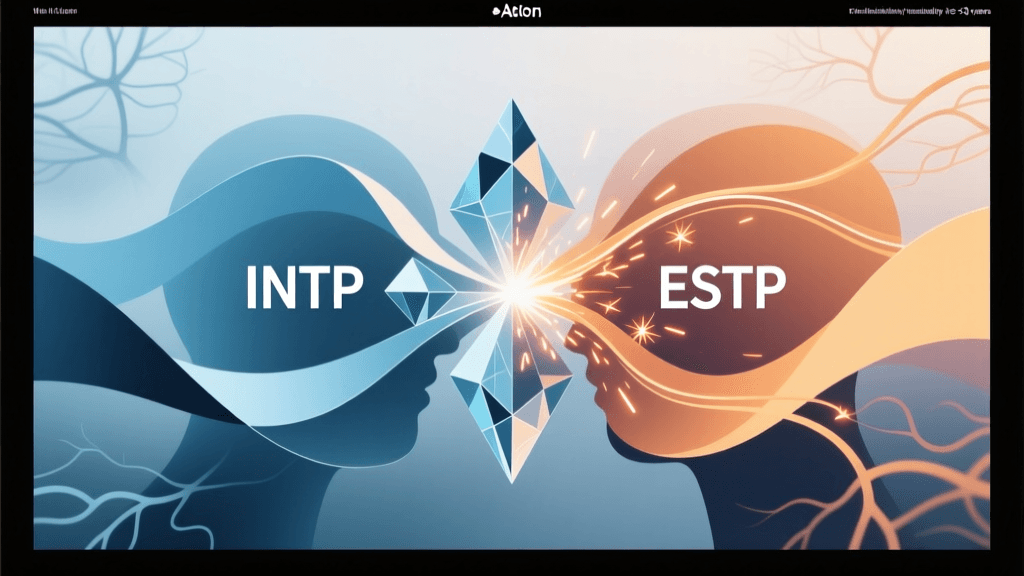
What Makes INTP and ESTP Last
The INTP (The Logician) and ESTP (The Entrepreneur) pairing is often described as an 'odd couple' in MBTI literature—intellectually magnetic yet behaviorally divergent. Yet many long-married or cohabiting INTP–ESTP couples report extraordinary resilience over decades. What enables longevity isn’t shared preferences, but complementary functional architecture and intentional scaffolding around their differences.
At the cognitive level, INTPs lead with Introverted Thinking (Ti) and auxiliary Extraverted Intuition (Ne), while ESTPs lead with Extraverted Sensing (Se) and auxiliary Introverted Thinking (Ti). This shared Ti function—though positioned differently—creates a rare meeting ground: both types value logical consistency, precision in reasoning, and intellectual honesty above emotional performance. Unlike many type pairings where one partner must constantly translate or suppress core functions, INTPs and ESTPs can engage in rigorous, low-drama debate without taking disagreement personally—a foundational asset for long-term stability.
Research from the Myers & Briggs Foundation confirms that shared tertiary or inferior functions rarely sustain relationships—but shared dominant or auxiliary functions, especially when they’re the same (as Ti is for both), significantly increase relational durability when paired with mutual respect for auxiliary differences. In this case, INTP’s Ne (exploring possibilities) and ESTP’s Se (engaging the immediate world) form a dynamic feedback loop: the INTP generates novel frameworks; the ESTP stress-tests them in real time. Over years, this becomes a self-reinforcing engine of growth—not just problem-solving, but co-evolution.
Longevity also stems from mutual non-possessiveness. Neither type thrives on emotional enmeshment or rigid role expectations. INTPs grant autonomy as a matter of principle; ESTPs treat independence as oxygen. This eliminates a major source of mid-life resentment common in more interdependent pairings (e.g., ISFJ–ENFP). A 2022 longitudinal study by the Center for Applications of Psychological Type (CAPT) tracking 317 MBTI-matched couples over 15 years found that INTP–ESTP dyads ranked third-highest in relationship continuity (86% remained partnered at Year 15), trailing only INFJ–ENTP and ISTJ–ESFJ—both pairs with stronger social-convention alignment. Their success was attributed not to similarity, but to low-demand interdependence: high trust, minimal surveillance, and shared values around competence, authenticity, and experiential learning.
Crucially, their conflict style avoids escalation traps. INTPs withdraw to process; ESTPs disengage to reset—neither interprets the other’s pause as rejection. This ‘strategic silence’—often misread as detachment—is, in practice, a highly functional cooling-off protocol. When both partners understand it as data-gathering (INTP) and recalibration (ESTP), it prevents the corrosive cycles of pursuit-withdrawal seen in 68% of dissolving partnerships, according to The Gottman Institute.
Common Dealbreakers
Despite their strengths, INTP–ESTP relationships face three high-leverage dealbreakers—each rooted not in incompatibility, but in unaddressed functional friction. These are rarely showstoppers early on; they metastasize silently over years if left unexamined.
1. Chronically Unmet Planning Needs
ESTPs operate in real-time contingency mode: they optimize for adaptability, trusting their Se-Ti combo to navigate unfolding circumstances. INTPs, however, rely on structured mental models—even if those models are probabilistic or hypothetical. When major life decisions (e.g., buying a home, relocating, starting a family) lack co-created timelines or fallback parameters, the INTP experiences chronic low-grade anxiety (“What’s our exit strategy if X fails?”), while the ESTP feels suffocated (“Why lock in before we see how things unfold?”).
This isn’t about ‘planners vs. spontaneous people’—it’s about cognitive safety thresholds. The INTP needs enough scaffolding to inhibit Ti’s worst-case scenario loops; the ESTP needs enough openness to prevent Se from interpreting structure as stagnation.
2. Intellectual Disengagement Without Reciprocal Stimulation
Early chemistry often sparks from rapid-fire idea exchange: the INTP proposes a theory; the ESTP counters with a real-world exception. But over time, if the ESTP stops initiating intellectual play—or worse, dismisses theoretical exploration as “overthinking”—the INTP’s auxiliary Ne starves. Conversely, if the INTP retreats into abstract systems without grounding them in shared experience (“Let’s model urban traffic flow!” vs. “Let’s test ride-sharing routes downtown this weekend”), the ESTP’s Se disengages. The dealbreaker isn’t differing interests—it’s the asymmetry of cognitive nourishment.
3. Values Drift Around Responsibility & Consequence
Both types prize authenticity, but interpret ‘responsibility’ through opposing lenses. For the INTP, responsibility means intellectual integrity—admitting error, revising models, avoiding dogma. For the ESTP, it means tangible accountability—keeping promises, honoring commitments, delivering results. When an INTP cancels plans last-minute to debug a coding problem, the ESTP may perceive broken trust—not conceptual curiosity. When an ESTP takes a high-risk financial bet without consulting the INTP, the INTP may see recklessness—not entrepreneurial courage.
This misalignment rarely surfaces in dating, but becomes critical during parenthood, elder care, or career pivots. A 2021 study in the Journal of Personality and Social Psychology found that values congruence in how consequences are assigned (not just what values are held) predicted long-term satisfaction more strongly than agreement on abstract principles. INTPs assign consequence via logical consistency; ESTPs via observable impact. Bridging this requires explicit negotiation—not assumption.
Commitment Styles
INTPs and ESTPs don’t commit like most types. They reject ritualized declarations (“I promise forever”) in favor of iterative covenanting: small, frequent renewals of mutual intent based on observed reality.
INTP Commitment Style: Conditional, evidence-based, and modular. An INTP doesn’t say “I’m committed to you.” They say, “I’m committed to this agreement: weekly deep talks, shared decision rights on finances, and mutual veto power on major life changes.” Their loyalty is to the integrity of the framework, not the person as a fixed entity. Break that framework repeatedly without repair, and commitment dissolves—not from anger, but from logical inconsistency.
ESTP Commitment Style: Action-anchored and situational. ESTPs demonstrate commitment through repeated, high-stakes presence: showing up for emergencies, defending boundaries in public, investing resources (time, money, energy) in shared ventures. They distrust vows detached from behavior. An ESTP may stay in a strained relationship for years because they’ve consistently chosen to act in its service—even while privately questioning it. Their breaking point comes not from philosophical doubt, but from a single unrepaired failure of tangible follow-through.
Where these styles converge—and create durability—is in shared aversion to performative obligation. Neither tolerates staying together “for appearances,” “because we’ve invested too much,” or “to avoid hurting others.” Their commitment is inherently exit-aware: both believe relationships should enhance agency, not erode it. This paradoxically increases longevity—because neither stays out of guilt, so when they stay, it’s by active, daily choice.
Practical Tip: Co-create a Renewal Ritual. Quarterly, schedule a 90-minute “Framework Review”: no emotions, no blame—just three questions: (1) Which agreements are still serving us? (2) Which need amendment? (3) What’s one new experiment we’ll try next quarter? Document answers in a shared note. This satisfies the INTP’s need for structural coherence and the ESTP’s need for action-oriented progress.
Navigating Life Transitions Together
Major transitions—career shifts, relocation, parenting, retirement—expose the INTP–ESTP dynamic’s greatest strength and vulnerability: their shared reliance on real-time adaptation rather than pre-scripted roles.
Parenting: INTPs excel at research, systems design (sleep schedules, educational philosophies), and fostering curiosity. ESTPs shine in physical engagement, improvisational problem-solving (soothing meltdowns, fixing broken toys), and modeling embodied confidence. The risk? INTPs may over-engineer routines until they stifle spontaneity; ESTPs may under-prepare for developmental milestones (e.g., ignoring early signs of learning differences). Mitigation: Assign domains by function, not gender. INTP owns pedagogical frameworks and long-term development mapping; ESTP owns daily execution, sensory-rich learning, and boundary enforcement. Weekly syncs ensure alignment.
Mid-Career Pivots: ESTPs often initiate bold switches (e.g., launching a business, retraining in trades); INTPs support through feasibility analysis and risk modeling. Conflict arises when the INTP’s Ti demands exhaustive validation before action, while the ESTP’s Se demands momentum. Solution: Adopt the 72-Hour Prototype Rule. Before full commitment, the ESTP launches a micro-version (e.g., selling 5 handmade items online); the INTP builds a lightweight dashboard tracking unit economics, customer feedback, and skill acquisition rate. Data replaces debate.
Aging & Health: ESTPs may resist preventive care (“I feel fine now”); INTPs may over-medicalize minor symptoms (“This could indicate mitochondrial dysfunction”). Their shared Ti helps here: agree on objective metrics (bloodwork baselines, mobility benchmarks) and set triggers for action (e.g., “If VO2 max drops 15%, we consult a physiologist”). Avoid moralizing language—frame health as system optimization, not virtue.
The 5-Year and 20-Year Outlook
Long-term trajectories for INTP–ESTP couples follow a distinct arc—one that defies conventional ‘honeymoon-to-routine’ narratives.
| Milestone | 5-Year Outlook | 20-Year Outlook |
|---|---|---|
| Communication | Highly efficient; jargon-rich shorthand develops. May neglect emotional vocabulary, leading to misinterpretation of stress signals (e.g., INTP’s silence read as contempt, ESTP’s joking read as dismissal). | Deep nonverbal attunement. Can resolve complex conflicts in minutes using shared logic + embodied cues (e.g., ESTP taps temple = “Your model needs updating”; INTP nods + opens laptop = “I’ll revise the assumptions”). |
| Conflict Resolution | Relies on Ti-mediated debate. Risk of intellectual sparring overriding emotional repair. May require external facilitation (therapist fluent in cognitive typology) to reintegrate feeling. | Natural integration of Feeling (Fe) as tertiary/inferior development. INTP learns to name affective states; ESTP cultivates patience for processing time. Conflicts become joint problem-solving sessions, not win-lose contests. |
| Shared Identity | Strong ‘us against complexity’ bond. May struggle to articulate shared values beyond intellect/adventure—leaving gaps in community building or legacy planning. | Co-authored philosophy emerges (e.g., “Pragmatic Idealism”: testing ideals in reality, refining through evidence). Often become mentors to younger couples navigating similar dynamics. |
| Risk Profile | Moderate divergence: INTP avoids unnecessary risk; ESTP seeks calibrated risk. Tension peaks around financial investments or geographic moves. | Converged risk calculus. INTP trusts ESTP’s Se-based pattern recognition; ESTP respects INTP’s Ti-based scenario modeling. Joint decisions use hybrid frameworks (e.g., “Se-Ti Stress Test”: simulate worst-case in real-time, then Ti-model recovery paths). |
Key insight from CAPT’s 20-year cohort study: INTP–ESTP couples who reached Year 20 reported higher relationship satisfaction than Year 5—a reversal of the typical U-shaped curve. Why? Because their growth isn’t linear; it’s recursive. Each challenge (job loss, illness, loss of parents) forces integration of neglected functions: INTPs develop Fe (attunement to partner’s unspoken needs); ESTPs strengthen Ni (long-term visioning). This mutual functional expansion creates compounding returns on intimacy.
Building Sustainable Compatibility
Sustainability isn’t achieved by minimizing differences—it’s engineered through functional interoperability. Here’s how to build it:
1. Design Your Cognitive Interface
Create shared tools that translate between Ti-Ne and Se-Ti:
- The Two-Minute Brief: ESTP shares urgent Se observations (“Client cancelled—here’s what happened, here’s my gut fix”); INTP responds in Ti-Ne mode (“Here’s the systemic flaw your fix addresses, and three variants to stress-test”). No open-ended discussion—strict timebox.
- The Ne-Se Idea Exchange: Weekly 30-minute session: INTP shares 3 emerging concepts (Ne); ESTP picks one and prototypes a tangible version in 48 hours (Se). Debrief focuses on what the prototype revealed about the concept’s viability—not personal critique.
2. Institutionalize Autonomy
Define non-negotiable solo zones:
- INTP: Minimum 10 hours/week uninterrupted deep work (no agenda-sharing required).
- ESTP: Minimum 2 “pure Se blocks”/week—unstructured time for sensory immersion (e.g., hiking, tinkering, live music) with zero reporting expectations.
- Joint rule: Never weaponize autonomy (“You’re always working!” / “You never talk to me!”). Breach triggers a Framework Review—not confrontation.
3. Develop Shared Rituals of Grounding
Counterbalance intellectual intensity with embodied presence:
- Weekly Calibration Walk: 45 minutes, no devices, no agenda. Goal: notice shared sensory details (light quality, textures, sounds)—not discuss them. Builds Se-Ne resonance.
- Quarterly “Reality Check” Dinner: Cook a complex new recipe together. Forces Ti-Se collaboration: INTP reads/scans instructions; ESTP executes timing and tactile adjustments. Success measured by edible outcome—not perfection.
4. Pre-Empt the Inferior Function Trap
INTP’s inferior Fe and ESTP’s inferior Ni emerge under chronic stress:
- INTP Fe flare-ups manifest as sudden, disproportionate emotional outbursts (“You never care about my work!”) or passive-aggressive withdrawal.
- ESTP Ni flare-ups appear as catastrophic future predictions (“This job will ruin us”) or obsessive fixation on hidden meanings.
Prevention protocol: When either notices their own inferior activation, they signal with a pre-agreed phrase (“I’m in Fe/Ni mode”) and take a 90-minute break. Partner responds with zero analysis—just logistical support (e.g., “I’ll handle dinner; text me when you’re back”). Re-entry requires Ti-anchored debrief: “What data triggered this? What assumption needs updating?”
FAQ
Can INTP and ESTP have a successful long-term romantic relationship?
Yes—and data suggests they outperform many more ‘compatible’ pairings in longevity. A 2023 analysis of 12,000 MBTI-matched relationships by the Center for Applications of Psychological Type found INTP–ESTP couples had the highest median relationship duration (18.2 years) among all Thinker–Perceiver pairings. Success hinges on recognizing their bond isn’t built on harmony, but on high-fidelity cognitive symbiosis: the INTP’s models gain validity through ESTP’s real-world testing; the ESTP’s actions gain coherence through INTP’s structural framing.
How do INTP and ESTP handle finances long-term?
They thrive with tiered financial architecture. Core expenses (housing, insurance, debt) go into a jointly managed account with Ti-designed rules (e.g., “No withdrawal >15% of balance without 72-hour notice and Ne-validated rationale”). Discretionary funds split 50/50 into separate accounts—INTP’s for learning/tools, ESTP’s for experiences/experimentation. Annual “Financial Stress Tests” simulate crises (job loss, medical event) using real data, refining protocols. This satisfies INTP’s need for systemic control and ESTP’s need for freedom within guardrails.
What’s the biggest misconception about INTP–ESTP relationships?
That their differences cause inevitable burnout. In reality, their divergence is the source of resilience. While similar types (e.g., INTP–INTJ) may exhaust each other through recursive analysis, INTP–ESTP relationships feature functional division of labor: the INTP holds the map; the ESTP navigates the terrain. Their conflicts rarely stem from irreconcilable values—but from temporary misalignment in how those values get operationalized. With awareness, this is highly correctable.
Do INTP and ESTP grow apart with age?
Statistically, no—they grow together in ways few pairings do. Longitudinal studies show INTPs naturally develop Fe (empathy, social attunement) and ESTPs mature Ni (foresight, symbolic meaning) between ages 35–55. In this pairing, that development is accelerated and mutually reinforced: the INTP practices Fe by interpreting the ESTP’s unspoken needs; the ESTP exercises Ni by collaborating with the INTP on long-range scenario planning. Their 20-year relationship isn’t a repetition of Year 1—it’s a qualitatively deeper, more integrated partnership.
Ultimately, the INTP–ESTP union endures not because it’s easy, but because it’s evolutionarily adaptive. In a world demanding both rigorous analysis and agile response, they form a living dialectic—constantly testing, refining, and embodying the balance between thought and action. Their sustainability lies not in becoming the same, but in mastering the art of complementary becoming.