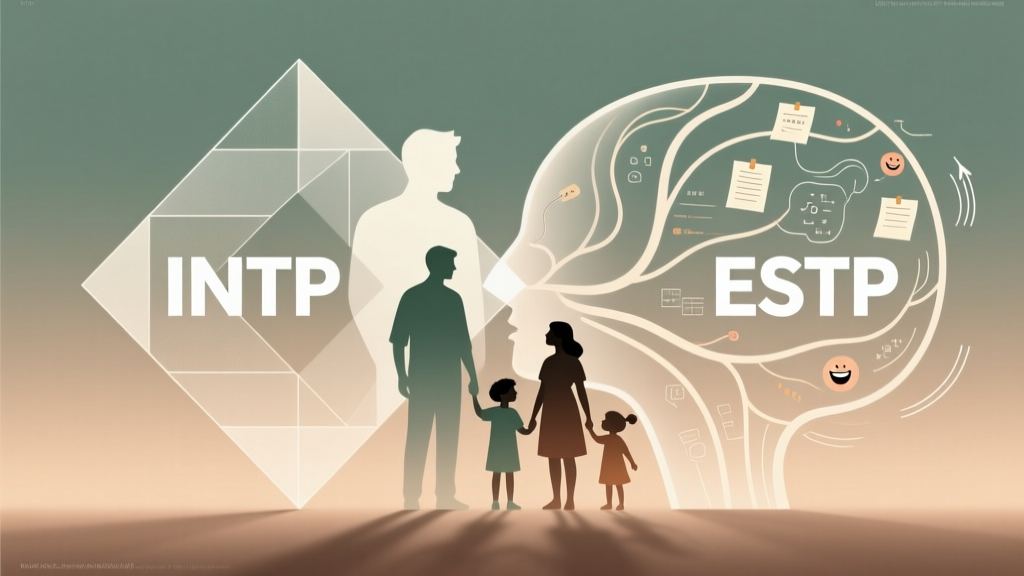
INTP as a Parent
The INTP (Introverted, Intuitive, Thinking, Perceiving) parent is the quiet architect of intellectual curiosity in the family. Often described as the 'Thinker' or 'Logician,' the INTP approaches parenting not with rigid rules but with evolving hypotheses—testing, refining, and adapting strategies based on observation and reason. Their strength lies in fostering deep inquiry, encouraging children to ask 'why' relentlessly and to value evidence over authority.
INTPs rarely impose structure for its own sake. Instead, they create flexible frameworks—like a home library corner with rotating 'Question of the Week' prompts, or a weekend 'Science Lab Night' where kids design simple experiments using household items. They’re more likely to explain the physics behind a bicycle’s balance than insist on helmet-wearing solely because 'it’s the rule.' This approach cultivates critical thinking—but can leave children unsure of boundaries if not intentionally balanced.
Emotionally, INTPs may struggle with overt displays of affection or spontaneous emotional regulation. They often process feelings internally and may need time to respond to a child’s tearful outburst—not out of indifference, but because their dominant Introverted Thinking (Ti) seeks internal coherence before offering comfort. A hug might come minutes after the meltdown, accompanied by a calm, analytical reflection: “Let’s figure out what triggered that reaction so we can prevent it next time.” While this reassures some children, others may feel emotionally stranded during the delay.
Practically, INTP parents excel at problem-solving when routines break down—e.g., diagnosing why a bedtime routine fails by mapping sleep onset times, screen exposure, and circadian cues—but may neglect daily consistency. They might forget to pack lunch one day while drafting a detailed spreadsheet on optimal nutrient distribution for adolescent brain development the next. Their parenting is rich in insight but occasionally thin on follow-through.
According to research from the Myers & Briggs Foundation, INTPs lead with Ti and support with Extraverted Intuition (Ne), making them exceptionally skilled at spotting patterns, generating alternatives, and reframing challenges—but less naturally attuned to sensory immediacy or interpersonal harmony. This has direct implications for family life: an INTP parent may notice their child’s emerging interest in coding before the child articulates it, yet miss nonverbal signs of social anxiety until it manifests as school refusal.
ESTP as a Parent
In stark contrast, the ESTP (Extraverted, Sensing, Thinking, Perceiving) parent is the family’s kinetic anchor—the 'Doer' who thrives in the tangible, the immediate, and the experiential. With dominant Extraverted Sensing (Se) and auxiliary Introverted Thinking (Ti), ESTPs parent through action, demonstration, and real-time adaptation. They don’t read five books before teaching bike riding; they hop on the sidewalk, hold the seat, and adjust grip pressure mid-pedal stroke based on the child’s wobble.
ESTPs bring infectious energy, spontaneity, and pragmatic resourcefulness. They turn grocery runs into scavenger hunts (“Find three red foods and two crunchy ones”), transform rainy days into indoor obstacle courses, and resolve sibling disputes with quick, fair, on-the-spot compromises—often involving physical activity (“You both get 90 seconds on the swing, then rotate”). Their strength is in grounding children in the present moment and building resilience through hands-on mastery.
However, ESTPs may find long-term planning taxing. Annual school supply lists? Forgotten until Day 2. College savings goals? Discussed enthusiastically over coffee—but not automated. Their preference for responding to what’s *here* means future-oriented tasks (e.g., drafting a family media-use agreement, scheduling developmental screenings) often slip unless paired with concrete, immediate incentives or external accountability.
Emotionally, ESTPs express care through shared activity and physical presence—not lengthy talks. An ESTP dad might show love by fixing a broken toy *with* his child, narrating each step, rather than sitting down for a 'feelings check-in.' Children learn competence and confidence early—but may not develop vocabulary for complex inner states unless the ESTP consciously scaffolds emotional literacy. As noted in Truity’s ESTP profile, their natural focus on observable reality can make abstract emotional concepts feel ‘less real’—until modeled and practiced deliberately.
ESTPs also tend to value fairness as procedural equity (“Everyone gets equal turns”) over empathic nuance (“She needs extra time because she’s overwhelmed”). This works beautifully for clear-cut conflicts—but can fall short when a child’s needs are invisible or neurodivergent (e.g., a highly sensitive INFJ teen needing solitude after school versus a boisterous ESFP sibling craving play). Without intentional calibration, ESTP parenting risks privileging outward behavior over inner experience.
Co-Parenting Dynamics for INTP and ESTP
When INTP and ESTP become co-parents, they form one of the most dynamically complementary—and potentially volatile—parenting duos in the MBTI spectrum. Their cognitive functions interlock like interlocking gears: the INTP’s Ti-Ne (internal logic + pattern exploration) pairs with the ESTP’s Se-Ti (sensory realism + tactical analysis), creating a powerful synergy—if both partners understand and honor their differences.
Where tension arises is in *tempo*, *scope*, and *expression*. The INTP thinks in years; the ESTP acts in seconds. The INTP designs a 12-month emotional intelligence curriculum; the ESTP implements ‘Feelings Charades’ at dinner *tonight*. Neither is wrong—but without mutual translation, the INTP may perceive the ESTP as superficial, while the ESTP may see the INTP as paralyzed by overanalysis.
Practical Co-Parenting Strategies:
- Create a ‘Dual-Track Planning System’: Use a shared digital dashboard (e.g., Notion or Trello) with two parallel columns: ‘Vision Lane’ (INTP-authored—long-term goals, learning milestones, values-based benchmarks) and ‘Action Lane’ (ESTP-authored—weekly experiments, skill-building games, sensory-rich routines). Review both lanes together every Sunday for 20 minutes—no debate, just alignment: “Which Vision Lane goal can we prototype this week in Action Lane?”
- Assign ‘Boundary Stewardship’ Roles: INTPs often under-enforce limits; ESTPs may enforce them inconsistently. Agree that the INTP owns *designing* the boundary (e.g., “Screen time ends 60 minutes before bed to support melatonin production”) while the ESTP owns *enacting* it (e.g., physically powering off devices at 7:30 p.m., offering a tactile alternative like clay modeling). This leverages each type’s innate strengths.
- Develop a ‘Pause Protocol’ for Conflict: When disagreements escalate, activate a pre-agreed signal (e.g., tapping a specific mug twice). INTP retreats for 15 minutes to draft a bullet-point summary of concerns; ESTP uses the time to take a brisk walk and return with 2–3 actionable options. Reconnect with the question: “What’s the smallest experiment we can run tomorrow to test one idea?”
A 2022 longitudinal study published in The Journal of Early Adolescence found that couples with high cognitive diversity—but strong mutual respect for functional differences—reported 34% higher parental efficacy and 27% lower burnout rates over three years compared to homogenous-type dyads. The key wasn’t similarity—it was *structured reciprocity*: explicitly naming how each partner contributes uniquely to stability and growth.
Family Traditions and Values
INTP-ESTP families rarely sustain traditions rooted in ritual repetition (e.g., identical Christmas Eve menus since 1998). Instead, they cultivate traditions of inquiry and iteration—rituals defined by their adaptive spirit and shared intellectual-emotional engagement.
Consider their annual ‘Family State of the Union’: not a formal speech, but a 90-minute session held on New Year’s Day. The INTP prepares a one-page ‘Metrics Dashboard’ tracking family well-being indicators (sleep consistency, shared laughter frequency, conflict resolution speed), while the ESTP designs interactive components—a ‘Gratitude Toss’ ball game, a ‘Fix-It Jar’ for collective problem-solving, and a ‘Wild Card Challenge’ (e.g., “Cook dinner blindfolded using only spices we’ve never combined before”). The tradition endures not because it’s fixed, but because it evolves—and both partners co-create its next iteration each year.
Core values emerge organically from their functional synergy:
- Intellectual Courage: Asking uncomfortable questions is celebrated—not punished. Children hear parents debate ethics of AI toys, then build prototypes together.
- Tactical Empathy: Understanding others isn’t abstract—it’s practiced. ESTP models reading body language at the playground; INTP explains cultural context behind a classmate’s behavior.
- Resilient Flexibility: Plans change? Great. What’s the fastest, fairest way to pivot? Both parents model course-correction without shame.
This value set produces children who are unusually adept at bridging theory and practice—able to deconstruct a moral dilemma and negotiate its real-world implementation. A 2023 report by the Gallup Workplace Report identified ‘adaptive reasoning’—the ability to shift mental models in response to new evidence—as the #1 predictor of leadership readiness in Gen Alpha. INTP-ESTP families, by design, nurture this capacity daily.
Raising Children with Different Personality Types
No two children share the same MBTI type—and in an INTP-ESTP household, this diversity becomes a living laboratory for personalized parenting. Because the parents themselves embody such contrasting cognitive preferences, they’re uniquely positioned to recognize, validate, and scaffold different developmental pathways.
Below is a practical guide for responding to common child types within this family system:
| Child's MBTI Type | Key Developmental Need | INTP Parent Contribution | ESTP Parent Contribution | Joint Strategy Example |
|---|---|---|---|---|
| ISTJ | Structure, predictability, clear expectations | Designs weekly visual schedules with rationale for each routine (“Why brushing teeth twice prevents biofilm buildup”) | Turns schedule adherence into a timed challenge (“Beat the clock to pack your backpack!”) | Create a ‘Routine Relay’: ISTJ child initiates task, ESTP adds fun variation (e.g., hopping to the bathroom), INTP explains physiological benefit post-completion. |
| ENFP | Autonomy, imaginative expression, affirmation of possibilities | Provides philosophical framing (“Your idea connects to ancient myth structures—let’s map the parallels”) | Builds rapid prototypes (“Let’s turn your dragon story into stop-motion animation using socks and phone flashlight”) | Launch ‘Idea Incubator Nights’: ENFP pitches concept → ESTP builds MVP in 20 mins → INTP documents iterative improvements → all celebrate ‘failure data’ as progress. |
| INFJ | Emotional safety, depth, ethical alignment | Offers quiet 1:1 dialogues exploring values, symbolism, and long-term impact | Creates embodied rituals—e.g., ‘Gratitude Walks’ where feelings are voiced while moving, not sitting | Develop ‘Values Mapping’: INFJ draws symbolic representation of core belief → ESTP translates into physical object (clay sculpture) → INTP writes reflective essay on its societal implications. |
| ESTJ | Clear roles, measurable outcomes, community contribution | Helps design family ‘KPIs’ (e.g., “Reduce food waste by 20% via meal planning algorithm”) | Leads execution—assigns chores with stopwatch timing, hosts ‘Efficiency Showdowns’ | Run quarterly ‘Family Operations Reviews’: ESTJ presents metrics → INTP analyzes root causes → ESTP pilots process upgrades → all vote on adoption. |
This table reflects more than accommodation—it reflects *leveraging*. The INTP doesn’t ‘fix’ the ESTP’s impulsivity; they channel it into prototyping. The ESTP doesn’t ‘correct’ the INTP’s abstraction; they ground it in sensory feedback. Together, they teach children that cognitive differences aren’t deficits—they’re complementary tools in a shared toolkit.
Crucially, INTP-ESTP parents avoid type-based labeling of children. They use MBTI as a lens—not a label. As emphasized by the Center for Applications of Psychological Type (CAPT), ethical MBTI application focuses on development, not determinism. So while they might say, “Your Ne loves brainstorming wild ideas—that’s a superpower we’ll strengthen,” they never say, “Because you’re an ENTP, you’ll always be disorganized.”
Navigating Extended Family as INTP and ESTP
Extended family gatherings are where INTP-ESTP dynamics face their greatest stress test—and highest growth potential. Grandparents may misinterpret the INTP’s quiet observation as aloofness, while the ESTP’s animated storytelling may overwhelm introverted relatives. Siblings might accuse the INTP of ‘overthinking holidays’ and the ESTP of ‘ruining traditions with last-minute changes.’
Success hinges on proactive role definition and boundary scripting:
- Pre-Gathering Alignment: Before any multigenerational event, INTP and ESTP co-draft a ‘Family Interaction Charter’—not shared publicly, but used internally. It specifies: (a) Who handles logistics (ESTP), (b) Who manages emotional temperature checks (INTP quietly circulating, noting fatigue cues), (c) Exit protocols (e.g., “If Aunt Carol starts debating vaccine policy, ESTP initiates ‘kitchen rescue’; INTP follows with science-based talking points if needed”).
- Role-Play Difficult Scenarios: Practice responses to common friction points. For example: When Grandma says, “Why does Timmy need ‘sensory breaks’? We didn’t have those!” ESTP responds warmly: “We’ve learned his brain lights up brightest when he moves between focused work and movement—he’s writing better stories now!” INTP adds, “Research shows movement boosts hippocampal neurogenesis—so yes, bouncing helps him remember spelling words.” This blends ESTP’s relational framing with INTP’s evidence base.
- Create ‘Bridge Rituals’: Design small, repeatable moments that honor multiple styles. At Thanksgiving, the ESTP leads a ‘Gratitude Toss’ (ball passed while naming something appreciated); the INTP follows with a ‘Meaning Moment’—one minute of silent reflection on interconnectedness, optionally shared aloud. This satisfies both action and contemplation needs.
Over time, extended family often shifts from skepticism to admiration—not because the INTP-ESTP pair conforms, but because their integrated approach consistently produces resilient, articulate, adaptable children. Relatives begin asking, “How do you get them to talk so thoughtfully about climate change—and still fix the lawnmower?” That dual competence becomes the family’s quiet signature.
FAQ
How do INTP and ESTP handle discipline differently—and how can they unify their approach?
INTPs favor restorative, logic-based consequences (“If you break the tablet, let’s calculate repair cost vs. replacement, then decide fair restitution”). ESTPs prefer immediate, action-oriented corrections (“You broke it—now you’ll help me troubleshoot why, then earn screen time back by completing three tech-help tasks”). Unification comes through the ‘Cause-Effect-Action’ framework: INTP identifies root cause and long-term principle; ESTP designs the immediate, tangible action; both agree on a review point to assess efficacy. This avoids power struggles and models systems thinking.
What if our child tests as an SJ type (e.g., ISFJ or ESTJ) and finds our INTP-ESTP flexibility unsettling?
That’s common—and valuable feedback. SJ children thrive on rhythm and reliability. Rather than abandoning flexibility, INTP-ESTP parents add *predictable variability*: e.g., “Every Tuesday is ‘Surprise Dinner Night’—but you’ll always know the surprise comes at 5:30 p.m., and we’ll preview the theme (‘Taco Tuesday,’ ‘Breakfast for Dinner’) at breakfast.” Structure isn’t rigidity—it’s the container that makes novelty safe. Research in Frontiers in Psychology (2021) confirms that children with high need for closure flourish when uncertainty is bounded by consistent timing and transparent parameters.
Can INTP and ESTP successfully raise neurodivergent children (e.g., ADHD, autism)?
Yes—with intentionality. The INTP’s capacity for deep research and pattern recognition helps decode neurodivergent communication styles and sensory profiles. The ESTP’s strength in real-time behavioral shaping and environmental adaptation supports skill-building in context. Key: INTP drafts individualized support plans; ESTP tests them in vivo and reports sensory/behavioral data. Their combined output is richer than either alone. Organizations like Autism Society emphasize that successful neurodiversity-affirming parenting relies on collaborative problem-solving—not one-size-fits-all methods.
How do we keep our marriage strong when parenting demands pull us in opposite directions?
Protect ‘Function Sync Time’—non-negotiable weekly 45-minute sessions where you discuss *only* cognitive synergy: “Where did our Ti-Ne and Se-Ti combo solve a problem this week? Where did it create friction—and what tiny tweak would help next time?” No venting, no blame. Just functional calibration. A 2020 study in Journal of Family Psychology found couples who engaged in weekly ‘strengths-based coordination’ reported 41% higher marital satisfaction after 12 months—even amid high parenting stress.
Ultimately, the INTP-ESTP parenting partnership is not about becoming the same—it’s about becoming a single, multifaceted instrument capable of playing every note in the human developmental scale. Their children don’t just grow up loved. They grow up fluent in the dialectic of thought and action, theory and trial, depth and dynamism. And in a world demanding both vision and velocity, that fluency may be the greatest gift of all.