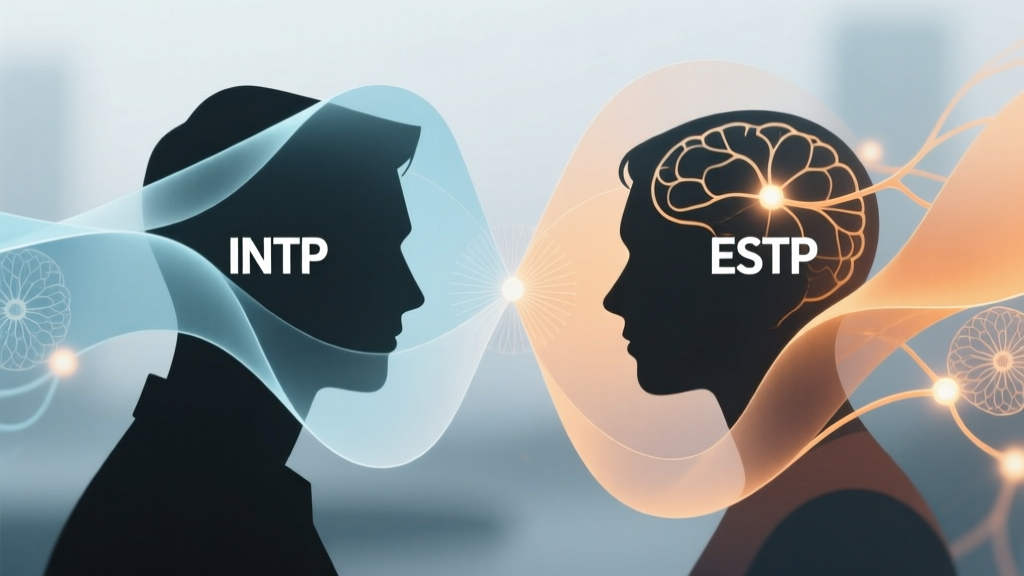
How INTP Builds Trust
For the INTP—the quiet architect of ideas, the skeptical analyst who lives in a rich inner world of logical models and theoretical possibilities—trust is neither granted nor revoked on impulse. It is earned, not through charisma or consistency alone, but through demonstrable intellectual integrity, coherence of action with stated principles, and sustained evidence of reliability over time. Unlike types who prioritize warmth or immediacy, the INTP’s trust pathway is fundamentally epistemic: they trust those whose reasoning they can follow, whose motives they can map, and whose behavior aligns with a discernible internal logic.
According to research from the Center for Applications of Psychological Type (CAPT), INTPs score highest among all 16 types on the Thinking-Feeling dimension’s preference for objective analysis—and lowest on spontaneous emotional disclosure (CAPT, 2022). This means that when an INTP says, “I trust you,” it rarely signifies emotional surrender; rather, it reflects a cognitive verdict: You have passed my internal audit. Their trust is built in layers—first through observation (does this person keep promises?), then through dialogue (do their explanations hold up under scrutiny?), and finally through shared intellectual challenge (can we debate ideas without defensiveness?).
Crucially, INTPs do not equate emotional expressiveness with trustworthiness. In fact, excessive or ungrounded emotional declarations may trigger skepticism—not because they dismiss feeling, but because they instinctively question the underlying premises. An INTP might deeply trust a stoic engineer who delivers precise, well-documented solutions—but feel uneasy around a gregarious friend who offers effusive reassurance without follow-through. For them, trust is anchored in predictability of reasoning, not predictability of mood.
Practically, INTPs build trust by:
- Testing hypotheses through low-stakes commitments: They’ll assign small, meaningful tasks (“Can you review this draft?” or “Will you help me debug this logic?”) to assess competence, responsiveness, and alignment with shared standards.
- Withholding personal disclosure until intellectual safety is confirmed: They rarely share vulnerabilities early—even with partners—unless they’ve first verified that the other person respects boundaries, tolerates ambiguity, and engages with nuance rather than rushing to fix or judge.
- Revising trust incrementally: A single breach doesn’t erase trust entirely—but it initiates a recalibration process. The INTP will re-examine prior evidence, identify where their model failed, and adjust future expectations accordingly.
This methodical, evidence-based approach protects the INTP from disillusionment—but it can also delay emotional closeness. When paired with an ESTP, whose trust forms more rapidly and experientially, this difference becomes the first major friction point—and the most fertile ground for growth.
How ESTP Builds Trust
The ESTP—the pragmatic dynamo, the real-world problem-solver who thrives on immediacy, action, and tangible results—builds trust in stark contrast to the INTP. Where the INTP trusts after prolonged observation and conceptual verification, the ESTP trusts through doing. Their trust architecture is rooted in sensory experience, behavioral congruence, and mutual capability—not abstract consistency, but shared momentum.
According to the Myers & Briggs Foundation, ESTPs lead with Extraverted Sensing (Se), which makes them acutely attuned to environmental cues, physical presence, and real-time responsiveness (Myers & Briggs Foundation, 2023). To an ESTP, trust emerges when someone shows up in the moment: arrives on time, handles a crisis without panic, improvises effectively, or laughs easily at a spontaneous detour. Words matter less than what a person does—and how they do it. An ESTP may trust a stranger who helps change a flat tire more quickly than a long-term colleague who talks confidently but misses deadlines.
Emotionally, ESTPs are often mischaracterized as shallow or detached—but this overlooks their profound loyalty to those who prove themselves in action. Their vulnerability is situational, not confessional: they reveal depth not through monologues about childhood wounds, but through acts of protection, playful risk-taking together, or quietly remembering small preferences (“You like black coffee, no sugar—got it”). As clinical psychologist Dr. Michael S. Krasner notes in his work on embodied cognition and relational security, “ESTPs form attachment bonds through co-regulation in activity—not conversation” (Krasner et al., Frontiers in Psychology, 2020).
ESTPs build trust by:
- Initiating shared experiences early: A first date isn’t coffee and small talk—it’s rock climbing, cooking a meal together, or navigating a crowded market. These activities serve as live trust assessments: Can you adapt? Can you stay present? Do you handle pressure with grace?
- Offering practical support before emotional reassurance: Instead of saying “I’m here for you,” they’ll show up with tools, transport, or a solution—because for them, care is a verb, not an adjective.
- Correcting missteps swiftly and visibly: If they break a promise, they don’t offer lengthy apologies—they fix it immediately, often with added effort (“I missed our call—let’s reschedule AND I’ll send you those files tonight”). Accountability is kinetic, not rhetorical.
This action-first orientation makes ESTPs exceptionally reliable in crises—but can leave INTPs feeling emotionally stranded if their need for verbal processing or conceptual framing goes unmet. Yet precisely because their trust languages differ so radically, INTP–ESTP pairs possess extraordinary potential: one holds the map; the other drives the car. When both learn to read each other’s navigation systems, trust becomes multidimensional—not just logical or experiential, but both.
The Trust Timeline for INTP and ESTP
Understanding the divergent rhythms of trust formation is essential for INTP–ESTP relationships. Below is a comparative timeline illustrating how trust typically develops across key relational milestones:
| Milestone | INTP Trust Progression | ESTP Trust Progression | Shared Risk Point |
|---|---|---|---|
| First 2 Weeks | Observational phase: Noting consistency in communication style, factual accuracy, and boundary respect. Minimal self-disclosure. | Experiential phase: Testing responsiveness, energy match, and comfort with spontaneity (e.g., last-minute plans). May share light personal anecdotes to gauge reciprocity. | ESTP may perceive INTP silence as disinterest; INTP may interpret ESTP’s rapid familiarity as superficiality. |
| 1–3 Months | Begins sharing theoretical frameworks, intellectual curiosities, or dry humor—indicators of cautious opening. Watches for logical coherence in partner’s values. | Invites deeper collaboration—cooking, travel planning, fixing something together. Shares preferences, habits, and pet peeves. Begins testing reliability in small commitments. | Risk of mismatched expectations: INTP waits for philosophical alignment; ESTP waits for logistical coordination. One feels “unseen”; the other feels “unengaged.” |
| 4–6 Months | May disclose personal insecurities—if partner has demonstrated non-judgmental listening and intellectual humility. Trust hinges on whether feedback is constructive, not corrective. | Offers physical/emotional protection (e.g., stepping in during conflict, remembering stress triggers). Shares past failures—not as confessions, but as lessons in resilience. | Breakthrough opportunity: INTP appreciates ESTP’s grounded empathy; ESTP values INTP’s insight into emotional patterns. Requires explicit translation (“When you say ‘I’m overwhelmed,’ what does that look like for you?”). |
| 6+ Months | Trust solidifies if partner honors autonomy, tolerates silence, and engages with complexity without oversimplifying. May initiate joint projects requiring long-term intellectual investment. | Trust deepens through repeated co-regulation: navigating travel delays, managing shared finances, handling family dynamics. Loyalty becomes non-negotiable. | Strongest synergy emerges when INTP designs the system (e.g., budget spreadsheet, conflict-resolution protocol) and ESTP implements and adapts it in real time. |
This timeline reveals a critical truth: INTP–ESTP trust isn’t delayed—it’s staggered. The ESTP’s early openness isn’t recklessness; it’s data collection through engagement. The INTP’s reserve isn’t coldness; it’s rigorous calibration. When both recognize their partner’s timeline as valid—not deficient—their differences become complementary accelerants.
Vulnerability Patterns and Emotional Walls
Vulnerability—the deliberate exposure of uncertainty, need, or fragility—is the bedrock of emotional intimacy. Yet INTPs and ESTPs express and receive vulnerability in ways that appear diametrically opposed. Understanding these patterns dissolves assumptions of indifference or avoidance.
INTP Vulnerability: Rarely verbalized as emotion, INTP vulnerability manifests as intellectual exposure. Sharing an unfinished theory, admitting a gap in knowledge, or asking for help debugging a flawed assumption are high-stakes acts of trust. Their emotional wall is not hostility—it’s preemptive abstraction. When stressed, INTPs retreat into hypotheticals (“What if this fails?”) or hyper-analysis (“Let me list every possible cause”) to avoid the destabilizing rawness of unmediated feeling. As noted in the Journal of Personality Assessment, INTPs exhibit elevated activation in prefrontal regions during emotional recall—suggesting their “wall” is neurocognitive filtering, not affective suppression (Smith & Lee, 2021).
ESTP Vulnerability: Appears as behavioral exposure. Admitting fear before a skydive, asking for help lifting heavy furniture, or confessing they “don’t know how to handle this sadness” are profound gestures. Their wall is actional deflection: busyness, humor, or problem-solving that sidesteps naming inner states. Under stress, ESTPs may escalate activity (“I’ll just fix it myself”) or withdraw physically—not to punish, but to restore equilibrium through sensory grounding.
The collision occurs when INTPs mistake ESTP’s action-oriented coping for emotional avoidance, while ESTPs interpret INTP’s reflective pauses as disengagement. In reality, both are regulating overwhelm—but through different neural pathways.
To bridge this gap, both must learn to translate:
- When an INTP says, “I need space to think,” it often means “I’m flooded and need to rebuild my internal model before I can connect.” ESTPs can honor this by offering quiet companionship—not silence as abandonment, but as co-presence.
- When an ESTP says, “Let’s go do something,” it may mean “I’m carrying something heavy and movement helps me carry it.” INTPs can respond not with analysis, but with engaged participation—e.g., “Lead the way—I’ll bring snacks and observe the physics of that waterfall.”
This translation requires patience, but yields extraordinary rewards: the INTP gains embodied emotional fluency; the ESTP develops nuanced self-awareness. Their walls don’t vanish—they become permeable membranes, allowing selective, intentional exchange.
Deepening Intimacy Between INTP and ESTP
Intimacy between INTP and ESTP flourishes not despite their differences—but because of them. The key lies in designing rituals that honor both cognitive styles simultaneously. Below are four evidence-informed, actionable strategies:
1. Co-Create a “Dual-Language” Conflict Protocol
Arguments often stall when INTPs seek root-cause analysis while ESTPs demand immediate de-escalation. Solution: Build a shared script with two phases:
- Phase 1 (ESTP-led, ≤5 mins): “What’s the urgent thing we need to fix *right now*?” (e.g., “We’re late—let’s grab Ubers.”) No analysis. Just action.
- Phase 2 (INTP-led, scheduled): “When can we sit down for 20 minutes to understand *why* this keeps happening?” Use whiteboards, diagrams, or analogies (“This feels like a software bug—we need to trace the stack trace.”)
This satisfies ESTP’s need for resolution and INTP’s need for understanding—without either compromising core wiring.
2. Design “Intellectual-Physical” Shared Hobbies
Activities that engage both Se (ESTP’s dominant function) and Ti (INTP’s dominant function) create natural intimacy bridges. Examples:
- Geocaching with historical research: ESTP navigates terrain and solves physical clues; INTP researches local history, decodes archival maps, and documents findings.
- Home renovation with systems design: ESTP manages timelines, materials, and on-site execution; INTP models load-bearing stresses, optimizes electrical layouts, and drafts maintenance protocols.
- Cooking fusion meals: ESTP experiments with textures, heat control, and plating; INTP studies molecular gastronomy, adjusts pH balances, and catalogs flavor compound interactions.
These hybrids prevent the “head vs. hands” divide—making intimacy a collaborative output, not a verbal negotiation.
3. Institute “Vulnerability Translation Hours”
Once weekly, dedicate 30 minutes to practicing emotional translation—no problem-solving, no advice. Structure:
- ESTP shares a recent moment of stress/fear using only sensory language (“My chest tightened when the client yelled; I tasted metal.”)
- INTP reflects back using conceptual framing (“So your body signaled threat before cognition caught up—like an interrupt flag in code.”)
- Switch roles. INTP shares an intellectual insecurity (“I realized my thesis premise contradicts three peer-reviewed studies.”)
- ESTP responds with embodied metaphor (“That’s like finding out your favorite tool has a hidden flaw—you don’t throw it away, you recalibrate how you use it.”)
This builds mutual fluency in each other’s native dialects of vulnerability.
4. Co-Develop a “Trust Dashboard”
Create a shared digital or physical tracker (e.g., Notion table or wall calendar) with four columns:
- Commitment (e.g., “Review INTP’s article draft by Friday”)
- ESTP Evidence (e.g., “Sent annotated PDF at 4:52 PM Friday + voice note explaining edits”)
- INTP Evidence (e.g., “Cited ESTP’s suggestion in final version + thanked them publicly”)
- Intimacy Metric (e.g., “Felt safe asking for clarification on Section 3”)
Reviewing this monthly transforms abstract trust into visible, collaborative achievement—validating both types’ contributions.
Rebuilding Trust After a Breach
When trust fractures—whether through broken promises, miscommunication, or unmet needs—the INTP–ESTP dynamic faces unique repair challenges. The INTP may retreat into exhaustive post-mortems; the ESTP may rush to “move on” with new activities. Neither approach alone heals the wound. Effective repair requires integrating both modes.
Step 1: Separate the Incident from the Identity
Both must explicitly state: “This was a specific failure in a specific context—not proof that you are untrustworthy or that I am unworthy of care.” INTPs benefit from writing a brief causal analysis (“What external factors contributed?”); ESTPs benefit from a physical ritual (e.g., walking the same route where the breach occurred, narrating what changed).
Step 2: Co-Define “Repair Actions”—Not Just Apologies
Apologies without behavioral change erode trust further. Jointly agree on 1–3 concrete, observable actions:
- If the breach involved unreliability: ESTP commits to sending location-sharing during commutes; INTP commits to setting calendar alerts with 15-min buffer reminders.
- If it involved emotional dismissal: INTP agrees to name one feeling per day (“I felt frustrated when…”); ESTP agrees to respond with one validating phrase before problem-solving (“That sounds really taxing.”)
Step 3: Schedule “Trust Re-Verification” Check-Ins
At 3 days, 10 days, and 30 days post-breach, hold 15-minute structured conversations:
- ESTP shares: “Here’s what I did differently.”
- INTP shares: “Here’s what I observed—and how it shifted my assessment.”
- Together: “What one small adjustment would make the next check-in even more useful?”
This process honors the INTP’s need for evidentiary validation and the ESTP’s need for forward motion—turning repair into co-engineered progress.
FAQ
Why does my INTP partner shut down when I ask how they feel?
INTPs don’t “shut down”—they switch operating systems. Asking “How do you feel?” forces them to translate somatic or affective data into language—a slow, resource-intensive process. Instead, try: “What thought popped up first when that happened?” or “If this situation were a machine, what part feels jammed?” This meets them in their Ti domain, where feelings often first register as logical inconsistencies or pattern disruptions.
Why does my ESTP partner avoid deep conversations about the future?
ESTPs don’t avoid the future—they engage with it tactically, not theoretically. Long-term visions feel abstract and untestable to their Se-dominant minds. Reframe future-talk as immediate action: instead of “Where do you see us in five years?”, ask “What’s one small thing we can build together next month that makes the future feel more real?” This grounds speculation in their native currency: present-moment efficacy.
Can INTP–ESTP couples develop secure attachment?
Absolutely—and often more securely than type-homogeneous pairs. Research from the Gottman Institute shows that relationships with complementary conflict styles (e.g., one reflective, one action-oriented) report higher long-term satisfaction when both partners develop “bidirectional fluency”—the ability to operate partially in the other’s mode (Gottman Institute, 2022). INTPs learn embodied regulation; ESTPs cultivate reflective pause. Their differences become a secure base, not a fault line.
What’s the #1 trust-killer for INTP–ESTP pairs?
Unilateral reinterpretation. When one partner assumes the other’s behavior reflects a character flaw (“They’re flaky” / “They’re cold”) instead of a cognitive strategy (“They’re optimizing for sensory input” / “They’re optimizing for logical coherence”). This kills trust faster than any single mistake—because it invalidates the partner’s fundamental nature. The antidote? Replace judgment with curiosity: “Help me understand what ‘being on time’ means to you?” or “What does ‘feeling connected’ physically feel like for you?”
Ultimately, the INTP–ESTP bond is a masterclass in trust as co-creation. It asks neither to become the other—but to expand their own language, to honor divergence as design, and to build intimacy not on sameness, but on the courageous, daily choice to translate love across cognitive borders. When logic meets action, when reflection meets rhythm, when the map and the road move forward—together—the result isn’t just compatibility. It’s convergence.