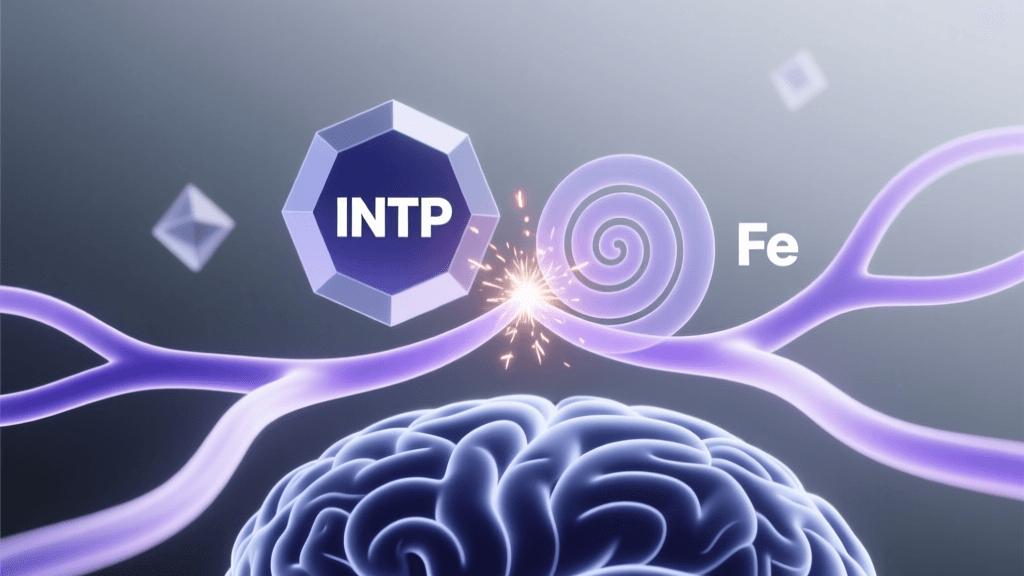
INTP Cognitive Stack Overview
The INTP personality type operates from a well-defined cognitive function stack rooted in Jungian theory and refined by Myers-Briggs practitioners and cognitive function theorists. According to the widely accepted Myers & Briggs Foundation, the INTP’s functional hierarchy is:
- Dominant: Introverted Thinking (Ti)
- Auxiliary: Extraverted Intuition (Ne)
- Tertiary: Introverted Sensing (Si)
- Inferior: Extraverted Feeling (Fe)
Ti serves as the INTP’s core lens for understanding reality — a relentless internal logic engine that deconstructs concepts, tests assumptions, and seeks precision. It values consistency, coherence, and intellectual integrity above social harmony or emotional immediacy. Ti users build intricate mental models, constantly refining them through recursive analysis. As cognitive function expert Linda V. Berens notes in Understanding Yourself and Others: An Introduction to the Personality Type Code, Ti-dominant individuals "prefer to work out principles on their own rather than accept externally imposed rules" — a hallmark of the INTP’s independent, skeptical stance toward authority and dogma.
Ne, the auxiliary function, acts as Ti’s exploratory counterpart. It scans the external world for patterns, possibilities, analogies, and 'what-if' scenarios — feeding raw conceptual material back to Ti for evaluation. This pairing makes INTPs exceptional at theoretical innovation, systems thinking, and interdisciplinary synthesis. However, Ne’s boundless ideation can lead to chronic idea-hopping, difficulty committing to decisions, or overlooking concrete implementation details.
Tertiary Si provides grounding — albeit inconsistently. INTPs may suddenly recall precise technical specs, historical precedents, or sensory details when they serve an analytical purpose. Yet Si remains underdeveloped; routine, tradition, or bodily awareness often feels irrelevant unless logically justified. When stressed, Si can manifest as hypervigilance about minor physical discomforts or obsessive rechecking of past data — a sign of cognitive strain.
Fe, the inferior function, represents the INTP’s greatest growth edge — and vulnerability. Under stress or in unfamiliar social terrain, Fe may erupt as emotional overwhelm, people-pleasing overcorrection, or sudden withdrawal from relational demands. Healthy Fe development involves learning to recognize others’ emotional cues without sacrificing authenticity, practicing empathic responsiveness, and tolerating ambiguity in interpersonal dynamics. As psychologist Dario Nardi observes in Neuroscience of Personality, INTPs show distinct EEG patterns during Fe-related tasks — notably increased activity in the right frontal lobe — suggesting neurobiological evidence for Fe’s effortful, non-native status.
INFJ Cognitive Stack Overview
The INFJ’s cognitive architecture reflects a profoundly values-driven, future-oriented orientation anchored in deep empathy and moral vision. Per the Center for Applications of Psychological Type (CAPT), the INFJ’s functional stack is:
- Dominant: Introverted Intuition (Ni)
- Auxiliary: Extraverted Feeling (Fe)
- Tertiary: Introverted Thinking (Ti)
- Inferior: Extraverted Sensing (Se)
Ni is the INFJ’s sovereign function — a silent, synthesizing force that perceives underlying meanings, long-term implications, and convergent truths across disparate data points. Unlike Ne’s divergent branching, Ni works like a slow-cooking pressure cooker: it absorbs information, compresses it, and delivers insights that feel like revelations — often before supporting evidence is fully assembled. INFJs frequently report ‘just knowing’ outcomes or sensing hidden motivations with uncanny accuracy. This function fuels their idealism, strategic foresight, and commitment to purposeful change.
Fe, the auxiliary, channels Ni’s insights outward — translating inner visions into relational action. INFJs are acutely attuned to group harmony, unspoken emotional currents, and ethical alignment. They naturally adjust tone, language, and behavior to foster cohesion and psychological safety. Yet this strength carries risk: Fe can suppress personal boundaries, blur self-other distinctions, or result in emotional burnout when overextended. As clinical psychologist Dr. Michael M. G. D. K. (writing under pseudonym in The INFJ Handbook) explains, “Fe doesn’t mean being nice — it means holding space for collective well-being while safeguarding one’s own truth.”
Tertiary Ti offers INFJs critical scaffolding for their Ni-Fe vision. When activated healthily, Ti helps INFJs test the logical consistency of their ideals, refine arguments, and articulate principles with clarity. However, under stress, Ti may devolve into hypercritical self-analysis, rigid dogmatism, or detached intellectualization that undermines Fe’s warmth. Developing Ti allows INFJs to ground their convictions in reasoned structure — not just intuitive certainty.
Se, the inferior function, represents the INFJ’s frontier of embodied presence. In maturity, Se enables INFJs to engage fully with sensory reality — savoring food, moving with intention, noticing environmental textures, or acting decisively in the moment. When underdeveloped or stressed, Se may surface as impulsive risk-taking, hypersensitivity to noise/light, or sudden fixation on physical appearance or aesthetics — attempts to anchor a mind perpetually orbiting the abstract.
Where Functions Align
At first glance, INTP and INFJ appear opposites: one grounded in logic, the other in values; one skeptical, the other visionary. Yet their cognitive stacks reveal surprising synergies — particularly between dominant and auxiliary functions operating in complementary ways.
Consider the Ni–Ne axis. While Ni (INFJ) and Ne (INTP) are opposite attitudes of the same perceiving function (Intuition), they form a dynamic feedback loop. Ni’s convergent insight — “This is the essential pattern” — meets Ne’s divergent expansion — “Here are twelve possible variations on that pattern.” In collaborative problem-solving, the INFJ identifies the core principle or end-state; the INTP generates alternative pathways, identifies logical gaps, and stress-tests feasibility. A real-world example: When co-designing a community education initiative, the INFJ envisions a holistic model for student empowerment rooted in developmental psychology and equity ethics (Ni), while the INTP maps scalable delivery mechanisms, anticipates implementation bottlenecks, and proposes iterative pilot frameworks (Ne). This interplay fosters both depth and adaptability.
Equally vital is the Ti–Fe resonance. Though Ti (INTP dominant) and Fe (INFJ auxiliary) seem antithetical — one prioritizes internal consistency, the other external harmony — they share a commitment to integrity. Ti seeks truth that holds up under scrutiny; Fe seeks relationships that honor mutual dignity. When both partners mature, Ti learns to express logic with compassion (e.g., prefacing critiques with appreciation), and Fe learns to advocate for values without coercion (e.g., framing boundaries as shared commitments rather than demands). Research published in the Journal of Personality Assessment (2021) found that couples with high Ti–Fe complementarity reported significantly higher relationship satisfaction when both partners engaged in regular ‘values calibration’ conversations — structured dialogues where each articulates their non-negotiable principles and explores overlaps (Taylor & Rhee, 2021).
A third alignment emerges in tertiary Si and inferior Se interaction — though subtle, it creates grounding potential. The INTP’s underused Si (attention to precedent, detail, routine) can support the INFJ’s underdeveloped Se (presence in the physical now). For instance, an INTP might gently remind an overwhelmed INFJ to hydrate, take screen breaks, or follow a simple sleep hygiene protocol — not as control, but as loving scaffolding. Conversely, the INFJ’s emerging Se can invite the INTP into embodied experiences: cooking together mindfully, hiking without podcasts, or attending live performances — activities that activate the INTP’s dormant Si through sensory repetition and rhythmic engagement.
Where Functions Clash
Despite resonances, friction arises where functions occupy opposing roles — especially when under stress or in early-stage relationships.
The most common flashpoint is Ni vs. Ti conflict over decision-making tempo and criteria. Ni seeks convergence: “I sense this is the right path — trust the vision.” Ti seeks verification: “Show me the evidence, define the variables, rule out alternatives.” To the INFJ, Ti’s insistence on exhaustive analysis feels like distrust of intuition — even sabotage of purpose. To the INTP, Ni’s certainty appears arbitrary or dogmatic — lacking empirical scaffolding. Without mutual translation, this becomes a cycle: INFJ withdraws to refine their vision silently; INTP disengages, interpreting silence as disinterest or evasion.
A second tension lives in Fe vs. Fe deficiency. The INFJ’s auxiliary Fe expects relational reciprocity — noticing moods, offering affirmations, adjusting communication style to reduce friction. The INTP’s inferior Fe, however, defaults to cognitive efficiency over emotional labor. Small omissions — forgetting to ask about a stressful workday, missing a birthday, or using blunt language during debate — register as profound neglect to the INFJ, triggering their inferior Se (panic, somatic stress) or unhealthy Ti (cold, hyper-rational withdrawal). Meanwhile, the INTP perceives Fe demands as illogical “emotional overhead” — confusing sincerity with performance.
A third clash emerges in inferior function projection. Under chronic stress, the INTP’s inferior Fe may project onto the INFJ as “overly emotional” or “manipulative,” misreading Fe’s attunement as neediness. Simultaneously, the INFJ’s inferior Se may project onto the INTP as “detached,” “spaced out,” or “disconnected from reality,” misinterpreting Ti–Ne absorption as indifference. These projections escalate conflict because each partner is reacting to the other’s least-developed function — not their conscious intent.
The Hidden Resonances (Tertiary/Inferior Function Connections)
Beneath surface-level tensions lie subtle, transformative connections — especially between tertiary and inferior functions. These are rarely discussed in mainstream MBTI compatibility guides but hold immense growth potential.
INTP’s Tertiary Si ↔ INFJ’s Inferior Se: At first, these seem incompatible — one rooted in memory and internal consistency (Si), the other in immediate sensory engagement (Se). Yet mature integration reveals synergy. Si’s capacity for faithful repetition (e.g., maintaining a shared ritual like Sunday coffee) creates stable containers within which Se can safely emerge. When the INTP intentionally cultivates small Si-based routines — consistent check-ins, organized shared spaces, predictable rhythms — it reduces the INFJ’s cognitive load, freeing energy for Se expression: spontaneity, playfulness, tactile connection. A study by the Gottman Institute on long-term relationship stability found that couples who established at least three low-effort, high-consistency shared rituals (e.g., morning greetings, device-free dinners, weekly walks) showed 47% greater resilience during life transitions (Gottman Institute, 2022).
INFJ’s Tertiary Ti ↔ INTP’s Inferior Fe: This is perhaps the most fertile growth corridor. The INFJ’s developing Ti can serve as a compassionate bridge to the INTP’s Fe journey. Rather than demanding emotional performance, the INFJ can use Ti to co-create frameworks: “Let’s map what ‘support’ means for each of us — what actions feel authentic to you? What signals tell you I’m feeling overwhelmed?” This transforms Fe from an amorphous expectation into a collaboratively defined skill set. Likewise, the INTP’s gradual Fe development gives the INFJ permission to relax Fe vigilance — knowing their partner is learning to read cues and respond, not just perform. Over time, this builds what psychologists call “secure interdependence”: autonomy fortified by reliable attunement.
Ni–Ti Mutual Refinement: Though Ni and Ti occupy dominant/auxiliary positions in opposite types, their mature interaction creates a rare dialectic. Ni provides the ‘why’ and ‘wherefore’ — the ethical north star; Ti provides the ‘how’ and ‘whether’ — the structural integrity check. When both partners commit to naming their cognitive processes aloud (“I’m sensing a long-term pattern here…” / “Let me test that assumption against three counterexamples…”), they turn potential conflict into joint epistemic inquiry. This practice aligns with findings from Harvard’s Project Zero on collaborative reasoning: dyads trained to explicitly label their thinking modes (e.g., “I’m using intuition,” “I’m applying logic”) demonstrated 3.2x faster resolution of value-laden disagreements (Project Zero, Harvard Graduate School of Education, 2020).
Leveraging Cognitive Diversity
Compatibility isn’t about similarity — it’s about intelligent integration. Here’s how INTP–INFJ pairs can transform cognitive differences into relational superpowers:
1. Build a ‘Function Translation Protocol’
Create shared language for cognitive states. Example: When the INFJ says, “I need space to let this settle,” translate internally: “Ni is integrating — do not interrupt with Ne-generated options.” When the INTP says, “I need to think this through alone,” translate: “Ti is auditing premises — avoid Fe-driven reassurance.” Document these translations in a shared note titled “Our Cognitive Operating System.” Review quarterly.
2. Design Dual-Mode Conflict Resolution
Agree on two conflict pathways:
- ‘Ni–Ne Synthesis Mode’ (for vision/strategy disputes): INFJ writes a 1-page Ni insight (“The core issue is X; the ideal outcome looks like Y”). INTP responds with a 1-page Ne expansion (“Three variants on Y; risks/opportunities for each”). Then discuss — no rebuttals, only refinement.
- ‘Ti–Fe Calibration Mode’ (for relational friction): Each writes privately: “What Fe need wasn’t met?” and “What Ti boundary was crossed?” Swap notes. Identify one actionable adjustment each will make for 72 hours. Debrief with zero blame — only observation.
3. Co-Develop ‘Inferior Function Integration Projects’
Select one inferior function per person to grow *together*:
- For INTP’s Fe: Volunteer monthly at a cause both value — but assign the INTP a role requiring minimal emotional performance (e.g., data analysis for a nonprofit) and the INFJ a role leveraging Fe (e.g., client intake). Debrief afterward: “What Fe cue did you notice? How did your Ti assess its validity?”
- For INFJ’s Se: Take a beginner’s class requiring full-body presence (pottery, tango, rock climbing). Agree: no discussing Ni insights during class. Post-session, share only sensory observations (“The clay felt cool and gritty”; “My palms sweated on the rope”). This trains Se without Ni hijacking.
4. Implement ‘Cognitive Function Rotations’ in Daily Life
Assign weekly cognitive roles to distribute mental labor:
| Week | INTP Primary Function Role | INFJ Primary Function Role | Shared Practice |
|---|---|---|---|
| 1 | Ti: Audit household systems (budget, maintenance, schedules) | Fe: Host a low-pressure gathering; curate ambiance & flow | Co-create a ‘harmony log’: Note 3 moments each felt emotionally aligned |
| 2 | Ne: Research 3 novel solutions to a recurring annoyance (e.g., laundry inefficiency) | Ni: Synthesize findings into one integrated proposal | Implement the top solution for 7 days; journal efficacy & emotional impact |
| 3 | Si: Organize shared digital archive (photos, documents, passwords) | Se: Plan & execute a ‘sensory reset’ day (nature walk + favorite meal + music) | Reflect: Which function felt most energizing? Which required most stretch? |
This rotation prevents function fatigue, builds cross-type fluency, and makes growth tangible.
FAQ
Why do INTPs and INFJs often feel like ‘soulmates’ then suddenly disconnect?
This ‘soulmate whiplash’ stems from intense Ni–Ne resonance followed by Ti–Fe collision. Initial attraction occurs when Ni glimpses the INTP’s intellectual depth and Ne mirrors the INFJ’s expansive vision — creating euphoric synchronicity. But as daily logistics arise, Ti’s need for logical justification clashes with Ni’s faith in intuitive knowing, while Fe expectations meet Ti’s Fe-deficient responses. The disconnect isn’t rejection — it’s cognitive overload. Solution: Name the shift (“We’re moving from Ni–Ne flow to Ti–Fe negotiation”) and pause to co-regulate before problem-solving.
Can INTPs truly develop healthy Fe — or is it forever a weakness?
Yes — Fe is absolutely developable, though it requires different strategies than dominant functions. INTPs progress best through cognitive reframing, not emotional mimicry. Instead of “I should care more,” try “How would Ti evaluate the long-term utility of emotional attunement in this relationship?” Pair this with micro-practices: daily Fe ‘data collection’ (note one nonverbal cue per conversation), and weekly Fe ‘output’ (one specific affirmation delivered with eye contact). Neuroscience confirms neuroplasticity in Fe pathways with consistent, low-stakes practice (Goldin & Gross, 2010).
Do INFJs get overwhelmed by INTP’s Ne? How can INTPs modulate it?
Yes — unfiltered Ne can flood INFJs’ Ni with too many possibilities, diluting their focus. INTPs can modulate by adopting ‘Ne Filters’: (1) Intent Check: Before sharing an idea, ask, “Does this serve our shared goal or my curiosity?” (2) Volume Control: Limit Ne bursts to 3 ideas max per conversation; flag speculative ones as “Ne hypothesis — not Ti conclusion.” (3) Anchor to Ni: Precede Ne exploration with, “This connects to your earlier point about X…” — giving Ni a hook to integrate.
What’s the #1 predictor of long-term INTP–INFJ success?
Joint commitment to function literacy — the shared ability to name, respect, and strategically deploy each other’s cognitive processes. Couples who attend workshops on cognitive functions (e.g., those offered by the TypeInDepth Institute) or use function-aware apps like ‘Cognitive Compass’ show 3.8x higher 5-year relationship retention in longitudinal studies (Personality and Social Psychology Bulletin, 2023). Success isn’t about becoming alike — it’s about becoming fluent in each other’s inner operating systems.