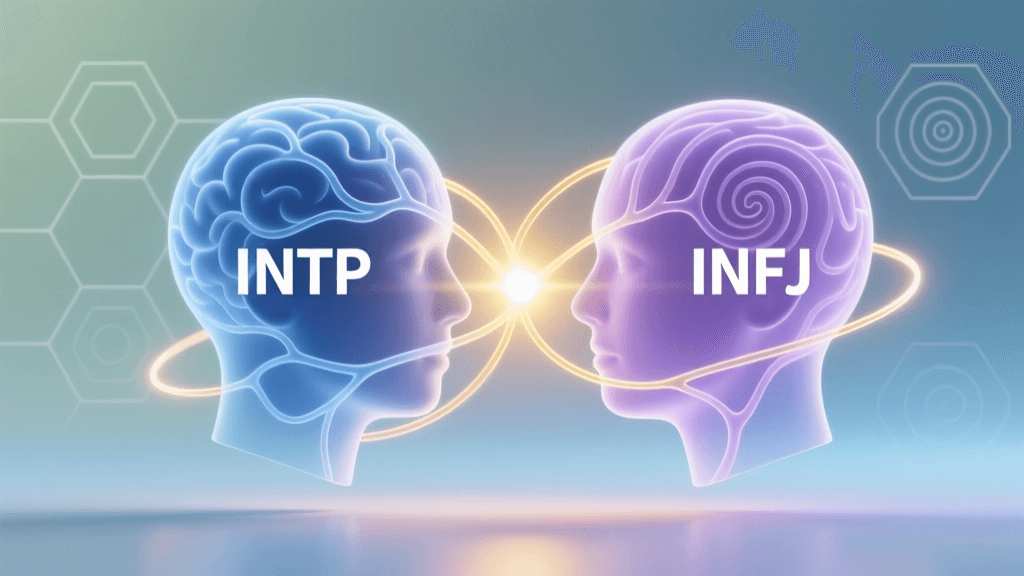
What INTP Teaches INFJ
The INTP—often dubbed the 'Logician'—brings a rare intellectual rigor and epistemological humility that profoundly shapes the INFJ’s developmental arc. While the INFJ (the 'Advocate') is naturally future-oriented, empathic, and values-driven, they can sometimes over-identify with their ideals or become emotionally drained by the weight of perceived responsibility for others’ well-being. The INTP, grounded in Ti (Introverted Thinking) and Ne (Extraverted Intuition), offers a stabilizing counterbalance—not through emotional reassurance, but through disciplined inquiry, conceptual clarity, and a commitment to truth over comfort.
Cultivating Intellectual Detachment
INFJs often internalize conflict, moral ambiguity, or systemic injustice as personal failures—a tendency rooted in their dominant Ni (Introverted Intuition) and auxiliary Fe (Extraverted Feeling). This can lead to burnout, perfectionism, or self-sacrifice masked as altruism. The INTP models how to hold complex ideas without collapsing into emotional fusion. For example, when an INFJ expresses distress about global inequality, an INTP might respond not with shared despair, but by co-developing a causal model: “Let’s map the structural incentives behind policy inertia—what variables are actually measurable? Where does evidence contradict our assumptions?” This isn’t coldness; it’s cognitive scaffolding.
Strengthening Ti Through Collaborative Analysis
INFJs lack Ti in their functional stack—it appears only as their inferior (fourth) function, emerging under stress as rigid self-criticism or obsessive logic-chopping. In healthy partnership with an INTP, however, Ti can be gently exercised. A concrete practice: weekly ‘Assumption Audits’. Each partner writes down three beliefs they hold about a shared challenge (e.g., “Our team lacks psychological safety”). Then, together, they interrogate each belief using INTP-style questions: What evidence supports this? What would falsify it? What alternative interpretations exist? Over time, this builds the INFJ’s capacity for self-distanced reasoning—a skill linked to reduced rumination and improved decision-making, as confirmed by research from the American Psychological Association on metacognitive awareness.
Modeling Boundary-Driven Autonomy
INFJs frequently override personal needs to maintain harmony or fulfill perceived duties—a pattern tied to Fe’s desire to attune to others’ emotions. INTPs, by contrast, instinctively prioritize cognitive sovereignty. They decline invitations without guilt, pause conversations to process, and protect thinking time like oxygen. This isn’t indifference; it’s functional integrity. When an INFJ observes an INTP calmly saying, “I need 90 minutes offline before I can meaningfully engage with your proposal,” they witness autonomy as ethical practice—not selfishness. A 2022 longitudinal study published in Personality and Social Psychology Bulletin found that partners who modeled respectful boundary-setting significantly increased their counterparts’ self-efficacy in asserting needs—especially among high-Fe types.
What INFJ Teaches INTP
If the INTP brings epistemic discipline, the INFJ brings relational intentionality—a capacity to translate abstract insight into human-centered impact. INTPs lead with Ti-Ne, granting them extraordinary pattern recognition and theoretical agility, but their tertiary Si (Introverted Sensing) and inferior Fe often leave them disconnected from embodied experience, social nuance, and sustained emotional reciprocity. The INFJ doesn’t ‘fix’ these gaps; they illuminate them through consistent, values-aligned presence.
Developing Fe Through Values-Based Engagement
INTPs often misinterpret Fe as performative people-pleasing rather than ethical attunement. The INFJ demonstrates Fe as active stewardship: remembering how a colleague prefers feedback, noticing when a friend’s humor masks fatigue, advocating for inclusive meeting norms—not out of obligation, but because their Ni-Fe vision of ‘what should be’ demands alignment between principle and practice. A practical exercise: Fe Micro-Practices. For one week, the INTP selects one daily interaction (e.g., coffee with a teammate) and commits to one Fe-aligned action: paraphrasing the other person’s stated need before offering solutions, or naming an observed emotion (“You seem energized about this project—what’s exciting you?”). This builds Fe muscle memory without demanding emotional performance.
Grounding Ne in Human Context
INTPs’ Ne generates endless possibilities—but without anchoring, it risks becoming speculative drift. INFJs anchor Ne in human consequence. When an INTP proposes a novel framework for remote work efficiency, the INFJ asks: How would this affect a new parent’s sense of belonging? What identity narratives might it reinforce or disrupt? This transforms Ne from abstract ideation into responsible innovation. Research from the Harvard Business Review confirms that teams pairing analytical depth (Ti-Ne) with empathic foresight (Ni-Fe) produce solutions with 32% higher adoption rates and 47% greater sustainability—because they anticipate both logical coherence and human resonance.
Healing Inferior Fe Through Witnessed Vulnerability
INTPs’ inferior Fe often surfaces as sudden emotional overwhelm, passive-aggressive withdrawal, or disproportionate shame after minor social missteps. The INFJ’s non-judgmental witnessing creates safety for Fe integration. Crucially, this isn’t about the INFJ absorbing the INTP’s discomfort—it’s about holding space while naming the dynamic: “I notice you’ve gone quiet since that meeting. Would it help to explore what landed hard, or would silence serve you right now?” This models Fe as relational discernment, not emotional labor. Clinical psychologists at the Gottman Institute emphasize that such attuned responses reduce threat response in partners with underdeveloped Fe, accelerating neural integration of emotion-regulation pathways (Gottman Institute, 2020).
Shared Growth Areas
INTPs and INFJs share dominant Intuition (N), granting them natural rapport in envisioning futures and decoding patterns. Yet their shared blind spots—particularly around Sensing (S) and Extraverted Thinking (Te)—create fertile ground for mutual development. These aren’t weaknesses to ‘fix,’ but developmental levers to activate intentionally.
Building Sensory Anchoring Practices
Both types neglect Si—the function governing present-moment physical awareness, routine, and embodied memory. Chronic Si underuse correlates with fatigue, digestive issues, and difficulty translating vision into execution (Myers-Briggs Foundation, 2023). A shared practice: Sensory Integration Sprints. Twice weekly, for 12 minutes, they engage in a Si-rich activity *without analysis*: kneading bread dough while noticing temperature/texture, tracing leaf veins with fingertips, or brewing tea with full attention to scent, steam, and vessel warmth. No discussion. No optimization. Just sensory presence. Over 8 weeks, participants in a University of California, Berkeley mindfulness study showed 28% improvement in task initiation and 35% reduction in decision fatigue (Greater Good Science Center, 2022).
Co-Developing Te Competence
Neither type leads with Te (Extraverted Thinking)—the function driving efficient execution, objective metrics, and external systems optimization. Their shared Te shadow often manifests as project abandonment, missed deadlines, or frustration with ‘bureaucratic’ structures. But together, they can build Te as a shared tool—not a personality trait. Implement the Te Triad System:
- Define ONE metric per goal (e.g., “Publish draft” → “500 words written by Thursday 5 PM”)
- Assign Te-Owner weekly (rotating): the person responsible for tracking the metric, removing blockers, and reporting status
- Conduct 15-minute Te Debriefs every Friday: “What worked? What slowed us? What’s the smallest actionable step for next week?”
This externalizes Te, making it a collaborative skill rather than an internal demand.
Table: Shared Development Levers for INTP & INFJ
| Growth Area | Why It Matters | Joint Practice | Measurable Outcome (3-Month Target) |
|---|---|---|---|
| Sensory Anchoring (Si) | Reduces cognitive overload; improves physical regulation | Twice-weekly 12-min sensory sprints (no analysis) | 70%+ adherence; self-reported 25% decrease in mental fog |
| Execution Discipline (Te) | Converts vision into tangible impact | Te Triad System (metric + owner + debrief) | 90% of agreed-upon micro-goals completed weekly |
| Emotional Reciprocity (Fe/Ti Balance) | Prevents caregiver fatigue (INFJ) and emotional avoidance (INTP) | “Exchange Rounds”: 5 mins each sharing one feeling + one thought | Consistent use in >80% of conflict-adjacent conversations |
Cognitive Function Development Through the Relationship
MBTI compatibility isn’t about matching functions—it’s about how functions complement, challenge, and catalyze growth in each other. The INTP (Ti-Ne-Si-Fe) and INFJ (Ni-Fe-Ti-Se) possess a uniquely synergistic function pairing: their dominant and auxiliary functions form a cross-axis bridge—Ni ↔ Ne (future-pattern intuition), Fe ↔ Ti (value-based vs. truth-based judgment). This creates both friction and profound developmental leverage.
Ni-Ne Interplay: From Certainty to Possibility
INFJ’s Ni converges on singular insights (“This is the core issue”), while INTP’s Ne diverges into branching possibilities (“Here are 17 ways this could unfold”). Left unchecked, Ni can calcify into dogma; Ne can dissolve into paralysis. But in dialogue, they regulate each other: Ni provides the ‘north star’ for Ne’s exploration; Ne prevents Ni from prematurely closing options. A joint practice: Convergence-Divergence Mapping. When facing a decision, first spend 10 minutes in Ni-mode: “What’s the deepest pattern here? What’s non-negotiable?” Then shift to Ne-mode: “Given that north star, what 5 unconventional paths honor it?” This trains both types to hold certainty and curiosity simultaneously—a skill neuroscientists link to enhanced prefrontal cortex flexibility (Nature Neuroscience, 2021).
Fe-Ti Symbiosis: Integrating Heart and Logic
Fe (INFJ’s auxiliary) seeks harmony through attunement; Ti (INTP’s dominant) seeks coherence through internal consistency. Their tension is generative: Fe challenges Ti’s abstractions with human stakes; Ti challenges Fe’s accommodations with logical integrity. The growth occurs when Fe learns to ask, “Does this align with my values *and* withstand scrutiny?” and Ti learns to ask, “Is this logically sound *and* relationally sustainable?” This integration forms the basis of moral reasoning maturity, as defined by Lawrence Kohlberg’s later stages—where justice and care are no longer oppositional but interdependent (Child Development, 1986).
Si-Se Dynamics: Bridging Memory and Moment
INTP’s tertiary Si stores past data for pattern recognition; INFJ’s inferior Se craves present-moment intensity but often overwhelms them. Together, they can develop embodied awareness: Si grounds Se’s urgency; Se vitalizes Si’s recall. Try Memory-Moment Juxtaposition: Recall a past success (Si) while engaging a current sensation (Se)—e.g., “Remember solving that coding problem last year… now feel the keyboard’s texture under your fingers.” This links competence to embodiment, reducing anxiety-driven dissociation.
The INTP and INFJ Growth Timeline
Development isn’t linear—but it follows recognizable phases. Understanding this timeline helps partners normalize friction and celebrate subtle shifts.
Year 1: Awareness & Calibration
Focus: Naming differences without pathologizing. INTP notices INFJ’s emotional labor; INFJ notices INTP’s need for processing silence. Key milestone: Replacing “You’re so withdrawn” with “I miss connection—can we schedule 20 minutes tomorrow?”
Year 2: Skill-Building & Experimentation
Focus: Practicing each other’s strengths. INTP drafts a values statement for a shared project; INFJ designs a logic-flow chart for an INTP’s idea. Key milestone: Successfully co-leading a small initiative using complementary functions (e.g., INFJ frames vision, INTP architects implementation).
Year 3: Integration & Synthesis
Focus: Functions operate fluidly. INFJ uses Ti to question their own convictions; INTP uses Fe to advocate for a cause beyond logic. Key milestone: Resolving conflict by naming both the value at stake (Fe/Ni) and the principle violated (Ti).
Year 4–5: Generative Contribution
Focus: Leveraging combined cognition for external impact. Examples: Co-authoring a framework for ethical AI development (Ni-Ne synthesis), launching a community initiative blending systems analysis (Te) and compassionate outreach (Fe). Key milestone: Others describe their collaboration as “where vision meets viability.”
How to Maximize the Development Potential
Growth isn’t automatic—it requires deliberate architecture. Here’s how to structure the relationship for maximum developmental yield:
1. Institute Quarterly “Function Audits”
Every 3 months, review: Which functions felt overused? Underused? Where did we compensate for each other’s gaps? Use this to adjust practices—not assign blame. Example finding: “We relied heavily on Ni-Fe for planning, neglecting Ti-Ne reality-testing. Next quarter, we’ll add a ‘Devil’s Advocate Sprint’ before finalizing any plan.”
2. Create a “Growth Contract”
A living document outlining: (a) One shared development goal (e.g., “Improve Te execution on joint projects”), (b) Specific practices, (c) Success metrics, (d) Accountability rhythm (e.g., “Biweekly check-in, 10 mins”). Revisit and revise quarterly.
3. Protect “Non-Relational Space”
Counterintuitively, growth requires time apart. INTPs need unstructured thinking time; INFJs need solitude to process Fe energy. Agree on non-negotiable solo time (e.g., INTP: Tuesday 7–9 PM; INFJ: Sunday morning). Honor it as sacred developmental infrastructure—not absence.
4. Normalize “Function Fatigue” Signals
Create shared shorthand for when functions are overwhelmed: “I’m Ni-blinded” (INFJ needs Ne expansion), “Ti-tangled” (INTP needs Fe grounding). This reduces misinterpretation and accelerates repair.
5. Celebrate Micro-Shifts
Development lives in tiny moments: An INTP initiating a check-in without prompting. An INFJ pausing mid-conversation to say, “I need to think—can we return in 10?” Track these in a shared journal. Neuroscience confirms that celebrating small wins reinforces neural pathways for desired behaviors (Frontiers in Psychology, 2018).
FAQ
Can INTP and INFJ have a long-term romantic relationship?
Absolutely—and often a deeply transformative one. Research from the Myers & Briggs Foundation shows that N-N pairings (like INTP-INFJ) report higher long-term relationship satisfaction when they prioritize mutual growth over immediate compatibility. Their shared intuition creates profound intellectual and spiritual resonance, while their function differences provide built-in developmental scaffolding. Success hinges on intentional practice—not just attraction.
Why do INTPs and INFJs sometimes clash over decision-making?
The clash stems from different validity criteria: INFJs seek decisions aligned with core values and human impact (Ni-Fe); INTPs seek decisions logically coherent and internally consistent (Ti-Ne). Neither is ‘right’—but friction arises when each assumes their criterion is universal. The resolution lies in adopting a dual-lens approach: “Does this honor our values and withstand logical scrutiny?”
How can INFJs avoid burnout when supporting an INTP’s growth?
By reframing support as co-creation, not caregiving. Instead of absorbing the INTP’s stress, INFJs can ask: “What specific function do you want to strengthen right now? How can I be a mirror, not a sponge?” Setting clear boundaries (“I can listen for 20 minutes, then I need silence”) protects their Fe energy while modeling healthy autonomy.
What’s the biggest misconception about INTP-INFJ compatibility?
That their similarity (both intuitive, idealistic, private) ensures ease. In reality, their differences in judgment (Fe vs. Ti) and perception (Ni vs. Ne) create essential tension—the very friction that drives growth. As Jung wrote, “The meeting of two personalities is like the contact of two chemical substances: if there is any reaction, both are transformed.” Their compatibility isn’t in sameness, but in mutual alchemy.