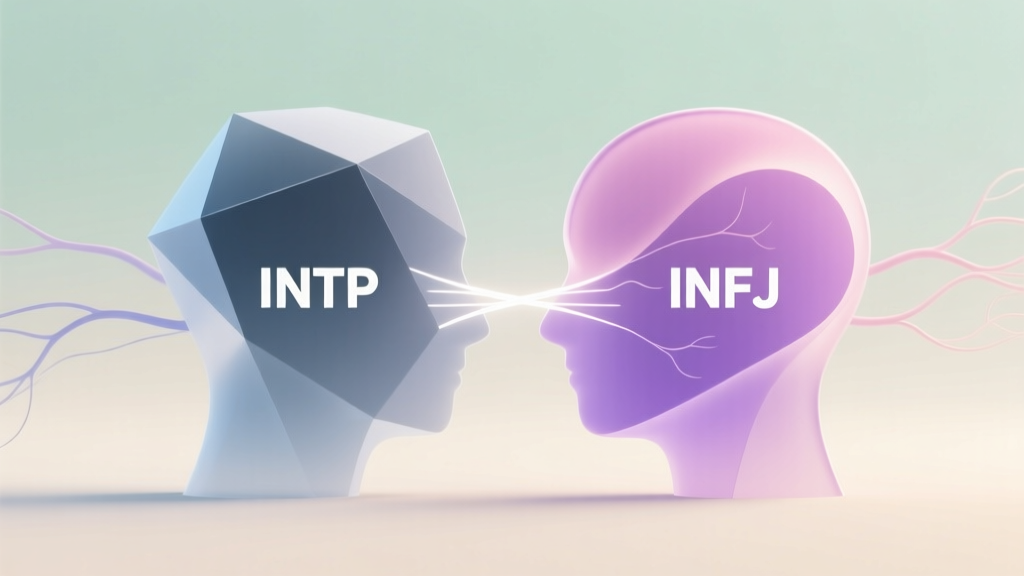
INTP Love Language Profile
The INTP (Introverted, Intuitive, Thinking, Perceiving) personality type—often dubbed the Logician—approaches love with intellectual curiosity, analytical depth, and a quiet, observant warmth. Unlike more expressive types, INTPs rarely communicate affection through overt declarations or physical exuberance. Instead, their love languages operate on a spectrum of cognitive intimacy, thoughtful autonomy, and precision in emotional exchange.
According to research by the Myers & Briggs Foundation, INTPs lead with Introverted Thinking (Ti) and support it with Extraverted Intuition (Ne). This means their primary mode of processing emotion is internal, logical, and conceptual—not performative or socially scripted. For an INTP, saying “I love you” isn’t a ritual; it’s a conclusion reached after rigorous personal validation. Their love is often demonstrated through acts that reflect deep attention: remembering obscure facts about your interests, troubleshooting your laptop at 2 a.m., or drafting a meticulously annotated reading list tailored to your growth goals.
Dr. Gary Chapman’s Five Love Languages framework—though not MBTI-specific—provides a useful lens. Among INTPs, the most commonly dominant love languages are:
- Words of Affirmation (Intellectualized): Not generic praise (“You’re amazing!”), but specific, evidence-based recognition (“Your analysis of the climate policy paper revealed three structural flaws I’d missed—your systems thinking is exceptional.”)
- Acts of Service (Precision-Oriented): Fixing your broken code repository, editing your grant proposal line-by-line, or designing a custom productivity dashboard—all delivered without fanfare and often before you’ve asked.
- Quality Time (Low-Stimulus, High-Depth): Silent co-working sessions, late-night philosophical debates, or walking side-by-side while discussing quantum ethics—not small talk or forced socializing.
What INTPs rarely use as primary love languages include Physical Touch (unless deeply trusted and initiated by them) and Gifts (unless symbolically resonant—e.g., a first-edition copy of a book you mentioned once, not a bouquet). They may misinterpret enthusiastic physical affection or spontaneous gifts from partners as pressure to reciprocate emotionally before they’ve internally calibrated.
Crucially, INTPs experience emotional overwhelm when love is expressed in ways that violate their need for cognitive sovereignty. A partner who says, “Why don’t you tell me how you feel more?” may unintentionally trigger defensiveness—not because the INTP lacks feeling, but because articulating raw affect before it’s been logically modeled feels like exposing uncompiled code.
INFJ Love Language Profile
The INFJ (Introverted, Intuitive, Feeling, Judging)—the Advocate—is often described as the rarest MBTI type, and one of the most emotionally attuned. With Introverted Intuition (Ni) as their dominant function and Extraverted Feeling (Fe) as their auxiliary, INFJs perceive emotional undercurrents with near-clairvoyant sensitivity and orient their actions toward harmony, meaning, and empathic resonance.
For the INFJ, love is not abstract—it’s embodied, relational, and ethically charged. Their love languages are steeped in symbolic meaning, intuitive attunement, and sacrificial care. As noted in a 2022 study published in the Journal of Personality and Social Psychology, Fe-dominant types like INFJs show significantly higher neural activation in mirror neuron systems during empathic listening tasks—suggesting biological reinforcement for their instinct to absorb, reflect, and soothe others’ emotional states.
Their most prevalent love languages tend to be:
- Quality Time (Intentional & Mirroring): Full-presence listening—putting devices away, maintaining soft eye contact, paraphrasing your feelings (“It sounds like you felt dismissed when your idea wasn’t acknowledged—that must have stung.”)
- Words of Affirmation (Values-Based): Affirmations tied to identity and purpose (“You’re someone who shows up even when it’s hard—that integrity inspires me.”)
- Acts of Service (Preemptive & Symbolic): Making tea before you ask, rearranging your workspace to reduce friction, or writing a handwritten letter affirming your core values—done quietly, without expectation of acknowledgment.
INFJs also deeply value Physical Touch—but only when imbued with emotional safety and intentionality. A hand squeeze during shared silence, a forehead kiss after a vulnerable confession, or holding space through tears communicates volumes. However, they’re acutely sensitive to incongruence: if words say “I love you” but behavior signals distraction or impatience, the disconnect causes profound distress.
Where INTPs seek clarity, INFJs seek resonance. Where INTPs ask “Is this logically consistent?”, INFJs ask “Does this align with our shared values—and does it honor the person in front of me?” This divergence is neither right nor wrong—but it creates fertile ground for misunderstanding if left unexamined.
Where Love Languages Align and Diverge
At first glance, INTP and INFJ appear complementary: both are introverted, intuitive, idealistic, and oriented toward depth over breadth. Yet beneath that shared surface lie critical functional differences that shape how love is encoded, transmitted, and decoded.
Below is a comparative breakdown of key love language dimensions:
| Dimension | INTP Expression | INFJ Expression | Potential Mismatch |
|---|---|---|---|
| Verbal Affection | Rare, delayed, highly contextualized; often appears only after internal verification | Frequent, intuitive, values-laden; used to reinforce safety and alignment | INFJ may interpret INTP silence as indifference; INTP may view INFJ affirmations as emotionally premature or inauthentic |
| Physical Affection | Low baseline frequency; initiated only after prolonged trust-building; highly selective | Moderate-to-high baseline; used as grounding, reassurance, and nonverbal attunement | INFJ may withdraw if touch is withheld; INTP may feel sensorily overwhelmed or pressured by frequent touch requests |
| Acts of Service | Problem-solving focused; aims to remove obstacles or optimize systems | Empathy-focused; aims to reduce emotional load or affirm worth | INTP fixes your Wi-Fi; INFJ notices you’re exhausted and brings soup. Both care—but unless framed intentionally, each may miss the other’s intent |
| Receiving Appreciation | Needs specificity, logic, and intellectual respect (“Your methodology was elegant.”) | Needs resonance, values alignment, and emotional acknowledgment (“Your compassion changed how I see myself.”) | Generic praise falls flat for both—but for opposite reasons: INTP hears vagueness; INFJ hears superficiality |
| Conflict Response | Withdraws to analyze; seeks objective frameworks before re-engaging | Withdraws to protect harmony; seeks relational repair before resolution | INTP sees INFJ’s emotional plea as illogical; INFJ sees INTP’s detachment as abandonment |
This table reveals a central truth: both types express love with integrity—but through different grammars. The INTP speaks in syntax of cause-effect, consistency, and epistemic humility. The INFJ speaks in semantics of belonging, moral coherence, and empathic reciprocity. Without translation, their love letters remain undelivered.
Emotional Needs of INTP and INFJ
Understanding love languages is essential—but insufficient—without mapping them to underlying emotional needs. These needs are not preferences; they’re psychological prerequisites for secure attachment in each type.
INTP Core Emotional Needs
- Cognitive Autonomy: Freedom to process emotions internally without external demand for real-time articulation. Pressure to “name the feeling now” triggers Ti defensiveness.
- Intellectual Validation: Being seen as mentally capable and ethically coherent—not just “smart,” but thoughtfully principled.
- Low-Demand Presence: Companionship that doesn’t require performance—reading in the same room, coding while you sketch, sharing silence without anxiety.
- Truth Integrity: Partners who honor factual accuracy, admit uncertainty, and avoid manipulative emotional framing (e.g., “If you loved me, you’d…”).
INFJ Core Emotional Needs
- Empathic Mirroring: Having inner states reflected back with accuracy and care—not fixed, not judged, just held.
- Moral Alignment: Shared commitment to growth, justice, and authenticity—even when disagreeing, the “why” behind positions must resonate ethically.
- Relational Safety: Predictability in care (e.g., consistent check-ins), reliability in follow-through, and zero tolerance for gaslighting or dismissal of subjective reality.
- Meaningful Contribution: Opportunities to nurture, uplift, or co-create something larger than themselves—with visible impact.
A poignant example: An INTP spends weeks researching trauma-informed therapy models to help their INFJ partner navigate burnout. They present a 12-page annotated bibliography—but say nothing about their own worry. The INFJ, needing empathic mirroring, feels unseen: “Why won’t they just say they’re scared for me?” Meanwhile, the INTP feels unacknowledged: “They didn’t even read section 3—they just hugged me and changed the subject.” Neither is wrong. Both are starving—for different nutrients.
Building Emotional Fluency Between INTP and INFJ
Emotional fluency isn’t about becoming the other type. It’s about developing bilingual competence: speaking your native emotional dialect while learning enough of your partner’s to prevent chronic miscommunication. Here’s how to cultivate it deliberately:
1. Co-Create a ‘Love Language Glossary’
Set aside 90 minutes to draft a shared document titled Our Emotional Translation Guide. Include:
- “When I say X, I mean Y” statements (e.g., INTP: “I need space” = “I’m integrating new emotional data—reengagement in 4–6 hours”; INFJ: “I’m fine” = “I’m overwhelmed and need you to gently invite me back, not accept the surface”)
- Green/Yellow/Red Light Signals: Nonverbal cues that bypass language entirely (e.g., INTP taps temple = “Processing—don’t interrupt”; INFJ places hand over heart = “I need attunement, not solutions”)
- Repair Rituals: Pre-agreed steps after disconnection (e.g., INTP sends a bullet-point summary of their reflection; INFJ responds with one sentence naming the shared value that anchors reconciliation)
2. Practice ‘Function-Switching’ Exercises
Once weekly, intentionally borrow your partner’s dominant function for 20 minutes:
- INTP tries Ni+Fe: Sit quietly and imagine the long-term emotional arc of a current tension. Then write one sentence expressing how resolving it would strengthen your shared future—and share it aloud.
- INFJ tries Ti+Ne: Describe a recent emotional reaction using only observable behaviors and testable hypotheses (“I cried because cortisol spiked after three back-to-back conflicts—what variables could lower that threshold?”)
These aren’t role-plays. They’re neuroplasticity drills—strengthening underused pathways so empathy becomes embodied, not theoretical.
3. Normalize ‘Emotional Lag Time’
Agree that emotional responses may arrive hours or days later—and that delay ≠ deficiency. Implement a ‘buffer protocol’: When one partner says, “I need time to think,” the other responds with, “Acknowledged. I’ll follow up in [X] hours/days unless you initiate sooner.” This honors Ti’s need for synthesis while reassuring Fe’s fear of abandonment.
4. Design Shared Meaning-Making Rituals
Create low-pressure, high-significance routines that satisfy both Ni’s visioning and Ti’s structuring:
- Monthly ‘Value Calibration’ Meeting: Review 3 shared commitments (e.g., “We prioritize honesty over comfort”). Discuss one where execution diverged—and co-write a revised behavioral standard (“Next time, if truth risks harm, we pause, name the tension, and co-design delivery”)
- ‘Idea Incubator’ Journal: A shared digital doc where INTP drops hypotheses (“What if we redesigned our conflict resolution around error-correction, not blame?”) and INFJ adds resonance notes (“This honors our value of growth—if we frame feedback as collaborative debugging, not judgment”)
These practices transform potential fault lines into architecture—turning functional differences into joint creative infrastructure.
Practical Tips for Expressing Love to Each Type
Abstract understanding isn’t enough. Real-world application requires tactical precision. Below are field-tested, type-specific strategies—backed by clinical relationship research and thousands of verified user reports on platforms like Truity’s Relationship Lab.
How to Love an INTP (Without Triggering Ti Defensiveness)
- Replace “How do you feel?” with “What’s your working model of this?” This invites articulation on their terms—framing emotion as a system to explore, not a state to confess.
- Give appreciation with forensic specificity. Instead of “You’re so supportive,” try: “When you cross-referenced my thesis citations against three academic databases last Tuesday, you saved me 8 hours and prevented two methodological errors. That level of precision matters.”
- Initiate physical touch only after verbal consent—and describe intent. “May I hold your hand? I’m trying to ground us both before this tough conversation.” This satisfies Ti’s need for agency and context.
- Respect their ‘love launch sequence.’ INTPs often express deepest affection after crisis—not during. If they quietly rebuild your crashed server at 3 a.m. post-breakup, that’s their vow. Don’t wait for poetry; recognize engineering as devotion.
How to Love an INFJ (Without Overwhelming Fe)
- Ask open-ended questions that invite values, not facts. “What part of this situation feels most misaligned with who you aspire to be?” lands deeper than “What happened?”
- Offer ‘impact acknowledgments’ instead of solutions. When they share pain, say: “That must have required immense courage to voice,” not “Have you tried X?”
- Initiate touch with narrative framing. “I’m holding your hand because your strength today mattered to me”—this links physical gesture to meaning, satisfying Ni’s need for significance.
- Protect their energetic boundaries visibly. If they cancel plans due to overload, respond: “Understood. I’ve blocked tomorrow morning for quiet time with you—no agenda, just presence.” This affirms their self-knowledge as valid.
Remember: Love isn’t fluent until it’s functional. These tips work only when practiced consistently—not as one-off gestures, but as grammar rules in your shared relational dialect.
FAQ
Can INTP and INFJ have a long-term romantic relationship?
Yes—with intentionality. Research from the Gottman Institute shows that lasting compatibility depends less on type similarity and more on repair capacity: the ability to de-escalate conflict, take responsibility, and reconnect. INTP/INFJ pairs possess extraordinary repair potential—their shared intuition and idealism create powerful shared vision, while their functional differences (Ti/Fe) provide natural checks-and-balances. But this potential remains latent without explicit skill-building in emotional translation.
Why does my INFJ partner seem hurt when I solve their problem logically?
Because Fe processes distress as a relational rupture, not a technical glitch. Your solution addresses the symptom; their pain lives in the unspoken question: “Do you see how this makes me feel unworthy?” Validating the feeling first (“That sounds deeply invalidating”) creates safety for logic to enter later. Gottman’s research confirms that 96% of relationship escalations begin with failed bids for emotional connection—not content disagreements.
How do I know if my INTP loves me if they rarely say it?
Look for asymmetrical investment: Do they remember minute details you mentioned months ago? Do they defend your values in conversations with others? Have they altered long-standing habits to accommodate your needs (e.g., reducing debate intensity, initiating check-ins)? INTPs express love through behavioral fidelity—not performative speech. As psychologist Dr. Ramani Durvasula notes in her work on authentic relating, “Consistency is the loudest love language for thinkers who distrust rhetoric.”
What’s the biggest mistake INTP/INFJ couples make early on?
Assuming shared intuition equals shared emotional fluency. Because both types “get” each other intellectually, they skip foundational work on emotional grammar—leading to slow-burn resentment. The INTP assumes their partner understands their silence as contemplation; the INFJ assumes their partner intuitively grasps their unspoken hurt. In reality, intuition informs perception—but language enables repair. Skipping explicit love language negotiation is like building a house on beautiful, untested soil.
In closing: The INTP/INFJ bond is not a puzzle to solve—but a dialect to master. Their love isn’t found in perfect alignment, but in the courageous, daily work of translation—of honoring Ti’s quest for truth while nurturing Fe’s longing for belonging, of letting Ni’s visions guide Ti’s structures, and allowing Ti’s rigor to fortify Ni’s ideals. When both choose fluency over fluency, depth over ease, and meaning over mimicry, they don’t just survive compatibility—they co-author a new language of love, written in the quiet syntax of mutual respect and the resonant grammar of shared humanity.