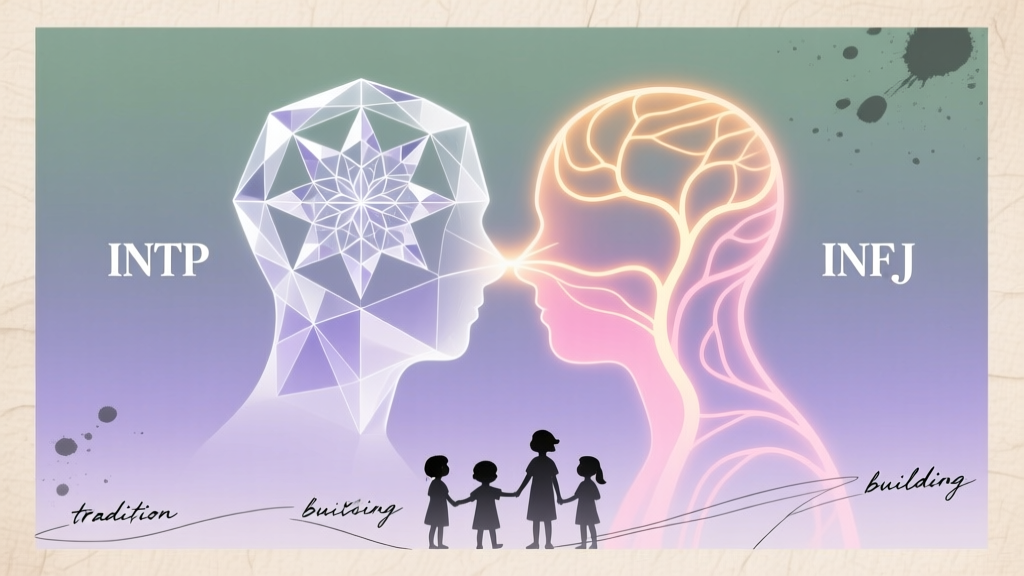
INTP as a Parent
The INTP (Introverted, Intuitive, Thinking, Perceiving) parent is often described as the 'philosopher-parent' — deeply curious, intellectually generous, and quietly observant. Rather than enforcing rigid routines, INTPs tend to approach parenting as an evolving experiment grounded in logic, autonomy, and open-ended inquiry. They rarely rely on tradition or authority for discipline; instead, they prefer to reason with their children, explaining the 'why' behind rules and encouraging critical thinking from an early age.
INTPs excel at fostering intellectual independence. A 2022 study published in Frontiers in Psychology found that children raised by parents high in Openness to Experience (a core trait strongly associated with INTPs) demonstrated significantly higher scores in divergent thinking and problem-solving flexibility by age 10. This aligns with the INTP’s natural inclination to ask ‘What if?’ rather than ‘What’s expected?’ — a mindset that nurtures creativity but can sometimes delay concrete action.
However, INTP parents may struggle with emotional scaffolding. Their preference for internal processing means they often withhold reassurance until they’ve fully analyzed a situation — which can leave sensitive or anxious children feeling unsupported in moments of acute need. They may also under-prioritize logistical consistency: forgetting school forms, missing pickup windows, or postponing household repairs while pondering theoretical alternatives. These aren’t signs of neglect — rather, they reflect a cognitive architecture optimized for ideation over execution.
Practical strengths include:
- Adaptive Learning Support: INTPs readily tailor educational approaches — e.g., designing custom science experiments for a child fascinated by volcanoes or coding a simple Python script to visualize fractions.
- Conflict De-escalation Through Reason: When siblings argue, INTPs often step in not with punishment, but with Socratic questioning: “What need wasn’t met? What assumptions are you both making?”
- Respect for Autonomy: INTPs typically avoid micromanaging homework or extracurriculars, trusting children to develop self-direction — a practice supported by longitudinal research from the American Psychological Association, which links parental autonomy support to stronger adolescent identity formation and academic resilience.
INFJ as a Parent
The INFJ (Introverted, Intuitive, Feeling, Judging) parent embodies what psychologist Carl Rogers called ‘unconditional positive regard’ — a deep, intuitive attunement to emotional nuance and developmental potential. INFJs parent with quiet intentionality, often crafting rich inner narratives about each child’s unique path. They’re less interested in behavioral compliance than in nurturing moral imagination, empathy, and authenticity. An INFJ mother might spend evenings journaling reflections on her child’s shifting social dynamics; an INFJ father may quietly rearrange weekend plans to accommodate a teenager’s unspoken need for solitude after a stressful week.
INFJs intuitively recognize micro-signals of distress — a withdrawn posture, a change in art style, hesitation before answering ‘How was school?’ — and respond with gentle, values-aligned guidance. This sensitivity is rooted in their dominant function, Introverted Intuition (Ni), which synthesizes patterns across time, and auxiliary Feeling (Fe), which harmonizes interpersonal needs. Yet this same strength carries risks: INFJs may over-identify with their children’s emotions, absorb stress as their own, or suppress their own boundaries to maintain familial peace.
A key challenge lies in INFJ perfectionism around emotional safety. They may feel profound guilt when unable to ‘fix’ a child’s sadness — even when that sadness is developmentally appropriate. Research from the Guilford Press notes that highly empathic parents, especially those scoring high on Fe-dominant traits, benefit significantly from structured self-compassion practices to prevent compassion fatigue.
Practical strengths include:
- Values-Based Moral Coaching: INFJs naturally guide children through ethical dilemmas using storytelling, metaphor, and real-world parallels — e.g., connecting a playground conflict to themes in *The Giver* or current events.
- Emotional Vocabulary Building: They introduce nuanced emotion words early (“disappointed,” “ambivalent,” “reverent”) and model healthy expression — a practice linked to improved emotional regulation in middle childhood (Journal of Child Psychology and Psychiatry).
- Ritualized Nurturing: INFJs often create small, consistent touchpoints — bedtime gratitude sharing, Sunday morning reflection walks, handwritten notes in lunchboxes — that anchor children in felt safety.
Co-Parenting Dynamics for INTP and INFJ
At first glance, INTP and INFJ appear mismatched: one prioritizes objective analysis; the other, subjective harmony. In reality, their shared Introverted Intuition (Ni) creates a rare, powerful synergy — both types see patterns beneath surface behavior, anticipate long-term consequences, and value depth over breadth. Where they diverge — in Thinking (T) vs. Feeling (F) and Perceiving (P) vs. Judging (J) — is where intentional co-parenting design becomes essential.
Below is a comparative framework outlining functional roles, friction points, and collaborative strategies:
| Domain | INTP Contribution | INFJ Contribution | Integration Strategy |
|---|---|---|---|
| Discipline Approach | Focuses on fairness, consistency of principle (e.g., “Rules exist to protect autonomy, not control behavior”) | Focuses on relational impact and restorative intent (e.g., “How can we repair trust after this choice?”) | Create a joint ‘Family Values Charter’ — co-written with children aged 8+. Each value (e.g., Respect, Curiosity, Kindness) includes both a logical rationale (INTP-authored) and an emotional intention (INFJ-authored). |
| Homework Support | Provides conceptual scaffolding — analogies, diagrams, open-ended extensions | Monitors emotional stamina — notices frustration cues, offers encouragement, structures breaks | Adopt the ‘30-Minute Dual Role’: First 15 min — INTP leads concept exploration; next 15 min — INFJ guides focus & emotional regulation; final 5 min — joint reflection on learning process. |
| Crisis Response | Seeks root-cause analysis, gathers data, proposes systemic solutions | Attends to immediate emotional field, comforts, stabilizes relationships | Agree on a ‘Crisis Protocol’: INFJ handles initial containment & affect labeling; INTP drafts a brief ‘Post-Crisis Insight Memo’ (shared only with partners/therapists) to identify structural triggers and preventive adjustments. |
| Long-Term Planning | Researches options (schools, therapies, enrichment), weighs pros/cons objectively | Envisions child’s future self, assesses alignment with core values and inner truth | Use ‘Dual Lens Review’: INFJ shares aspirational vision first; INTP then evaluates feasibility, resource constraints, and evidence base — without dismissing the vision. Final decisions require both lenses. |
This complementary dynamic works best when both partners explicitly name and honor their contributions — not as compromises, but as interdependent intelligences. For example, when deciding whether to enroll a child in competitive robotics, the INTP might present cost-benefit analyses of skill transfer and college admissions impact, while the INFJ articulates how the environment supports or undermines the child’s need for creative collaboration versus individual recognition. The synthesis isn’t ‘halfway between’ — it’s a third space where logic serves meaning, and meaning informs logic.
Crucially, both types must guard against mutual projection. INTPs may misinterpret INFJ’s quiet concern as passive-aggression; INFJs may read INTP’s detached analysis as emotional abandonment. Weekly ‘Function Check-Ins’ — 20-minute conversations focused solely on naming which cognitive functions were dominant that week (e.g., “I led with Ti [Introverted Thinking] during the IEP meeting — felt precise but maybe too cold”) — build meta-cognitive awareness and reduce reactive misattunement.
Family Traditions and Values
INTP-INFJ families rarely adopt traditions wholesale. Instead, they co-create rituals infused with intellectual resonance and emotional significance. These aren’t just ‘things we do’ — they’re living expressions of shared values made tangible.
Consider the ‘Question Jar’ tradition: Every Sunday evening, family members write anonymous questions — philosophical (“Is fairness always kind?”), practical (“Why do onions make us cry?”), or personal (“What makes you feel most like yourself?”). On Monday morning, one question is drawn and discussed over breakfast. The INTP ensures factual accuracy and logical coherence; the INFJ holds space for vulnerability and ensures all voices are heard. Over time, this ritual cultivates epistemic humility, emotional literacy, and intergenerational dialogue — all core to both types’ value systems.
Another signature practice is the ‘Values Mapping Project’, conducted annually during winter break. Using large poster paper, the family charts three concentric circles:
- Inner Circle: Non-negotiable values (e.g., intellectual honesty, compassion, curiosity)
- Middle Circle: Evolving priorities (e.g., financial independence, artistic expression, community service)
- Outer Circle: Contextual adaptations (e.g., remote learning during pandemic, flexible bedtimes during travel)
Shared values consistently emerging in INTP-INFJ families include:
- Depth over Speed: Prioritizing thorough understanding over rapid completion — reflected in extended dinner conversations, multi-week science projects, or re-reading beloved books with new questions.
- Authenticity as Safety: Explicitly teaching children that masking (suppressing true thoughts/feelings to fit in) erodes self-trust — a stance validated by autism research showing strong correlations between camouflaging and anxiety in neurodivergent individuals.
- Constructive Disagreement: Modeling respectful debate — e.g., assigning opposing positions on a topic (“Should libraries prioritize physical books or digital access?”) and requiring evidence + empathy-based counterpoints.
Raising Children with Different Personality Types
No two children — even biological siblings — share identical MBTI preferences. An INTP-INFJ household may raise an ESTJ teen who thrives on structure and responsibility, an ENFP toddler bursting with spontaneous joy, and an ISTP preteen who learns exclusively through tactile experimentation. This diversity is not a complication — it’s the ultimate laboratory for type-aware parenting.
The INTP parent’s strength lies in recognizing cognitive wiring differences without pathologizing them. They’ll notice that their ESTJ child organizes toys by category and color, then help them build a ‘Toy Inventory System’ with labels and checklists — honoring the child’s Sensing-Judging (SJ) preference for order. Meanwhile, the INFJ parent will intuit that their ENFP child’s ‘chaotic’ bedroom reflects an inner world teeming with symbolic connections — and instead of demanding tidiness, co-design a ‘Creative Sanctuary Zone’ with designated spaces for inspiration, expression, and rest.
Key evidence-informed strategies include:
- Differentiated Communication: Speak to an ISTJ child with clear expectations and concrete examples (“Please set the table by 5:30 — forks on the left, napkins folded here”). With an INFP child, lead with values and invitation (“Would you like to help us create a peaceful dinner space together?”).
- Strength-Based Scaffolding: Leverage type-aligned learning modalities. For an ESTP child, turn math into a backyard measurement challenge; for an INTJ child, frame history as a strategic simulation game (“If you were Napoleon in 1812, what intelligence gaps would you address?”).
- Sibling Mediation Through Type Literacy: Teach children basic type concepts early (using age-appropriate language like ‘brain styles’). When conflict arises, guide them to name differences: “You love planning every detail (like your dad), and you love jumping in and adjusting as you go (like your mom). How can we blend those superpowers for this project?”
A particularly powerful intervention is the ‘Type Reflection Journal’, adapted for children ages 8+. Each week, kids respond to prompts like:
- “When did I feel most energized this week? Was I with people or alone?”
- “What helped me understand something new — pictures, words, doing it, or talking it through?”
- “When I’m stressed, what do I usually do? What helps me feel calm again?”
For neurodivergent children — including those with ADHD, autism, or giftedness — INTP-INFJ parents often become fierce, research-savvy advocates. Their combined drive for systemic understanding (INTP) and deep attunement to individual essence (INFJ) allows them to navigate complex educational and medical systems while fiercely protecting the child’s intrinsic dignity. They’re unlikely to accept ‘just behavior management’ without exploring root causes — a stance increasingly validated by integrative pediatric models promoted by the American Academy of Pediatrics.
Navigating Extended Family as INTP and INFJ
Extended family gatherings pose distinct challenges for INTP-INFJ couples. INTPs may withdraw into analytical observation — noting inconsistencies in relatives’ beliefs or inefficiencies in event logistics — while INFJs absorb ambient emotional tension, attempting to soothe unspoken rifts. Both risk exhaustion, resentment, or miscommunication if unprepared.
Proactive strategies include:
- Pre-Gathering Alignment: Spend 30 minutes before any multigenerational event reviewing: (1) Shared non-negotiables (e.g., “No unsolicited parenting advice”), (2) Exit signals (e.g., tapping wrist = time to leave), and (3) Debrief timing (“We’ll process tonight after kids sleep”).
- Role-Defined Presence: Agree who handles which relational tasks. The INFJ might gently redirect Aunt Carol’s criticism with empathic reframing (“I hear how much you care about Maya’s confidence — we’re supporting that through her art therapy”), while the INTP could engage Grandpa in a fascinating tangent about vintage watch mechanics, creating natural buffer space.
- Children’s Preparedness: Brief kids beforehand using type-aware language: “Nana loves big hugs and loud stories — that’s how she shows love. Your brother might need quiet time after — that’s how he recharges. Both are okay.” Normalize neurodiversity within the family system.
- Post-Event Integration: Use the ‘Rose-Thorn-Bud’ debrief: One rose (positive moment), one thorn (stressor), one bud (insight or growth opportunity). This balances INTP’s analytical processing with INFJ’s meaning-making — preventing either partner from spiraling into rumination or dismissal.
When facing judgment about parenting choices — such as delaying formal reading instruction for a late-blooming child or accommodating sensory needs at holidays — INTP-INFJ couples wield formidable persuasive power. The INTP marshals developmental neuroscience and longitudinal outcomes data; the INFJ articulates the child’s lived experience with poetic precision. Together, they transform defensiveness into dignified advocacy — a model that often shifts extended family perspectives over time.
FAQ
How do INTP and INFJ parents handle disagreements about screen time?
INTPs typically evaluate screen use through cognitive impact: Does this app strengthen pattern recognition? Does that game improve spatial reasoning? INFJs assess relational and emotional impact: Does this show deepen empathy? Does this platform foster authentic connection or comparison anxiety? Their resolution process involves co-researching peer-reviewed studies (e.g., from JAMA Pediatrics) and co-creating a ‘Digital Values Agreement’ — not rigid time limits, but principles like “Screens enhance learning when used intentionally” or “We pause devices during shared meals to practice presence.”
What if our child tests as ENTJ or ESFP — types seemingly opposite to ours?
Opposite preferences don’t indicate incompatibility — they signal complementary potential. An ENTJ child brings decisive leadership and organizational clarity that can ground INTP’s theoretical explorations and INFJ’s idealism. An ESFP child infuses spontaneity and sensory joy that disrupts over-intellectualization and invites embodied presence. The key is avoiding ‘type correction’ — don’t try to make your ESFP child sit still for philosophy lectures. Instead, co-create hybrid experiences: Turn a nature walk (ESFP strength) into a citizen-science project (INTP interest) documenting local biodiversity, narrated with poetic observations (INFJ gift).
How can we prevent our INFJ’s empathy from leading to burnout while our INTP stays engaged?
Structural boundaries are essential. Implement ‘Empathy Caps’: INFJ commits to offering deep listening for 20 minutes per child per day — scheduled, protected time. Outside that window, they use gentle, loving scripts: “I want to give you my full attention — can we talk after I recharge for 15 minutes?” Meanwhile, the INTP takes ownership of logistical sustainability: managing calendars, coordinating care, researching respite options. Crucially, both partners schedule quarterly ‘Replenishment Audits’ — reviewing energy expenditures and adjusting systems, not just intentions.
Do INTP-INFJ couples have higher divorce rates — and is our parenting sustainable long-term?
No credible longitudinal data links MBTI type combinations to divorce rates — such claims lack empirical foundation and conflate personality with pathology. What does predict long-term parenting sustainability is functional differentiation: the ability to maintain selfhood while staying emotionally connected. INTP-INFJ couples possess exceptional potential here — their shared Intuition fosters shared vision; their complementary T/F and P/J functions create natural division of labor. Sustainability hinges not on similarity, but on conscious skill-building in communication, boundary-setting, and mutual appreciation — all well-supported by evidence-based interventions like Emotionally Focused Family Therapy (Routledge, 2022).
In closing, the INTP-INFJ parenting partnership is not about achieving perfect harmony — it’s about cultivating intelligent, compassionate friction. When the INTP’s relentless questioning meets the INFJ’s unwavering belief in human potential, something rare emerges: a family culture where curiosity is sacred, feelings are honored, logic serves love, and every child — regardless of type — learns they are known, valued, and free to become.