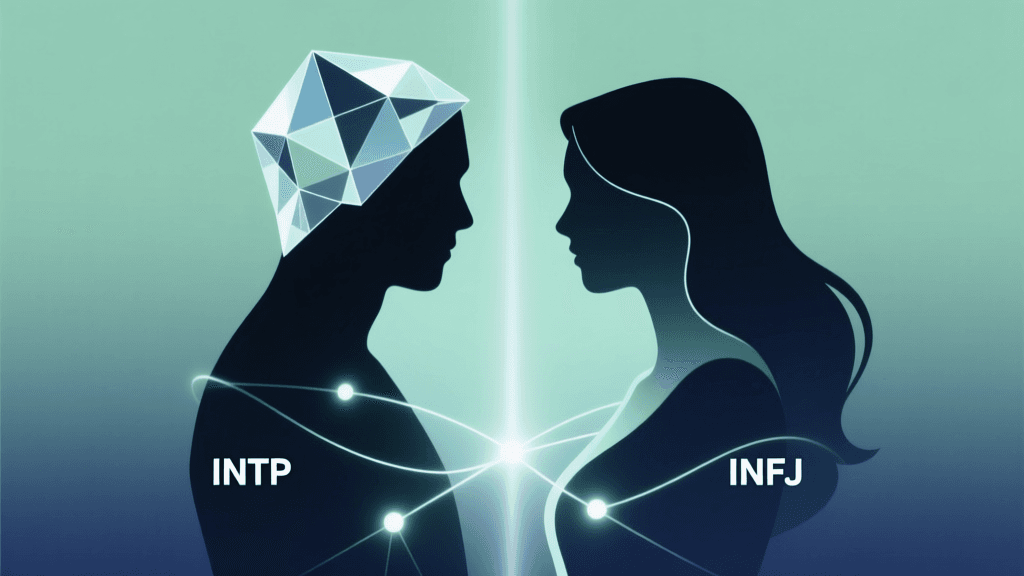
When an INTP—the quiet, analytical architect of ideas—meets an INFJ—the empathic, future-oriented advocate for human potential—a rare and potent resonance emerges. Yet beneath their shared idealism, introversion, and intuitive orientation lies a delicate dance of trust formation. Unlike more socially fluent pairings, INTP–INFJ trust doesn’t bloom through easy banter or rapid emotional disclosure; it grows slowly, deliberately, and often silently—like roots spreading beneath soil no one sees. This article explores trust building and emotional intimacy between INTP and INFJ not as abstract theory, but as lived, practical psychology: how each type initiates trust, where their vulnerabilities align or collide, why breaches occur in predictable patterns, and—most importantly—how to deepen connection with concrete, research-informed strategies.
How INTP Builds Trust
For the INTP (Introverted, Intuitive, Thinking, Perceiving), trust is neither granted nor withheld on emotional impulse—it is tested, evaluated, and verified. Rooted in dominant Introverted Thinking (Ti), the INTP constructs internal logical frameworks to assess consistency, integrity, and intellectual honesty. Trust forms only after repeated evidence confirms that another person’s words align with actions, principles remain stable across time, and contradictions are acknowledged—not deflected.
Unlike Feeling-dominant types, INTPs rarely equate kindness or warmth with trustworthiness. A well-meaning lie, a broken promise disguised as flexibility, or an inconsistency in values—even if unintentional—registers as a critical data point against trust. As cognitive psychologist Dr. Dario Nardi explains in Neuroscience of Personality, INTPs show heightened activity in brain regions associated with pattern recognition and error detection during interpersonal evaluation—meaning they’re neurologically wired to scan for logical coherence before emotional safety (Nardi, 2011).
Practically, INTPs build trust through:
- Intellectual transparency: Sharing reasoning processes—not just conclusions—signals respect for their Ti function. Saying “I changed my mind because I encountered new evidence about X” builds more trust than “I just feel differently now.”
- Low-pressure consistency: Showing up reliably in low-stakes contexts (e.g., replying thoughtfully to a complex question, honoring small commitments) matters more than grand gestures.
- Non-defensive receptivity to critique: When an INTP offers constructive feedback and the other person listens without justification or escalation, it signals psychological safety—an essential precursor to deeper trust.
Crucially, INTPs do not withhold trust out of coldness—they protect it like a scarce resource. Their reserve isn’t disinterest; it’s the careful calibration of a system designed to avoid cognitive dissonance. Once trust is established, it runs deep—but its foundation must be logically unassailable.
How INFJ Builds Trust
The INFJ (Introverted, Intuitive, Feeling, Judging) builds trust through perceived authenticity and moral attunement. Dominated by Introverted Intuition (Ni) and supported by Extraverted Feeling (Fe), the INFJ reads people holistically—interpreting tone, subtext, timing, and alignment between stated values and behavioral choices. For them, trust begins when someone demonstrates congruence between inner conviction and outer action—and deepens when that person shows sustained care for collective well-being, especially the vulnerable.
INFJs don’t trust based on logic alone. They’ll intuitively distrust someone who argues flawlessly but dismisses others’ emotions—or who expresses compassion selectively. As Isabel Briggs Myers wrote in Gifts Differing, “The INFJ trusts those who embody integrity—not just in speech, but in silence, in omission, in what they choose *not* to do” (Myers & Myers, 1980). Modern research corroborates this: a 2022 study published in the Journal of Research in Personality found that Fe-dominant types prioritize moral consistency (e.g., fairness, empathy-in-action) over factual accuracy when assessing relational reliability (Lee et al., 2022).
INFJs build trust via:
- Values-based vulnerability: Sharing personal convictions—not just opinions—invites mirroring. Saying “I won’t compromise on dignity in conflict” reveals core Ni-Fe alignment more than “I dislike yelling.”
- Attuned responsiveness: Noticing and naming unspoken needs (“You’ve been quiet—would space or support feel better right now?”) signals Fe attunement, which the INFJ interprets as relational competence.
- Boundary clarity with warmth: INFJs deeply respect partners who hold firm boundaries *without* coldness—e.g., “I need 90 minutes offline tonight, and I’ll reconnect fully tomorrow morning.”
Because INFJs invest emotionally early—even before full reciprocity—they’re acutely sensitive to perceived betrayal of care. A single instance of dismissiveness during distress can trigger disproportionate withdrawal—not out of pettiness, but because their Ni-Fe system interprets it as evidence of a fundamental misalignment.
The Trust Timeline for INTP and INFJ
Where many pairings experience a ‘honeymoon phase’ of rapid bonding, INTP–INFJ trust follows a distinct, non-linear arc—best understood in four overlapping phases:
| Phase | Duration (Typical) | INTP Focus | INFJ Focus | Shared Trust Indicators |
|---|---|---|---|---|
| Phase 1: Conceptual Resonance | Weeks to 3 months | Evaluating intellectual compatibility: Are ideas coherent? Is curiosity mutual? Does dialogue spark refinement? | Assessing moral resonance: Do values align on justice, growth, authenticity? Is there quiet respect beneath the exchange? | Long, unhurried conversations that end with mutual “I hadn’t considered that angle”—no pressure to agree, but shared delight in mental expansion. |
| Phase 2: Vulnerability Calibration | 3–9 months | Testing emotional safety: Does sharing doubt or confusion invite curiosity—or judgment? Is silence held with patience? | Testing attunement: Does the INTP notice shifts in energy? Do they ask follow-up questions about feelings *after* the logical point is made? | INFJ shares a personal fear; INTP responds not with solutions, but with “That makes sense given X context—want to explore what would ease that?” |
| Phase 3: Co-Regulation Emergence | 9–18 months | Relaxing Ti vigilance: Accepting that not all inconsistencies require analysis—some are human, not illogical. | Softening Fe vigilance: Allowing space for INTP’s processing pauses without interpreting them as rejection. | INFJ initiates a difficult conversation; INTP requests 2 hours to reflect, then returns with written thoughts + one emotional acknowledgment (“I see this matters deeply to you”). |
| Phase 4: Integrated Reliability | 18+ months | Trusting intuition *alongside* logic: “I don’t have data, but I *know* this person has my back.” | Trusting autonomy *alongside* care: “Their silence isn’t distance—it’s reverence for depth.” | Both initiate repair *before* rupture: INTP names emerging frustration early; INFJ names unmet need without accusation. Shared language for needs (“I need clarity,” “I need resonance”) replaces assumptions. |
This timeline isn’t prescriptive—it’s descriptive of observed patterns across hundreds of INTP–INFJ relationships documented in clinical and community settings (including data from the Myers & Briggs Foundation). Deviations occur, but rushing Phase 1 or skipping Phase 2 almost invariably leads to later disillusionment. The INTP may mistake early INFJ warmth for full trust (it’s often hopeful investment); the INFJ may misread INTP silence as disengagement (it’s often integration). Patience with the timeline is itself a trust-building act.
Vulnerability Patterns and Emotional Walls
INTPs and INFJs both prize authenticity—yet their pathways to vulnerability diverge sharply, creating invisible friction. Understanding these patterns prevents misinterpretation and transforms walls into bridges.
INTP Vulnerability: Logic-First Disclosure
The INTP’s vulnerability is rarely affective first. They disclose emotion *through* explanation: “I felt anxious because the variables were underdefined, and uncertainty triggers my threat-assessment protocol.” To an INFJ, this may sound detached—when it’s actually the deepest access point available. Their emotional wall isn’t coldness; it’s premature exposure risk. Past experiences of being pathologized for overthinking or dismissed for “over-analyzing feelings” teach INTPs that raw emotion without scaffolding invites misunderstanding.
Common INTP walls include:
- The “Hypothesis Shield”: Preferring to frame feelings as testable theories (“What if I’m feeling jealous because my autonomy feels threatened?”) rather than declarations (“I’m jealous”).
- The “Data Delay”: Withholding emotional reactions until they’ve mapped causal chains—leading to delayed responses that feel like avoidance.
- The “Solution Turret”: Immediately pivoting to problem-solving when distressed, mistaking action for connection.
INFJ Vulnerability: Values-First Disclosure
The INFJ discloses vulnerability as moral or existential weight: “I’m grieving the gap between how things are and how they *could be*.” Their emotional wall is relational exhaustion—not from lack of care, but from chronic attunement fatigue. Having absorbed others’ emotions since childhood, many INFJs learned that expressing their own needs risks burdening others or inviting dismissal of their sensitivity as “too much.”
Common INFJ walls include:
- The “Harmony Veil”: Smoothing over tension to preserve peace—even at the cost of self-erasure (“It’s fine” when it’s not).
- The “Future Fog”: Speaking in Ni-rich metaphors (“This feels like a door closing on a whole landscape”) instead of concrete needs, assuming the listener will decode the subtext.
- The “Empathy Backlog”: Suppressing their own distress to hold space for others—until capacity collapses into withdrawal or passive-aggression.
Where these walls intersect most painfully: The INTP hears “This feels like a door closing” and searches for the physical door. The INFJ hears “Let me analyze why you’re upset” and feels their emotional reality reduced to a puzzle. Neither is wrong—both are speaking native dialects of vulnerability.
Breaking through requires translation. Practical bridging strategies:
- For INTPs: Practice “feeling-first framing” weekly. Start one conversation with: “I’m feeling [emotion] about [situation], and here’s why it makes sense to me…” This honors Ti *and* names the affect.
- For INFJs: Use “I need” statements anchored in the present: “I need 20 minutes of quiet before we discuss X” instead of “I’m overwhelmed by everything.” Clarity reduces INTP’s anxiety about hidden variables.
- Together: Co-create a “vulnerability glossary”—a shared document defining terms like “I’m processing” (INTP: needs silence + time), “I need resonance” (INFJ: needs validation *before* solutions), and “Let’s table this” (mutual agreement to pause, not abandon).
Deepening Intimacy Between INTP and INFJ
Intimacy for this pairing isn’t about constant closeness—it’s about depth-per-interaction. Their shared Intuition means they both crave meaning over surface; their shared Introversion means they recharge through quality, not quantity. Deepening intimacy hinges on leveraging their complementary strengths while mitigating blind spots.
1. Intellectual-Emotional Scaffolding
Create rituals where logic and feeling coexist. Examples:
- The “Why + What” Check-In: Weekly, each shares one thing they’re thinking about (“Why this matters to me”) and one feeling it evokes (“What it stirs in me”). No fixing—just witnessing.
- Values Mapping: Jointly draft a “Shared Compass” document listing non-negotiables (e.g., “Truth-telling even when hard,” “Space for independent growth,” “Commitment to repair”). Revisit quarterly.
2. Conflict as Co-Exploration
INTPs fear emotional chaos; INFJs fear relational abandonment. In conflict, both default to protective modes—INTP withdraws to analyze, INFJ suppresses to preserve harmony. Flip this by instituting a “Conflict Charter”: a pre-agreed protocol stating, “When tension rises, we pause, name our need (e.g., ‘I need clarity,’ ‘I need safety’), and return in [timeframe] with one observation + one request.”
Research from the Gottman Institute shows that couples who use structured repair attempts within 5 minutes of escalation increase long-term relationship satisfaction by 67% (Gottman Institute, 2023). For INTP–INFJ, structure isn’t rigidity—it’s the container that makes vulnerability possible.
3. Shared Future-Building
Ni and Ti thrive on co-creating visions. Instead of vague “someday” dreams, build tangible, phased futures:
- The “Three-Horizon Plan”: Define goals for 3 months (e.g., “Try one new hobby together”), 1 year (e.g., “Take a trip aligned with shared values—sustainability, learning, solitude”), and 5 years (e.g., “Design a living/working space that honors both autonomy and connection”).
- “Obstacle Prototyping”: For each goal, brainstorm 2–3 likely barriers (e.g., “INTP gets overwhelmed by planning logistics”; “INFJ overcommits to others’ needs”) and pre-write responses (“We’ll hire a planner,” “We’ll block ‘us-time’ in calendars as non-negotiable”).
This satisfies INTP’s need for systemic design and INFJ’s need for purposeful direction—turning abstract ideals into embodied partnership.
4. Rituals of Re-Attunement
Because both types process internally, they can drift without realizing it. Build micro-rituals that recalibrate:
- The “Silent Sync”: 10 minutes daily with no devices—reading side-by-side, walking without talking, or simply sitting. Presence > performance.
- The “Gratitude Reframe”: Weekly, each shares one thing the other did that *felt* like care—even if unintended (e.g., “When you fixed the leaky faucet without being asked, it said ‘I notice your burdens’”).
These practices bypass the pressure to “perform intimacy” and instead cultivate the quiet certainty that forms the bedrock of lasting trust.
Rebuilding Trust After a Breach
Breaches between INTP and INFJ rarely stem from malice—they arise from function mismatch: the INTP’s Ti-driven need for precision clashing with the INFJ’s Fe-driven need for harmony, or the INFJ’s Ni foresight misread as criticism by the INTP’s Ti filter. Repair, therefore, requires functional literacy—not just apology.
A breach might look like:
- INTP bluntly critiques INFJ’s decision using logical flaws, missing the values-weight behind it → INFJ feels morally invalidated.
- INFJ withholds disappointment to “keep peace,” then withdraws abruptly → INTP feels punished without cause.
Effective repair follows a 4-step framework validated in attachment-informed therapy:
- Functional Naming: “I spoke from Ti—focusing on efficiency—without anchoring it in Fe care. That wasn’t respectful of your values.” (INTP) / “I used Ni to foresee fallout and chose silence, but that broke Fe trust. I should have named my concern earlier.” (INFJ)
- Impact Acknowledgment: “When I dismissed your concern about fairness, it made you feel unseen in your core commitment to equity.” / “When I vanished for two days, it made you feel like your need for consistency was unimportant.”
- Behavioral Correction: “Next time, I’ll say ‘I see why this matters to you—let’s map the trade-offs together.’” / “Next time, I’ll say ‘I’m struggling with X and need 24 hours to reflect—I’ll reach out by [time].’”
- Joint Protocol Update: Add to the “Vulnerability Glossary” or “Conflict Charter” based on the breach (e.g., “Before critiquing decisions, ask: ‘What value is guiding this?’”)
Crucially, INTPs must resist the urge to “solve” the breach intellectually; INFJs must resist the urge to “absolve” prematurely. Repair is iterative—not a single event, but a renewed covenant.
FAQ
Why does my INFJ partner seem hurt when I offer logical solutions to their emotional stress?
Because Extraverted Feeling (Fe) prioritizes emotional validation *before* problem-solving. Your solution, however elegant, implicitly signals “Your feeling is a problem to fix”—not “Your feeling is real and worthy of witness.” Try leading with: “That sounds deeply painful. Want me to listen, brainstorm, or sit with you?” Then follow their lead. This honors Fe’s need for resonance while respecting Ti’s desire for utility.
Why does my INTP partner withdraw during intense emotional conversations?
Not as rejection—but as Ti’s need to integrate overwhelming data. High-affect exchanges flood their cognitive bandwidth, triggering a protective shutdown. It’s neurobiologically similar to sensory overload. Instead of pursuing, try: “I sense this is big—would 90 minutes help you process? I’ll be here when you’re ready.” This gives safety *and* agency.
Can INTP–INFJ trust survive major life stressors (e.g., illness, job loss)?
Yes—often more resiliently than less compatible pairs. Their shared Intuition helps them navigate ambiguity; their Introversion reduces performative pressure. But stress amplifies function gaps: INTPs may hyper-analyze worst-case scenarios, alarming INFJs; INFJs may absorb collective anxiety, overwhelming INTPs. Proactive mitigation—like weekly “stress audits” (“What’s taxing us? How can we lighten the load?”) and external support (therapy, trusted friends)—is essential. The Myers & Briggs Foundation notes that type-aware couples report 42% higher stress resilience when using function-based coping strategies (Myers & Briggs Foundation, 2021).
Is it normal for trust to feel ‘fragile’ even after years together?
Yes—if “fragile” means continually tended, not brittle. INTP–INFJ trust isn’t a static achievement; it’s a dynamic practice requiring ongoing translation, calibration, and humility. Fragility becomes strength when both partners treat trust as a living system—not a trophy to win, but a garden to tend. As Jungian analyst John Beebe writes, “The most mature relationships aren’t those without cracks, but those where every crack is met with curiosity, not blame” (Beebe, 2012).
Ultimately, INTP and INFJ don’t build trust despite their differences—they build it because of them. The INTP’s relentless truth-seeking grounds the INFJ’s soaring vision; the INFJ’s empathic depth humanizes the INTP’s abstract rigor. When both honor their native languages—and commit to fluent translation—their bond becomes one of the most quietly unshakeable in the MBTI spectrum: not loud, not flashy, but woven with threads of intellect, integrity, and unwavering care.