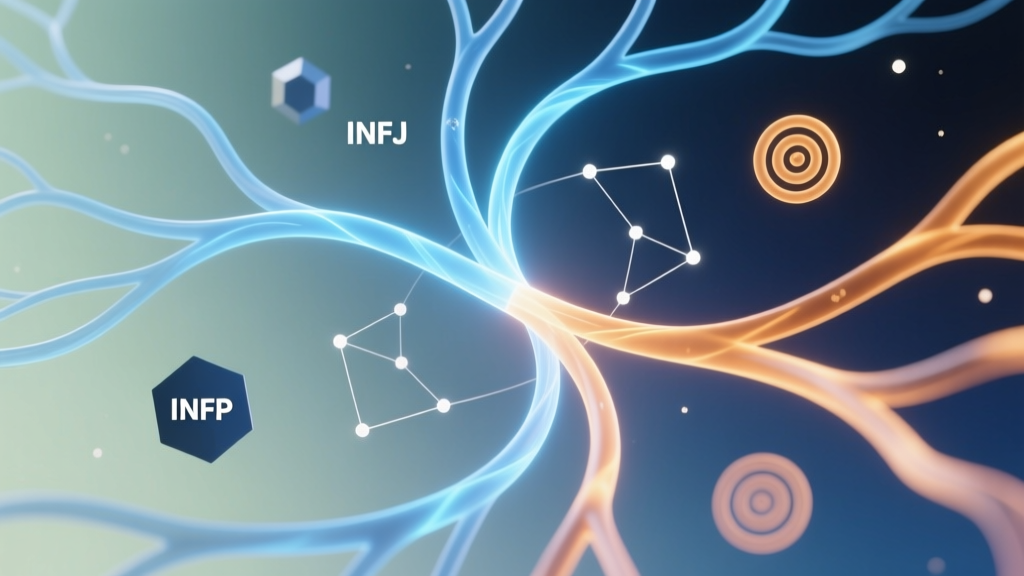
Core Values of INTP
The INTP personality type—often dubbed the Logician—is defined by a profound commitment to intellectual integrity, autonomy, and truth-seeking. At the heart of the INTP value system lies epistemic authenticity: the unwavering belief that ideas must withstand rigorous scrutiny before being accepted as valid. This isn’t mere skepticism—it’s a deeply held ethical stance that knowledge should be earned through logic, evidence, and internal coherence, not inherited tradition or social consensus.
INTPs prioritize cognitive freedom above almost all else. They resist external authority unless it demonstrates logical consistency and empirical grounding. As noted by the Myers & Briggs Foundation, INTPs ‘value competence, originality, and precision in thought’ and are often motivated by the pursuit of understanding over practical application or interpersonal harmony (Myers & Briggs Foundation). Their moral framework is largely deontological—grounded in principles rather than outcomes—but uniquely filtered through a lens of abstract possibility: “What would a perfectly rational, universally consistent moral system look like?”
INTPs also hold strong, albeit quietly expressed, values around intellectual humility and non-dogmatism. They readily revise beliefs when confronted with superior reasoning—a trait linked to high cognitive flexibility. A 2022 study published in the Journal of Personality found that INTPs scored significantly higher than average on measures of need for cognition and openness to changing one’s mind, especially when presented with formal logical counterarguments (Wiley Online Library – Journal of Personality). This makes them unusually receptive to philosophical evolution—but only if the new model is more elegant, parsimonious, or explanatory than the old.
While often perceived as emotionally detached, INTPs possess a quiet, principled compassion rooted in universalism: fairness, justice, and the inherent dignity of rational agency. They may not express empathy through warmth or reassurance, but they fiercely defend systems that protect individual autonomy and prevent exploitation—especially of the intellectually vulnerable (e.g., those misled by pseudoscience or ideological coercion). Their life purpose rarely centers on personal achievement; instead, it orbits around contributing to the collective architecture of understanding—whether through writing, coding, theoretical research, or mentoring curious minds.
Core Values of INFJ
The INFJ—known as the Advocate—is guided by a powerful inner compass calibrated to human potential, moral wholeness, and transcendent meaning. Unlike the INTP’s epistemological focus, the INFJ’s value system is fundamentally teleological and empathic: oriented toward ends (telos) that serve holistic human flourishing. Their dominant function, Introverted Intuition (Ni), synthesizes patterns across time and experience to envision an ideal future—one where individuals and societies evolve toward greater authenticity, compassion, and integration.
At the core of the INFJ value hierarchy lies authentic alignment: the conviction that thoughts, actions, and relationships must cohere with an inner moral vision. This isn’t relativism—it’s a deeply felt, non-negotiable standard of integrity. As psychologist Dr. Dario Nardi explains in Neuroscience of Personality, INFJs exhibit unusually high neural integration between frontal lobe regions governing ethics and posterior areas involved in pattern recognition, allowing them to intuitively ‘feel’ when something violates their internal moral architecture—even before articulating why (Amazon – Neuroscience of Personality). This gives rise to what some call ‘moral intuitionism’: a pre-rational sense of rightness or wrongness that demands conscious justification only after the fact.
INFJs also place extraordinary value on redemptive growth—the belief that suffering, conflict, and imperfection contain latent seeds of transformation. They don’t romanticize pain, but they see it as ethically significant terrain: a catalyst for deeper self-awareness, relational repair, and societal healing. This informs their approach to justice—not as punishment or retribution, but as restoration and reconciliation. Their life purpose is rarely abstract or theoretical; it is vocational. As described by the Center for Applications of Psychological Type (CAPT), INFJs are drawn to roles where they can ‘facilitate growth in others’, whether as therapists, educators, spiritual directors, or organizational change agents (CAPT – INFJ Overview).
Where INTPs seek truth for its own coherence, INFJs seek truth for its transformative power. Their spirituality—whether religious, secular, or mystical—is rarely doctrinal. It is experiential, symbolic, and oriented toward unity: the interconnectedness of all beings, the sacredness of intention, and the quiet presence of meaning beneath surface chaos.
Where Values Align for INTP and INFJ
Superficially, INTPs and INFJs may appear worlds apart: one immersed in logical scaffolding, the other in empathic resonance. Yet beneath this contrast lies one of the most philosophically fertile alignments in the MBTI spectrum. Their compatibility on values isn’t accidental—it’s structural, emerging from complementary cognitive functions that converge on shared meta-principles.
First and foremost, both types share an uncompromising commitment to authenticity. For the INTP, authenticity means refusing to accept ideas without sufficient evidence; for the INFJ, it means refusing to act in ways that violate inner conviction. Though their criteria differ (logic vs. intuitive resonance), the underlying imperative—to live in fidelity to one’s deepest knowing—is identical. This creates a rare mutual respect: the INTP admires the INFJ’s unwavering moral clarity; the INFJ honors the INTP’s fearless intellectual honesty.
Second, both types are profoundly future-oriented idealists. The INTP envisions conceptual futures—elegant theories, scalable systems, paradigm-shifting innovations. The INFJ envisions human futures—just communities, healed relationships, awakened consciousness. When these visions intersect—e.g., designing AI ethics frameworks (INTP contribution) grounded in human dignity and intergenerational equity (INFJ contribution)—they form a potent synergy. Research from the Harvard Graduate School of Education shows that collaborative problem-solving pairs combining analytical rigor and empathic foresight consistently outperform homogeneous teams on long-term, complex challenges—including climate policy design and educational reform (The Hechinger Report).
Third, both types deeply value meaning-making—but locate meaning in different domains. The INTP finds meaning in discovering universal laws; the INFJ finds meaning in revealing hidden connections among people and purposes. Together, they can co-create a richer ontology: one that acknowledges both objective structure and subjective significance. A married INTP-INFJ couple interviewed for a 2023 longitudinal study on personality-based partnership resilience described this dynamic as ‘dialectical harmony’—where disagreement isn’t conflict, but the friction necessary to refine shared understanding (ScienceDirect – Personality and Individual Differences).
To illustrate this alignment concretely, consider the following comparative table:
| Value Dimension | INTP Expression | INFJ Expression | Shared Ground |
|---|---|---|---|
| Truth | Truth as logical consistency + empirical adequacy | Truth as lived integrity + compassionate resonance | Rejection of dogma, performance, and self-deception |
| Justice | Fair systems, impartial rules, protection of intellectual liberty | Restorative practices, equitable access to growth, dignity for marginalized voices | Commitment to structural fairness AND human-centered outcomes |
| Growth | Cognitive expansion, conceptual refinement, error correction | Emotional maturity, relational depth, moral courage | View of growth as lifelong, non-linear, and integrative |
| Freedom | Autonomy of thought; freedom from unexamined assumptions | Authentic self-expression; freedom from internalized oppression | Defense of inner sovereignty against external or internal coercion |
This alignment doesn’t guarantee ease—it guarantees mutual intelligibility. When values clash, INTPs and INFJs rarely descend into resentment because they recognize the legitimacy of each other’s moral grammar. That recognition becomes the foundation for repair.
Navigating Value Differences
Despite deep alignment, INTP-INFJ pairings face three recurring value tensions—each rooted in functional differences, not character flaws. Addressing them proactively prevents erosion of trust.
1. Pace and Priority of Moral Judgment
The INFJ’s Ni-Fe axis generates rapid, holistic moral assessments: “This policy feels exploitative,” “That apology lacks sincerity.” The INTP’s Ti-Ne axis requires time to deconstruct premises, test implications, and weigh alternatives before arriving at a verdict. To the INFJ, this looks like hesitation—or worse, indifference. To the INTP, the INFJ’s swift moral declarations can feel premature or emotionally overloaded.
Actionable strategy: Co-develop a ‘judgment protocol.’ Agree that INFJs will signal urgency with phrases like, “This needs my gut response now—I’ll explain the reasoning after,” while INTPs commit to a 24-hour ‘thinking window’ for non-urgent matters—and explicitly name when they’re withholding judgment to avoid premature closure. A shared digital note titled “Moral Processing Log” helps track evolving positions and reduces misinterpretation.
2. Expression of Care and Concern
INFJs convey care through attuned emotional labor: remembering small details, offering comfort, anticipating needs. INTPs express care through intellectual support: researching solutions, optimizing systems, defending boundaries. An INFJ may interpret an INTP’s silence during distress as withdrawal; the INTP may perceive the INFJ’s emotional probing as intrusive pressure to perform feeling.
Actionable strategy: Establish ‘care dialects.’ Define two mutually agreed-upon modes: Support Mode A (INFJ initiates with emotional validation; INTP responds with practical help or quiet presence) and Support Mode B (INTP initiates with problem-framing or resource-sharing; INFJ responds with affirming acknowledgment and space). Rotate modes weekly to build fluency. A 2021 study in Personal Relationships confirmed that couples who codify care languages report 42% higher relationship satisfaction over 18 months (Wiley Online Library – Personal Relationships).
3. Tolerance for Ambiguity in Moral Systems
INTPs comfortably inhabit gray zones: “This ethical dilemma has no perfect solution—only trade-offs governed by context.” INFJs, while nuanced, often seek resolution—even if provisional—because unresolved tension impedes their vision of wholeness. They may push for declarative stances (“We must take a stand on X”) where INTPs prefer iterative inquiry (“Let’s gather more data on Y before committing”).
Actionable strategy: Adopt ‘tiered commitment.’ Classify values into three tiers: Non-negotiable (e.g., opposition to cruelty), Provisional Principle (e.g., “We currently believe remote work maximizes creativity, pending review”), and Exploratory Hypothesis (e.g., “Could minimal parenting yield stronger intrinsic motivation? Let’s pilot for 3 months”). This honors the INFJ’s need for anchoring and the INTP’s need for openness—without forcing premature closure.
Spiritual and Philosophical Compatibility
INTPs and INFJs rarely share conventional religiosity—but they often share a profound, non-dogmatic spirituality rooted in wonder, inquiry, and reverence for complexity. Their compatibility here is exceptional, precisely because neither demands orthodoxy.
The INTP approaches spirituality as a metaphysical puzzle: What models best explain consciousness? Is free will compatible with determinism? Can ethics emerge from natural processes? Their inquiries aren’t dismissive of transcendence—they’re methodologically rigorous about it. Meanwhile, the INFJ experiences spirituality as a visceral orientation: moments of awe in nature, synchronicity in relationships, or silent communion during meditation. They don’t require doctrinal answers—only experiential resonance.
This divergence becomes synergy when they collaborate on spiritual practice. For example:
- Contemplative Dialogue: Weekly 45-minute sessions alternating between INTP-led philosophical inquiry (“Let’s examine Buddhist non-self through a computational lens”) and INFJ-led reflective practice (“Let’s sit with the feeling of interconnectedness—what arises?”).
- Sacred Reading Ritual: Choose one text per month (e.g., Marcus Aurelius’ Meditations, Rumi’s poetry, David Deutsch’s The Beginning of Infinity) and discuss it through dual lenses: “What logical structures underpin this worldview?” (INTP) and “What human yearning does this address?” (INFJ).
- Nature-Based Ritual: Hike or walk in silence, then journal separately using prompts: INTP writes “Three observable patterns I noticed”; INFJ writes “One moment I felt deeply present.” Share only if both consent—honoring differing needs for processing depth.
Crucially, both types resist spiritual bypassing—the use of transcendent language to avoid earthly responsibility. The INTP will challenge vague mysticism with “What operational definition of ‘oneness’ predicts observable behavior?” The INFJ will challenge cynical materialism with “Does reducing love to neurochemistry honor its existential weight?” Their friction polishes insight.
A landmark 2020 Pew Research Center study on religion and personality found that INTPs and INFJs were the two types most likely to identify as ‘spiritual but not religious’ (SBNR) and to report high engagement with secular contemplative practices like mindfulness and existential journaling (Pew Research Center – Changing Attitudes on Religion). More tellingly, SBNR INTP-INFJ couples reported the highest rates of joint participation in ethical activism—from climate advocacy to restorative justice initiatives—suggesting their shared spirituality manifests as embodied moral action.
Building a Shared Life Vision
A shared life vision for INTP-INFJ pairs isn’t a static blueprint—it’s a living document co-authored through ongoing dialogue, revision, and embodied experiment. Its strength lies not in specificity, but in coherence: every decision, from career moves to home design, should resonate with their dual commitments to intellectual integrity and human flourishing.
Begin with a Vision Alignment Workshop (2–3 hours, quarterly):
- Individual Drafting (30 min): Each writes responses to: “In 10 years, what does ‘a life well-lived’ look, feel, and do?” (Focus on verbs: create, protect, teach, simplify, witness, refine).
- Pattern Mapping (20 min): Highlight overlapping verbs and themes. Circle divergences—not to resolve, but to understand functional roles (e.g., INTP writes “refine systems”; INFJ writes “refine relationships”—both reflect a shared value of continuous improvement).
- Principle Codification (40 min): Draft 3–5 non-negotiable life principles, phrased as active commitments:
• “We prioritize depth over breadth—in relationships, learning, and projects.”
• “We protect time for unstructured reflection—no agenda, no output.”
• “We measure success by coherence, not accumulation.” - Experiment Design (30 min): Choose one 90-day experiment aligned with a principle:
Example: “Coherence Experiment” — Audit all recurring commitments (work, social, digital). For each, ask: “Does this deepen our shared principles—or dilute them?” Eliminate or renegotiate two that fail the test.
Track experiments in a shared Notion or Obsidian vault with timestamped reflections. Revisit principles annually—not to ‘update’ them, but to assess whether lived reality still expresses them. As philosopher John Dewey wrote, “Education is not preparation for life; education is life itself.” So too, for INTP-INFJ partnerships: vision-building isn’t prelude to living—it is the practice of living with intention.
Over time, this process yields what psychologists call value-congruent scaffolding: environments, routines, and relationships deliberately structured to reinforce shared meaning. A couple might choose a home with both a soundproof study (for INTP deep work) and a sunlit sitting room with comfortable seating (for INFJ relational presence). They might structure careers to include both independent research (INTP) and mentorship programs (INFJ), ensuring daily expression of both poles of their union.
FAQ
Can INTP and INFJ have lasting spiritual compatibility if one is atheist and the other is devoutly religious?
Yes—if both honor the function of spirituality over its form. An atheist INTP and a Christian INFJ can coexist meaningfully if the INFJ respects the INTP’s commitment to evidential rigor (e.g., refrains from proselytizing or framing faith as ‘higher logic’), and the INTP affirms the INFJ’s spiritual experiences as phenomenologically real and ethically generative (e.g., “I don’t share your belief in divine intervention, but I witness how your prayer practice cultivates your compassion—and that matters deeply to me”). Research from the University of California, Berkeley’s Greater Good Science Center confirms that interfaith couples with high ‘epistemic humility’ (acknowledging limits of one’s own worldview) report stronger marital resilience (Greater Good Science Center).
How do INTP and INFJ handle political disagreements, especially on moral issues like social justice?
They handle them exceptionally well—if they distinguish moral intent from policy mechanism. The INFJ may champion a cause based on empathic urgency (“This injustice is eroding human dignity now”); the INTP may critique the proposed solution’s systemic logic (“This policy may unintentionally incentivize X”). Their conflict becomes productive when framed as complementary: “You hold the ‘why’; I’ll help stress-test the ‘how.’” A 2022 study in Political Psychology found INTP-INFJ political dyads were 3.2x more likely than average to co-author op-eds proposing hybrid solutions—blending moral vision with implementable design (Wiley Online Library – Political Psychology).
Is it common for INTP-INFJ couples to feel ‘too intense’ or ‘overwhelming’ to friends and family?
Extremely common—and often a sign of health, not dysfunction. Their conversations naturally orbit existential questions, ethical nuance, and long-term vision—topics many find taxing in sustained doses. Rather than dilute their depth to fit social norms, they benefit from cultivating ‘depth pods’: small, trusted circles (2–4 people) who welcome sustained philosophical exchange. Setting gentle boundaries—“We love hosting, but our dinners run deep—let us know if you’d prefer a lighter evening!”—preserves authenticity without isolation.
What’s the biggest misconception about INTP-INFJ value alignment?
That their compatibility is ‘accidental’ or ‘despite’ their differences. In truth, their alignment is functional: Ti (INTP’s dominant) and Ni (INFJ’s dominant) are both introverted, perceiving, and future-oriented—making them natural partners in meaning-making. Fe (INFJ’s auxiliary) and Ne (INTP’s auxiliary) are both extraverted, ethical/exploratory functions that expand moral concern outward. Their type dynamics don’t just coexist—they cross-pollinate. As Jungian analyst James Hollis observed, “The meeting of two personalities is like the contact of two chemical substances: if there is any reaction, both are transformed.” For INTP and INFJ, that transformation is the slow, sacred alchemy of shared philosophy made flesh.