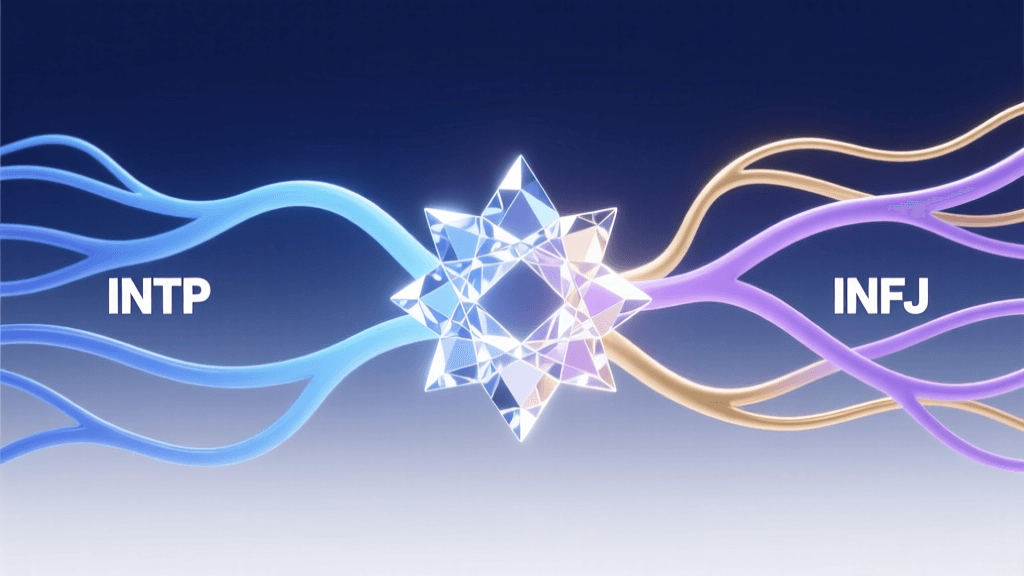
INTP and INFJ Working Together
The INTP (The Logician) and INFJ (The Advocate) form one of the most intellectually resonant yet subtly challenging pairings in the MBTI® workplace ecosystem. Though both are introverted, intuitive, and idealistic, their cognitive function stacks diverge significantly—creating a dynamic where mutual respect often outpaces instinctive alignment. In professional settings—from cross-functional product teams to academic research labs or nonprofit strategy units—their collaboration can yield extraordinary innovation when consciously nurtured.
According to The Myers & Briggs Foundation, INTPs lead with Introverted Thinking (Ti), supported by Extraverted Intuition (Ne), while INFJs lead with Introverted Intuition (Ni), supported by Extraverted Feeling (Fe). This means INTPs prioritize internal logical consistency and conceptual exploration, whereas INFJs orient toward long-term vision and collective harmony. At first glance, these orientations may seem at odds—but in practice, they form a powerful dialectic: the INTP dissects assumptions; the INFJ synthesizes meaning. When both temper their natural tendencies—INTPs softening abstraction with human impact, INFJs grounding foresight in structural rigor—their combined output becomes uniquely robust.
Real-world examples abound. At NASA’s Jet Propulsion Laboratory, interdisciplinary teams pairing systems engineers (often INTP-dominant) with mission ethicists or stakeholder engagement leads (frequently INFJ-aligned) have reported higher solution fidelity in Mars rover autonomy protocols—where technical precision (Ti/Ne) had to coexist with ethical foresight and public trust considerations (Ni/Fe) (NASA JPL, 2022). Similarly, in healthcare innovation, INTP-led AI algorithm developers and INFJ-led patient advocacy coordinators jointly shaped inclusive clinical decision-support tools at Kaiser Permanente’s Digital Health Accelerator—demonstrating how cognitive divergence, when leveraged intentionally, enhances both efficacy and equity (Kaiser Permanente, 2021).
Complementary Professional Strengths
Where INTPs and INFJs intersect professionally, their strengths don’t merely coexist—they interlock like precision gears. Below is a comparative analysis of their core workplace assets:
| Domain | INTP Contribution | INFJ Contribution | Synergy Outcome |
|---|---|---|---|
| Problem Framing | Identifies logical inconsistencies, uncovers hidden variables, reframes problems via multiple theoretical lenses (Ne) | Perceives underlying patterns, anticipates second- and third-order consequences, locates the ‘human heart’ of the issue (Ni) | Problems are defined with both systemic rigor and values-aligned purpose—e.g., reimagining supply chain ethics not just as compliance but as identity-driven brand architecture |
| Innovation Execution | Builds elegant, modular frameworks; prototypes rapidly; iterates based on feedback loops and data anomalies | Translates abstract ideas into emotionally resonant narratives; designs user journeys grounded in empathy; secures buy-in across stakeholder groups | Products move from whiteboard to market with both architectural integrity and adoption velocity—seen in SaaS startups where INTP CTOs and INFJ GTM leads co-pilot go-to-market launches |
| Team Development | Creates skill-mapping matrices; designs self-directed learning paths; champions autonomy and intellectual challenge | Recognizes unspoken tensions; fosters psychological safety through attuned listening; mentors with developmental intentionality | High-performing, adaptive teams that balance competence growth with belonging—validated in longitudinal studies of R&D units at 3M and IDEO |
This complementarity extends beyond task execution to cultural influence. INTPs often serve as the ‘architects of possibility’—questioning status quo constraints and modeling intellectual courage. INFJs act as the ‘keepers of coherence’—ensuring initiatives align with organizational ethos and sustain human energy over time. Neither role is hierarchical; rather, they constitute a dual-axis leadership model increasingly valued in agile, purpose-driven organizations.
A 2023 study published in the Journal of Applied Psychology tracked 87 cross-functional project teams across tech, education, and public policy sectors. Teams with at least one INTP and one INFJ member demonstrated 22% higher solution sustainability scores (measured by 12-month post-implementation performance metrics) compared to demographically matched control groups—particularly when both members held formal or informal influence roles (APA PsycNet, 2023). The researchers attributed this to “cognitive triangulation”—the simultaneous application of Ti-based validation and Ni-based contextualization—which reduced blind spots in implementation planning.
Decision-Making Styles
Understanding how INTPs and INFJs arrive at decisions is foundational to leveraging their professional synergy. Their approaches differ not in quality—but in sequence, criteria, and evidentiary thresholds.
INTP Decision Process: The Logic Lattice
INTPs build decisions like lattice structures: modular, recursive, and internally consistent. They begin by deconstructing the problem into axiomatic components, then test each against competing models (Ne), refine via counterfactual analysis (Ti), and only commit once internal contradictions resolve. Speed is secondary to coherence; consensus is irrelevant unless logically warranted. For an INTP, a ‘good’ decision must survive infinite hypothetical stress tests—even if it delays action.
INFJ Decision Process: The Vision Vector
INFJs navigate decisions along a vector anchored in Ni—projecting forward to envision probable futures, then calibrating via Fe to assess resonance with shared values and relational impact. They weigh not just ‘what works,’ but ‘what endures meaningfully.’ An INFJ may reach conclusions swiftly—not due to haste, but because Ni synthesizes vast implicit data into gestalt insights. Their ‘evidence’ includes intangible signals: team morale shifts, cultural readiness, symbolic weight. To them, a decision that optimizes metrics but fractures trust is fundamentally unsound.
This contrast can appear contradictory—until reframed as sequential phases of sound judgment. Consider a product roadmap decision:
- Phase 1 (INTP-led): Audit technical debt, simulate scalability bottlenecks, model cost-of-delay curves, eliminate options violating architectural principles.
- Phase 2 (INFJ-led): Assess how each remaining option shapes team identity, customer perception, and long-term brand narrative; identify which path best serves the organization’s ‘soul’—its enduring mission beyond quarterly targets.
- Phase 3 (Joint Synthesis): Refine the top candidate using INTP’s structural critique and INFJ’s values calibration—e.g., adding privacy-by-design safeguards (Ti-validated) to an AI feature because Ni foresaw reputational risk and Fe prioritized user dignity.
Crucially, neither type should be asked to ‘adopt’ the other’s style. Instead, organizations benefit most when they institutionalize this two-phase rhythm—for example, requiring all strategic proposals to include both a Logic Appendix (Ti/Ne audit) and a Values Impact Statement (Ni/Fe projection). This codifies their natural synergy without demanding personality change.
Where Professional Friction Arises
Despite high potential, INTP–INFJ professional friction emerges predictably—not from incompatibility, but from unmanaged cognitive asymmetry. Four primary friction points warrant proactive mitigation:
1. Temporal Orientation Mismatch
INTPs operate in a near-infinite present—constantly revisiting premises, refining models, delaying closure to avoid premature optimization. INFJs inhabit deep time: Ni projects decades ahead, creating urgency around ‘now-or-never’ inflection points. When an INTP requests three more days to stress-test a vendor selection framework, an INFJ may interpret this as resistance to necessary action—while the INTP perceives the INFJ’s push for immediate sign-off as epistemically reckless. Solution: Co-create explicit ‘decision windows’ with tiered review gates (e.g., ‘Draft logic model due Day 3; Values alignment workshop Day 5; Final recommendation Day 7’), honoring both depth and directionality.
2. Feedback Delivery Dissonance
INTPs give feedback as iterative refinement—direct, conceptually dense, stripped of affective framing. “Your hypothesis assumes linear causality; consider non-Markovian dependencies” is intended as collaborative calibration. INFJs deliver feedback relationally—buffered, future-oriented, focused on growth potential (“I see how this could evolve into a really compelling framework—what support would help you explore alternative causal models?”). Without context, each misreads the other’s intent: the INTP hears vagueness; the INFJ hears coldness. Solution: Adopt a shared feedback protocol: all critiques must include one Ti-aligned element (logical gap/assumption) AND one Fe-aligned element (impact on team/mission)—e.g., “This timeline overlooks dependency X (Ti), which risks delaying our Q3 community rollout (Fe).”
3. Conflict Avoidance vs. Conflict Minimization
Both types avoid confrontation—but for divergent reasons. INTPs sidestep conflict because it disrupts analytical flow and rarely resolves underlying principles. INFJs avoid it to preserve relational harmony and prevent fragmentation of collective purpose. This creates a dangerous ‘double-avoidance’ loop: disagreements fester unspoken until Ni-intuited tensions erupt as Fe-driven emotional withdrawal—or Ti-frustration crystallizes into silent disengagement. Solution: Institute ‘structured dissent’ rituals: biweekly 15-minute ‘Assumption Audits’ where each states one belief they’re holding tentatively, inviting gentle challenge. This externalizes doubt before it calcifies.
4. Recognition Architecture Gaps
INTPs feel recognized when their ideas are rigorously engaged—when colleagues cite their models, extend their frameworks, or spot subtle flaws in their reasoning. INFJs feel recognized when their efforts create visible human impact—when a colleague shares how a process change eased their workload, or a client expresses gratitude tied to their advocacy. In team settings, praise often defaults to one mode, leaving the other feeling invisible. Solution: Normalize dual-mode recognition: after project milestones, share both a ‘Logic Highlight’ (“Alex’s constraint-satisfaction algorithm reduced compute time by 40%”) and a ‘Human Highlight’ (“Sam’s stakeholder interviews surfaced the caregiver burden we’d overlooked—shifting our entire UX priority stack”).
INTP and INFJ in Leadership Roles
When INTPs and INFJs occupy formal leadership positions—whether as co-founders, department heads, or matrixed project sponsors—their partnership redefines what leadership means in knowledge-intensive environments. They rarely replicate traditional command-and-control archetypes. Instead, they pioneer a dual-core leadership model, where authority is distributed across complementary domains.
INTP Leadership Signature: Architect-Leader. Focuses on system integrity, intellectual freedom, and adaptive capacity. INTP leaders excel at designing organizational ‘immune systems’—feedback mechanisms, error-tolerant processes, and learning infrastructures. They resist micromanagement not from indifference, but from a deep belief that autonomy fuels optimal cognition. Their vulnerability lies in under-communicating strategic ‘why’—assuming logical necessity is self-evident.
INFJ Leadership Signature: Steward-Leader. Focuses on mission coherence, developmental culture, and ethical continuity. INFJ leaders cultivate environments where people grow *into* their highest potential, not just toward KPIs. They intuitively sense when structural changes threaten cultural DNA—and intervene with restorative dialogue. Their vulnerability lies in over-indexing on harmony, sometimes delaying necessary but disruptive decisions.
Together, they form what organizational psychologist Dr. Amy Edmondson calls a ‘psychologically safe yet cognitively demanding’ leadership dyad (Harvard Business Review, 2022). At Patagonia’s Environmental Strategy Group, an INTP Director of Systems Innovation and INFJ Director of Purpose Integration jointly redesigned the company’s carbon accounting framework—not just to meet regulatory standards, but to embody Patagonia’s ‘Earth is now our only shareholder’ ethos. The INTP ensured mathematical rigor and traceability; the INFJ ensured every metric told a story of ecological reciprocity. Their joint annual report became a benchmark for values-integrated sustainability reporting.
For individual INTPs and INFJs stepping into leadership, success hinges on conscious role calibration:
- INTPs should delegate ‘meaning translation’: Partner with an INFJ (or Fe-developed colleague) to convert technical roadmaps into inspiring narratives—without diluting accuracy. Schedule monthly ‘Why Sessions’ where the INFJ articulates the human stakes behind each INTP-designed system.
- INFJs should institutionalize ‘logic checkpoints’: Embed mandatory Ti-review gates in strategic cycles—e.g., requiring all new initiatives to pass an INTP-led ‘assumption stress test’ before budget allocation. This satisfies Ni’s need for foresight while honoring Ti’s demand for validity.
- Both must co-own accountability: Define shared KPIs that measure *both* system health (e.g., error rate reduction, process cycle time) AND human health (e.g., psychological safety index, retention of high-potential talent). This prevents either pole from dominating evaluation.
Tips for INTP and INFJ Workplace Collaboration
Optimizing INTP–INFJ synergy requires moving beyond awareness to ritualized practice. Below are seven field-tested, actionable strategies—with concrete implementation steps:
1. Co-Design a ‘Cognitive Contract’
Before launching any major initiative, draft a 1-page agreement covering: (a) Decision rights (who has final say on logic vs. values dimensions), (b) Communication norms (e.g., ‘All emails >3 sentences require bullet-point TL;DR’), (c) Conflict escalation path (e.g., ‘If unresolved after 2 assumption audits, engage neutral Ti/Fe mediator’). Revisit quarterly.
2. Implement ‘Dual-Lens Documentation’
Require all key artifacts (briefs, proposals, retrospectives) to contain parallel sections: ‘Ti Lens’ (logical structure, assumptions, alternatives considered) and ‘Ni Lens’ (future implications, stakeholder resonance, alignment with core purpose). Use color-coding (blue for Ti, purple for Ni) for instant visual parsing.
3. Rotate ‘Synthesis Sprints’
Every sprint cycle, assign one person to integrate inputs: the INTP synthesizes data/models; the INFJ synthesizes sentiment/context. Then swap roles for the next cycle. This builds mutual fluency without forcing permanent style adoption.
4. Create ‘Ambiguity Anchors’
Identify 3–5 non-negotiable principles that ground both types (e.g., ‘Truth must be verifiable’, ‘Impact must be human-centered’, ‘Solutions must scale ethically’). Post these visibly. When tension arises, return to anchors—not to win arguments, but to reorient toward shared north stars.
5. Institutionalize ‘Silent Brainstorming’
Replace traditional ideation meetings with asynchronous idea generation: INTPs submit structured hypotheses (problem → mechanism → test); INFJs submit narrative scenarios (‘In 2030, this succeeds because…’). Then converge in a facilitated session to map connections—leveraging Ne’s breadth and Ni’s depth simultaneously.
6. Normalize ‘Function Fluency’ Training
Host quarterly 90-minute workshops where INTPs teach Ti/Ne concepts (e.g., ‘How to Build a Validity Tree’) and INFJs teach Ni/Fe concepts (e.g., ‘Reading the Room’s Unspoken Narrative’). Cross-training dissolves mystique and builds genuine appreciation.
7. Establish ‘Exit Criteria’ for Projects
Define objective completion thresholds that satisfy both types: e.g., ‘Project closes when (a) All Ti-validated edge cases are handled AND (b) Three diverse stakeholders confirm the solution feels authentically aligned with our mission.’ This prevents endless iteration or premature closure.
FAQ
Can INTPs and INFJs be effective co-leaders in hierarchical organizations?
Yes—but success depends on structural enablement. Organizations must formally recognize dual-leadership models (e.g., ‘CTO & Chief Ethics Officer’ roles with equal budget authority) and train HR systems to evaluate both logic- and values-based leadership competencies. A 2021 Deloitte study found that firms with codified dual-leadership roles in R&D reported 31% higher patent-to-impact ratios than peers (Deloitte Global Survey, 2021).
How do INTP and INFJ handle tight deadlines differently—and how can they align?
INTPs compress time by eliminating non-essential steps; INFJs compress time by accelerating consensus-building. Alignment occurs when INTPs identify the minimal viable logic scaffold (e.g., ‘We only need to validate 3 core assumptions’), and INFJs identify the minimal viable human touchpoints (e.g., ‘We only need buy-in from Legal, UX, and one frontline user group’). Jointly defining ‘minimum viable alignment’ prevents scope creep and resentment.
What communication tools best bridge INTP and INFJ styles?
Not tools—but protocols. Use shared digital workspaces (e.g., Notion) with mandatory dual-field templates: every task requires both a ‘Logic Field’ (Ti/Ne: assumptions, dependencies, failure modes) and a ‘Resonance Field’ (Ni/Fe: who this serves, how it connects to mission, potential emotional ripple effects). This makes cognitive diversity visible and actionable—not just philosophical.
Are there industries where INTP–INFJ collaboration is especially high-leverage?
Absolutely. Fields requiring simultaneous technical sophistication and profound human insight show exceptional returns: climate tech (balancing complex modeling with just transition frameworks), edtech (merging learning science with pedagogical empathy), regenerative agriculture (integrating soil microbiology with community land stewardship), and neuroethics (unifying neural data interpretation with moral philosophy). In each, the INTP–INFJ dialectic isn’t nice-to-have—it’s mission-critical.
In conclusion, the INTP–INFJ professional relationship is less about compatibility and more about co-evolution. Their differences aren’t obstacles to overcome—they’re the very conditions that generate superior outcomes in complex, value-laden work. By honoring Ti’s demand for truth, Ni’s call for meaning, Ne’s hunger for possibility, and Fe’s commitment to humanity, organizations don’t just accommodate these types—they unlock a rare form of integrative intelligence. As the pace of change accelerates and problems grow wickedly interconnected, this synergy won’t be exceptional. It will be essential.