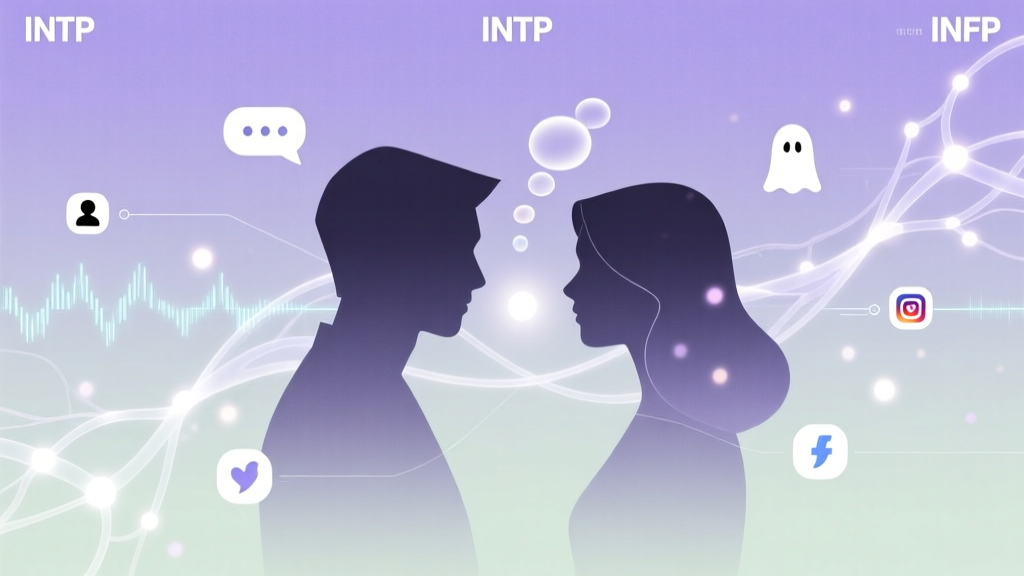
INTP Digital Communication Style
The INTP (Introverted, Intuitive, Thinking, Perceiving) personality type—often dubbed the Logician—approaches digital interaction with a distinct blend of intellectual curiosity, low emotional bandwidth for small talk, and high value placed on autonomy and precision. In the Digital Age Relationship Dynamics framework, INTPs don’t merely use technology—they optimize it. Their digital footprint is rarely performative; instead, it’s functional, asynchronous, and deeply selective.
INTPs prefer written over spoken communication because it allows time for cognitive processing. According to the Myers-Briggs Foundation, INTPs rely heavily on Introverted Thinking (Ti), meaning they internally analyze, refine, and verify ideas before expressing them—even in text. This leads to delayed but highly intentional responses. A 2022 Pew Research Center study found that 68% of adults who identify as highly analytical (a trait strongly correlated with Ti-dominant types) report preferring messaging apps over voice calls for relationship conversations—especially when discussing complex or emotionally nuanced topics (Pew Research Center, 2022).
INTPs also exhibit low tolerance for digital clutter: redundant notifications, group chats with off-topic banter, or platforms demanding constant engagement (e.g., Stories-driven feeds) often trigger cognitive overload. They gravitate toward minimalist tools—email for deep exchange, Signal for encrypted one-on-one dialogue, Obsidian or Notion for shared idea mapping—and may disable non-essential alerts entirely. Their ideal digital environment is quiet, searchable, editable, and devoid of performative pressure.
Crucially, INTPs do not equate responsiveness with care. For them, sending a well-reasoned paragraph after 12 hours signals deeper investment than three rapid-fire ‘lol’ replies. Misinterpreting this as disengagement is one of the most common friction points in INTP–INFP relationships—especially when the INFP’s emotional radar reads silence as withdrawal rather than incubation.
INFP Digital Communication Style
The INFP (Introverted, Intuitive, Feeling, Perceiving)—the Mediator—engages with digital spaces through the lens of authenticity, emotional resonance, and symbolic meaning. While also introverted, their dominant function is Introverted Feeling (Fi), which prioritizes internal values, moral alignment, and heartfelt expression. Unlike the INTP’s Ti-driven need for logical coherence, the INFP’s Fi seeks emotional congruence—even in pixels.
INFPs often use digital tools as extensions of inner life: mood-based playlists on Spotify, poetic captions on Instagram, private blogs or Substack newsletters where they process feelings through metaphor and narrative. A 2023 study published in Computers in Human Behavior found that Fi-dominant users are 3.2× more likely than average to curate personal digital spaces (e.g., desktop wallpapers, journaling apps, aesthetic Pinterest boards) as therapeutic outlets for self-reflection and identity affirmation (Computers in Human Behavior, Vol. 145, 2023).
However, this inward orientation doesn’t mean INFPs avoid connection—it means their outreach is values-filtered. They’ll invest hours crafting a thoughtful DM to someone whose worldview aligns with theirs, yet ignore dozens of generic LinkedIn requests. When texting a partner, INFPs often embed subtext: emoji choices carry weight (✨ signals hope; 🌙 signals vulnerability; 📜 signals shared ideals), punctuation is deliberate (a period may feel cold; ellipses suggest openness), and timing matters (sending a message at 2 a.m. isn’t impulsive—it’s when their inner world feels most articulate).
Where INTPs fear emotional inefficiency, INFPs fear emotional inauthenticity. They may mute group chats that feel superficial, unfollow accounts promoting consumerist or cynical narratives, and decline video calls if they’re emotionally unprepared—even if it seems ‘rude’ by conventional standards. Their digital boundaries are ethical, not logistical.
Texting, Messaging and Response Patterns
At first glance, INTP and INFP texting styles appear compatible: both are introverted, reflective, and averse to forced small talk. But beneath surface harmony lies a subtle rhythm mismatch—one rooted in cognitive function hierarchy, not indifference.
Consider this real-world scenario: An INFP sends a tender, image-rich text at 9:17 p.m.: “Saw this sunset and thought of our conversation about impermanence… felt soft and sad and beautiful all at once. 🌅🕊️” The INTP reads it at 9:22 p.m., pauses, opens Notes, jots down three associations (Heraclitus’ flux doctrine, atmospheric refraction physics, Rilke’s Letters to a Young Poet), then closes the app. They reply at 7:03 a.m.: “Fascinating how perception of beauty intertwines with entropy awareness. Also—did you know sunset colors intensify when particulate matter increases? Not romantic, but scientifically poignant.”
To the INFP, this feels like an emotional deflection. To the INTP, it’s the highest form of engagement: synthesizing feeling with intellect, honoring the depth of the original sentiment by expanding its frame.
Practical Alignment Strategies:
- Create a ‘Shared Language Key’: Co-develop shorthand for emotional states and intentions. Example: ‘[Ti-mode]’ signals ‘I’m analyzing—will circle back with synthesis,’ while ‘[Fi-open]’ means ‘I’m sharing raw feeling—no fixing needed.’ This reduces misattribution of silence or tone.
- Adopt Tiered Response Norms: Agree on response expectations per channel: e.g., WhatsApp = 24-hour window for non-urgent; Signal = ‘read receipt off, reply when coherent’; email = reserved for idea-sharing or planning. This honors both types’ needs without guilt-tripping.
- Use Voice Notes Strategically: INFPs often express nuance better verbally; INTPs may find voice notes overwhelming. Compromise: INFP records a 90-second voice note expressing emotion; INTP replies via text—but includes one sentence acknowledging the feeling (“That sounded tender and important”) before pivoting to analysis.
A comparative table illustrates core differences and bridges:
| Dimension | INTP Tendency | INFP Tendency | Bridging Practice |
|---|---|---|---|
| Response Timing | Variable (hours/days); prioritizes conceptual accuracy over speed | Emotionally timed (may reply instantly if moved; delay if needing integration) | Agree on ‘soft deadlines’: ‘If I haven’t replied in 36h, I’ll send a 1-sentence status update (e.g., “processing—back tonight”).’ |
| Tone Calibration | Neutral, precise, occasionally dry; avoids emoticons unless ironic | Warm, lyrical, symbol-rich; uses emojis as emotional grammar | INTP adds one intentional emoticon per message (e.g., 🌐 for global thinking, 🧩 for puzzle-solving); INFP accepts ‘period = full stop, not coldness’ as stylistic choice. |
| Conflict Initiation | Writes structured, logic-based messages; avoids ‘you’ statements | Uses metaphors or third-person stories to soften tension (e.g., ‘I felt like a compass spinning…’) | Adopt a ‘Draft-Share-Reflect’ protocol: Each writes privately, shares drafts simultaneously, then discusses patterns—not content—first (e.g., ‘I noticed we both used nature metaphors—what does that say about how we hold this?’). |
Social Media as a Couple
For many couples, going public on social media marks relational milestones. For INTP–INFP pairs, it’s rarely that simple. Their shared introversion means neither craves virality—but their divergent values create distinct stakes.
INTPs approach social media as a data ecosystem. They may maintain a low-profile LinkedIn for professional networking, a GitHub for code sharing, or a Mastodon account for niche philosophy threads—but reject platforms demanding personal revelation. Public couple photos feel like unnecessary metadata: unverifiable, context-free, and prone to misinterpretation. As cognitive scientist Dr. Thomas Basile notes in his work on digital identity, “When authenticity is conflated with exposure, introverted thinkers often opt out—not from disconnection, but from semantic dilution” (Nieman Lab, 2021).
INFPs, meanwhile, engage social media as a values-based canvas. They may post poetry-inspired Instagram carousels, TikTok reflections on social justice, or Pinterest boards titled ‘Sacred Spaces We Want to Build Together.’ But crucially, their sharing is selective and symbolic—not documentary. A photo isn’t ‘proof we’re together’; it’s a visual haiku encoding shared meaning (e.g., two mugs on a sunlit windowsill = quiet companionship, not relationship status).
The tension arises when INFPs interpret INTPs’ absence from couple-centric posts as rejection of the relationship’s validity, while INTPs perceive INFPs’ curated posts as emotional labor they can’t reciprocate authentically.
Actionable Solutions:
- Define ‘Public’ Collaboratively: Draft a joint social media charter: What does ‘being a couple online’ mean to us? Options include: (a) zero shared accounts, (b) one private joint account for close friends/family only, (c) coordinated symbolism (e.g., both change profile pics to matching abstract art on anniversaries). Revisit quarterly.
- Decouple Sharing from Validation: Replace ‘Did we post?’ with ‘Did we co-create something meaningful offline this week?’ Track tangible intimacy metrics—e.g., shared Google Doc of dream destinations, collaborative Spotify playlist titled ‘Our Quiet Soundtrack’—rather than follower counts.
- Use Platform Strengths Intentionally: Let INFP handle Instagram aesthetics (visual storytelling), INTP manage a private Notion database of shared goals/values/inside jokes. This honors each type’s contribution without forcing role convergence.
Long-Distance and Digital Connection
Long-distance relationships (LDRs) are often framed as tests of commitment—but for INTP–INFP pairs, they’re laboratories of *intentional design*. With no physical proximity to default to, every digital interaction must be consciously architected for depth, not convenience.
Research from the University of Kansas reveals that LDR couples who prioritize communication quality over frequency report 34% higher relationship satisfaction than geographically close couples relying on habitual contact (University of Kansas, 2020). This aligns perfectly with INTP–INFP strengths: both excel at rich, low-frequency exchanges—but require scaffolding to prevent drift.
Without structure, INTPs may retreat into autonomous projects (learning astrophysics, building a retro gaming emulator), while INFPs may spiral into existential loneliness masked by poetic solitude. The antidote isn’t more calls—it’s *ritualized resonance*.
Proven Ritual Frameworks:
- The Dual-Journal Sync: Use a shared, encrypted Etherpad or CryptPad doc. INFP writes stream-of-consciousness reflections each Sunday evening; INTP adds annotations Tuesday morning—not corrections, but cross-references (e.g., ‘Your line about “rootless trees” reminded me of Camus’ concept of absurd freedom’). No expectation to ‘respond’—just witness and connect ideas.
- Asynchronous Audio Walks: Both download the same ambient soundscape (e.g., rainforest recording from Calm app), then walk separately while listening. Afterwards, exchange one voice note each: INFP shares sensory/emotional impressions; INTP shares observational details (bird calls heard, light shifts noted). The shared audio creates invisible togetherness; the separate reflections honor autonomy.
- ‘Values Mapping’ Sessions: Monthly 60-minute Zoom call with strict agenda: 20 min reviewing shared core values (e.g., ‘intellectual honesty,’ ‘creative sanctuary’), 20 min identifying one recent action that embodied each value, 20 min designing one micro-ritual to reinforce it digitally (e.g., ‘Send one article/poem weekly that embodies “curiosity + compassion”’).
Critical to success: Both types must explicitly name and grieve the losses of physical presence—without solutioneering. An INFP might say, ‘I miss your silence beside me—the kind that holds space, not emptiness.’ An INTP might respond, ‘I’ve modeled the neurochemistry of shared stillness. Turns out oxytocin release peaks not during talking, but during parallel focus. We’re optimizing for that.’ Naming the absence validates it; framing it through their native lenses transforms grief into shared inquiry.
Setting Digital Boundaries in the Relationship
Boundary-setting is often misframed as restriction. For INTP–INFP couples, it’s actually *liberation*—a way to protect the very qualities that make their bond rare: intellectual rigor, emotional authenticity, and mutual reverence for inner life.
Common boundary pain points include:
- The Notification Trap: INFPs may feel hurt when INTPs disable chat alerts; INTPs feel assaulted by INFPs’ ‘heart emoji’ follow-ups to unanswered texts.
- The Archive Dilemma: INFPs save meaningful texts as emotional artifacts; INTPs auto-delete chats to reduce cognitive load—triggering INFP fears of erasure.
- The Algorithm Anxiety: INFPs worry their partner’s muted Instagram story means disinterest; INTPs mute stories to avoid dopamine spikes from irrelevant content.
Boundary Co-Creation Protocol:
- Function Audit: List every digital tool used (WhatsApp, iMessage, Instagram, Discord, etc.). For each, identify its primary function (e.g., ‘WhatsApp = urgent logistics’; ‘Email = idea exchange’).
- Non-Negotiables Inventory: Each writes 3 non-negotiable boundaries (e.g., INFP: ‘No unsolicited critique of my social posts’; INTP: ‘No expectation to watch live streams of my daily routine’).
- Translation Layer: Convert boundaries into positive, shared commitments. Instead of ‘Don’t mute my stories,’ agree: ‘We’ll share one intentional, low-pressure moment weekly via voice note—no visuals, no performance.’
- Renewal Ritual: Every 90 days, review boundaries using this prompt: ‘Which rule protected our connection? Which became a cage? What new digital reality requires updating?’
This process transforms boundaries from walls into living architecture—designed not to keep each other out, but to hold space for both minds and hearts to breathe.
FAQ
How do INTP and INFP handle digital conflict differently—and how can they bridge it?
INTPs instinctively depersonalize conflict, dissecting arguments like logic puzzles: ‘What assumptions underlie this claim? Where’s the evidence gap?’ INFPs experience conflict as a values rupture—‘Does this mean my core beliefs aren’t safe with you?’ This leads INTPs to offer solutions prematurely, while INFPs withdraw to protect their inner sanctum.
Bridging tactic: Implement a ‘Pause-Anchor-Return’ sequence. At first tension, both type ‘⏸️’ (no explanation needed). After 30 minutes, INFP sends an ‘anchor phrase’ reflecting their value at stake (e.g., ‘I need to feel my sensitivity is honored’). INTP replies with one sentence validating that value—before addressing content. Only then do they return to resolution.
Is it healthy for an INTP–INFP couple to have completely separate social media lives?
Yes—if it’s a conscious choice aligned with shared values. Research shows relationship health correlates with alignment of digital intentions, not degree of online overlap (American Psychological Association, 2022). Many thriving INTP–INFP couples maintain zero joint accounts but co-create private digital artifacts (shared music libraries, collaborative fiction docs, encrypted memory journals). The key is ensuring separation serves connection—not avoidance.
What’s the biggest digital pitfall for long-distance INTP–INFP couples?
The ‘Intellectual Comfort Trap’: INTPs may over-index on idea-sharing (sending articles, debating theories) to avoid emotional vulnerability, while INFPs absorb this as proof their feelings aren’t welcome. Simultaneously, INFPs may over-share poetic vulnerability, unintentionally pressuring the INTP to reciprocate emotionally before they’re ready.
Solution: Institute ‘Mode Switching’—dedicated times for pure idea exchange (INTP-led), pure feeling reflection (INFP-led), and ‘Third Space’ activities (e.g., watching a silent film simultaneously while sharing reactions via text). This prevents either function from colonizing the relationship.
How can INTP and INFP build digital trust when they process information so differently?
Trust isn’t built through identical processing—it’s built through predictable honoring of difference. An INTP demonstrates trust by citing an INFP’s past insight in a debate (‘As [Name] once observed about empathy and systems-thinking…’). An INFP demonstrates trust by defending an INTP’s need for silence to a friend asking, ‘Why hasn’t he texted back in 2 days?’
Track trust-building through ‘micro-attunements’: small, observable acts that prove you see their cognitive architecture. Examples: INFP bookmarks a philosophy podcast episode relevant to INTP’s current obsession; INTP saves an INFP’s favorite poem in a shared note titled ‘This Resonates.’ These aren’t grand gestures—they’re linguistic love letters written in each other’s native code.
In the Digital Age, where connection is abundant but resonance is rare, the INTP–INFP pairing offers a profound counter-narrative: that the deepest bonds aren’t forged in constant contact, but in the courageous, patient, and exquisitely tailored architecture of mutual understanding—built one intentional pixel, one thoughtful paragraph, one shared silence at a time.