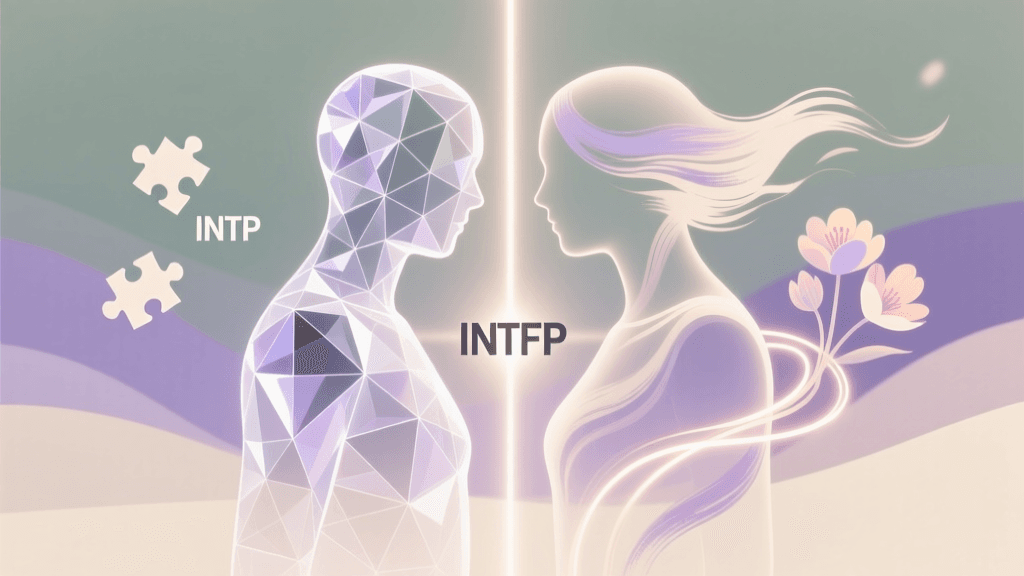
Why INTP and INFP Click Romantically
At first glance, the INTP (The Logician) and INFP (The Mediator) may seem like kindred spirits wrapped in quiet intensity—both introverted, intuitive, and idealistic. Yet their shared dominant function axis—Introverted Thinking (Ti) for INTPs and Introverted Feeling (Fi) for INFPs—creates a rare, magnetically complementary dynamic in romance. Unlike many type pairings where cognitive functions clash or compete, INTP and INFP form what Jungian typologist Linda V. Berens called a "harmonious polarity": two inward-focused, values-driven types who speak different emotional dialects but share the same philosophical grammar of authenticity, depth, and meaning.CAPT Romantically, this manifests as profound mutual fascination. The INFP is drawn to the INTP’s sharp intellectual curiosity—the way they deconstruct ideas with playful rigor—and perceives it not as coldness, but as a unique form of devotion: the INTP invests mental energy as an act of care. Conversely, the INTP is captivated by the INFP’s rich inner emotional world—their moral clarity, poetic sensitivity, and unwavering commitment to personal truth. Where others might find the INFP overly subjective, the INTP often experiences their Fi depth as intellectually compelling: “How do you *know* that so surely? What internal logic supports it?” This question isn’t skepticism—it’s genuine epistemic respect. Ne (Extraverted Intuition), the auxiliary function for both types, serves as their shared bridge to possibility. In romance, Ne fuels joint daydreaming—imagining alternative futures, co-creating symbolic rituals (“What if we moved to a cottage near the sea and wrote letters by candlelight?”), or philosophizing about love itself (“Is romantic love evolutionarily adaptive—or is it a cultural technology for expanding empathy?”). This shared Ne creates fertile ground for emotional intimacy rooted not in surface-level compatibility, but in co-constructed meaning. Crucially, both types exhibit low social performance pressure. They rarely perform affection for external validation. Instead, love is expressed through sustained attention, thoughtful questions, remembered details (“You mentioned your grandmother’s recipe last month—I found a 1940s cookbook with it”), and protected space for each other’s inner lives. A 2022 study published in the Journal of Research in Personality found that couples sharing high openness-to-experience (a trait strongly correlated with N-dominant types) reported significantly higher relationship satisfaction when conflict was resolved through collaborative meaning-making rather than compromise or concessionElsevier. For INTP–INFP pairs, “collaborative meaning-making” isn’t a technique—it’s their native tongue. Attachment research further illuminates their resonance. Both types score highly on secure-autonomous attachment in clinical assessments when raised in emotionally responsive environments—but more tellingly, they demonstrate remarkable tolerance for *non-possessive* intimacy. Neither seeks constant proximity nor demands emotional mirroring. The INFP’s Fi anchors them in self-trust; the INTP’s Ti grounds them in conceptual self-sufficiency. Together, they build what psychologist Susan Johnson terms a "safe haven with breathing room"—a bond where closeness doesn’t require fusion, and distance doesn’t signal rejectionDr. Sue Johnson. This allows their romance to breathe, deepen, and evolve without suffocation or abandonment anxiety.Where Romantic Friction Arises
Despite their alignment, INTP–INFP romantic friction follows predictable, functionally rooted patterns—not personality flaws, but natural tensions between Ti and Fi operating in different domains. Understanding these isn’t about fixing the other person; it’s about designing relational infrastructure that honors both systems. 1. Conflict Expression & Repair TimingINTPs process conflict internally via Ti: they withdraw to analyze cause-effect chains, identify logical inconsistencies, and formulate precise articulations. To them, silence is active work—not avoidance. INFPs, however, experience conflict through Fi: it registers viscerally as moral injury or value violation. Their instinct is to seek immediate emotional attunement (“Do you still see me as worthy?”), not debate premises. When an INTP retreats for 48 hours to “figure things out,” the INFP may interpret it as rejection or indifference—even though the INTP is drafting a 3-page reflection on how their own assumptions contributed to the rupture. 2. Love Language Mismatch (Not Incompatibility)
Gary Chapman’s Five Love Languages framework reveals a subtle but critical divergence. While both types rank Words of Affirmation and Quality Time highly, their expression differs radically:
- INTP: Affirms through intellectual validation (“Your analysis of climate policy was structurally sound”) and quality time defined by low-stimulus co-presence (reading silently side-by-side, coding while partner sketches).
- INFP: Affirms through values-based recognition (“I admire how fiercely you protect your integrity”) and quality time defined by vulnerable sharing (late-night confessions, walking while naming fears).
INTPs apply Ti-Ne to decisions: they generate endless hypotheticals, weigh probabilistic outcomes, and resist closure until all variables are modeled. To an INFP, whose Fi-Ne prioritizes alignment with core values *now*, this can feel like emotional stalling—especially around commitments signaling relational permanence (moving in, defining exclusivity, discussing long-term goals). The INFP may interpret analytical delay as lack of investment, while the INTP perceives the INFP’s values-driven urgency as impulsive or insufficiently examined. 4. External Validation Needs
Though both are introverted, their tertiary functions diverge: INTPs use Extraverted Sensing (Se) under stress—seeking tangible proof of love (shared meals, physical touch, spontaneous adventures). INFPs use Extraverted Thinking (Te) under stress—needing logistical reliability (consistency in communication, follow-through on promises, visible effort toward shared goals). When unmet, these needs manifest as resentment: the INTP feels the INFP is “emotionally withholding” if touch or spontaneity is scarce; the INFP feels the INTP is “unreliable” if plans shift without notice or promises evaporate into theoretical possibilities.
INTP and INFP in a Romantic Relationship (Early/Mid/Long-Term Stages)
Understanding how their dynamic evolves across time prevents misreading natural transitions as deterioration.Early Stage (0–6 Months): The Resonance Honeymoon
This phase thrives on Ne-driven discovery. Conversations flow effortlessly—from quantum ethics to favorite childhood metaphors. Both feel *seen* in ways rare for their types: the INTP appreciates the INFP’s non-judgmental receptivity to their abstract tangents; the INFP feels the INTP’s questions probe their values without demanding conformity. Physical intimacy often develops slowly but meaningfully—guided by mutual consent and emotional calibration rather than social scripts. Key risk: over-idealization. Their shared idealism may gloss over practical incompatibilities (e.g., financial habits, family expectations). Actionable tip: Schedule one “reality anchor” conversation monthly—discussing concrete topics like debt, health routines, or holiday plans—with explicit permission to voice discomfort without defensiveness.Mid-Stage (6–24 Months): The Integration Crucible
As novelty fades, Ti and Fi begin negotiating shared infrastructure. This is where friction surfaces—but also where profound growth occurs. The INTP learns to translate Ti insights into Fi-accessible language (“When I withdrew yesterday, it wasn’t about you—it was my brain debugging a flawed assumption about fairness. Here’s what I realized…”). The INFP learns to hold space for Ti processing without filling silence with reassurance-seeking (“I trust your process. I’ll journal while you think—let me know when you’re ready”). Shared projects emerge organically: co-writing speculative fiction, building a permaculture garden, or launching a podcast critiquing pop psychology. Success hinges on ritualizing *dual-processing*: e.g., agreeing that after a disagreement, the INTP shares written reflections within 48 hours, and the INFP responds with a voice note capturing emotional resonance—not rebuttal.Long-Term Stage (2+ Years): The Sovereign Partnership
Mature INTP–INFP relationships resemble intertwined root systems—deeply connected yet independently nourished. They develop a private dialect: abbreviations for complex concepts (“That’s a classic Fi-overload moment”), shared metaphors (“We’re in our ‘library phase’ this month—low output, high absorption”), and nonverbal cues signaling need-states (e.g., the INTP placing their glasses on the table means “I need 90 minutes of silent recalibration”; the INFP lighting a specific candle signals “I’m holding space for tender things”). Longevity correlates strongly with mutual support for autonomous growth: the INTP encourages the INFP’s activism or artistry not as “projects,” but as expressions of Fi integrity; the INFP champions the INTP’s technical deep dives not as “nerdy hobbies,” but as Ti-based contributions to collective understanding. Research from the Gottman Institute confirms that relationships surviving 15+ years share one trait: partners consistently express interest in each other’s inner worlds—even when those worlds evolve in divergent directionsGottman Institute.INTP and INFP as Friends
Friendship between INTPs and INFPs often predates romance—and provides vital scaffolding for it. Their platonic dynamic is arguably their strongest: lower stakes allow full expression of complementary strengths. INTPs admire INFP friends’ ability to articulate nuanced emotional truths; INFPs value INTP friends’ capacity to dismantle dogma with gentle precision. They make exceptional creative collaborators—e.g., an INFP writes evocative character backstories while the INTP designs coherent magic-system rulesets. Conflict resolution is smoother among friends because expectations are less entangled with identity validation. Practical friendship tip: Co-create a “curiosity jar”—drop anonymous questions weekly (“What’s something you believe that most people find strange?”) and discuss answers over tea. This ritual honors both Ne exploration and Fi authenticity without romantic pressure.INTP and INFP at Work
In professional settings, INTP–INFP pairs excel in roles demanding ethical innovation and systemic thinking—research ethics boards, sustainable design firms, educational technology development. Their synergy lies in balancing critique and compassion: the INTP identifies logical flaws in proposed policies; the INFP surfaces unintended human consequences. However, workplace friction arises when organizational structures demand Te-driven efficiency (deadlines, metrics, hierarchy). INTPs may disengage from “busywork” perceived as logically unsound; INFPs may resist enforcing policies conflicting with their values. Mitigation strategy: Formalize their partnership as a “Design Integrity Duo”—with explicit mandate to review initiatives through dual lenses (Ti: “Does this hold up to scrutiny?” / Fi: “Does this honor human dignity?”). Document findings in shared, plain-language memos—not to persuade, but to broaden organizational perspective.Tips for INTP and INFP Compatibility
These aren’t generic advice—they’re functionally targeted interventions:- Build a Translation Protocol: Create a shared document titled “Our Dialect Dictionary.” List phrases each says that the other misinterprets (e.g., INTP: “Let me think about that” → INFP hears “I reject this” → Revised INTP phrase: “I need 24h to align this with my values framework. I’ll reply by Thursday 5pm.”).
- Structure Processing Time: Agree on “processing windows”: When tension arises, INTP gets 36 hours of low-contact time; INFP gets one 20-minute “heart-check-in” call during that window (“Just say ‘I’m still here’ and ‘I’m working on understanding’”). This satisfies Fi’s need for safety and Ti’s need for autonomy.
- Co-Design Rituals of Reconnection: Move beyond generic “date nights.” Examples: “Silent Studio Night” (create separately, share process—not product), “Values Mapping Hour” (use whiteboard to diagram how recent decisions reflect core principles), or “Ne Spark Walk” (walk without agenda, pausing whenever either spots something intriguing—a cracked sidewalk pattern, a bird’s nest—to explore its symbolism together).
- Externalize the Third Voice: When stuck, ask: “What would our wisest, most compassionate future selves advise *this version of us* right now?” This bypasses Ti’s over-analysis and Fi’s self-blame, activating shared Ne vision.