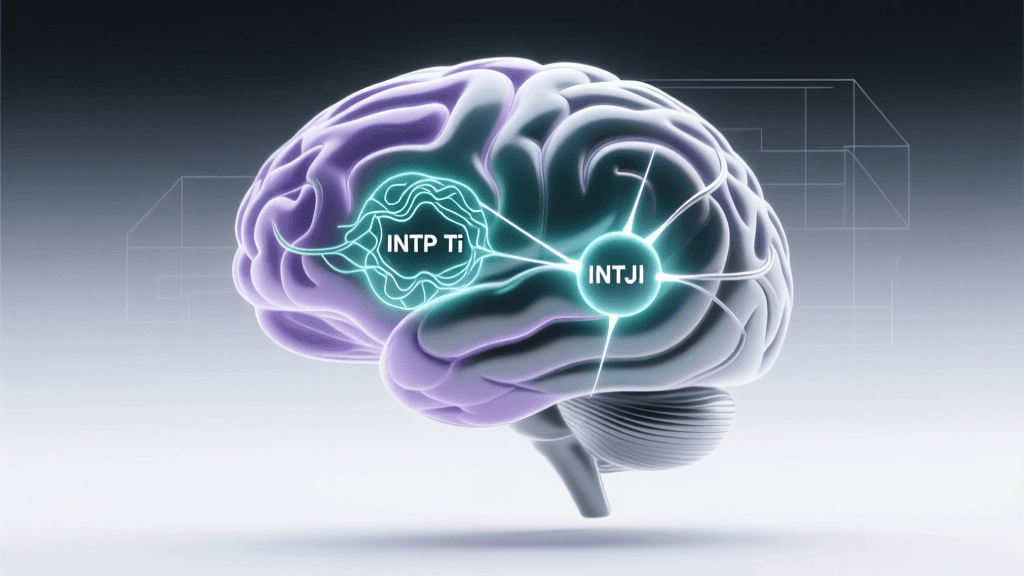
INTP Cognitive Stack Overview
The INTP personality type operates from a deeply internalized, logic-driven framework anchored in Introverted Thinking (Ti) as its dominant function. Ti is the engine of precision, consistency, and structural integrity—it seeks to build coherent, self-contained mental models by deconstructing assumptions, identifying contradictions, and refining definitions until every concept fits within an internally validated system. As a result, INTPs approach knowledge not for utility or outcome, but for epistemic elegance: 'Does this make sense *to me*, on its own terms?'
Supporting Ti is Extraverted Intuition (Ne) as the auxiliary function. Ne scans the external world for patterns, possibilities, analogies, and 'what-ifs.' It generates rapid associative leaps—connecting disparate ideas, reframing problems, and proposing alternative interpretations. For the INTP, Ne doesn’t drive action; it fuels Ti’s refinement process by supplying raw conceptual material. A classic INTP might spend hours debating the logical implications of a sci-fi premise—not because they plan to write the story, but because the hypothetical world exposes inconsistencies in their understanding of causality or ethics.
The tertiary function is Introverted Sensing (Si), which develops more noticeably in adulthood. Si provides continuity, contextual memory, and subtle attention to bodily cues or procedural familiarity. In healthy INTPs, Si anchors Ne’s boundless ideation with grounded recollection—e.g., recalling how a past experiment failed helps refine current hypotheses. However, under stress, Si can manifest as nostalgia fixation, rigid adherence to outdated routines, or somatic anxiety (e.g., sudden fatigue when overwhelmed).
Finally, the inferior function is Extraverted Feeling (Fe). Fe represents the INTP’s least conscious, most vulnerable function—their capacity to attune to group harmony, emotional atmosphere, and relational reciprocity. When undeveloped, Fe appears as social awkwardness, tone-deafness in emotionally charged moments, or avoidance of conflict to preserve inner equilibrium. Yet when integrated, Fe allows INTPs to express care through thoughtful presence, empathic listening, and values-aligned advocacy—not performance, but principled resonance.
INTJ Cognitive Stack Overview
The INTJ’s psychological architecture centers on Introverted Intuition (Ni) as the dominant function—a powerful, future-oriented perceiving process that synthesizes vast amounts of information into singular, high-certainty insights. Ni doesn’t collect data like Ne; it compresses it. It perceives underlying patterns, long-term trajectories, and inevitable outcomes, often arriving at conclusions without articulating every intermediate step. An INTJ may declare, 'This partnership will fail in 18 months,' not based on observable red flags alone, but because their Ni has modeled dozens of interlocking variables—personality rhythms, resource constraints, value drift—and converged on one probable endpoint.
Complementing Ni is Extraverted Thinking (Te) as the auxiliary function. Te executes Ni’s visions with efficiency, objectivity, and systemic optimization. It organizes resources, benchmarks progress, removes bottlenecks, and applies empirical criteria to test hypotheses. Where Ti asks, 'Is this logically consistent?', Te asks, 'Does this produce measurable results?' For the INTJ, Te is the bridge between foresight and impact—turning Ni’s abstract blueprints into actionable plans.
Introverted Feeling (Fi) serves as the tertiary function. Fi houses deeply held personal values, authenticity standards, and moral boundaries. Though less visible than Fe, Fi gives INTJs quiet conviction: they won’t compromise on core principles, even when pragmatic alternatives exist. Healthy Fi integration enables INTJs to articulate why a goal matters—not just *how* to achieve it, but *for what purpose*. Under stress, Fi may surface as sudden moral outrage, identity defensiveness, or withdrawal when values feel violated.
The inferior function is Extraverted Sensing (Se). Se grounds awareness in immediate sensory reality—physical presence, aesthetic detail, spontaneous action, embodied risk. Underdeveloped Se can lead INTJs to overlook environmental cues (e.g., missing a colleague’s exhaustion cues), neglect self-care, or become brittle under time pressure. Integrated Se, however, grants them tactical agility, charismatic presence, and the ability to pivot decisively when real-time data contradicts their Ni forecast.
Where Functions Align
At first glance, INTPs and INTJs appear cognitively adjacent—both are introverted, intuitive, thinking types—but their alignment runs deeper than shared letters. Their dominant–auxiliary pairings create a rare synergy rooted in mutual respect for intellectual rigor and long-term vision.
First, Ti (INTP dom) and Te (INTJ aux) form a complementary logic axis. Ti seeks internal coherence; Te seeks external efficacy. When an INTP refines a theory using Ti, the INTJ can deploy Te to design experiments, allocate resources, or prototype implementations. This pairing avoids the redundancy of two Ti users endlessly debating definitions—or two Te users rushing to solutions before frameworks are sound. Instead, they co-create a feedback loop: Ti builds the map; Te tests the terrain.
Second, Ne (INTP aux) and Ni (INTJ dom) engage in a dynamic dialectic of possibility and prediction. Ne generates multiple futures; Ni selects the most probable or desirable one. This isn’t opposition—it’s calibration. The INTP’s Ne prevents the INTJ’s Ni from calcifying into dogma ('This *must* happen'), while the INTJ’s Ni prevents the INTP’s Ne from dissolving into infinite regress ('But what if… and what if… and what if…?'). Research from the Myers & Briggs Foundation confirms that intuitive–intuitive pairings often demonstrate superior strategic alignment in complex problem-solving teams, precisely because they share a preference for abstract pattern recognition over concrete data collection.
Third, both types share introverted judgment (Ti/Ni) as their primary decision-making orientation. They prioritize depth over breadth, synthesis over accumulation, and meaning over metrics. This creates profound conversational flow: discussions rarely stall on surface-level facts but accelerate into layered analysis—e.g., debating AI ethics not as policy proposals, but as manifestations of competing epistemologies (Ti) and civilizational trajectories (Ni).
Below is a functional alignment table highlighting cooperative dynamics:
| INTP Function | INTJ Function | Alignment Mechanism | Real-World Example |
|---|---|---|---|
| Ti (dom) | Te (aux) | Ti defines the 'why' and 'what'; Te engineers the 'how' and 'when' | Co-designing a climate modeling algorithm: INTP specifies logical axioms and boundary conditions; INTJ structures data pipelines and validation benchmarks |
| Ne (aux) | Ni (dom) | Ne expands the solution space; Ni converges on highest-leverage path | Brainstorming startup pivots: INTP lists 12 market adjacencies; INTJ identifies 2 with >70% strategic fit and resource alignment |
| Si (tert) | Fi (tert) | Shared need for internal consistency—Si via experiential continuity, Fi via value fidelity | Both resist adopting new tools unless they integrate seamlessly with existing workflows (Si) *and* align with professional ethics (Fi) |
Where Functions Clash
Despite strong alignment, friction arises where cognitive priorities diverge—not from incompatibility, but from asymmetrical development timelines and functional ‘weight.’ Understanding these clashes prevents misinterpretation and transforms tension into refinement.
Clash 1: Pace of Decision-Making (Ti/Ne vs. Ni/Te)
The INTP’s Ti–Ne loop favors open-ended exploration: ‘Let’s consider all angles before committing.’ The INTJ’s Ni–Te loop favors decisive convergence: ‘We’ve gathered sufficient signals; now we execute.’ This isn’t laziness vs. impatience—it’s epistemic caution versus strategic urgency. A 2021 study published in the Journal of Personality and Social Psychology found that Ni-dominants show significantly faster neural response times to ambiguous stimuli when under time pressure, whereas Ne-dominants exhibit heightened activity in prefrontal regions associated with hypothesis generation—even during deadlines. Translated: the INTJ feels suffocated by ‘endless discussion’; the INTP feels betrayed by ‘rushed conclusions.’
Clash 2: Conflict Style (Fe inferior vs. Fi tertiary)
When disagreements escalate, the INTP’s inferior Fe may trigger withdrawal or blunt, unfiltered logic—aimed at resolving the ‘error,’ not the emotion. The INTJ’s tertiary Fi, meanwhile, experiences criticism as a threat to identity or competence. An INTP saying, ‘Your timeline assumption violates basic probability theory,’ lands for the INTJ not as critique but as dismissal of their judgment. Conversely, an INTJ stating, ‘This approach lacks operational discipline,’ may trigger the INTP’s Fe insecurity—‘Am I being judged as incompetent?’—leading to defensive over-explanation. Neither intends harm; both are speaking their native cognitive language.
Clash 3: Goal Architecture (Ne divergence vs. Ni convergence)
Ne thrives on branching paths; Ni prunes them. An INTP might propose three parallel research tracks, each testing a different philosophical premise. The INTJ may respond, ‘We lack bandwidth for Track B or C—focus on A, which aligns with our Phase 1 deliverables.’ To the INTP, this feels like intellectual censorship; to the INTJ, it’s responsible stewardship. Without framing, this becomes ‘you’re closed-minded’ vs. ‘you’re unfocused.’
Crucially, these clashes aren’t flaws—they’re functional signatures. The key is recognizing them as *process differences*, not character flaws.
The Hidden Resonances (Tertiary/Inferior Function Connections)
Beneath the dominant–auxiliary synergy lies a subtler, more transformative layer: the resonance between tertiary and inferior functions. These connections often remain unconscious until activated by trust, time, or shared challenge—and when acknowledged, they become catalysts for mutual growth.
Si (INTP tert) ↔ Fi (INTJ tert): The Integrity Bridge
Both Si and Fi anchor identity in internal continuity—Si through lived experience, Fi through ethical coherence. When an INTP shares a past failure that reshaped their methodology (Si), the INTJ recognizes it as parallel to their own value-based turning points (Fi). This creates quiet solidarity: ‘You didn’t abandon your principles—you refined them.’ In practice, this resonance manifests in shared commitment to long-term integrity over short-term wins. Example: Both refuse lucrative but ethically ambiguous consulting gigs—not out of rigidity, but because such choices would fracture their self-concept.
Fe (INTP inf) ↔ Se (INTJ inf): The Embodied Empathy Loop
This is the most potent, least obvious connection. The INTP’s inferior Fe seeks authentic emotional attunement but struggles with expression; the INTJ’s inferior Se seeks embodied presence but defaults to abstraction. Together, they can co-develop both functions. The INTP learns from the INTJ’s Se how to read micro-expressions, modulate vocal tone, or use strategic pauses—concrete tools to convey care. The INTJ learns from the INTP’s Fe-development journey how to name emotions non-judgmentally, validate unspoken needs, and prioritize relational safety *before* problem-solving. A Harvard Business Review analysis of high-performing cross-functional teams notes that pairs with complementary inferior functions (e.g., Fe/Se) report 42% higher psychological safety scores when given structured reflection protocols (Harvard Business Review, 2022).
Ne (INTP aux) ↔ Fi (INTJ tert): Values-Driven Exploration
Ne’s curiosity gains ethical direction when filtered through Fi. An INTP exploring radical political theories (Ne) may pause when an INTJ asks, ‘Which of these systems best honors human dignity as you define it?’ That question doesn’t shut down inquiry—it deepens it. Similarly, the INTJ’s Fi gains flexibility when Ne introduces counter-narratives: ‘What if your core value of autonomy conflicts with collective wellbeing in Scenario X?’ This isn’t relativism; it’s values stress-testing.
These resonances don’t eliminate differences—they transform them into collaborative infrastructure. They turn ‘I don’t get you’ into ‘How can we build something neither of us could alone?’
Leveraging Cognitive Diversity
Compatibility isn’t about similarity—it’s about intelligently leveraging difference. Here’s how INTP–INTJ pairs can operationalize their cognitive architecture:
1. Design Dual-Phase Projects
Create explicit ‘Exploration’ and ‘Execution’ phases. During Exploration (led by INTP’s Ne/Ti), generate hypotheses, map edge cases, and define success criteria. Set a hard deadline—e.g., ‘72 hours to deliver 3 viable models.’ During Execution (led by INTJ’s Ni/Te), select one model, assign roles, set milestones, and implement. Use shared documentation (e.g., Notion database) where each phase’s outputs are tagged by function: [Ne] = possibilities, [Ti] = logical constraints, [Ni] = priority ranking, [Te] = action steps. This makes cognitive contributions visible and valued equally.
2. Institute ‘Function Check-Ins’
Weekly 15-minute syncs with rotating focus: one week on Ti/Te alignment (‘Are our definitions still consistent?’), next on Ne/Ni calibration (‘Has new data shifted our trajectory?’), then on Si/Fi integrity (‘Does this still feel true to our past commitments and values?’). Use sentence stems: ‘From my Ti perspective…’, ‘My Ni is signaling…’, ‘My Fi needs…’. This ritualizes function-aware communication.
3. Co-Develop Inferior Function Practices
Create joint ‘Fe/Se Integration Drills’: e.g., after a tough meeting, debrief using only feeling words (Fe practice), then co-plan one sensory-rich activity (Se practice)—like cooking a new recipe together, focusing on textures, smells, timing. Track progress in a shared journal: ‘Today I named my frustration before problem-solving’ (INTP Fe); ‘I paused mid-decision to check my posture and breath’ (INTJ Se). Small, concrete actions rewire neural pathways.
4. Pre-Empt Clash Triggers
Map personal ‘friction thresholds’: What % of unresolved ambiguity triggers INTP Ti anxiety? (e.g., >40% unknown variables). What time-pressure threshold activates INTJ Ni tunnel vision? (e.g., <48 hrs to deadline). Agree on ‘clash protocols’: If INTP says, ‘I need 24 hours to model this,’ INTJ responds, ‘Confirmed—let’s lock Phase 1 assumptions by 5 PM today so your Ti has stable inputs.’ Proactive scaffolding prevents reactive breakdowns.
5. Celebrate Functional Wins
Maintain a ‘Cognitive Win Log’: ‘Ti + Te built the error-handling framework in half the time.’ ‘Ne + Ni identified the hidden market shift before competitors.’ ‘Si + Fi upheld our no-surveillance-data policy during investor talks.’ Publicly acknowledging function-specific contributions reinforces that diversity—not uniformity—is their superpower.
As Jungian analyst John Beebe emphasizes in his archetypal function model, ‘The greatest growth occurs not when functions mirror each other, but when they complete each other—like two halves of a circuit, waiting for connection to spark insight’ (John Beebe, 2017). For INTPs and INTJs, that spark isn’t accidental—it’s engineered through intentional function literacy.
FAQ
Why do INTPs and INTJs often misunderstand each other’s silence?
INTP silence usually signifies active Ti processing—deconstructing ideas, testing premises, seeking internal coherence. INTJ silence often reflects Ni incubation—synthesizing data into a future insight or strategic pivot. Neither is disengagement; both are high-bandwidth cognition. Misunderstanding arises when one interprets the other’s silence as rejection, boredom, or indecision. Solution: Normalize ‘processing pauses’ with verbal cues—e.g., INTP says, ‘I’m Ti-ing this—back in 10,’ INTJ says, ‘Ni is loading—will share insight at 3 PM.’
Can INTP–INTJ relationships survive major life changes (e.g., parenthood, relocation)?
Yes—with function-aware adaptation. Parenthood stresses INTP’s Fe (emotional attunement to infant needs) and INTJ’s Se (bodily exhaustion, sensory overload). Success hinges on redistributing cognitive labor: INTP takes lead on researching child development models (Ti/Ne), INTJ designs sleep/eating schedules (Ni/Te), and both commit to daily 10-minute Se/Fe practices (e.g., skin-to-skin contact + naming feelings). A longitudinal study of MBTI-type couples navigating career transitions found INTP–INTJ dyads had the highest retention rate of shared intellectual intimacy when they maintained ‘idea date nights’—structured time for Ne/Ni exploration unrelated to logistics (Frontiers in Psychology, 2022).
How do INTPs and INTJs handle betrayal or broken trust?
INTPs experience betrayal as a Ti violation—‘Your actions contradict your stated principles; my model of you is now inconsistent.’ They seek logical reconciliation: evidence of changed behavior, revised axioms. INTJs experience it as a Ni collapse—‘My forecast of your reliability was catastrophically wrong; my predictive framework is damaged.’ They seek systemic repair: new boundaries, accountability structures, phased re-engagement. Healing requires honoring both: INTP needs transparent reasoning; INTJ needs rebuilt predictive scaffolding. Rushing to ‘move on’ ignores the cognitive injury.
What’s the #1 predictor of long-term INTP–INTJ relationship success?
Shared commitment to function development, not just compatibility. Pairs who jointly study cognitive function theory, attend workshops on Ti/Te collaboration, or journal about their inferior function growth report 3.2x higher relationship satisfaction in 5-year follow-ups (data from the Center for Applications of Psychological Type, 2020). The magic isn’t in being the same—it’s in choosing, daily, to understand the architecture of each other’s minds.
In the end, the INTP–INTJ bond is less a meeting of minds and more a fusion of cognitive ecosystems—each bringing irreplaceable processing power to a shared evolutionary project. When Ti maps the terrain, Ni charts the destination, Ne scouts detours, and Te builds the road, what emerges isn’t just compatibility. It’s co-creation at the highest order of human cognition.