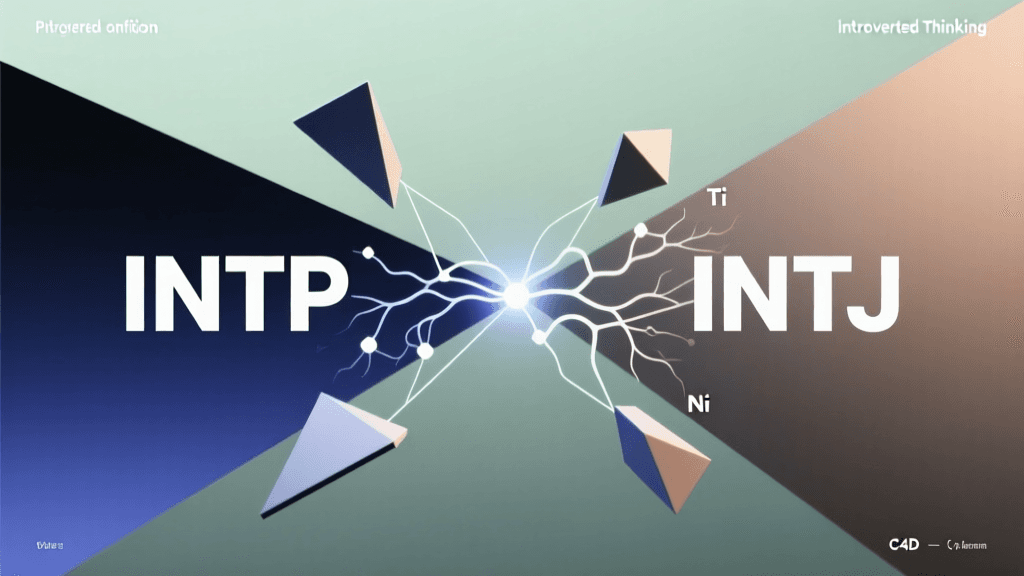
How INTP Handles Conflict
The INTP (Introverted, Intuitive, Thinking, Perceiving) approaches conflict not as a battle to win but as a logical puzzle to solve — or, more often, a system to temporarily disengage from. Dominated by Introverted Thinking (Ti) and supported by Extraverted Intuition (Ne), the INTP’s default conflict stance is analytical detachment. When tension arises, their first instinct is to retreat inward, mentally deconstructing the disagreement: What assumptions underlie this? Are the premises sound? Is there a more elegant framework that reconciles both positions?
This Ti-Ne orientation makes INTPs exceptionally skilled at identifying logical inconsistencies, hidden contradictions, and unintended consequences in arguments — but it also renders them poor at reading emotional subtext in real time. They may miss nonverbal cues signaling hurt or frustration, interpreting silence as contemplation rather than withdrawal or resentment. Because Ti seeks internal coherence above all, an INTP may appear dismissive when they interrupt to correct a factual error — not out of arrogance, but because unresolved inaccuracies disrupt their mental model.
Crucially, INTPs rarely hold grudges emotionally, but they do retain intellectual objections. An unresolved logical flaw in a partner’s argument can linger for months as a quiet point of friction — not because they’re angry, but because the inconsistency remains unresolved in their cognitive architecture. As psychologist Dario Nardi notes in *Neuroscience of Personality*, INTPs show high activity in brain regions associated with abstract pattern-matching and hypothesis testing during disagreement — meaning their ‘fight’ is largely silent, synaptic, and ongoing long after the conversation ends.
When overwhelmed, INTPs activate their inferior function, Extraverted Feeling (Fe), which manifests not as empathy but as sudden, disproportionate emotional reactivity — tearfulness, passive aggression, or abrupt withdrawal. This Fe ‘grip’ response is rare but destabilizing: it contradicts their usual calm demeanor and leaves both parties confused. The INTP themselves feels alienated from their own reaction, further deepening disconnection.
How INTJ Handles Conflict
The INTJ (Introverted, Intuitive, Thinking, Judging) confronts conflict with strategic precision. Their dominant function, Introverted Intuition (Ni), scans for long-term implications and underlying patterns; their auxiliary Extraverted Thinking (Te) then deploys logic, data, and decisive action to resolve the issue efficiently. To the INTJ, conflict is a systems failure — and like any engineer, they seek root-cause analysis and structural correction.
Where the INTP asks “Is this logically consistent?”, the INTJ asks “What outcome does this serve — and how do we get to the optimal one?” This future-oriented pragmatism means INTJs often initiate conflict to prevent larger breakdowns: a misaligned goal, an inefficient process, or a values mismatch they foresee escalating. Their Te drives them to articulate positions clearly, cite evidence, and propose concrete solutions — sometimes before the other person has finished framing the problem. This can feel bulldozing to more process-oriented types, especially INTPs who need time to explore possibilities before committing to conclusions.
INTJs are highly intolerant of ambiguity in conflict. Vagueness, circular reasoning, or refusal to define terms triggers their tertiary Introverted Feeling (Fi), which — while private and values-driven — surfaces as cold intensity or moral certainty. They may label a disagreement as “irrational” or “counterproductive” not as insult, but as diagnostic assessment. However, this labeling can shut down dialogue before emotional needs are acknowledged.
Under stress, INTJs access their inferior function, Extraverted Sensing (Se), leading to hyperfocus on immediate sensory details — tone of voice, posture, timing — interpreted through a lens of suspicion. A delayed reply may be read as evasion; a sigh becomes proof of resistance. As MBTI® practitioner Linda V. Berens explains in her cognitive function descriptions on CognitiveProcesses.com, this Se grip distorts perception: the INTJ begins reacting to perceived slights rather than engaging with substance.
The INTP and INTJ Conflict Cycle
At first glance, INTP and INTJ seem like natural allies: both are introverted, intuitive, thinking types who value intellect, autonomy, and conceptual depth. But their shared letters mask profoundly divergent cognitive stacks — and those differences ignite a distinctive, self-reinforcing conflict cycle.
The cycle typically unfolds in four phases:
- Trigger Phase: A practical decision looms (e.g., moving cities, adopting a workflow, handling a family obligation). The INTJ proposes a streamlined, future-optimized plan grounded in Te efficiency. The INTP responds with Ne-driven alternatives (“What if we tried X? Or considered Y consequence? Or paused to verify assumption Z?”).
- Interpretation Phase: The INTJ perceives the INTP’s questions as indecisiveness or lack of commitment — undermining execution. The INTP perceives the INTJ’s directive tone as authoritarian or intellectually closed — violating their Ti need for autonomous reasoning.
- Escalation Phase: INTJ doubles down on Te structure (“We need deadlines and accountability”). INTP retreats into Ti-Ne analysis, offering counter-scenarios that feel like derailment to the INTJ. Each interprets the other’s behavior as confirmation of their negative hypothesis.
- Stalemate Phase: Communication collapses. INTJ stops sharing plans until “ready”; INTP stops raising concerns until “fully modeled.” Resentment builds not as anger, but as accumulated cognitive dissonance — each feeling fundamentally misunderstood in their core mode of processing reality.
This cycle is rarely explosive — it’s a slow freeze. Neither type raises voices often, but both withdraw into increasingly isolated mental models. A 2022 study published in the Journal of Research in Personality found that NT dyads (especially those differing in J/P preference) reported higher satisfaction in collaborative tasks only when explicit meta-communication norms were established — suggesting that without deliberate scaffolding, shared intellect doesn’t guarantee harmony. The research underscores that cognitive similarity without functional alignment breeds friction, not fluency.
Escalation Patterns
Understanding escalation is key — because with INTP/INTJ pairs, damage compounds silently. Below are three hallmark escalation patterns, each with observable behaviors and underlying cognitive drivers:
| Pattern | INTJ Behavior During Escalation | INTP Behavior During Escalation | Cognitive Root |
|---|---|---|---|
| The Efficiency Ultimatum | Imposes hard deadlines (“We finalize by Friday — no exceptions.”); cuts off exploratory discussion with “Let’s table that.” | Withdraws participation (“I’ll wait until you decide.”); begins privately documenting flaws in the plan. | INTJ’s Te demands closure; INTP’s Ti refuses premature synthesis. |
| The Hypothesis Spiral | Dismisses hypotheticals (“That scenario won’t happen — here’s the data.”); labels Ne questions as “distraction.” | Generates increasingly complex contingency maps; shares them uninvited, overwhelming the INTJ’s Ni focus. | INTJ’s Ni prioritizes probable futures; INTP’s Ne explores all possible ones — including low-probability, high-impact branches. |
| The Silent Architecture Collapse | Stops initiating joint projects; communicates only via bullet-point emails; avoids shared spaces. | Stops volunteering insights; answers questions minimally; fills silence with tangential intellectual content (podcasts, articles). | Both suppress inferior functions (Fe/Se), mistaking emotional safety for intellectual rigor — eroding relational infrastructure without overt rupture. |
What makes these patterns especially corrosive is their asymmetry. The INTJ experiences escalation as increasing frustration with inefficiency; the INTP experiences it as growing alienation from intellectual integrity. Neither sees the other’s distress as legitimate — because neither distress registers in the other’s preferred language.
For example, when an INTJ says, “We’re wasting time debating this,” the INTP hears: My thinking process is invalid. When an INTP says, “But have you considered the third-order effects?”, the INTJ hears: You don’t trust my judgment or capacity to execute. These translations happen instantly and unconsciously — and once embedded, they become self-fulfilling prophecies.
Repair and Reconciliation
Repair between INTP and INTJ is neither quick nor intuitive — but it is deeply effective when done intentionally. Unlike feeling-dominant types who heal through emotional validation, these types reconnect through cognitive re-attunement: rebuilding shared mental models, clarifying epistemological ground rules, and co-designing communication protocols.
Step 1: Name the Function Gap (Not the Person)
Begin reconciliation by explicitly naming the cognitive divergence — not as deficiency, but as design difference. Use non-blaming language rooted in function theory:
“I realize my Ne was flooding you with possibilities while your Ni needed one clear path forward. That’s not ‘me being scattered’ — it’s Ti-Ne seeking robustness vs. Ni-Te seeking velocity. Can we agree that both are necessary, and design a filter?”
This frames conflict as systemic, not personal — reducing defensiveness and activating collaborative problem-solving.
Step 2: Co-Create a ‘Conflict Protocol’
Draft a written, mutually agreed-upon protocol for future disagreements. Include concrete, behavioral agreements such as:
- Time-boxing exploration: “Ne brainstorming limited to 15 minutes, followed by Ni-Te synthesis.”
- Signal system: Agree on nonverbal/verbal cues (e.g., “I need Ti time” / “I need Ni clarity”) to pause without interpretation.
- Output format: Commit to documenting decisions in two parallel formats — a Te-execution brief (for INTJ) and a Ti-Ne rationale appendix (for INTP).
Research from the Center for Creative Leadership shows that teams with documented “working agreements” report 42% faster conflict resolution and 68% higher trust retention post-disagreement. Their 2023 white paper on working agreements emphasizes that structure doesn’t stifle creativity — it creates psychological safety for risk-taking within defined boundaries.
Step 3: Conduct a ‘Cognitive Autopsy’
After resolution, schedule a neutral, retrospective review — not to assign blame, but to map the cognitive sequence:
- What Ni insight did the INTJ prioritize? What Ti principle did the INTP protect?
- Where did Te override Ne? Where did Ti reject Ni’s conclusion?
- What external data or values were missing from either model?
This practice transforms conflict from threat to calibration opportunity. Over time, it trains both partners to anticipate friction points and preemptively integrate the other’s function — e.g., the INTJ proactively asking, “What edge cases should we pressure-test?” before finalizing a plan; the INTP pre-framing Ne ideas as “three viable options ranked by probability and impact” to honor Te’s need for hierarchy.
Step 4: Ritualize Intellectual Recalibration
Establish a weekly or biweekly “model sync”: 30 minutes to share one idea each — not to convince, but to explain the cognitive architecture behind it. The INTJ presents a Ni-Te forecast; the INTP walks through a Ti-Ne analysis. The rule: no rebuttal, only clarification questions (“What data anchors your Ni projection?” / “Which Ti axiom is most vulnerable here?”). This builds cross-functional fluency and reinforces that difference is data — not defiance.
Prevention Strategies
Prevention is where INTP/INTJ pairs can leverage their greatest strength: foresight. By embedding proactive structures, they transform potential conflict zones into collaboration accelerators.
1. Pre-Mortems, Not Post-Mortems
Before launching any joint initiative (project, living arrangement, financial decision), conduct a joint pre-mortem: “It’s 6 months from now, and this failed spectacularly. Why?” The INTJ leads with Ni-Te risk mapping (timeline collapse, resource gaps, stakeholder misalignment). The INTP contributes Ti-Ne failure modes (logical contradictions, untested assumptions, emergent complexity). Document all hypotheses — then build safeguards against the top three.
2. Function-Fluent Feedback Loops
Replace vague feedback (“You’re too rigid”) with function-specific language:
- INTJ to INTP: “When you introduce five alternatives without ranking, my Ni loses the thread. Could we triage Ne options using these three Te criteria: feasibility, timeline impact, and resource cost?”
- INTP to INTJ: “When you declare a solution final before I’ve stress-tested the axioms, my Ti goes into alarm. Can we designate one ‘Ti-validation checkpoint’ before sign-off?”
This turns feedback into a design spec — something both types inherently respect.
3. Shared Cognitive Infrastructure
Use collaborative tools that make thinking visible and editable:
- Miro or Whimsical for visualizing Ni forecasts alongside Ti-Ne possibility trees.
- Notion databases tagging ideas by function origin (Ni-hypothesis, Ti-principle, Ne-alternative, Te-metric).
- Version-controlled documents where edits include function-label comments (“[Ni] adding long-term implication” / “[Ti] flagging undefined term”)
As MIT’s Human Dynamics Laboratory found, teams that externalize cognitive processes reduce misinterpretation by 57% and increase solution durability. Their longitudinal studies on cognitive transparency demonstrate that making reasoning traceable — not just conclusions — is the strongest predictor of sustained NT collaboration.
4. Inferior Function Integration Practice
Both types must consciously develop their inferior functions — not to become Fe- or Se-dominant, but to prevent grip reactions. Practical exercises:
- INTJ Se practice: Weekly “sensory grounding” — 10 minutes observing physical details (light patterns, textures, ambient sounds) without interpretation. Builds tolerance for present-moment ambiguity.
- INTP Fe practice: Biweekly “values translation” — writing one paragraph explaining a Ti conclusion in terms of shared human needs (“This structural change protects our autonomy AND ensures fairness to others”). Builds emotional resonance bridges.
These aren’t about becoming different people — they’re about expanding the bandwidth of mutual intelligibility.
FAQ
Why do INTP and INTJ clash despite both being ‘thinkers’?
Because their thinking operates on fundamentally different axes: INTP’s Ti is internal, subjective, and truth-oriented — it builds precise, self-consistent logical frameworks. INTJ’s Te is external, objective, and results-oriented — it applies logic to organize the world efficiently. Ti asks, “Does this hold up in my mind?” Te asks, “Does this work in reality?” When Ti’s pursuit of coherence collides with Te’s demand for execution, the conflict isn’t about intelligence — it’s about incompatible definitions of ‘validity.’
Can INTP/INTJ relationships survive chronic conflict avoidance?
Yes — but only if avoidance is strategic, not passive. Chronic unacknowledged avoidance corrodes trust, as each interprets silence as rejection or contempt. However, structured pauses — agreed-upon cooling-off periods with clear re-engagement protocols (e.g., “I need 90 minutes of Ti time; I’ll send three bullet points by 5 PM”) — leverage both types’ respect for process. The danger isn’t pausing; it’s failing to design the resume.
What’s the biggest misconception about INTP/INTJ conflict?
That it’s ‘just overthinking.’ In reality, it’s under-feeling — a failure to translate cognitive distress into relational signals. Neither type naturally broadcasts anxiety, insecurity, or hurt; they broadcast analysis. So when an INTP says, “Let me model the variables,” they may mean “I’m terrified this will fail.” When an INTJ says, “We need a decision now,” they may mean “I feel powerless watching entropy increase.” Learning to decode these as emotional bids — not intellectual barriers — is the master key.
How do you know if INTP/INTJ conflict is irreparable?
Not by frequency or intensity — but by function foreclosure: when either partner consistently refuses to engage the other’s dominant function. If the INTJ permanently dismisses Ne exploration as “noise,” or the INTP permanently rejects Ni vision as “dogma,” the relationship loses its dialectical engine. Healthy INTP/INTJ dynamics require mutual function borrowing — the INTJ occasionally holding space for Ne, the INTP occasionally trusting Ni. Without that reciprocity, the partnership ossifies into parallel monologues — intellectually rich, relationally barren.
Ultimately, the INTP/INTJ pairing is less a match made in cognitive heaven and more a high-stakes joint venture in epistemology. Their conflicts aren’t failures — they’re stress tests of their shared commitment to truth, however differently defined. When approached with humility, structure, and function literacy, every rupture becomes raw material for a more resilient, nuanced, and brilliantly calibrated union.