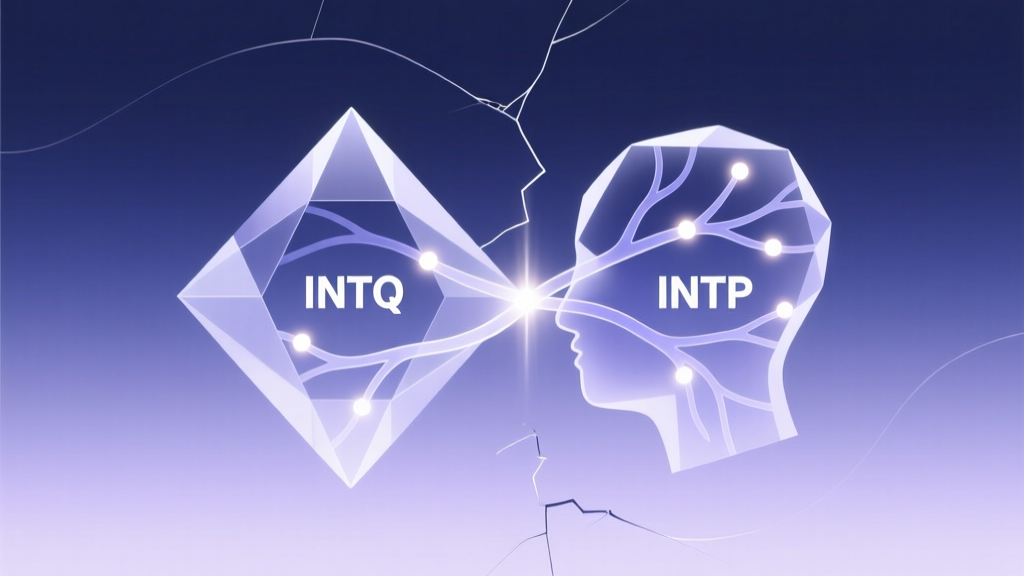
How INTP Builds Trust
For the INTP (Introverted, Intuitive, Thinking, Perceiving), trust is not granted—it is earned through intellectual consistency, honesty, and non-intrusive respect for autonomy. Unlike types that prioritize warmth or shared emotion as early trust signals, the INTP’s foundational trust metric is cognitive reliability: Does this person think clearly? Do their words align with their actions over time? Are they intellectually honest—even when it’s inconvenient?
INTPs approach relationships like hypothesis testing. They observe, analyze, and revise assumptions based on evidence. A single contradiction—e.g., a partner claiming to value transparency but withholding information during conflict—can trigger a months-long recalibration period. According to research from the Myers & Briggs Foundation, INTPs score highest among all 16 types in preference for logical coherence and lowest in reliance on social cues or emotional expressiveness as trust indicators.
Crucially, INTPs do not equate familiarity with trust. They may spend years in close proximity to someone—colleagues, roommates, even long-term partners—without lowering their emotional guard unless three conditions are met:
- Consistency of reasoning: The person demonstrates stable values and principles across contexts (e.g., advocating fairness at work and applying it in personal disagreements).
- Intellectual humility: Willingness to revise opinions when presented with compelling evidence—not as weakness, but as integrity.
- Respect for silence and space: No pressure to perform emotion, share feelings on demand, or conform to relational scripts (e.g., daily check-ins, forced vulnerability exercises).
Practical tip for partners of INTPs: Instead of asking “How do you feel?” try “What’s your current working model of what happened?” This invites engagement on their native terrain—analysis—while leaving room for emotional insight to emerge organically. As clinical psychologist Dr. Elaine Aron notes in her work on highly sensitive thinkers, over-pressuring introverted intuitives into premature emotional disclosure often triggers withdrawal, not closeness.
How INTJ Builds Trust
The INTJ (Introverted, Intuitive, Thinking, Judging) builds trust through strategic alignment and demonstrated competence. Where the INTP tests logic, the INTJ evaluates execution: Can this person follow through on commitments? Do their long-term goals cohere with mine? Is their decision-making process both principled and effective?
Trust for the INTJ is less about moment-to-moment authenticity and more about architectural integrity—the structural soundness of another person’s character over time. An INTJ may forgive a single lapse in judgment if it’s followed by rigorous self-audit and systemic correction. But repeated inconsistency—especially around stated values or responsibilities—is treated as a red flag indicating flawed internal architecture.
According to a 2022 longitudinal study published in the Journal of Personality and Social Psychology, INTJs show significantly higher activation in prefrontal cortex regions associated with future-oriented planning during interpersonal evaluation—meaning they’re constantly modeling “how this person fits into my 3-, 5-, and 10-year vision” (APA PsycNet, 2022). This isn’t cold calculation; it’s deep stewardship of emotional energy. INTJs invest trust sparingly because they understand its long-term relational ROI—and they protect it fiercely.
INTJs also require clarity of boundaries and role expectations. Ambiguity—such as undefined relationship status, vague commitments (“we’ll see”), or inconsistent communication norms—erodes trust faster than outright disagreement. Their ideal trust-builder is a shared document (yes, literally): a mutual agreement outlining core values, conflict protocols, and growth intentions. Not as legalism—but as cognitive scaffolding.
Practical tip for partners of INTJs: When addressing a concern, lead with structure. Say: “I’d like to discuss X using this framework: (1) What happened, (2) How it impacted my sense of safety/goals, (3) One concrete change I’d like us to co-design.” This honors their need for precision and forward motion.
The Trust Timeline for INTP and INTJ
While both types are slow to trust, their timelines operate on different frequencies—and misalignment here is the most common source of early friction. Below is a comparative timeline illustrating typical trust milestones:
| Milestone | INTP Typical Timeline | INTJ Typical Timeline | Joint Risk Zone |
|---|---|---|---|
| Initial openness to sharing ideas (not feelings) | Weeks 1–4: Rapid ideation exchange if intellectually stimulated | Weeks 2–6: Cautious idea-sharing; filters for strategic relevance | INTP may perceive INTJ as “cold”; INTJ may see INTP as “scattered” |
| First admission of uncertainty or doubt | Months 3–6: Only after observing consistent intellectual humility | Months 4–8: After verifying reliability in high-stakes situations | INTP may withdraw if INTJ doesn’t reciprocate doubt-sharing; INTJ may misinterpret INTP’s hesitation as indecisiveness |
| Willingness to co-create systems (routines, agreements) | Months 6–12: Requires proof that structure won’t stifle exploration | Months 3–7: Actively initiates frameworks once alignment is confirmed | INTJ may push for agreements too early; INTP may resist, triggering INTJ’s “lack of commitment” alarm |
| Sharing unfiltered emotional reactions (not just analysis) | Year 1–2+: Emerges only after sustained safety + no history of weaponized logic | Year 1–3+: Occurs when emotions are framed as data points in long-term strategy | Highest vulnerability point—both fear being misunderstood as “illogical” for feeling, or “irrational” for analyzing feeling |
This timeline reveals a critical insight: INTJs often reach the “co-creation” stage before INTPs feel safe enough to engage with it. The INTJ’s instinct to design shared systems—communication rhythms, financial plans, conflict de-escalation protocols—can unintentionally pressure the INTP, who experiences structure as potentially limiting until proven otherwise. Conversely, the INTP’s extended observation phase can read as evasiveness to the INTJ, who interprets delay as lack of investment.
Resolution requires explicit negotiation of pacing. A successful INTP–INTJ pair will agree on a “trust calibration protocol”: e.g., “We’ll revisit our shared agreement every 90 days—not to enforce it, but to ask: ‘Does this still serve our growth, or has new evidence emerged?’” This satisfies the INTJ’s need for forward motion while honoring the INTP’s requirement for iterative validation.
Vulnerability Patterns and Emotional Walls
Both INTP and INTJ possess formidable emotional armor—not out of indifference, but as a hard-won defense against misattunement. Their walls are built from different materials and serve distinct functions:
“The INTP’s wall is a library—dense, well-cataloged, and accessible only via precise citation. The INTJ’s wall is a fortress—engineered for defense, with drawbridges lowered only for verified allies.”
— Dr. Linda V. Berens, TypeInDepth, 2021
INTP Vulnerability Pattern: INTPs rarely lead with emotion—but they do reveal vulnerability through intellectual exposure. Admitting “I don’t know” on a topic they’ve studied deeply, sharing an unfinished theory, or confessing a flaw in their own logic are high-stakes acts of trust. Their emotional wall rises not against feeling, but against feeling without context. Unprompted emotional outbursts, guilt-tripping, or demands for instant reassurance trigger immediate retreat because they violate the INTP’s core need for cognitive coherence in emotional exchange.
INTJ Vulnerability Pattern: INTJs disclose vulnerability as strategic disclosure. They share doubts, fears, or insecurities only when doing so serves a larger objective—e.g., soliciting collaborative problem-solving, preempting future failure, or inviting calibrated support. Their wall guards against inefficient emotional labor: venting without solution-focus, circular arguments, or emotional demands that derail long-term aims. To an INTJ, saying “I’m overwhelmed” is not a cry for comfort—it’s a request to co-optimize workflow.
The danger arises when these patterns collide:
- An INTP shares a half-formed idea about relationship dynamics, hoping for collaborative refinement → The INTJ hears “problem to solve” and drafts an action plan → The INTP feels reduced to a case study, not a partner.
- An INTJ says, “I’m reconsidering our travel plans due to budget constraints” → The INTP hears “withdrawal signal” and retreats to analyze possible causes → The INTJ perceives silence as disengagement, not processing.
Breaking through requires reframing vulnerability itself. For INTP–INTJ pairs, the safest entry point is shared epistemic humility: jointly acknowledging the limits of their models. Phrases like “My current understanding suggests X—but I’m open to data that updates it” or “Here’s my best hypothesis about why we’re stuck—what’s yours?” transform vulnerability from exposure into co-inquiry.
Deepening Intimacy Between INTP and INTJ
Intimacy for this pairing isn’t forged in candlelit confessions—it’s built in late-night whiteboard sessions, annotated book exchanges, and quiet walks where silence isn’t emptiness but shared cognitive resonance. Here’s how to cultivate it intentionally:
1. Co-Design a “Cognitive Safety Protocol”
Create mutually agreed-upon rules for high-stakes conversations. Example:
- No diagnosis language: Replace “You’re being defensive” with “I noticed tension when X was mentioned—can we explore what that activated?”
- Pause-and-replay: Either partner can say “Rewind”—pausing to restate the last 2–3 sentences verbatim before continuing.
- Source-checking: Before escalating, ask: “Is this reaction based on this interaction—or a pattern from past experience?”
This protocol leverages both types’ strengths: the INTP’s love of precise language and the INTJ’s commitment to systemic improvement.
2. Practice “Dual-Mode Sharing”
Structure vulnerability exchanges in two layers:
- Analysis Layer: “Here’s what my brain observed…” (e.g., “I noticed we haven’t discussed finances in 8 weeks, and my anxiety spikes around unpredictability.”)
- Embodied Layer: “And here’s what my body felt…” (e.g., “My shoulders tighten, and I scroll aimlessly—that’s my signal something needs tending.”)
The INTP gains permission to name physical sensations without “explaining them away”; the INTJ learns to treat somatic data as valid input—not noise. Research from the Trauma Research Foundation confirms that linking cognitive insight with bodily awareness significantly increases emotional regulation capacity in high-functioning analytical types.
3. Build “Anti-Fragile Rituals”
Rituals that grow stronger through stress—not despite it. Examples:
- The Quarterly Calibration: A scheduled 90-minute session using this agenda: (1) What worked? (2) What broke down—and what did it reveal? (3) One micro-adjustment for next quarter.
- The “Idea Incubator” Journal: A shared digital doc where each adds raw thoughts, questions, or concerns—no replies required for 48 hours. Responses must include: (a) one point of agreement, (b) one question, (c) one resource (article, quote, tool).
- The Silence Walk: Weekly 45-minute walk with zero verbal output—followed by 15 minutes of written reflection exchanged afterward. Proven to reduce amygdala reactivity while strengthening nonverbal attunement (NIH, 2020).
These practices avoid the pitfalls of traditional intimacy-building (forced eye contact, timed sharing) while meeting both types’ needs for depth, agency, and low-pressure connection.
Rebuilding Trust After a Breach
A breach between INTP and INTJ is rarely dramatic—it’s a slow accumulation of micro-fractures: missed deadlines that erode the INTJ’s faith in reliability; INTP’s delayed responses interpreted as indifference; or an INTJ’s blunt feedback delivered without context, triggering the INTP’s fear of intellectual invalidation.
Rebuilding requires a forensic yet compassionate audit—not blame assignment, but system diagnosis. Follow this 5-phase framework:
Phase 1: De-escalation Through Precision
Agree on a 72-hour moratorium on interpretation. Each writes separately: “What objectively occurred? (Dates, words spoken, actions taken.)” No adjectives. No motives. Just observable facts.
Phase 2: Root-Cause Mapping
Using the factual record, identify the underlying need each violated:
- INTP breach example: Canceling plans last-minute → Violated INTJ’s need for predictability and respect for scheduled time as sacred.
- INTJ breach example: Critiquing INTP’s project idea publicly → Violated INTP’s need for intellectual safety and iterative development space.
Phase 3: Structural Repair Proposal
Each proposes one systemic change—not behavioral promise (“I’ll be more considerate”) but architectural adjustment:
- “I’ll add buffer time to all shared commitments and notify you 48h in advance of any change.”
- “I’ll flag idea critiques as ‘preliminary feedback’ and offer private follow-up before group discussion.”
Phase 4: Co-Signature Agreement
Document the repair terms in writing—including review date and success metrics (e.g., “Zero rescheduled commitments in Q3; 90% of idea feedback delivered privately first”). Sign digitally. Store in shared cloud.
Phase 5: Evidence-Based Validation
Track adherence for 30 days. At review, present data: screenshots of calendar invites, timestamps of messages, documented feedback logs. Let evidence—not intent—measure restoration.
This method transforms rebuilding from emotional labor into collaborative engineering—a process both types find intrinsically meaningful.
FAQ
Can INTP and INTJ develop romantic chemistry despite low emotional expressiveness?
Absolutely—but it manifests as intellectual magnetism amplified by mutual respect. Chemistry emerges when the INTP’s conceptual daring meets the INTJ’s strategic vision: debating quantum ethics while planning a sustainable off-grid home, or co-authoring a manifesto on education reform. Romantic spark isn’t in grand gestures, but in the electric silence after solving a complex problem together—the shared neural hum of aligned cognition. As relationship researcher Dr. John Gottman affirms, deep compatibility in high-functioning analytical couples correlates more strongly with shared meaning-making than emotional effusiveness.
Why does my INTJ partner seem frustrated when I need time to process emotions?
Your INTP need for reflective solitude clashes with the INTJ’s instinct to solve the emotion. They interpret your silence as either disengagement or passive resistance—not as necessary integration time. Reframe it: “I need 24 hours to map the emotional data points. Then I’ll share my analysis and proposed next steps.” This gives the INTJ forward motion while honoring your process.
How do we handle conflict without one of us shutting down?
Implement a “conflict triage” system: Classify issues as Green (resolve synchronously), Yellow (document, schedule 48h later), or Red (requires third-party facilitator). Agree that Yellow/Red items get no verbal escalation until designated time. This prevents INTP overwhelm and INTJ impatience simultaneously.
Is it possible for INTP and INTJ to achieve true emotional intimacy—or are we destined to stay cerebral?
You’re not destined—you’re designed for a rare form of intimacy: epistemic intimacy. This is the profound bond formed when two minds co-create frameworks for understanding themselves and the world. It includes emotion—but frames feeling as data within a larger model of human complexity. Studies of long-term analytical couples show their intimacy deepens with age, as shared intellectual history becomes an irreplaceable emotional archive (American Psychological Association, 2019). Your path isn’t toward becoming more “emotional”—but toward making emotion legible, useful, and integrated within your shared architecture of meaning.
In closing: INTP–INTJ trust isn’t fragile—it’s fractal. It grows not in linear increments, but in recursive layers of mutual understanding, each iteration revealing deeper structural coherence. When built intentionally, this pairing doesn’t just survive complexity—they thrive within it, building intimacy one rigorously examined truth at a time.