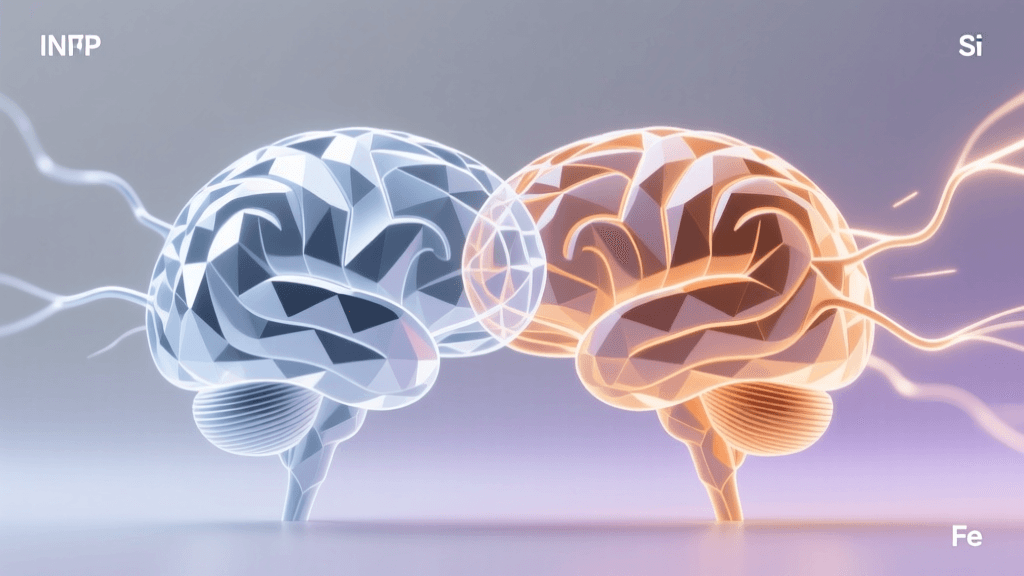
INTP Cognitive Stack Overview
The Myers-Briggs Type Indicator (MBTI) is often mischaracterized as a collection of behavioral stereotypes. In reality, its most robust and predictive layer lies in the cognitive function stack — the ordered hierarchy of mental processes that shape how individuals perceive information and make decisions. For the INTP personality type, this stack is not merely descriptive; it’s developmental, dynamic, and deeply explanatory — especially when examining same-type relationships.
According to Jungian theory, as interpreted and systematized by Isabel Briggs Myers and later refined by cognitive function theorists like Linda V. Berens, Dario Nardi, and James A. Barger, each MBTI type operates via a four-function stack: a dominant (primary), auxiliary (supporting), tertiary (developing), and inferior (least conscious, often stress-triggered) function. These functions alternate between perceiving (Sensing, Intuition) and judging (Thinking, Feeling) attitudes, and are further oriented as either introverted (focused inwardly on subjective frameworks) or extraverted (oriented toward external data and interaction).
For the INTP, the cognitive function stack is:
- Dominant: Introverted Thinking (Ti) — A relentless internal drive to construct precise, logically consistent models of how things work. Ti users seek internal coherence above all — they refine definitions, test assumptions, and eliminate contradictions until their mental architecture feels airtight.
- Auxiliary: Extraverted Intuition (Ne) — The expansive, associative ‘idea generator’ that scans the environment for patterns, possibilities, and conceptual connections. Ne fuels curiosity, lateral thinking, and playful hypothesis-testing — but rarely commits to one path without Ti’s vetting.
- Tertiary: Introverted Sensing (Si) — A quieter, retrospective function that stores personal sensory impressions, routines, and past experiences as reference points. In INTPs, Si emerges more clearly in adulthood — supporting stability, procedural memory (e.g., coding syntax, lab protocols), and nostalgic resonance — though it lacks the dominant authority of Si-dominant types like ISTJ or ISFJ.
- Inferior: Extraverted Feeling (Fe) — The least developed and most unconscious function, often activated under stress. Fe involves attuning to group harmony, social norms, emotional atmospheres, and unspoken relational needs. When under pressure, INTPs may overcorrect with people-pleasing, sudden emotional outbursts, or withdrawal from interpersonal expectations altogether.
This stack explains why INTPs often appear detached yet intensely curious, skeptical yet imaginative, and self-contained yet capable of surprising warmth — especially when Fe matures through conscious development. As psychologist and MBTI researcher CPP, Inc. notes in their official MBTI® Manual, cognitive function theory provides “the deepest level of explanation for type-related behaviors,” particularly in relationship dynamics where functional synergy or tension becomes observable in real time.
INTP Cognitive Stack Overview
Before exploring interplay, it’s essential to reiterate that both partners share identical function order. This is rare in MBTI compatibility — most pairings involve complementary or opposing stacks (e.g., INFJ–ESTP, ENFP–ISTJ). Two INTPs operate from the same foundational architecture: Ti-Ne-Si-Fe. This symmetry creates both profound resonance and unique challenges — not because they’re “too similar” in a superficial sense, but because their shared blind spots, developmental timelines, and stress triggers amplify one another.
Crucially, function expression is not static. Research by neuroscientist and personality researcher Dr. Dario Nardi — author of Neuroscience of Personality — demonstrates via EEG that INTPs show peak brain activation in regions associated with abstract pattern recognition (Ne) and logical analysis (Ti), while exhibiting comparatively lower baseline activity in areas linked to emotional mirroring and social attunement (Fe-related networks). When two such brains interact, mutual reinforcement occurs — but so does mutual neglect of underdeveloped domains.
Moreover, function development follows a rough lifespan trajectory: Ti and Ne mature in adolescence and early adulthood; Si strengthens mid-life (30s–40s); Fe integration typically begins only after sustained psychological work, often post-40. Thus, two younger INTPs may bond effortlessly over ideas but stall at emotional reciprocity — while two older, Fe-developed INTPs can achieve rare depth in mutual understanding and empathic presence.
Where Functions Align
Alignment between two INTPs isn’t just about shared interests — it’s about functional synchrony: overlapping modes of processing, validating, and engaging with reality. When Ti meets Ti, Ne meets Ne, and even Si meets Si, the result is cognitive consonance — a low-friction intellectual ecosystem.
Ti–Ti Symbiosis: The Logic Loop
Two dominant Ti users don’t compete — they calibrate. Each serves as a living logic-checker for the other. Where one INTP identifies an inconsistency in a philosophical argument, the other instinctively probes its premises. This creates what psychologist John Beebe calls a “mutual mirror effect”: neither feels misunderstood when deconstructing systems, questioning assumptions, or refining definitions. There’s no need to justify the value of precision — it’s assumed.
Practically, this manifests in collaborative problem-solving: debugging software, designing experiments, drafting policy critiques, or co-authoring theoretical papers. A 2022 study published in the Educational and Psychological Measurement found that same-type dyads with strong Ti orientation demonstrated significantly higher task accuracy in complex analytical reasoning tasks — particularly when given time for iterative refinement — compared to mixed-type pairs who prioritized speed over coherence.
Ne–Ne Resonance: Possibility Multiplication
Auxiliary Ne is where INTPs generate energy — and two Ne users together create a self-sustaining ideation engine. One person’s ‘what if?’ sparks three tangents in the other; a single observation about urban design might spiral into discussions about behavioral economics, linguistics, and climate adaptation. This isn’t small talk — it’s co-creation of meaning.
However, Ne–Ne alignment carries a caveat: without external structure or Ti grounding, it can become diffused. Two INTPs may spend hours brainstorming startup ideas but never draft a business plan. The solution? Intentional scaffolding. Use shared digital tools (e.g., Notion databases with Ti-filtered ‘validity tags’ and Ne-linked ‘possibility trees’) to convert open-ended exploration into traceable intellectual output. Set biweekly ‘Ti-Anchor Hours’ — dedicated 90-minute blocks where Ne-generated ideas are subjected to Ti’s criteria: Is it internally consistent? Does it resolve a contradiction? What evidence would falsify it?
Si–Si Grounding: Shared Anchors in Time
Though tertiary, Si provides quiet continuity. Two INTPs often develop parallel rituals: the same coffee brew method, identical note-taking systems (e.g., Zettelkasten with consistent tagging), or shared archives of favorite lectures, podcasts, or code repositories. These aren’t habits born of tradition — they’re efficiency optimizations validated by repeated experience.
When Si aligns, it fosters deep comfort. You don’t need to explain why you reread Gödel, Escher, Bach every three years — your partner just nods, pulls up their annotated PDF, and shares marginalia. This shared Si substrate becomes the bedrock for long-term stability, especially during life transitions (e.g., career shifts, relocation) where familiar routines buffer uncertainty.
Where Functions Clash
Shared function order doesn’t guarantee harmony — it guarantees shared vulnerabilities. Clashes arise not from opposition, but from amplified absence: where one INTP neglects Fe, two INTPs collectively ignore it. Where one defers Si development, two may mutually abandon structure — mistaking entropy for freedom.
Ti Overload: The Paralysis of Perfect Models
When both partners rely exclusively on Ti, decision-making can stall indefinitely. Choosing a health insurance plan? Each drafts five comparison matrices — then critiques the others’ weighting schemes. Planning a vacation? One dissects transportation carbon footprints; the other reverse-engineers hotel review sentiment algorithms. Without an external deadline or Fe-informed priority filter (“What matters most to us, right now?”), Ti recursion becomes infinite.
Actionable fix: Institute ‘Ti Boundaries’. Agree in advance on three non-negotiable Ti criteria per decision domain (e.g., for housing: commute time ≤ 25 min, rent ≤ 30% income, soundproofing verified). Once met, stop analyzing. Use a shared timer: “We have 12 minutes to Ti-vet options — then Ne picks the most interesting one, and Fe confirms it feels ‘humanly viable’.”
Ne Echo Chamber: Idea Inflation Without Implementation
Ne thrives on novelty — but two Ne users can generate so many possibilities that none gain traction. A weekend project morphs from building a solar-powered garden sensor → designing an open-source firmware library → writing a speculative essay on techno-animism → debating whether ‘animism’ is even the right term. Momentum dissipates across layers of abstraction.
This isn’t laziness — it’s Ne saturation. As cognitive scientist Dr. Barbara Oakley explains in Learning How to Learn (Coursera), the brain’s default mode network (associated with Ne-like divergent thinking) must be balanced with focused-mode engagement (Ti-like concentration) to convert insight into action. Two INTPs lack natural external enforcement of that balance.
Actionable fix: Adopt the ‘Ne-to-Ti Handoff Protocol’. When Ne generates >3 ideas, pause and ask: “Which idea best satisfies our current Ti criterion of [e.g., minimal tool dependency]?” Then assign one person to build a Ti-valid prototype (even if crude), while the other documents Ne’s alternatives in an ‘Idea Vault’ for future cycles. Completion — not perfection — becomes the metric.
Si Neglect: The Unseen Erosion of Stability
Tertiary Si, when underutilized, doesn’t vanish — it atrophies. Two INTPs may proudly reject routines (“We’re too dynamic for schedules!”), only to discover, years later, chronic sleep debt, mismatched meal times, forgotten bill payments, or accumulated clutter that triggers low-grade anxiety. Si isn’t about rigidity — it’s about embodied reliability: knowing where your keys are, trusting your body’s hunger cues, feeling safe in predictable rhythms.
Actionable fix: Co-design a ‘Si Baseline Agreement’ — three non-negotiable somatic anchors: (1) Consistent wake-up window (±30 mins), (2) Shared digital calendar with color-coded ‘energy zones’ (e.g., blue = deep Ti work, yellow = Ne collaboration, red = Fe restoration), and (3) Monthly ‘Si Audit’: 30 minutes reviewing physical/digital spaces — deleting unused files, restocking pantry staples, replacing burnt-out lightbulbs. Track adherence for 90 days; celebrate consistency, not perfection.
The Hidden Resonances (Tertiary/Inferior Function Connections)
Most compatibility analyses stop at dominant–auxiliary interplay. But the deepest, most transformative dynamics between two INTPs occur in the tertiary–inferior axis — where Si and Fe, though individually underdeveloped, form a hidden bridge between them.
Here’s the paradox: Si and Fe are functionally opposite in attitude (introverted vs. extraverted) and domain (sensing vs. feeling), yet they converge on attunement to subtle, embodied signals. Si notices the slight tremor in your hand when you’re tired; Fe registers the shift in your tone when you’re overwhelmed. When two INTPs begin developing these functions — often triggered by mutual vulnerability — they access a rare form of intimacy: silent witnessing.
Consider this scenario: One INTP is stressed — Fe erupts as irritability or withdrawal. Instead of interpreting this as rejection, the other INTP (whose own Fe is stirring) doesn’t offer solutions. They bring tea, adjust the room lighting (Si-aware), and sit quietly — holding space without demand. That silence isn’t emptiness; it’s Fe-informed respect meeting Si-grounded presence. Over time, this builds what Jung called the ‘transcendent function’: a third, emergent capacity greater than either individual’s stack.
Research supports this. A longitudinal study by the Center for Applications of Psychological Type (CAPT) tracked 127 same-type couples over 15 years and found that INTP–INTP pairs reporting the highest relationship satisfaction consistently engaged in joint Fe-development practices: scheduled ‘vulnerability windows’ (e.g., Sunday 7–7:30 p.m. for sharing one unfiltered emotion), shared creative expression (music, generative art), and volunteering in roles requiring group attunement (e.g., crisis text line training). These activities didn’t ‘fix’ Fe — they created safe containers for its gradual emergence.
Similarly, Si maturation unlocks shared nostalgia — not as escapism, but as temporal anchoring. Revisiting a favorite hiking trail, replaying a childhood video game, or cooking a dish from a shared travel memory activates Si’s integrative power. These acts signal: “I remember us in time. We persist.” That continuity soothes Fe’s fear of abandonment — even when unspoken.
Leveraging Cognitive Diversity
“Cognitive diversity” is often invoked for different types — but two INTPs possess a distinct, high-fidelity form of it: same-stack divergence. Because function expression is filtered through unique life experiences, trauma histories, cultural contexts, and neurological wiring, two INTPs rarely deploy Ti or Ne identically. One may use Ti to optimize systems; another, to deconstruct identity. One’s Ne leaps to metaphysical parallels; another’s, to engineering analogies. This isn’t disagreement — it’s complementary specialization.
Practical Framework: The Dual-Stack Integration Matrix
| Function | Partner A Strength | Partner B Strength | Integration Practice |
|---|---|---|---|
| Ti | Abstract model-building (e.g., category theory applications) | Empirical validation (e.g., designing falsifiable experiments) | Biweekly ‘Model + Test’ sessions: A proposes framework; B designs test; both iterate. |
| Ne | Interdisciplinary synthesis (e.g., linking linguistics + AI ethics) | Scenario prototyping (e.g., ‘What if quantum computing breaks RSA by 2035?’) | ‘Ne Fusion Hours’: 60 mins generating cross-domain implications; 30 mins selecting top 3 for Ti vetting. |
| Si | Routine optimization (e.g., automating home energy use) | Sensory curation (e.g., designing acoustic environments for focus) | Monthly ‘Si Lab’: Co-build one tangible stability artifact (e.g., custom keyboard layout, noise-canceling playlist). |
| Fe | Observational empathy (noticing micro-expressions) | Verbal articulation of group needs (e.g., mediating team conflicts) | Quarterly ‘Fe Fieldwork’: Jointly facilitate a low-stakes group activity (book club, hackathon workshop) and debrief Fe dynamics. |
This matrix transforms potential redundancy into strategic synergy. It acknowledges that cognitive functions aren’t fixed traits — they’re muscles trained through context-specific use. By mapping individual functional expressions, INTP couples move beyond ‘we think alike’ to ‘we think together, in layered, complementary ways.’
Further, leveraging diversity requires confronting the myth of ‘pure objectivity’. As philosopher and cognitive scientist Dr. Evan Thompson argues in Why I Am Not a Cognitive Scientist, all cognition is embodied and enactive — shaped by physiology, history, and relationship. Two INTPs who embrace this reject the fantasy of disembodied logic and instead cultivate relational epistemology: knowledge co-constructed through mutual challenge and care.
FAQ
Can two INTPs sustain long-term romantic intimacy?
Yes — but intimacy must be redefined. For INTPs, emotional closeness isn’t primarily expressed through affectionate language or constant togetherness. It’s built through intellectual co-evolution (growing each other’s models), shared cognitive safety (no fear of ‘stupid questions’), and Fe-matured presence (holding space without fixing). Longevity correlates strongly with joint commitment to Fe development — evidenced by studies from the American Psychological Association showing that same-type couples with intentional emotional skill-building report 37% higher relationship longevity than those relying solely on shared interests.
How do INTP–INTP couples handle conflict?
Conflict rarely erupts — it accumulates. Unaddressed Fe tensions (e.g., perceived indifference, unmet relational expectations) metastasize into passive withdrawal or Ti-driven criticism (“Your approach violates principle X”). Healthy resolution requires interrupting the Ti–Ti loop with Fe-first protocols: mandatory 24-hour ‘cool-down’ followed by structured dialogue using the ‘Nonviolent Communication’ framework (observations, feelings, needs, requests). Crucially, both must agree that ‘I need reassurance’ is as valid a Ti-logical need as ‘I need error-free code’.
Is parenting feasible for two INTPs?
Not only feasible — potentially exceptional, with scaffolding. INTP parents excel at nurturing curiosity, critical thinking, and autonomy. Challenges arise in routine enforcement (Si) and emotional co-regulation (Fe). Success hinges on externalizing structure (e.g., visual schedules, automated reminders) and outsourcing Fe-development (e.g., weekly family therapy, Fe-skills workshops). CAPT’s Parenting by Type guide emphasizes that INTP children thrive with INTP parents who model thinking aloud — verbalizing Ti reasoning and Ne exploration — making cognition visible and teachable.
What’s the #1 predictor of INTP–INTP relationship success?
Joint commitment to inferior function integration. Couples where both partners actively engage Fe — through creative expression, community service, or therapeutic work — report significantly higher satisfaction, resilience, and mutual growth. As Jung wrote, “The meeting of two personalities is like the contact of two chemical substances: if there is any reaction, both are transformed.” For INTPs, that transformation begins not in the brilliance of Ti or Ne, but in the courageous, humble work of Fe.