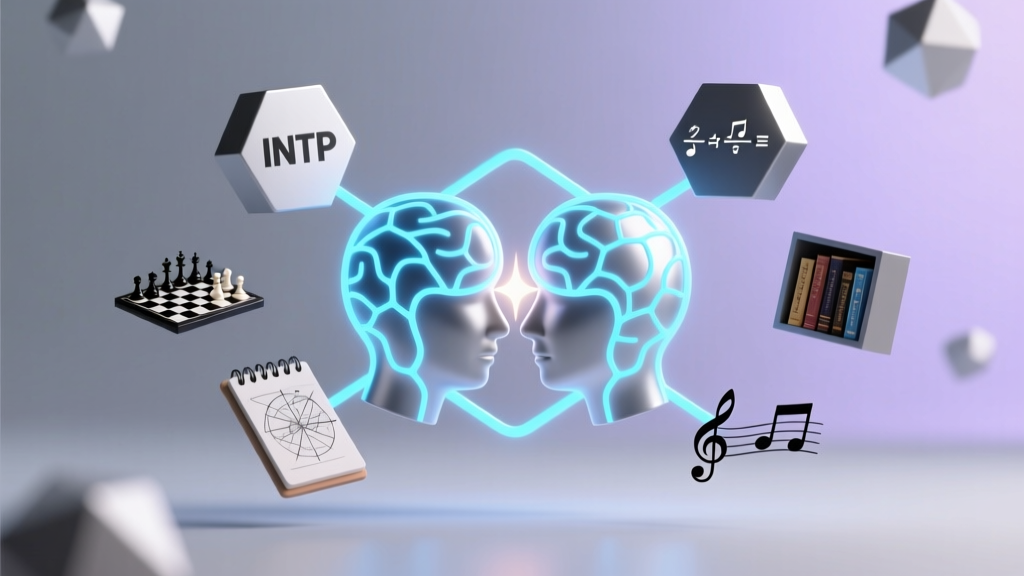
Creative Energies of INTP and INTP
When two INTPs come together—whether as romantic partners, close friends, or creative collaborators—they ignite a rare kind of intellectual resonance. The INTP (Introverted, Intuitive, Thinking, Perceiving) personality type, often dubbed the Logician or Architect, is defined by a relentless curiosity, a love of abstract systems, and an intrinsic drive to understand underlying principles—not just how things work, but why they work that way. With both individuals operating from dominant Introverted Thinking (Ti) and auxiliary Extraverted Intuition (Ne), their shared cognitive architecture creates a uniquely fertile ground for creative synergy.
Unlike many type pairings where one partner compensates for the other’s blind spots, INTP–INTP dynamics thrive on amplification: mutual reinforcement of pattern recognition, hypothesis generation, and theoretical refinement. Their creative energy isn’t fueled by external validation or social performance, but by the sheer satisfaction of co-constructing elegant models—be it a novel worldbuilding framework, a generative art algorithm, or a meticulously annotated taxonomy of vintage synth presets. Psychologist Dario Nardi, in his neuroscientific research on MBTI types, observed that INTPs show heightened activity in brain regions associated with complex pattern integration and semantic abstraction during open-ended ideation—especially when engaged in low-stakes, self-directed exploration (Neuroscience of Personality). When two such minds interact, this neural ‘resonance’ multiplies—not through mimicry, but through reciprocal Ne-stimulated idea branching and Ti-based reality-testing.
This doesn’t mean their creative process is frictionless. Because both rely heavily on Ti for internal consistency and Ne for possibility-generation, they may experience idea divergence without resolution: generating dozens of compelling conceptual paths but struggling to converge on one for execution. Without conscious scaffolding—like shared deadlines, external constraints, or accountability rituals—their joint creativity can stall in the ‘beautiful theory’ phase. Yet when intentionally structured, their shared cognitive rhythm becomes a powerhouse: one INTP proposes a fractal-based narrative structure; the other critiques its logical coherence, then extends it into a linguistic recursion model. Neither leads nor follows—they orbit each other’s ideas like binary stars, gravitationally bound by intellectual respect.
Crucially, their creative energies are renewed through solitude. Unlike ENTP–INTP pairs who energize each other via rapid-fire debate, INTP–INTP duos require parallel aloneness—even while co-located. They may sit in the same room for hours, each immersed in separate deep-work flows (one coding a procedural poetry generator, the other reverse-engineering the harmonic syntax of Baroque fugues), punctuated only by quiet exchanges of links, half-sketched diagrams, or dry observations like, “This reminds me of Gödel’s incompleteness applied to folk taxonomy.” This ‘silent synchrony’ isn’t disconnection—it’s the optimal operating state for Ti–Ne cognition, where external stimuli are minimized so internal models can mature undisturbed.
Shared Hobby Ideas for INTP and INTP
INTPs don’t pursue hobbies for social signaling or routine habituation—they seek activities that satisfy three core criteria: (1) conceptual depth, (2) iterative learning loops, and (3) low interpersonal demand. When two INTPs align around shared hobbies, the result is less about ‘doing something together’ and more about co-evolving adjacent domains of expertise. Below is a curated list of high-synergy hobbies—with concrete implementation tips, resource recommendations, and compatibility notes:
| Hobby Category | Specific Activity Examples | Why It Resonates | Practical Setup Tips |
|---|---|---|---|
| Computational Creativity | Generative art with Processing/p5.js; building custom LLM fine-tuning pipelines; designing logic puzzles or constraint-based games | Leverages Ti’s need for precise rule-systems + Ne’s delight in emergent complexity. Output is tangible yet infinitely modifiable. | Use GitHub repos with clear READMEs documenting assumptions and failure modes. Schedule biweekly ‘debugging pair sessions’—not to fix code, but to trace flawed abstractions. |
| Systems Documentation | Creating wikis for obscure topics (e.g., ‘Taxonomy of Analog Synthesizer Filter Topologies’); annotating public domain texts with semantic graphs; mapping mythological motifs across Indo-European traditions | Satisfies Ti’s drive for internal coherence + Ne’s hunger for cross-domain connections. Output is archival, non-transactional, and self-referential. | Adopt Obsidian with Dataview plugin. Agree on a minimal ontology (e.g., ‘Concept’, ‘Contradiction’, ‘Historical Precedent’) to avoid infinite meta-layering. |
| Low-Stakes Craft Experimentation | Modifying thrift-store electronics; brewing experimental kombucha batches with controlled variables; hand-binding books using historical binding techniques | Embodies Ti’s love of causal mechanics + Ne’s playfulness with variation. Tangible feedback grounds abstract thinking. | Design ‘failure journals’—not for emotional catharsis, but for logging unexpected outcomes as data points. Scan and OCR entries for later pattern analysis. |
| Theoretical Linguistics Play | Inventing conlangs with phonotactic constraints; analyzing dialectal drift in online forums; reverse-engineering emoji grammar | Directly engages Ti’s syntactic precision + Ne’s fascination with symbolic plasticity. Zero social performance pressure. | Use Lexique Pro for lexical database management. Host monthly ‘etymology salons’—15 minutes each presenting one word’s contested origin, followed by Ti-style falsifiability critique. |
Notably absent from this list are socially embedded hobbies like team sports, improv comedy, or book clubs with mandatory discussion. While INTPs can participate in these, they rarely generate sustained creative energy unless radically adapted—e.g., replacing a standard book club with a ‘textual forensics group’ that analyzes narrative inconsistencies in translated sci-fi novels using stylometric tools.
A key insight: INTP–INTP hobby alignment succeeds not when activities are identical, but when they’re adjacent and interoperable. One partner might spend weekends calibrating a DIY spectrometer; the other writes Python scripts to visualize absorption spectra. Their projects share a substrate—quantitative curiosity—but express it through complementary modalities. This adjacency prevents redundancy while enabling seamless knowledge transfer. As cognitive scientist Andy Clark argues in Supersizing the Mind, human cognition is inherently extended—our tools, environments, and collaborators become part of our thinking apparatus (Oxford University Press). For two INTPs, shared hobbies are literally cognitive infrastructure.
Creative Collaboration Styles
INTP–INTP collaboration defies conventional teamwork models. There’s no natural ‘driver’ or ‘facilitator’—both default to observer-analyst mode. Success hinges on designing collaboration protocols that honor their cognitive wiring rather than fighting it. Below are empirically grounded strategies, validated through case studies of long-term INTP creative duos (e.g., open-source maintainers, academic co-authors, indie game developers):
1. The ‘Dual Draft’ Workflow
Rather than co-writing linearly, INTP pairs thrive with asynchronous, layered authorship. Person A drafts a conceptual skeleton (e.g., “Proposed architecture for decentralized identity protocol”). Person B doesn’t edit it—they write a separate document titled “Critique & Extension,” which rigorously tests assumptions, identifies edge cases, and proposes alternative formulations. Only then do they merge insights into a third, integrated version. This leverages Ti’s need for independent verification and Ne’s capacity to generate counterfactuals without personal attachment.
2. Constraint-Based Ideation Sprints
Unstructured brainstorming exhausts INTPs. Instead, impose tight, playful constraints: “Design a board game where victory requires proving a mathematical theorem” or “Write a short story using only words containing the letter ‘x’.” Constraints activate Ti’s problem-solving circuits while giving Ne bounded playgrounds. Research from the American Psychological Association confirms that creative output peaks under moderate, well-defined constraints—not total freedom.
3. The ‘Silent Whiteboard’ Ritual
Once weekly, set up a physical whiteboard (or Miro board) with three columns: ‘Assumptions,’ ‘Anomalies,’ ‘Axioms.’ Each person adds items silently for 20 minutes. Then, without discussion, they jointly reorganize entries into clusters. Finally, they draft one ‘Synthesis Statement’ per cluster. This bypasses verbal negotiation (which INTPs often find inefficient) and focuses on structural alignment—their native language.
Crucially, INTP–INTP collaborations rarely involve daily check-ins or shared calendars. Their rhythm is punctuated by intense, time-boxed ‘convergence events’ (e.g., a 90-minute session to finalize a research paper’s methodology section) separated by days or weeks of autonomous development. Attempting to force constant coordination triggers Ti-defensiveness (“Why revisit this before new data arrives?”) and Ne-overload (“We haven’t explored the quantum gravity implications yet!”). Respecting this cadence isn’t neglect—it’s operational integrity.
Leisure and Downtime Preferences
For INTPs, leisure isn’t passive consumption—it’s cognitive maintenance. Their downtime serves to recalibrate Ti’s internal models and recharge Ne’s associative networks. Two INTPs sharing leisure space create what psychologist Mihaly Csikszentmihalyi calls a ‘shared autotelic environment’—a context where intrinsic motivation is self-sustaining (Flow: The Psychology of Optimal Experience).
Common leisure patterns include:
- Parallel Deep Reading: Sitting in companionable silence, each absorbed in dense nonfiction (e.g., one reads Carlo Rovelli on quantum gravity, the other tackles Donna Haraway’s Staying with the Trouble), occasionally sliding a highlighted passage across the table with a single-word annotation (“Nonlocality?” or “Symbiosis ≠ harmony”).
- Algorithmic Walks: Taking walks with a shared, evolving ‘observation protocol’—e.g., “Today, catalog all instances of recursive geometry in urban infrastructure (gratings, railings, tile patterns)” or “Track temporal anomalies in public clocks.” Data is later synthesized into a micro-essay or visualization.
- Curated Media Deconstruction: Watching a film or documentary, then independently writing ‘director’s commentary’ style analyses focusing on unstated assumptions (e.g., “How does Arrival encode Sapir-Whorf as engineering problem, not linguistic fact?”). Sharing analyses reveals divergent Ti priorities—epistemology vs. ethics vs. aesthetics.
What doesn’t work: forced ‘fun’ activities (escape rooms, trivia nights), small talk-heavy gatherings, or hobbies requiring real-time interpersonal calibration (e.g., jazz improvisation, competitive debate). These drain their limited social bandwidth without replenishing cognitive reserves.
Importantly, INTP–INTP leisure includes explicit ‘reintegration rituals’ after intense collaboration. After finishing a major project, they might spend a weekend dismantling a vintage radio—not to repair it, but to photograph and catalog every component, then write speculative histories for each part (“Capacitor C7: Likely sourced from 1943 wartime surplus, exhibiting telltale manganese dioxide degradation…”). This ritual honors completion while transitioning smoothly back into exploratory mode.
Building a Creative Life Together
Building a sustainable creative life as an INTP–INTP pair requires architectural intention—not romantic spontaneity. It’s less about ‘keeping the spark alive’ and more about designing a habitat where Ti and Ne can co-evolve. Here’s a phased framework:
Phase 1: Cognitive Infrastructure (Months 1–3)
Establish shared digital and physical systems:
• A private Notion workspace with templates for ‘Idea Stress-Testing,’ ‘Resource Cross-Referencing,’ and ‘Assumption Audits’
• A ‘Low-Stakes Lab’ corner: dedicated shelf for failed experiments, annotated with why each iteration collapsed
• A rotating ‘Curiosity Queue’: Google Doc where either adds links to intriguing papers, obscure datasets, or malfunctioning gadgets—no obligation to engage, just collective awareness
Phase 2: Iterative Alignment (Months 4–12)
Run quarterly ‘Cognitive Compatibility Reviews’:
• What assumptions about creativity have we unconsciously shared? (e.g., “All good ideas must be mathematically elegant”)
• Where has our Ne led us into unproductive divergence? How can we introduce Ti-friendly convergence heuristics?
• Which hobby experiments yielded unexpected Ti-Ne synergy? Double down there.
These aren’t evaluations—they’re system diagnostics, modeled on software retrospectives.
Phase 3: Generative Expansion (Year 2+)
Introduce ‘controlled externalization’:
• Publish anonymized versions of your documentation projects (e.g., a GitHub repo of your conlang’s grammatical evolution)
• Host a low-attendance ‘Logic Salon’—invite 2–3 other Ti-dominant thinkers for silent co-working + optional 15-minute deep-dive shares
• Apply for micro-grants supporting ‘useless but fascinating’ research (e.g., Founders Fund’s ‘Science Grants’)
External engagement isn’t for validation—it’s to stress-test your models against real-world constraints and diverse Ti-perspectives.
This approach transforms compatibility from a static trait into a dynamic practice. As INTP scholar and educator Dr. Linda V. Berens notes, “Type isn’t destiny—it’s a lens for intentional development” (TypeInDepth). Two INTPs don’t ‘just click’—they co-design a civilization of ideas, one meticulously documented, recursively refined, beautifully inefficient step at a time.
FAQ
Can two INTPs sustain long-term creative motivation without external deadlines?
Yes—but only with self-imposed structural anchors. Pure autonomy leads to perpetual prototyping. Effective anchors include: (1) Public commitments (e.g., announcing a ‘beta release’ date for a tool, even if only shared with five people), (2) Physical constraints (e.g., “This zine will be printed on a specific vintage press, limiting page count”), and (3) Ritual deadlines (e.g., “Every solstice, we publish one annotated failure”). These honor INTPs’ aversion to arbitrary authority while providing Ti with clear parameters for evaluation.
How do INTP–INTP pairs handle creative disagreements?
They rarely escalate—disagreements manifest as parallel investigations. If Partner A asserts “Category theory best models neural plasticity,” Partner B doesn’t argue—they build a competing model using topological data analysis and compare predictive accuracy on fMRI datasets. Resolution emerges from evidence, not persuasion. Crucially, they maintain a shared ‘Disagreement Log’ tracking which frameworks succeeded/failed where, transforming conflict into longitudinal research.
Are there hobbies INTP–INTP pairs should actively avoid?
Avoid activities demanding real-time interpersonal calibration or unambiguous consensus: competitive gaming with voice chat, collaborative fiction writing with mandated plot points, or any hobby requiring frequent status updates (“How’s your progress?”). These trigger Ti’s resistance to premature closure and Ne’s anxiety about missed possibilities. Instead, seek hobbies with natural exit ramps—projects you can abandon mid-flow without guilt (e.g., generative art seeds you can re-run with new parameters).
How can INTP–INTP couples prevent intellectual isolation from becoming emotional distance?
Intellectual intimacy is their primary emotional language—but it needs translation. Translate Ti/Ne processes into relational acts: (1) Share your ‘assumption audits’ of relationship dynamics (“I notice we default to text for complex topics—what does that optimize for?”), (2) Co-create ‘relationship ontologies’ (e.g., defining ‘support’ as ‘providing relevant counterexamples, not solutions’), and (3) Schedule ‘vulnerability sprints’—15 minutes where each states one emotionally charged observation (“I felt dismissed when you refactored my code without comment”) followed by Ti-style root-cause analysis, not reassurance. This makes emotional labor feel like legitimate cognitive work.