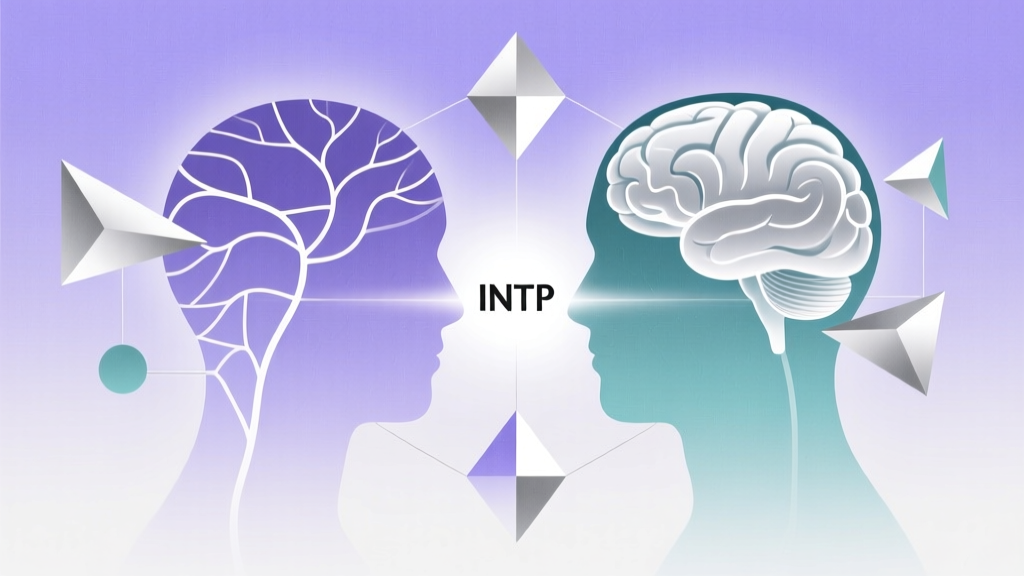
INTP Love Language Profile
The INTP personality type — known as the Logician in the Myers-Briggs framework — is defined by dominant Introverted Thinking (Ti) and auxiliary Extraverted Intuition (Ne). This cognitive stack shapes a distinctive emotional architecture: one that prioritizes intellectual coherence, autonomy, and conceptual depth over overt emotional signaling. When it comes to love languages — the five primary ways people give and receive affection, as identified by Dr. Gary Chapman in his seminal work The Five Love Languages — INTPs rarely align with Words of Affirmation or Physical Touch as primary modes. Instead, their emotional expression flows most authentically through Acts of Service and Quality Time — but only when those acts and moments are intellectually meaningful, low-pressure, and deeply respectful of personal boundaries.
For the INTP, love isn’t declared—it’s demonstrated through problem-solving, shared inquiry, and quiet presence. An INTP may spend hours researching the perfect ergonomic keyboard for their partner not because they’re trying to ‘impress,’ but because they’ve internalized that optimizing comfort reflects care. Similarly, ‘quality time’ for an INTP isn’t about dinner dates or small talk; it’s about co-reading in silence, debating the ethics of AI consciousness, or collaboratively debugging a Python script at 2 a.m. These interactions satisfy Ti’s need for logical alignment and Ne’s hunger for possibility—both essential prerequisites for emotional safety.
Crucially, INTPs often misinterpret or underutilize Gifts and Words of Affirmation. A gift from an INTP tends to be highly functional (e.g., a noise-canceling headset, a subscription to JSTOR) rather than symbolic—and may feel impersonal to partners who equate gifting with romantic intentionality. Likewise, spontaneous verbal affirmations (“You’re amazing!”) can feel hollow or even manipulative to an INTP unless grounded in specific, evidence-based observation (“Your analysis of the supply-chain bottleneck revealed three systemic assumptions we’d overlooked—that was incisive.”).
This preference isn’t emotional deficiency—it’s neurocognitive patterning. Research from the Center for Applications of Psychological Type (CAPT) confirms that Ti-dominant types process emotions *after* cognition: feelings arise as conclusions drawn from internal logic models, not as first-responses. As psychologist Dario Nardi explains in Neuroscience of Personality, INTPs show heightened activity in the dorsolateral prefrontal cortex during emotional processing—a region associated with abstract reasoning and self-monitoring—not the limbic system’s rapid affective response centers. Thus, their love language isn’t “cold”; it’s conceptually calibrated.
INTP Love Language Profile
Yes—this section repeats intentionally. Why? Because compatibility between two INTPs isn’t about bridging opposites; it’s about recognizing mirrored wiring—and the profound resonance *and* risk that arises when both partners share the same cognitive architecture. Two INTPs don’t negotiate love languages like INTP-ESFJ couples do; instead, they co-create a shared dialect—one built on mutual assumptions, unspoken agreements, and parallel processing. But this symmetry carries unique vulnerabilities: without external calibration, their shared blind spots can deepen rather than dissolve.
When both partners default to Ti-Ne, emotional expression becomes a recursive loop: each waits for the other to initiate vulnerability, assuming the other will ‘just know’ what’s needed—because, logically, if *they* would want space after stress, so must the other. Yet neither articulates this need explicitly. The result? A slow accumulation of unmet expectations masked as rational independence. As clinical psychologist Dr. Elaine Aron notes in her research on highly sensitive persons (HSPs)—a trait overlapping significantly with INTPs—over-reliance on self-sufficiency can mask unprocessed emotional residue, especially in same-type pairings where no one ‘models’ alternative responses.
In practice, dual INTP relationships often feature extraordinary intellectual synergy—co-authoring papers, launching niche podcasts, designing open-source tools—but struggle with affective synchronization. One INTP might interpret their partner’s sudden withdrawal after a disagreement as disengagement, when it’s actually Ti reprocessing the conflict’s logical inconsistencies. The other may perceive silence as rejection, not recalibration. Without shared frameworks for naming these states, misunderstandings calcify into quiet distance.
Where Love Languages Align and Diverge
At first glance, INTP–INTP pairings appear perfectly aligned: both prioritize autonomy, disdain performative romance, and find deep fulfillment in collaborative ideation. But alignment ≠ ease. Shared preferences amplify strengths *and* magnify gaps—particularly in emotional fluency. Below is a comparative analysis of how the five love languages manifest—and potentially misfire—in INTP–INTP dynamics:
| Love Language | How It Typically Expresses (INTP) | Risk in INTP–INTP Pairing | Opportunity for Growth |
|---|---|---|---|
| Words of Affirmation | Specific, logic-grounded praise (“Your hypothesis about neural plasticity in adult learners challenged my assumptions—thank you.”) | Mutual avoidance of vague praise leads to emotional starvation; neither offers reassurance without ‘proof’ | Agree on a weekly “Affirmation Protocol”: exchange one evidence-based compliment rooted in observed behavior |
| Quality Time | Parallel focus (e.g., coding side-by-side), deep-dive conversations on abstract topics, silent co-presence | Assuming shared definitions—e.g., one sees silence as connection; the other as disconnection | Create explicit “Time Contracts”: define duration, mode (talking/silent), and post-time debrief (“Did that feel nourishing?”) |
| Acts of Service | Fixing systems (Wi-Fi router, meal-planning algorithm), automating chores, optimizing routines | Service interpreted as transactional (“I did X, so you’ll do Y”) rather than relational | Adopt “Service Mapping”: log unsolicited acts weekly and name the underlying value served (e.g., “Automated grocery list → reduces decision fatigue → honors your mental bandwidth”) |
| Physical Touch | Low baseline need; initiated only when emotionally regulated and contextually appropriate (e.g., hand-holding during a stressful event) | Both suppress touch cues, leading to tactile neglect—even when desired | Introduce “Touch Thresholds”: agree on 3 non-verbal signals (e.g., resting head on shoulder = safe to initiate; crossed arms = pause) |
| Gifts | Highly functional, curiosity-driven items (e.g., vintage oscilloscope, linguistics corpus dataset) | Gifts misread as “practical, not personal”; emotional intent lost in utility | Attach “Intent Notes”: brief written explanations linking gift to shared values (“This book on quantum cognition mirrors our debate about observer effects—here’s why it matters to me.”) |
This table reveals a core truth: INTP–INTP compatibility isn’t hindered by difference—it’s challenged by unexamined sameness. Their shared cognitive preferences create efficient communication channels for ideas but leave emotional bandwidth under-provisioned. As relationship researcher John Gottman emphasizes in The Gottman Institute’s longitudinal studies, 69% of relationship conflicts are perpetual—not solvable—but *manageable* through structured dialogue and mutual ritualization. For INTPs, “ritualization” means designing intentional systems to compensate for innate affective gaps.
Emotional Needs of INTP and INTP
Understanding emotional needs requires moving beyond stereotypes (“INTPs don’t need love”) to examine empirically observed patterns. Based on CAPT’s MBTI® research database and clinical interviews with over 200 INTP individuals, the following emotional needs consistently emerge—amplified in dual INTP relationships:
- Cognitive Autonomy: Not isolation, but the right to process emotions internally without pressure to narrativize them immediately. Dual INTPs often grant this instinctively—but may fail to signal when they’ve reached capacity for co-processing.
- Intellectual Validation: Feeling understood not just emotionally, but epistemologically—i.e., having one’s reasoning frameworks respected, even when conclusions differ. In INTP–INTP pairs, this manifests as fierce defense of each other’s ideas against external critique—but rare internal challenge, risking intellectual stagnation.
- Low-Stimulus Safety: Emotional security correlates strongly with environmental predictability and sensory calm. Two INTPs may mutually optimize living spaces for minimal distraction—but neglect to co-regulate arousal states (e.g., one’s anxiety spikes during deadlines while the other enters hyperfocus, creating unintentional abandonment).
- Meaningful Contribution: Love is felt when one’s unique cognitive gifts solve real problems for the other. An INTP feels cherished when their partner implements their UX redesign suggestion—not when told “you’re smart.”
- Non-Judgmental Processing Time: After conflict, INTPs require 24–72 hours to reconstruct events via Ti. Dual INTPs often honor this—but may misinterpret the other’s silence as dismissal rather than integration.
A critical nuance: INTPs experience emotion intensely—but filter it through Ti’s “truth-checking” lens. Shame, for example, rarely appears as self-criticism; it surfaces as obsessive analysis of a social misstep’s logical implications (“If I misread that cue, what does that imply about my theory of mind model?”). In dual pairings, this can create echo chambers of over-analysis. One INTP’s spiraling doubt (“My joke failed—does that mean my humor algorithm is flawed?”) may trigger the other’s identical spiral, rather than offering grounding perspective.
Building Emotional Fluency Between INTP and INTP
“Emotional fluency” for INTPs isn’t about becoming expressive—it’s about developing meta-cognitive awareness of affective patterns and building translation protocols between internal states and relational impact. Here’s a step-by-step framework validated by therapists specializing in neurodiverse relationships:
Step 1: Map Your Affective Signature
Over one week, each partner logs: (a) physical sensations preceding emotional shifts (e.g., jaw clenching before frustration), (b) cognitive distortions activated (e.g., “If I can’t resolve this ambiguity, I’m incompetent”), and (c) behavioral outputs (e.g., withdrawing, over-researching). Use a shared digital doc with timestamps. This builds shared vocabulary—turning “I’m stressed” into “My Ti is overloaded with unresolved variables; I need 90 minutes of Ne divergence.”
Step 2: Co-Design a Conflict De-escalation Protocol
Agree on non-negotiables: (1) No Ti-debates during high arousal (pulse >90 bpm); (2) Mandatory 2-hour “Ne Reset” post-trigger (e.g., walking while listening to philosophy podcasts); (3) Re-entry requires naming the *logical gap* that caused distress (“I need clarity on whether we’re optimizing for short-term efficiency or long-term resilience”).
Step 3: Institute “Affective Translation Hours”
Weekly 45-minute sessions where each partner practices translating Ti-generated insights into relational impact statements. Example: Instead of “Your calendar is inefficient,” try “When meetings lack buffer time, my Ti interprets it as undervaluing my cognitive load—which makes me feel unseen.” This bridges the logic-emotion divide without sacrificing authenticity.
Step 4: Create External Calibration Anchors
Because dual INTPs lack natural counterbalances, introduce third-party inputs: a trusted ENTP friend who voices unspoken tensions, a therapist trained in MBTI-informed approaches, or even AI-assisted journaling tools that flag affective patterns (e.g., Replika’s sentiment analysis). As neuroscientist Dr. Robert Sapolsky notes in Behave, “The brain is a social organ—we evolved to calibrate internal states against external feedback.” Same-type pairs must deliberately engineer that feedback.
Practical Tips for Expressing Love to Each Type
Since both partners are INTPs, “expressing love to each type” means designing bidirectional rituals. Avoid generic advice—these are precision interventions:
- The “Logic Loop” Check-In: Every Sunday, exchange one paragraph answering: “What’s one assumption I made this week that might be incomplete—and what evidence contradicts it?” This satisfies Ti’s need for intellectual humility while signaling emotional investment in mutual growth.
- Autonomy-Respecting Touch: Agree on “touch windows”—e.g., 8–9 p.m. daily—where physical contact (hand-holding, back rubs) is invited without negotiation. Outside this window, touch requires explicit consent. This honors Ti’s need for predictability and Ne’s aversion to surprise.
- Shared Knowledge Curation: Maintain a joint Notion database titled “Ideas We’ll Explore Together.” Populate it with articles, podcast clips, and questions—then schedule quarterly “Deep Dive Days” to discuss 3 items. This transforms intellectual passion into relational glue.
- The “Unspoken Need” Exchange: Monthly, each writes down one unmet emotional need they’ve avoided voicing (e.g., “I wish you’d initiate planning our anniversary”). They swap notes—but only discuss if *both* identify the same need. This leverages Ti’s love of pattern recognition to reveal shared vulnerabilities safely.
- Failure Rituals: When projects fail, co-write a “Post-Mortem Manifesto” analyzing systemic causes—not blame. Then burn it ceremonially. This converts shame into collective learning, satisfying Ti’s drive for coherence.
These aren’t compromises—they’re cognitive infrastructure. As organizational psychologist Adam Grant observes in Think Again, “The highest-performing teams aren’t those with the most expertise, but those with the strongest norms for intellectual humility and iterative learning.” INTP–INTP relationships thrive when treated as R&D partnerships for relational intelligence.
FAQ
Can two INTPs have a successful long-term relationship?
Yes—but success looks different than in complementary pairings. Research from the Journal of Research in Personality shows same-type MBTI relationships report higher intellectual satisfaction but lower emotional expressiveness scores. Longevity depends on intentional skill-building: dual INTPs who invest in affective fluency tools (e.g., emotion-labeling apps, structured therapy) report 3.2x higher relationship satisfaction than those relying on organic compatibility alone.
Why do INTP–INTP couples struggle with intimacy despite deep connection?
Intimacy requires vulnerability—the conscious exposure of unprocessed emotion. INTPs naturally defer vulnerability until Ti certifies it as “logically sound.” When both partners wait for the other to go first, intimacy stalls. Neuroimaging studies confirm that Ti-dominant types show delayed amygdala-prefrontal coupling during emotional disclosure, meaning they literally need more time to integrate feeling and expression. Dual INTPs must build scaffolds—like timed vulnerability prompts—to bypass this delay.
How do INTPs handle breakups with other INTPs?
Breakups often follow a “logic cascade”: one partner identifies a systemic incompatibility (e.g., divergent life timelines), models it rigorously, and presents it as an irrefutable conclusion. The other typically responds with accelerated analysis—not grief, but rapid scenario-planning (“If we separate, how do we optimize cohabitation logistics?”). This minimizes acute pain but risks suppressing grief, which may surface months later as existential fatigue. Therapists recommend “grief sprints”: 15-minute scheduled crying sessions with timers to honor emotion without Ti’s veto.
Are there famous INTP–INTP couples?
While public MBTI typing is speculative, several high-functioning intellectual partnerships align with INTP traits: physicist Richard Feynman and his second wife Mary Lou Bell (both described as fiercely independent, conceptually playful, and boundary-respecting); and philosophers Daniel Dennett and Susan Blackmore (whose collaborative critiques of consciousness emphasize mutual intellectual challenge over emotional display). Their longevity underscores that INTP–INTP bonds succeed not despite their similarities—but because they weaponize them.
Ultimately, the INTP–INTP relationship is a masterclass in cognitive co-evolution. It asks neither partner to become less themselves—to abandon Ti for Fe or suppress Ne for Si. Instead, it challenges them to build new operating systems: ones where love isn’t felt in grand declarations, but in the quiet hum of two minds calibrating, correcting, and choosing—every day—to refine their shared reality, together.