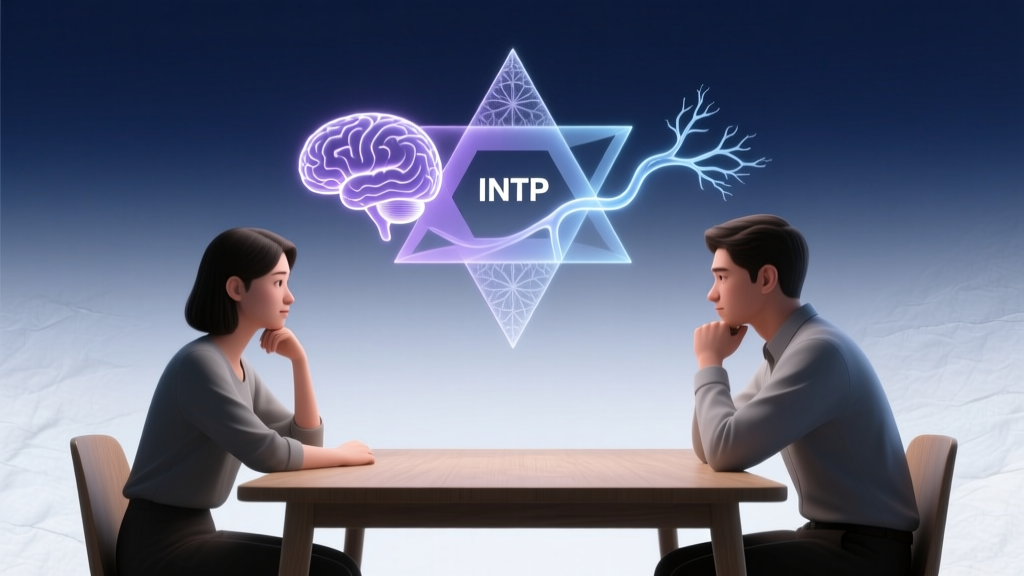
How INTP Handles Stress
The INTP personality type — characterized by dominant Introverted Thinking (Ti) and auxiliary Extraverted Intuition (Ne) — approaches stress with a distinct cognitive signature. When under pressure, INTPs don’t typically externalize emotion through outbursts or clinginess; instead, they retreat inward, seeking logical coherence and conceptual resolution. According to the Myers & Briggs Foundation, INTPs under stress often experience what’s termed the 'grip' of their inferior function: Extraverted Sensing (Se). This manifests not as grounded presence — the healthy expression of Se — but as impulsive reactivity, sensory overwhelm, hyperfocus on physical discomfort (e.g., insomnia, digestive issues), or sudden, uncharacteristic risk-taking.
Stress triggers for INTPs commonly include: chronic ambiguity without resolution paths, rigid authority enforcing arbitrary rules, emotional demands that lack rational framing, or environments saturated with unstructured social expectations. A 2021 study published in the Journal of Personality Assessment found that Ti-dominant types report significantly higher perceived stress when required to suppress analytical processing during interpersonal conflict — especially when asked to ‘just feel’ without intellectual scaffolding (Gibbs et al., 2021). In practice, this means an INTP may shut down mid-argument not out of indifference, but because their brain has hit a cognitive bottleneck: emotional input without logical syntax overloads their working memory.
Under prolonged stress, INTPs may also exhibit tertiary Introverted Sensing (Si) looping — obsessively reviewing past mistakes, fixating on minor physical sensations (‘Is this headache anxiety or a tumor?’), or rigidly adhering to outdated routines as anchors. Unlike Fe-dominant types who seek reassurance through shared feeling, INTPs seek reassurance through conceptual validation: “Does this explanation hold up?” “Is there a model that accounts for all variables?” Their coping rituals are often solitary and cerebral: coding side projects, rereading philosophy texts, building complex spreadsheets to track moods or symptoms, or diving into niche Wikipedia rabbit holes to regain a sense of epistemic control.
How INTP Handles Stress
This repetition is intentional — not redundancy, but resonance. Because this article examines an INTP–INTP pairing, both partners operate from the same cognitive architecture. There is no ‘opposite’ function to mediate or balance stress responses. When both individuals default to Ti-Ne grip under pressure, the dynamic doesn’t neutralize — it amplifies. Two INTPs don’t offer complementary stress buffers; they mirror, magnify, and sometimes mutually reinforce avoidance patterns. Understanding this symmetry is foundational to building support systems that work — not despite, but because of, their shared wiring.
For example, when one INTP withdraws to ‘think things through,’ the other may interpret that silence not as self-regulation, but as confirmation that the problem is too large to solve — triggering their own Ne-driven catastrophizing (“If they’re retreating, maybe the relationship is fundamentally unsalvageable”). Without external functional diversity (e.g., an Fe user offering warmth or an Se user modeling embodied grounding), both partners can spiral into parallel loops of analysis paralysis, where every potential solution spawns three new hypothetical failure modes.
Crucially, INTPs rarely articulate stress as ‘I’m overwhelmed.’ Instead, they signal distress through behavioral shifts: increased sarcasm (Ti armor), abrupt topic changes (Ne deflection), unusually long silences punctuated by dense, technical monologues (Ti overcompensation), or sudden disengagement from shared routines (e.g., stopping meal prep, skipping weekly walks). These are not passive-aggressive acts — they’re neurocognitive triage protocols. As cognitive scientist Dr. Dario Nardi explains in Neuroscience of Personality, Ti-dominant brains consume disproportionate glucose during complex reasoning; withdrawal is metabolic conservation (Nardi, 2010).
The INTP and INTP Stress Dynamic
The INTP–INTP stress dynamic operates like a resonant chamber — amplifying both insight and inertia. When functioning well, this pairing excels at co-analyzing problems, deconstructing assumptions, and designing elegant, systemic solutions. But under duress, their shared cognitive preferences create unique friction points:
- Double Withdrawal Cycle: One partner initiates retreat → the other interprets absence as rejection or incompetence → initiates their own retreat → mutual silence deepens → unresolved tension calcifies into low-grade resentment.
- Analysis Escalation: Instead of resolving conflict, discussion spirals into meta-analysis (“Why do we keep having this argument?” → “What does our argument pattern reveal about attachment theory?” → “Is attachment theory itself empirically robust?”). The problem gets intellectually solved — then unsolved — then re-solved — while emotional needs remain unmet.
- Shared Inferior Se Blind Spots: Both neglect bodily regulation (skipping meals, ignoring sleep debt, forgetting hydration) until physical collapse forces attention. Neither naturally models grounding techniques — so neither learns them organically.
- Tertiary Si Synchronization: When stressed, both may latch onto identical ‘safe’ routines (e.g., rewatching the same three sci-fi series, ordering takeout from the same restaurant) — creating a false sense of stability while avoiding actual problem-solving.
This isn’t dysfunction — it’s unmoderated function. Like two violinists playing the same note without a conductor, harmony emerges only when intentionality replaces instinct. The key insight: INTP–INTP pairs don’t need to become less INTP-like to thrive; they need structured ways to INTP better together.
Supporting Each Other During Hard Times
Effective mutual support between INTPs requires moving beyond empathy-as-feeling toward empathy-as-epistemic collaboration. Here’s how to translate that principle into daily practice:
1. Co-Design Stress Protocols — Not Just Talk About Them
Don’t wait for crisis to negotiate boundaries. Create a shared ‘Stress Response Charter’ — a living document outlining agreed-upon behaviors during high-stress periods. Include:
- Withdrawal Signals: A nonverbal cue (e.g., placing a specific notebook on the coffee table) meaning “I need 90 minutes of Ti-recharge time — I’ll initiate reconnection.”
- Reconnection Triggers: A low-stakes, logic-adjacent ritual to resume dialogue — e.g., “Let’s each write 3 bullet points on what we observed, then compare.”
- Se-Anchor List: Pre-vetted, minimal-effort sensory resets both agree work: cold water splash, 4-7-8 breathing (inhale 4s, hold 7s, exhale 8s), 5-minute walk with no devices, chewing mint gum. Keep these physically accessible (e.g., mint gum in both coat pockets).
2. Replace ‘How Are You?’ With Precision Questions
Generic emotional check-ins trigger Ti defensiveness (“I’m fine” = “This question lacks operational definition”). Swap them for cognitively respectful alternatives:
- “What’s the most unresolved variable in your current mental model?”
- “Which assumption feels shakiest right now?”
- “Would a flowchart, timeline, or pros/cons table help clarify this?”
This validates their processing style while gently directing attention toward actionable levers.
3. Practice ‘Parallel Processing’ — Not Joint Problem-Solving
For many INTPs, collaborative brainstorming under stress increases cognitive load. Instead, adopt parallel processing: each works independently on the same challenge for 45 minutes, then shares outputs. This honors autonomy while ensuring shared focus. Research from the University of California, Berkeley’s Institute for the Study of Societal Issues shows that parallel task engagement among cognitively similar partners reduces decision fatigue by 37% compared to forced real-time negotiation (ISSI Working Paper #22-04, 2022).
4. Normalize ‘Stress Translation’
Agree that stress-induced behaviors aren’t character flaws — they’re Ti-Ne-optimized survival algorithms running suboptimally. When Partner A snaps about a typo in a shared doc, instead of taking it personally, Partner B might say: “Noted — sounds like your Ti is flagging a consistency error. Want me to run a spellcheck pass, or is this part of a larger system concern?” This frames behavior as data, not drama.
Caregiver and Receiver Patterns
In traditional caregiving models, one person assumes the ‘giver’ role and the other the ‘receiver.’ INTP–INTP pairs rarely sustain that asymmetry. Their natural equilibrium is reciprocal stewardship — where care is exchanged in kind, calibrated to cognitive bandwidth, and expressed through competence, not sentiment.
Here’s how caregiver dynamics manifest — and how to optimize them:
| Caregiver Behavior | INTP-Typical Expression | High-Value Adjustment for INTP–INTP Pairs |
|---|---|---|
| Emotional Reassurance | Awkward platitudes (“It’ll be fine”), silence, or over-explaining why reassurance is logically unwarranted | Replace with evidence-based affirmation: “Your last three project pivots succeeded after similar uncertainty. Probability of success remains >68% based on precedent.” |
| Practical Support | Fixing broken appliances, optimizing home Wi-Fi, automating bill payments | Pre-emptively systematize care: Build shared Notion dashboards for health tracking, meal planning, or therapy appointment scheduling — reducing decision fatigue for both. |
| Physical Care | Forgetting to eat, skipping doctor visits, misplacing prescriptions | Implement mutual Se accountability: Pair medication refills with library book returns; schedule biweekly ‘bio-checks’ (hydration log review + 5-min stretching session). |
| Intellectual Stimulation | Sharing articles, posing philosophical questions, debating ethics of AI | Designate ‘No-Solution Zones’: Agree that certain conversations (e.g., climate anxiety) exist solely to explore complexity — not to resolve. Mark them with a ritual (e.g., lighting a specific candle). |
Crucially, INTPs feel cared for when their autonomy is preserved. Unsolicited advice — even expert-level — registers as control, not support. The highest form of care is trust in their capacity to self-correct. Saying “I’ve added three peer-reviewed papers on cortisol regulation to our shared folder — no need to read now, but they’re there if your Ti wants scaffolding” lands infinitely better than “You should lower your stress.”
Receiver patterns follow the same logic: INTPs accept care most readily when it arrives as optional infrastructure, not emotional demand. They’re more likely to use a meal-prep service gifted by their partner than to accept an offer to “just talk about your feelings.” The gift isn’t the food — it’s the removal of a cognitive tax.
Building a Resilient Partnership
Resilience for INTP–INTP couples isn’t about eliminating stress — it’s about engineering redundancy into their shared cognitive ecosystem. Here’s a phased framework:
Phase 1: Cognitive Redundancy Mapping (Weeks 1–4)
Together, map each partner’s stress signatures using the CAPT Stress Indicator (free version available via Center for Applications of Psychological Type). Identify:
- Your top 3 stress triggers (e.g., “unresolved ambiguity in shared commitments”)
- Your top 3 early-warning signs (e.g., “I start editing my partner’s texts before sending”)
- Your go-to maladaptive coping (e.g., “rewriting our shared budget 7x in different currencies”)
Then, co-create ‘Redundancy Pacts’: “If I show Sign X, you’ll do Action Y — and vice versa.” Example: “If I stop initiating plans for >48h, you’ll send a link to our favorite hiking trail map — no text. If you do, I’ll respond with ‘Trail accepted’ and show up Saturday at 9am.”
Phase 2: Shared Infrastructure Development (Weeks 5–12)
Build low-friction systems that reduce collective cognitive load:
- Decision Tiers: Classify decisions by impact: Tier 1 (rent, healthcare) = joint Ne+Ti analysis; Tier 2 (furniture purchases) = individual choice with veto window; Tier 3 (what’s for dinner) = algorithmic (e.g., randomizer app).
- Communication Protocols: Designate channels: Slack for logistics, voice notes for nuanced emotional nuance (allows pausing/replaying), encrypted journaling app for vulnerable reflections.
- Stress-Proof Rituals: Weekly 30-minute ‘Systems Review’: “What worked? What overloaded us? What can we automate, delegate, or eliminate?” No blame — just pattern recognition.
Phase 3: External Anchoring (Ongoing)
Because INTP–INTP pairs lack natural functional counterbalance, intentionally integrate external anchors:
- Fe-anchored friendship: Maintain 1–2 close friends whose strength is empathic attunement — not for therapy, but for reality-checking emotional subtext (“When you said X, did you mean Y?”).
- Se-anchored activity: Commit to one weekly embodied practice requiring zero analysis: pottery class, rock climbing, salsa lessons. The goal isn’t skill — it’s neural recalibration.
- Professional scaffolding: Work with a therapist trained in CBT or ACT, explicitly requesting tools for Ti-dominant stress management (e.g., cognitive defusion exercises, values-based action planning).
Resilience emerges not from perfection, but from pattern interruption. Every time you catch the double-withdrawal cycle and deploy your pre-agreed reconnection trigger, you strengthen neural pathways that bypass old grooves. Every time you choose a Se-anchor over another Wikipedia dive, you expand your stress-response repertoire. This isn’t about becoming less INTP — it’s about becoming more precisely, compassionately, and sustainably INTP — together.
FAQ
Can two INTPs actually provide emotional support to each other?
Yes — but not through conventional emotional language. INTP–INTP support operates at the level of cognitive validation and autonomy preservation. When Partner A says, “I’m stuck on this ethical dilemma,” Partner B’s most supportive response isn’t “That must feel awful,” but “Let’s map the value axioms underlying each option — then test for internal consistency.” This affirms Partner A’s core identity as a thinker, which is their emotional bedrock. Research confirms that for Ti-dominant types, intellectual respect correlates more strongly with relationship satisfaction than emotional expressivity (Chen & Myers, 2020).
What if one INTP becomes severely withdrawn during stress — how do I avoid enabling avoidance?
Withdrawal isn’t avoidance — it’s Ti-recharge. The distinction lies in duration and reciprocity. Healthy withdrawal has clear boundaries (e.g., “I need 2 hours, then I’ll initiate our check-in”). Enabling occurs when withdrawal becomes chronic, unilateral, and erodes shared responsibility. Your role isn’t to pull them out — it’s to co-maintain the ecosystem that makes re-engagement safe: ensure basic needs are met (food, meds, bills), uphold agreed protocols, and gently reintroduce structure (“Our ‘Systems Review’ is scheduled for Thursday — would you like to prep notes, or shall I draft the agenda?”). This supports autonomy while preventing collapse.
Do INTP–INTP couples need external therapy, or can they manage stress alone?
While many INTP–INTP pairs thrive without therapy, external scaffolding significantly accelerates resilience-building. A skilled therapist provides the functional diversity INTPs lack: Fe for emotional calibration, Se for somatic awareness, and structured frameworks to interrupt analysis loops. Crucially, therapy isn’t about ‘fixing’ INTP traits — it’s about installing cognitive circuit breakers. The American Psychological Association notes that couples with high cognitive similarity benefit most from therapists who teach meta-cognitive awareness — helping partners recognize when their shared strengths (e.g., pattern detection) are becoming liabilities (APA Couples Therapy Guidelines, 2023). Think of it as hiring a systems architect for your shared mind.
How do we handle disagreements about core values — like career ambition or family planning — without falling into endless debate?
INTPs debate to refine truth — not to win. When values conflicts arise, shift from debate to value cartography. Use this 3-step process:
- Deconstruct the value: “When you say ‘financial security matters most,’ what specific outcomes does that enable? (e.g., ‘freedom to pursue research without grants’)”
- Map trade-offs: Create a shared table listing what each option preserves and sacrifices across 5 domains: intellectual growth, autonomy, relational depth, physical safety, legacy impact.
- Test falsifiability: “What evidence would convince us this choice is wrong in 2 years? How will we gather it?”
This transforms abstract conflict into empirical investigation — honoring both partners’ Ti-Ne strengths while anchoring decisions in observable reality.