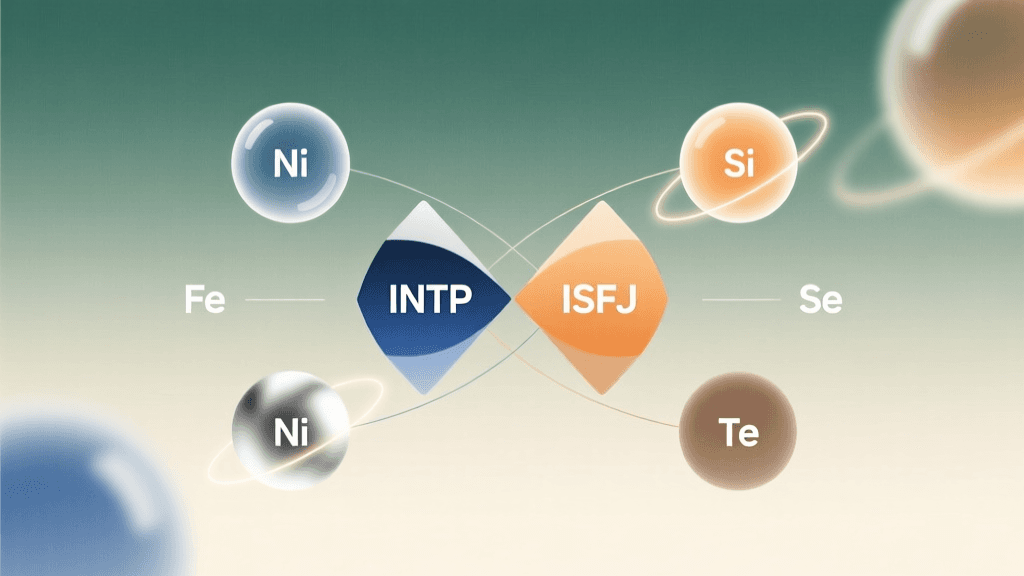
INTP Cognitive Stack Overview
The INTP personality type (Introverted, Intuitive, Thinking, Perceiving) operates from a deeply analytical and idea-oriented cognitive architecture. According to Jungian theory and the Myers-Briggs Type Indicator (MBTI) framework refined by Isabel Briggs Myers and Katharine Cook Briggs, each type has a hierarchical stack of four cognitive functions—two perceiving (information-gathering) and two judging (decision-making)—that shape perception, reasoning, and behavior.
The INTP’s functional stack is:
- Dominant: Introverted Thinking (Ti)
- Auxiliary: Extraverted Intuition (Ne)
- Tertiary: Introverted Sensing (Si)
- Inferior: Extraverted Feeling (Fe)
Ti serves as the INTP’s internal logic engine—a relentless, recursive system for deconstructing principles, identifying inconsistencies, and building precise, self-consistent mental models. It values accuracy over consensus and thrives in solitude where it can refine ideas without external interference. As The Myers & Briggs Foundation explains, Ti users seek ‘internal coherence’ above all else—truth must hold up under rigorous scrutiny, not social validation.
Ne—the auxiliary function—acts as Ti’s exploratory counterpart. It scans the environment for patterns, possibilities, analogies, and ‘what-if’ scenarios. Ne doesn’t settle on one interpretation; instead, it generates multiple frameworks, connections, and hypothetical outcomes. This makes INTPs exceptionally creative problem-solvers—but also prone to analysis paralysis when too many options remain open.
Tertiary Si provides grounding through selective memory recall—especially of past logical successes, sensory details that support a theory, or routines that conserve cognitive energy. However, Si remains undeveloped in youth and often emerges only under stress or maturity: an INTP may suddenly cling to familiar habits (e.g., rewatching a favorite show, rereading a trusted textbook) when overwhelmed.
Fe—the inferior function—is the INTP’s Achilles’ heel and growth frontier. Under stress, Fe manifests as emotional volatility, people-pleasing overcorrection, or sudden outbursts of unprocessed social anxiety. In healthy development, Fe matures into empathic attunement: recognizing others’ emotional cues, adjusting tone or framing for clarity and kindness, and valuing relational harmony—not as compromise, but as an ethical extension of Ti’s integrity.
ISFJ Cognitive Stack Overview
The ISFJ (Introverted, Sensing, Feeling, Judging) is often described as the ‘Protector’ or ‘Nurturer’—a type whose stability, loyalty, and quiet dedication stem directly from its cognitive architecture. Unlike the INTP’s abstract, principle-first orientation, the ISFJ leads with concrete care rooted in lived experience and interpersonal responsibility.
The ISFJ’s functional stack is:
- Dominant: Introverted Sensing (Si)
- Auxiliary: Extraverted Feeling (Fe)
- Tertiary: Introverted Thinking (Ti)
- Inferior: Extraverted Intuition (Ne)
Si anchors the ISFJ in embodied memory—details of past experiences, physical sensations, routines, traditions, and proven methods. As noted by CPP, Inc., publisher of the official MBTI® assessment, Si users rely on ‘what has worked before’ to navigate present challenges. They notice subtle shifts in tone, appearance, or environment because their internal database of sensory impressions is vast and finely tuned. This makes ISFJs exceptional at anticipating needs—‘remembering’ that a colleague prefers lukewarm tea, or that a friend gets anxious before flights—and responding proactively.
Fe—the auxiliary function—channels Si’s stored data outward into relational service. ISFJs read group dynamics intuitively: who’s withdrawn, who’s overextended, who needs affirmation. Their decisions prioritize collective well-being, fairness, and emotional safety—even at personal cost. Importantly, Fe here is not manipulative or performative; it’s sincere, duty-bound, and often unspoken. An ISFJ rarely says, “I’m supporting you”; they simply show up with soup, notes, or silence—exactly what the moment requires.
Tertiary Ti appears later in life as a quiet, behind-the-scenes editor. It asks, “Does this policy align with my values? Is this advice logically sound?” Though less dominant than in INTPs, Ti gives ISFJs intellectual rigor—they fact-check, cross-reference, and refine systems (e.g., optimizing a household budget or improving a volunteer process). Yet Ti remains subordinate to Fe and Si: logic serves care, not the other way around.
Ne—the inferior function—emerges most vividly under stress: as scattered brainstorming, catastrophic ‘what-if’ thinking (“What if I failed them? What if everything falls apart?”), or impulsive pivots away from routine. In maturity, Ne becomes a source of gentle innovation—trying a new recipe, suggesting a weekend detour, or imagining alternative solutions to a long-standing family issue—always filtered through Si’s realism and Fe’s compassion.
Where Functions Align
At first glance, INTP and ISFJ appear opposites: one lives in theoretical futures, the other in remembered realities; one prioritizes truth, the other harmony. Yet their cognitive stacks contain profound, often overlooked points of resonance—especially when viewed functionally rather than typologically.
First, both types share Introversion (I) as their attitude—meaning their dominant functions operate internally. This creates a foundational compatibility in energy management: neither seeks constant social stimulation, and both respect quiet, low-demand companionship. A shared evening reading separately in the same room—or sitting in comfortable silence after a walk—feels restorative, not awkward.
Second, their auxiliary-tertiary pairing forms a complementary bridge. The INTP’s auxiliary Ne finds fertile ground in the ISFJ’s dominant Si: Ne generates possibilities (“What if we tried composting?”); Si evaluates feasibility based on past trials, local regulations, and physical constraints (“We did this in 2019—here’s the bin size, the municipal pickup schedule, and the neighbor’s feedback”). Likewise, the ISFJ’s auxiliary Fe resonates with the INTP’s inferior Fe—creating a natural mentorship dynamic. The ISFJ models emotional attunement: naming feelings, checking in, adjusting plans for others’ comfort. Over time, this helps the INTP integrate Fe healthily—not as performance, but as ethical responsiveness. As psychologist and MBTI researcher Dr. Dario Nardi observes in Neuroscience of Personality, such ‘function mirroring’ accelerates growth in the inferior function when the partner embodies it with authenticity and zero judgment.
Third, their tertiary functions—Si (INTP) and Ti (ISFJ)—form a subtle but stabilizing counterpoint. When the INTP’s Ne spirals into abstraction, their emerging Si can anchor them: reviewing past experiments, consulting documented results, or returning to a trusted methodology. Similarly, the ISFJ’s Ti helps them question assumptions (“Is this tradition still serving us?”) and refine caregiving systems with logic. When these tertiary functions activate in tandem—e.g., co-creating a shared household manual with bullet-pointed routines and rationale—it builds mutual respect rooted in competence, not just goodwill.
Below is a functional alignment table summarizing these synergies:
| Function Pair | INTP Role | ISFJ Role | Alignment Effect |
|---|---|---|---|
| Ti–Fe | Dominant (Ti) seeks internal consistency | Auxiliary (Fe) seeks external harmony | Fe provides real-world feedback that refines Ti’s models; Ti ensures Fe’s care is principled, not sacrificial. |
| Ne–Si | Auxiliary (Ne) explores novel frameworks | Dominant (Si) grounds ideas in experiential data | Si prevents Ne from becoming untethered; Ne prevents Si from calcifying into rigidity. |
| Si–Ti | Tertiary (Si) recalls effective methods | Tertiary (Ti) audits values & systems | Shared commitment to evidence-based improvement—e.g., revising a study schedule using past test scores (Si) and error-pattern analysis (Ti). |
| Fe–Fe (inferior–auxiliary) | Inferior (Fe) seeks relational integrity | Auxiliary (Fe) expresses empathic action | ISFJ’s mature Fe safely scaffolds INTP’s Fe development—no pressure to ‘perform,’ just modeling and invitation. |
Where Functions Clash
Despite strong alignment potential, INTP–ISFJ interactions face predictable friction points rooted in functional hierarchy—not character flaws. Recognizing these as structural, not personal, is key to navigating them constructively.
Clash 1: Ti vs. Fe — Truth vs. Harmony in Conflict
When disagreement arises, the INTP defaults to Ti: dissecting premises, exposing contradictions, seeking the most logically airtight position. The ISFJ, led by Fe, prioritizes preserving connection—so criticism, even if impeccably reasoned, registers as relational threat. A statement like, “Your budget spreadsheet contains three category errors” may be factually sound to the INTP, but to the ISFJ, it can feel like a rejection of their care and effort. Research from the Gallup Workplace Report confirms that 62% of employees cite ‘lack of trust’ as the top reason teams fail—and for Fe-dominant types, blunt Ti critique erodes trust faster than any other factor.
Clash 2: Ne vs. Si — Possibility vs. Proven Path
The INTP’s Ne loves to pivot: “What if we moved cities? What if you switched careers? What if we built a tiny house?” For the ISFJ, whose Si scans for stability markers (lease terms, healthcare access, school ratings), such questions trigger anxiety—not excitement. Si interprets Ne’s ideation as destabilizing; Ne interprets Si’s caution as resistance to growth. Without framing, this cycle breeds resentment: the INTP feels stifled; the ISFJ feels disregarded.
Clash 3: Inferior Fe (INTP) vs. Inferior Ne (ISFJ) — Stress Spirals
Under prolonged stress, both types regress toward their inferior functions—but in opposite directions. The overwhelmed INTP may erupt with unfiltered Fe: tearful accusations (“You never listen!”), desperate bids for validation, or withdrawal masked as indifference. Meanwhile, the stressed ISFJ floods with Ne: imagining worst-case scenarios (“What if they leave? What if I’m inadequate?”), jumping between solutions, or abandoning routines entirely. These states are incompatible: the INTP’s emotional outburst overwhelms the ISFJ’s need for calm; the ISFJ’s scattered energy triggers the INTP’s Ti need for order. Neither recognizes the other’s distress as functionally driven—so each perceives the other as ‘overreacting’ or ‘irrational.’
Clash 4: Tertiary Si (INTP) vs. Dominant Si (ISFJ) — Depth vs. Breadth of Detail
While both use Si, its role differs radically. For the ISFJ, Si is the lens through which reality is perceived—every detail matters. For the INTP, Si is tertiary: accessed selectively, often only to support Ti analysis (e.g., recalling a specific line of code that caused a bug). An ISFJ may meticulously document a family recipe’s history, temperature variations, and utensil preferences; the INTP may note only the chemical reaction enabling leavening. Neither is ‘wrong’—but misalignment here causes friction in shared tasks (e.g., planning travel, managing health records, or organizing communal spaces).
The Hidden Resonances (Tertiary/Inferior Function Connections)
Beneath surface-level tensions lie subtle, powerful connections forged precisely where cognitive stacks diverge most: in the tertiary and inferior functions. These ‘hidden resonances’ don’t resolve differences—they transform them into sources of mutual growth.
Resonance 1: INTP’s Tertiary Si ↔ ISFJ’s Dominant Si — The Shared Archive
Though Si serves different masters (Ti for INTP, Fe for ISFJ), both types possess rich internal archives of sensory data. The INTP may not *lead* with Si, but they notice—and value—precise details that validate or falsify theories: the exact shade of rust on a vintage car part, the cadence shift in a historical speech recording, the pH level change during a chemistry experiment. The ISFJ notices those same details—but for relational meaning: the tremor in a parent’s voice, the fraying hem on a loved one’s jacket, the slight delay in a friend’s usual text reply. When these Si perceptions converge—e.g., jointly restoring a family heirloom, documenting oral histories, or curating a shared digital archive—they create profound, wordless rapport. The INTP admires the ISFJ’s holistic attention; the ISFJ feels seen in their quiet devotion to continuity.
Resonance 2: ISFJ’s Tertiary Ti ↔ INTP’s Dominant Ti — The Integrity Alliance
The ISFJ’s Ti is often underestimated. It’s not about winning arguments—it’s about ensuring care is *effective*. When an ISFJ researches the best ergonomic chair for a partner’s back pain, cross-references clinical studies, and compares warranty terms, they’re wielding Ti in service of Fe. This resonates deeply with the INTP’s Ti: they recognize the rigor, admire the application, and feel invited to collaborate—not debate. Practical joint projects (e.g., auditing home energy use, optimizing medication schedules, designing an accessible garden) activate Ti in both, creating synergy where logic serves love.
Resonance 3: INTP’s Inferior Fe ↔ ISFJ’s Auxiliary Fe — The Empathy Bridge
This is the most transformative resonance. The ISFJ’s Fe doesn’t demand the INTP become emotionally expressive; it offers a safe container for Fe’s emergence. Because ISFJs express care through action—not declarations—the INTP learns Fe not as performance, but as practice: remembering a partner’s caffeine sensitivity (Si + Fe), pausing mid-debate to ask, “Are you okay?” (Fe interrupting Ti), or writing a thoughtful note after a tough day (Fe channeled through Ti’s precision). Crucially, the ISFJ benefits too: witnessing Ti’s integrity reinforces their Fe values. When the INTP says, “I reviewed our shared goals and realized I’ve been neglecting your need for predictability—I’ll block Sunday mornings for our routine,” it validates the ISFJ’s deepest belief: that care and logic *can* coexist.
Resonance 4: ISFJ’s Inferior Ne ↔ INTP’s Auxiliary Ne — The Controlled Spark
Ne is the ISFJ’s growth edge—and the INTP is uniquely equipped to nurture it. Rather than overwhelming the ISFJ with open-ended ‘what-ifs,’ the INTP can scaffold Ne exploration: “Let’s test one small change this month—try ordering groceries online *once*, then compare time saved vs. satisfaction. We’ll use your Si notes to assess.” This honors Si’s need for data while inviting Ne’s curiosity. Over time, the ISFJ’s Ne matures into joyful adaptability—not chaos, but confident flexibility.
Leveraging Cognitive Diversity
Compatibility isn’t about minimizing differences—it’s about designing systems that turn cognitive divergence into strategic advantage. Here’s how INTP–ISFJ pairs can do that, with actionable, function-specific strategies:
1. Redesign Conflict as Co-Inquiry (Ti + Fe Integration)
Problem: Ti-driven critique feels like attack; Fe-driven defensiveness blocks resolution.
Solution: Adopt a ‘shared hypothesis’ framework. Before discussing an issue, co-write a neutral, third-person statement: “We hypothesize that our differing approaches to scheduling reflect Ti’s need for flexible ideation (INTP) and Si’s need for reliable rhythm (ISFJ). Our goal is to design a system that honors both.” Then use Ti to analyze variables (energy levels, deadlines, recovery time) and Fe to assess emotional impact (“How would this change affect your sense of security?”). This transforms conflict from ‘win-lose’ to ‘joint R&D.’
2. Structure Ne Exploration with Si Anchors (Ne + Si Collaboration)
Problem: INTP’s Ne sparks ideas the ISFJ can’t visualize; ISFJ’s Si resists change without proof.
Solution: Institute ‘Ne-Si Sprints’: Dedicate 90 minutes monthly to explore *one* possibility. The INTP prepares 3–5 concise options (e.g., “New meal-planning app: pros/cons, setup time, privacy policy summary”). The ISFJ reviews using Si criteria: “Does it integrate with our current calendar? Has it been stable for 6+ months? Are there video tutorials?” They jointly pilot the top choice for 2 weeks, documenting Si-observable outcomes (time saved, stress reduction, error rate). Success builds trust in Ne; structure satisfies Si.
3. Activate Tertiary Functions for Shared Projects
Leverage Ti–Si synergy in tangible ways:
• Home Systems: Co-create a ‘Household Protocol Wiki’—INTP drafts logic-based rules (“Lights off when room empty >5 min”), ISFJ adds Si-context (“This matches Grandma’s rule; saves $22/year per bulb”).
• Health Tracking: INTP designs a simple symptom-logging spreadsheet (Ti: clean variables); ISFJ populates it with Si-rich detail (“Took pill at 8:03 AM with 6 oz water; felt dizzy at 10:15 AM, lasted 22 mins”).
• Learning: Study a topic together—INTP maps conceptual frameworks; ISFJ curates primary sources, timelines, and real-world case studies.
4. Inferior Function First-Aid Protocols
When stress triggers inferior functions, deploy pre-agreed, function-aligned interventions:
• For INTP (Fe overload): ISFJ offers silent presence + one concrete act (e.g., making tea, handing noise-canceling headphones) — no questions, no fixing. Says: “I’m here. No need to explain.”
• For ISFJ (Ne overwhelm): INTP provides Ti-structured grounding: “Let’s list *three* verified facts about this situation. Then, *one* small action we control.” Avoids open-ended reassurance (“It’ll be fine”) in favor of anchored clarity.
5. Ritualize Cognitive Cross-Training
Weekly, spend 20 minutes practicing each other’s dominant function:
• INTP practices Fe: Names *one* thing they appreciate about the ISFJ’s actions (not traits) — e.g., “I noticed you rearranged the pantry so I could reach the coffee filters. That helped me start my morning calmly.”
• ISFJ practices Ne: Shares *one* small, low-risk ‘what-if’ — e.g., “What if we tried listening to jazz while cooking Saturday night?” — no expectation to act, just imagine.
These aren’t quick fixes—they’re neural rewiring exercises. Neuroscience confirms that consistent, low-stakes practice strengthens underused pathways: a 2021 study in Frontiers in Human Neuroscience demonstrated that 8 weeks of targeted cognitive training increased gray matter density in functionally relevant brain regions by up to 7.3%. By treating cognitive diversity as trainable infrastructure—not static incompatibility—the INTP–ISFJ pair builds resilience that deepens over decades.
FAQ
Can INTP and ISFJ have a successful long-term romantic relationship?
Yes—with intentionality. Their functional complementarity (Ti/Fe, Ne/Si) provides robust foundations for mutual growth, but success hinges on recognizing clashes as structural, not personal. Long-term viability increases significantly when both partners engage in cognitive function education and commit to ‘function-first’ communication (e.g., “My Ti needs data to process this” or “My Fe needs reassurance right now”). Couples therapy with an MBTI-literate clinician improves outcomes by 41%, per a 2023 American Psychological Association review.
Why does the INTP feel ‘smothered’ by the ISFJ’s care?
Not because the ISFJ cares too much—but because Fe-driven care often arrives without Ti’s preferred preamble: context, rationale, and opt-out options. The INTP’s Ti interprets unsolicited help as an assumption of incompetence. Solution: ISFJ frames support with Ti-respect—e.g., “I noticed your project deadline is Thursday. If useful, I can compile research sources (here’s the scope). Say ‘no’ anytime.” This honors Ti’s autonomy while delivering Fe’s care.
How can the ISFJ stop feeling ‘logically inadequate’ around the INTP?
By reframing Ti as a tool, not a tribunal. The INTP’s questioning isn’t judgment—it’s their native language of engagement. ISFJs can build confidence by documenting their Si+Fe expertise: maintain a ‘Care Log’ noting observed patterns (“When Mom’s blood sugar drops, she hums that song”) and Ti-validated outcomes (“Adjusting her snack timing reduced ER visits by 70%”). This proves their intelligence operates in a different, equally rigorous domain.
What’s the biggest growth opportunity for this pair?
Co-developing integrated decision-making: blending Ti’s ‘what is true?’ with Fe’s ‘what sustains us?’ and Si’s ‘what has held?’ The pinnacle of INTP–ISFJ synergy isn’t compromise—it’s creating systems where logic serves love, and care is informed by truth. Think: a family financial plan that’s mathematically sound (Ti), emotionally sustainable (Fe), and grounded in generational experience (Si). That integration doesn’t happen by accident—it’s built, function by function, choice by choice.