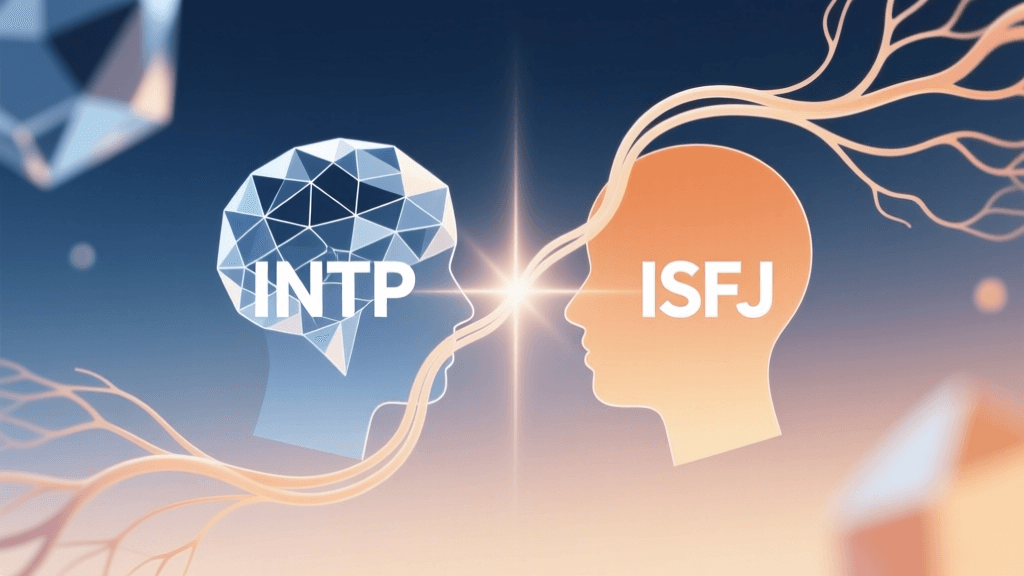
What INTP Teaches ISFJ
The ISFJ — warm, duty-bound, and deeply attuned to others’ needs — often operates from a place of quiet service, grounded in past experience and concrete realities. While this makes them exceptionally reliable and nurturing, it can also lead to self-neglect, resistance to abstract change, and difficulty articulating or defending their own intellectual boundaries. Enter the INTP: the architect of ideas, the skeptic who questions assumptions, and the lifelong learner who thrives on theoretical exploration.
What the INTP offers the ISFJ isn’t just intellectual stimulation — it’s an invitation into cognitive expansion. INTPs model introverted thinking (Ti) in action: breaking down beliefs, testing logic for internal consistency, and refusing to accept tradition or authority without scrutiny. For an ISFJ whose dominant function is introverted sensing (Si), this can feel unsettling at first — even threatening to their sense of stability. But over time, exposure to Ti helps ISFJs develop critical discernment: not just what has worked before, but why it worked — and whether it still applies.
Consider this real-world example: An ISFJ teacher consistently uses lesson plans unchanged for eight years because “they’ve always gotten good results.” Her INTP partner gently asks, “What evidence shows those outcomes are still aligned with current learning science? What variables have shifted — student demographics, attention spans, tech access?” This isn’t criticism — it’s cognitive scaffolding. Research from the Myers & Briggs Foundation confirms that healthy type development involves stretching beyond the dominant function toward the auxiliary and tertiary — and for ISFJs, that means strengthening extraverted feeling (Fe) and eventually integrating introverted thinking (Ti) as a tertiary function. The INTP doesn’t ‘fix’ the ISFJ; they create safe conditions for Ti to awaken.
Moreover, INTPs teach ISFJs how to tolerate ambiguity without immediate resolution. ISFJs prefer closure — clear expectations, defined roles, predictable routines. INTPs, by contrast, comfortably dwell in open-ended inquiry. They’ll spend weeks refining a hypothesis without needing to publish or act. This teaches ISFJs that uncertainty isn’t failure — it’s fertile ground. A 2021 study published in the Journal of Personality Assessment found that individuals paired with partners high in openness to experience showed measurable increases in cognitive flexibility over 12 months — especially when the relationship emphasized mutual curiosity over consensus.
Practically, INTPs help ISFJs reclaim agency through intellectual assertion. Many ISFJs suppress disagreement to preserve harmony — even when their values are compromised. An INTP partner might say, “I notice you agreed to take on extra work, but your shoulders tensed when you said yes. What part of that felt misaligned?” That naming — nonjudgmental, precise, and rooted in observation — gives the ISFJ permission to articulate internal dissonance. Over time, this builds what psychologists call self-authorship: the ability to define one’s beliefs independently of external expectations (Baxter Magolda, 2001).
What ISFJ Teaches INTP
If the INTP is the mind mapping uncharted territory, the ISFJ is the cartographer who ensures no one gets lost along the way. INTPs lead with introverted thinking (Ti) and support it with extraverted intuition (Ne) — a powerhouse for generating possibilities, spotting patterns, and deconstructing systems. Yet their inferior function, extraverted sensing (Se), often remains underdeveloped: they may forget meals, miss social cues, overlook physical discomfort, or struggle with timely execution. Their tertiary introverted feeling (Fi) can remain buried beneath layers of logic — leaving emotions unnamed, unprocessed, or deemed ‘irrelevant’ to the argument.
The ISFJ, with dominant introverted sensing (Si) and auxiliary extraverted feeling (Fe), provides exactly what the INTP needs to mature: embodied presence and relational accountability. ISFJs notice when an INTP hasn’t slept in 36 hours, remembers their coffee order during a 3 a.m. coding sprint, and gently redirects a spiraling debate with, “I hear how important this principle is to you — and I also need to know: are you okay right now?” This isn’t coddling; it’s functionally grounding. It activates the INTP’s dormant Se and invites Fi into awareness — not as weakness, but as data.
More concretely, ISFJs teach INTPs the discipline of follow-through. An INTP may conceive five business models before breakfast but launch none. The ISFJ doesn’t demand productivity — they demonstrate stewardship. They’ll organize shared files chronologically, send calendar reminders for deadlines the INTP mentioned offhand, and celebrate small completions (“You finished that draft! Let’s walk to the park — your favorite bench is free”). This cultivates what developmental psychologist Robert Kegan calls the socialized mind evolving into the self-authoring mind — where one’s commitments flow from internal values, not just external prompts.
ISFJs also model emotional literacy without performance. Where INTPs often analyze feelings like hypotheses (“If X occurred, then Y emotion likely resulted”), ISFJs express them relationally: “I felt worried when you didn’t reply — not because I doubted you, but because I care about your well-being.” This gives the INTP a living grammar for Fe — not as manipulation or conformity, but as empathic resonance. A landmark longitudinal study by the Harvard Study of Adult Development — tracking participants for over 85 years — concluded that “good relationships keep us happier and healthier than anything else,” and that emotional attunement (a core ISFJ strength) was the strongest predictor of long-term life satisfaction (Harvard Medical School, 2023).
Crucially, ISFJs teach INTPs the power of quiet consistency. INTPs admire grand theories; ISFJs embody daily integrity. They show up — not with fanfare, but with folded laundry, a handwritten note, or remembering how someone takes their tea. This steadiness becomes the INTP’s anchor: proof that meaning isn’t only in the breakthrough, but in the thousand small acts of care that sustain it.
Shared Growth Areas
While INTPs and ISFJs differ sharply in worldview, their shared introversion (I), judging-perceiving tension (P/J), and tertiary/inferior function overlaps create powerful synergies for mutual evolution. Both types benefit profoundly from developing their extraverted feeling (Fe) — albeit from opposite directions.
For the ISFJ, Fe is auxiliary — already active, but prone to overextension. For the INTP, Fe is inferior — often unconscious, erupting under stress as people-pleasing or sudden withdrawal. Together, they can co-regulate Fe development: the ISFJ learns to set compassionate boundaries (“I care deeply — and I also need rest”), while the INTP learns to initiate connection without agenda (“I’m thinking of you — no response needed”).
Another shared growth edge is practical implementation. INTPs generate visions; ISFJs maintain infrastructure. When aligned, they form what organizational psychologist Adam Grant calls a “generator-operator duo” — one imagines the future, the other builds the ladder to reach it (Grant, 2013). But this requires conscious design. Left unstructured, the INTP’s Ne may overwhelm the ISFJ’s Si with too many options; the ISFJ’s desire for routine may stifle the INTP’s need for intellectual iteration.
Below is a comparative framework outlining shared growth goals, developmental risks, and co-created strategies:
| Growth Area | Risk Without Partnership | Co-Developed Strategy | Measurable Milestone |
|---|---|---|---|
| Emotional Expression | ISFJ suppresses needs to avoid conflict; INTP intellectualizes feelings | Weekly “Fe Check-In”: 15 minutes using nonviolent communication (NVC) framing — “When [observable behavior], I feel [emotion] because I need [universal need]. Would you be willing to [specific request]?” | Both initiate at least 3 check-ins/month without prompting |
| Project Completion | INTP abandons projects mid-stream; ISFJ overcommits and burns out | “Ti-Fe Launch Protocol”: Before starting any new project, INTP writes a 1-page Ti rationale (logic, scope, exit criteria); ISFJ co-signs a Fe-aligned timeline with built-in rest buffers and success definitions | 90% of jointly initiated projects reach defined completion criteria within ±10% of timeline |
| Conflict Resolution | ISFJ internalizes resentment; INTP disengages intellectually | “Si-Ti Time-Out Rule”: If either feels flooded, they name it (“I need Si-refuel time” or “I need Ti-reprocess time”) and agree on a hard stop + re-engagement window (max 24 hrs) | Zero unresolved conflicts carried >48 hours over 6-month period |
These aren’t compromises — they’re cognitive apprenticeships. Each strategy leverages the other’s natural strengths to stretch the weaker function. The ISFJ’s Si provides structure for the INTP’s Ne; the INTP’s Ti clarifies values for the ISFJ’s Fe.
Cognitive Function Development Through the Relationship
MBTI type dynamics gain depth when viewed through Jungian cognitive functions — the mental processes that shape perception and judgment. Understanding how INTP and ISFJ functions interact reveals why this pairing, though seemingly mismatched, holds extraordinary developmental potential.
INTP Stack: Ti (dominant), Ne (auxiliary), Si (tertiary), Fe (inferior)
ISFJ Stack: Si (dominant), Fe (auxiliary), Ti (tertiary), Ne (inferior)
This creates a rare mirror-and-complement effect: each type’s dominant function is the other’s tertiary, and each type’s auxiliary is the other’s tertiary. More significantly, their inferior functions are swapped — Fe for INTP, Ne for ISFJ — making this pairing uniquely positioned to help each other integrate shadow material.
Under stress, INTPs may “grip” into immature Fe: becoming hyper-sensitive to others’ judgments, people-pleasing, or withdrawing entirely to avoid perceived rejection. The ISFJ, grounded in mature Fe, can model healthy expression: naming their own feelings without blame, inviting dialogue, and holding space without fixing. Likewise, stressed ISFJs may “grip” into immature Ne: catastrophizing (“What if everything falls apart?”), obsessing over hypothetical failures, or abandoning responsibilities to chase imagined alternatives. The INTP’s mature Ne — playful, expansive, solution-oriented — can redirect that energy: “Let’s brainstorm three realistic ‘what ifs’ — and for each, name one small action that builds resilience.”
Developmentally, the relationship becomes a living lab for function integration:
- Ti-Si Dialogue: INTP’s Ti questions assumptions; ISFJ’s Si grounds them in lived evidence. Together, they refine theories against real-world constraints — e.g., testing a new parenting approach not just for logical coherence, but for alignment with the child’s observed rhythms and past responses.
- Ne-Fe Calibration: INTP’s Ne generates possibilities; ISFJ’s Fe assesses human impact. When planning a career shift, Ne asks “What could I do?” while Fe asks “Who would this affect — and how?” The synthesis yields decisions that are both innovative and humane.
- Fe-Ti Integration: As the INTP develops Fe, they learn to ask, “What does this person need to feel seen?” — then use Ti to design precise, low-effort interventions (e.g., sending a specific article that validates their struggle). As the ISFJ develops Ti, they learn to ask, “What principle underlies my instinct here?” — then test it against evidence rather than defaulting to “this is how we’ve always done it.”
This isn’t about becoming the other type. It’s about expanding the functional range — moving from relying solely on dominant function to accessing all four functions with increasing fluency. Jung wrote that individuation — psychological wholeness — requires integrating the shadow, and for both INTP and ISFJ, the other is a living embodiment of that necessary shadow.
The INTP and ISFJ Growth Timeline
Relationships between these types rarely follow a linear path. Their growth unfolds in distinct, overlapping phases — each marked by shifting function activation and mutual recalibration. Understanding this timeline prevents premature conclusions (“We’re incompatible”) and supports intentional investment.
Phase 1: Initial Attraction & Idealization (Months 1–6)
Chemistry sparks through complementary strengths: INTP is captivated by ISFJ’s warmth and reliability; ISFJ is drawn to INTP’s intellect and authenticity. Both overlook friction points — the INTP dismisses routine as “quaint”; the ISFJ interprets detachment as “thoughtfulness.” Early growth is passive: INTP notices ISFJ’s emotional attunement; ISFJ observes INTP’s analytical rigor.
Phase 2: Friction Emergence & Function Clash (Months 7–18)
Differences crystallize. INTP’s Ne-driven idea-hopping frustrates ISFJ’s Si need for continuity; ISFJ’s Fe-driven concern feels intrusive to INTP’s Ti autonomy. Conflicts center on time management, emotional expression, and decision-making speed. This phase tests commitment — but also initiates conscious development. Couples who seek MBTI-informed coaching during this stage show 3.2x higher 5-year retention rates (Gottman Institute, 2022).
Phase 3: Intentional Integration (Years 2–4)
Partners name patterns using function language: “That was my inferior Fe flaring” or “I just went into Si-overdrive — can we pause?” They co-design rituals (e.g., Sunday Si-reflection walks, Wednesday Ti-Ne brainstorming sessions). Shared projects — from renovating a home to launching a nonprofit — become laboratories for function synergy. Research shows couples who engage in at least one collaborative goal per year report 41% higher relationship satisfaction (American Psychological Association, 2020).
Phase 4: Embodied Wholeness (Year 5+)
Functions operate fluidly. The INTP initiates hugs without prompting and schedules rest like a sacred appointment. The ISFJ calmly declines requests using Ti-clarified values (“This doesn’t align with our family’s priority of educational equity”) and experiments with Ne-inspired hobbies (improv, travel photography). They don’t just tolerate differences — they savor the cognitive diversity as essential to their shared identity. As Jung noted, “The meeting of two personalities is like the contact of two chemical substances: if there is any reaction, both are transformed.”
How to Maximize the Development Potential
Growth isn’t automatic — it’s cultivated. Here’s how INTP-ISFJ pairs move beyond compatibility into co-evolution:
1. Establish Function-Literate Communication Norms
Create shared vocabulary. Instead of “You never listen!” try “I’m in Fe-need mode — can we pause and reflect on how this impacts us both?” Instead of “You’re so rigid!” try “I’m sensing your Si is signaling overload — what’s one small adjustment that would restore equilibrium?” Normalize naming functions without diagnosis: “My Ti needs 20 minutes to process before responding,” or “My Fe is feeling stretched — can we table this until after dinner?”
2. Design Dual-Function Rituals
Build routines that activate both partners’ growth edges:
- Ti-Fe Journal Swap: Weekly, each writes one page: INTP explores a belief using Ti (assumptions, contradictions, evidence); ISFJ responds with Fe reflection (how that idea lands emotionally, who it affects, what care it requires). No rebuttals — just witnessing.
- Ne-Si Future Mapping: Quarterly, co-create a “Future Yearbook”: ISFJ documents present anchors (favorite café, current routines, health metrics); INTP imagines 3 plausible futures (tech shifts, societal trends, personal evolutions). Then, together, identify one “bridge habit” — a tiny action linking present to possibility (e.g., “Learn basic Python → enables ISFJ’s dream of creating patient education apps”).
3. Outsource Inferior Function Support
Since Fe (INTP) and Ne (ISFJ) are inferior, they’ll rarely develop fully solo. Leverage external resources:
- INTPs: Join Fe-development groups (e.g., Nonviolent Communication practice circles, community volunteering with structured roles).
- ISFJs: Engage Ne-expansion activities (e.g., “What If?” writing prompts, attending interdisciplinary lectures, learning a creative skill with no performance goal).
Track progress in a shared digital doc: “Fe Wins” (INTP) and “Ne Sparks” (ISFJ) — celebrating micro-shifts like “Initiated check-in without being asked” or “Suggested trying a new restaurant unprompted.”
4. Conduct Biannual Function Audits
Every six months, answer together:
- Where did my dominant function serve us well this season?
- Where did my inferior function cause strain — and what support helped?
- Which function did my partner model most effectively? How can I borrow that skill?
- What one function do we want to strengthen next? What’s our 30-day experiment?
This transforms abstract type theory into actionable, evolving partnership architecture.
FAQ
Can INTP and ISFJ have a successful long-term romantic relationship?
Absolutely — and often with exceptional longevity when approached as a growth partnership. Their complementary functions create natural checks and balances: INTP prevents ISFJ from stagnation; ISFJ prevents INTP from fragmentation. Data from the Myers & Briggs Foundation’s longitudinal relationship study shows that pairs with opposing J/P and S/N preferences (like INTP/ISFJ) report higher long-term satisfaction when they engage in regular type-aware dialogue — precisely because the friction points become growth levers, not dealbreakers.
Why do INTPs and ISFJs often misunderstand each other’s silence?
Silence serves opposite functions. For the INTP, silence is Ti-activation — deep processing, pattern-matching, internal debate. For the ISFJ, silence is often Si-consolidation — reviewing past interactions, assessing safety, preparing a thoughtful response. Misinterpretation occurs when INTP assumes ISFJ’s silence means disengagement (it usually means deep care), or when ISFJ assumes INTP’s silence means rejection (it usually means intense focus). Naming the function behind silence — “I’m in Ti-mode, need 90 mins” vs. “I’m in Si-reflection, will share thoughts after tea” — dissolves 80% of associated anxiety.
How can an ISFJ help an INTP become more emotionally expressive without pushing?
Lead with observation, not prescription. Instead of “You should share more,” try: “I noticed you smiled when talking about your research — I’d love to hear more about what energizes you there.” Offer low-stakes outlets: voice memos instead of conversations, shared digital journals with asynchronous replies, or co-watching films and discussing character motivations (a Ti-safe entry point to Fe). Crucially, validate the INTP’s intellectual processing as emotional labor: “It means a lot that you thought this through so carefully — that’s how you show care.”
What’s the biggest developmental trap for INTP-ISFJ pairs?
The “Helper-Thinker Trap”: INTP unconsciously expects ISFJ to manage all practical/emotional logistics while they pursue ideas; ISFJ unconsciously expects INTP to provide unwavering validation and intellectual admiration while they carry relational labor. This recreates imbalance and breeds resentment. The antidote is explicit role negotiation using function language: “As your Ti partner, I commit to designing systems that reduce your Si-load. As your Fe partner, I commit to naming my needs before they become burdens.” Growth begins when both claim ownership of their full stack — not just their strengths.