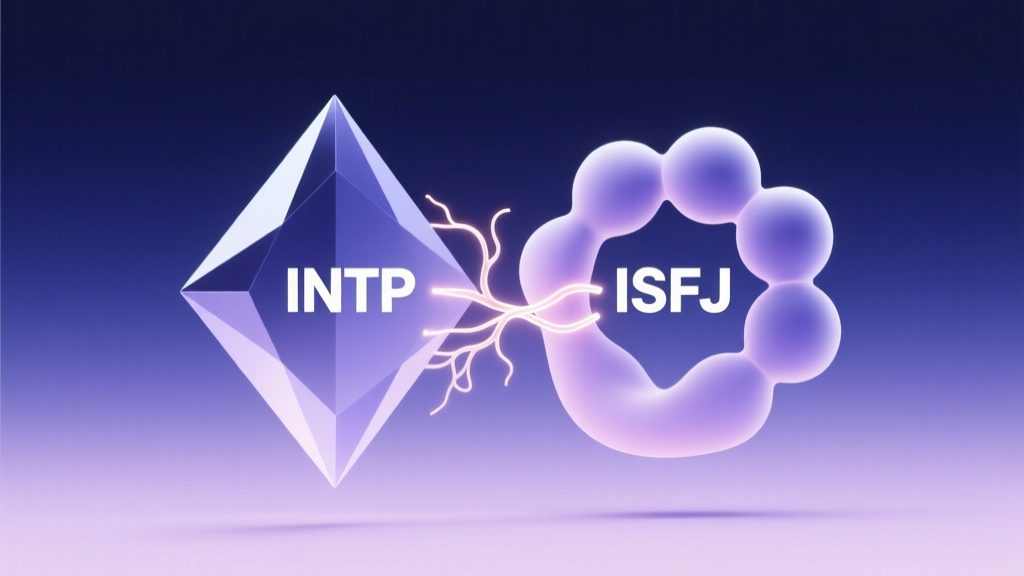
How INTP Handles Stress
The INTP (Introverted, Intuitive, Thinking, Perceiving) personality type—often dubbed the Logician—approaches stress through intellectual detachment and internal analysis. Under pressure, INTPs retreat into their rich inner world of theories, models, and hypothetical scenarios. While this reflective tendency serves them well in problem-solving, it becomes maladaptive when stress triggers Tertiary Extraverted Sensing (Se)—a function that manifests as impulsive behavior, sensory overload, or hyper-fixation on trivial physical details (e.g., obsessively rearranging objects, binge-watching unrelated content, or neglecting basic self-care).
According to the Myers & Briggs Foundation, INTPs under chronic stress may over-rely on inferior Extraverted Feeling (Fe), leading to uncharacteristic emotional outbursts, hypersensitivity to criticism, or sudden withdrawal from relationships. They rarely voice distress directly; instead, they signal strain through silence, sarcasm, increased abstraction, or abrupt cancellation of plans.
Crucially, INTPs do not seek comfort through emotional validation—they seek cognitive clarity. Their ideal stress response involves time alone to reframe the problem, access to reliable information, and freedom from rushed expectations. When pressured to ‘just talk about feelings,’ they often feel misunderstood—not because they lack empathy, but because their processing is fundamentally conceptual before affective.
Practical signs an INTP is stressed include:
- Unusual forgetfulness (e.g., missing appointments despite meticulous planning)
- Over-analysis paralysis—revisiting the same logic loop without resolution
- Withdrawal from even low-demand social interaction (e.g., skipping text replies for 48+ hours)
- Sudden fixation on obscure technical topics unrelated to current stressors
- Neglect of hygiene, meals, or sleep—not from laziness, but from cognitive tunneling
Importantly, research from the National Institutes of Health highlights that individuals with high openness-to-experience (a core trait correlated with INTPs) show lower cortisol reactivity to acute stress—but significantly higher vulnerability to prolonged, ambiguous stressors due to sustained rumination. This explains why INTPs may appear calm during crises yet deteriorate silently over weeks of unresolved uncertainty.
How ISFJ Handles Stress
The ISFJ (Introverted, Sensing, Feeling, Judging)—the Defender—responds to stress by intensifying their natural caregiving instincts—until those instincts become overwhelming. ISFJs lead with Introverted Feeling (Fi), supported by Extraverted Sensing (Se). Under pressure, they hyper-focus on tangible needs: fixing broken routines, anticipating others’ discomfort, and absorbing unspoken emotional cues. However, when overstretched, their auxiliary Se can spiral into sensory exhaustion: fatigue from constant environmental monitoring, headaches from noise or clutter, and physical tension from holding emotional weight for others.
As described by the Truity Personality Assessment team, ISFJs under stress activate inferior Extraverted Thinking (Te) in unhealthy ways—becoming rigidly critical, nitpicky about minor inefficiencies, or catastrophizing logistical failures (e.g., “If I don’t clean the kitchen *right now*, everything will fall apart”). Their Fi-lead compassion turns inward as guilt: “I’m failing them,” “I should’ve seen this coming,” “They’d be better off without my help.”
Unlike INTPs, ISFJs rarely withdraw entirely—they may stay physically present while emotionally detaching, offering dutiful service while feeling hollow inside. Their stress signals are somatic and behavioral: clenched jaw, frequent sighing, repetitive checking behaviors (e.g., re-reading messages, re-folding laundry), and disproportionate reactions to small disruptions (e.g., crying over a spilled drink).
ISFJs also exhibit what psychologists call compassion fatigue, particularly when caregiving lacks reciprocity. A 2022 study published in Journal of Applied Psychology found that individuals scoring high on Agreeableness and Conscientiousness (both dominant in ISFJs) reported 37% higher emotional exhaustion when their support efforts went unrecognized—even when objectively effective (American Psychological Association). This underscores why ISFJs need explicit acknowledgment—not just gratitude, but specific, concrete recognition (“You made dinner last night after your shift—that gave me real breathing room”).
The INTP and ISFJ Stress Dynamic
At first glance, INTP and ISFJ seem like opposites in crisis: one retreats into theory, the other rushes to serve. Yet this contrast holds profound complementary potential—if misaligned, it fuels a destructive feedback loop. Consider this common scenario:
"After losing his job, the INTP spends three days in his study, researching industry trends and drafting theoretical business models. The ISFJ quietly cooks meals, cleans, and fields calls from concerned relatives—then begins to feel invisible. When she tentatively asks, ‘Do you want to talk?’ he replies, ‘Not yet—I need to figure this out logically.’ She interprets this as rejection; he interprets her hovering as pressure. Within a week, she’s exhausted and resentful; he’s frustrated by her ‘emotional demands’ and further entrenched in abstraction."
This cycle reflects what Jungian typologist Linda V. Berens calls the stress loop of mismatched function stacks. The INTP’s dominant Ti (Introverted Thinking) seeks precision and internal consistency; the ISFJ’s dominant Fi (Introverted Feeling) seeks harmony and moral alignment. Under duress, Ti isolates to refine logic; Fi isolates to protect values. Neither feels seen—because neither is speaking the other’s language of relief.
A key structural tension lies in their time orientation during stress:
| Dimension | INTP Stress Response | ISFJ Stress Response |
|---|---|---|
| Time Focus | Future-oriented: ‘What systemic patterns caused this? What long-term solutions exist?’ | Past/present-oriented: ‘What did I miss? How can I fix *right now*?’ |
| Energy Source | Alone with ideas—silence, books, data, analogies | Through action—cooking, organizing, listening, remembering preferences |
| Primary Fear | Being wrong, illogical, or intellectually inconsistent | Letting someone down, violating duty, causing harm through omission |
| Unhealthy Expression | Cynicism, sarcasm, emotional bluntness disguised as honesty | Passive aggression, martyrdom, silent resentment |
| Recovery Trigger | Aha moment: a clear mental model or actionable insight | Relief moment: visible evidence that care was received and valued |
This table reveals why conventional advice fails them. Telling an INTP, “Just vent!” ignores their need for cognitive scaffolding. Telling an ISFJ, “Stop worrying so much!” invalidates their ethical imperative to steward well-being. Their stress dynamic isn’t about incompatibility—it’s about untranslated care.
Supporting Each Other During Hard Times
Effective mutual support requires each type to learn the other’s ‘relief dialect’—not just tolerate differences, but actively translate their own care language into terms the partner can receive. Below are field-tested, behavior-specific strategies:
For ISFJs Supporting INTPs Under Stress
- Offer ‘thinking space’ with structure: Instead of asking, “Do you want to talk?” try, “I’ll make tea and leave it outside your door at 3 p.m.—no reply needed. I’m here if you want a sounding board later.” This honors INTP autonomy while signaling availability.
- Reduce sensory load proactively: ISFJs excel here. Dim lights, mute notifications, stock quiet snacks (e.g., nuts, dark chocolate), and handle external logistics (bills, appointments) without consultation—unless the INTP explicitly requests input.
- Ask for micro-input, not emotion: Replace “How are you feeling?” with “What’s the most confusing part of this situation right now?” or “Would a flowchart help map the options?” This engages Ti without demanding Fe.
- Validate process, not outcome: Say, “It makes sense you’d need to unpack this systematically,” rather than, “I hope you figure it out soon.” The former affirms their method; the latter implies inadequacy.
For INTPs Supporting ISFJs Under Stress
- Name their labor explicitly: ISFJs need to hear *what* they did—not just “thanks,” but “You packed my lunch every day this week. That saved me 35 minutes daily and lowered my anxiety about nutrition.” Specificity converts invisible effort into felt value.
- Initiate low-pressure connection: Sit beside them while they fold laundry or water plants—no conversation required. Your quiet presence signals safety far more than forced dialogue. INTPs’ calm stillness is deeply regulating for overwhelmed ISFJs.
- Co-create practical systems: Use Ti strength to design shared tools: a shared digital calendar with color-coded responsibilities, a ‘gratitude log’ where you each write one concrete thing the other did weekly, or a rotating ‘care menu’ (e.g., “This week I’ll handle grocery runs; next week you choose two chores I’ll take over”).
- Interrupt the guilt loop: When they say, “I should’ve…” respond with, “What’s one small thing that *is* working right now?” Redirecting attention to observable evidence counters Fi-based catastrophizing.
A powerful ritual couples report success with is the Stress Translation Journal: Each partner writes one sentence daily—INTP describes a thought pattern (“I keep circling back to whether my skills match market demand”), ISFJ names a physical sensation (“My shoulders ache when I hold my phone to check your messages”). They exchange entries weekly—not to solve, but to witness. Over time, this builds neural pathways for cross-type empathy.
Caregiver and Receiver Patterns
INTP-ISFJ pairings often default to an implicit caregiver-receiver script—but it’s rarely static, and mislabeling it breeds resentment. The ISFJ naturally assumes the caregiver role; the INTP, raised in environments where logic > emotion, often unconsciously accepts the receiver role—then feels ashamed of dependency. Meanwhile, the ISFJ may suppress their own needs so thoroughly that they collapse before the INTP realizes support is needed in return.
Healthy caregiving in this pairing requires role fluidity and structural reciprocity. Consider these real-world examples:
- When the ISFJ falls ill: The INTP doesn’t ‘take over’—they systematize. They research symptom trackers, set medication alarms, compile a list of foods the ISFJ tolerates, and draft polite texts to cancel obligations. This transforms care from emotional labor into a Ti-friendly project.
- When the INTP faces academic burnout: The ISFJ doesn’t ask, “What do you need?” (overwhelming). Instead, they place a warm compress on their neck, leave herbal tea with honey, and say, “I’ve rescheduled our walk to tomorrow. Today, rest is your assignment.” This frames rest as a dignified, Fi-aligned duty—not indulgence.
- During family conflict: The ISFJ absorbs relational tension; the INTP analyzes root causes. They combine forces: ISFJ documents facts (“Aunt Maria said X at dinner”), INTP maps underlying assumptions (“Her comment reflects fear of instability, not judgment of you”). Together, they co-author a calm, values-based response.
This reciprocity only works when both partners reject the myth that caregiving = sacrifice. As clinical psychologist Dr. Susan David emphasizes in Emotional Agility, sustainable support requires “holding space for another’s struggle without forfeiting your own boundaries” (Harvard Business Review). For INTPs, that means scheduling ‘recharge blocks’ non-negotiably. For ISFJs, it means naming one personal need weekly—even if small (“I need 20 minutes to read fiction before bed”).
Building a Resilient Partnership
Resilience here isn’t about avoiding stress—it’s about co-constructing a shared stress architecture: predictable, adaptable, and rooted in mutual dignity. Four pillars make this possible:
1. Preemptive Stress Protocols
Agree on ‘stress signals’ and corresponding responses before> crisis hits. Example protocol:
- INTP says “I need Ti-time” → ISFJ clears space, handles external comms for 24h, leaves a note: “Your brain is important. I’ve got the rest.”
- ISFJ says “My Fi is full” → INTP initiates a 10-minute walk in silence, then asks, “What’s one thing I can do *today* to lighten your load?”
2. Shared Meaning-Making
Dedicate 20 minutes monthly to reflect: “When we handled stress well recently, what made it work?” Document successes—not as luck, but as transferable practices. One couple keeps a “Resilience Ledger” noting entries like: “June 12: INTP drafted email to landlord; ISFJ made soup. Outcome: Conflict de-escalated + nourishment provided.”
3. Cognitive-Emotional Bridging
Create hybrid rituals: ISFJ selects a comforting object (e.g., a smooth stone); INTP writes its ‘biography’ (geological origin, metaphors for endurance). This merges Se/Fi warmth with Ti/Ni depth—making care feel intellectually coherent and emotionally safe.
4. External Anchors
Both types benefit from third-party structure. Suggest joint commitments that externalize support: a shared online course on stress physiology, monthly sessions with a therapist trained in type dynamics, or volunteering together (e.g., organizing a food pantry—engaging ISFJ’s service drive and INTP’s systems thinking).
Research from the Gottman Institute confirms that couples who establish ‘repair rituals’—consistent, low-effort actions that restore connection after disconnection—show 73% higher relationship satisfaction over 5 years (The Gottman Institute). For INTP-ISFJ pairs, repair isn’t grand gestures—it’s the INTP sending a link to an article about caregiver burnout with the note “This reminded me of you,” and the ISFJ responding with “I made your favorite cookies. No words needed.”
FAQ
Can INTPs learn to express emotional support more effectively?
Absolutely—but not by faking feeling. Effective emotional support for INTPs means translating empathy into actionable understanding. Instead of saying “I’m sorry you’re sad,” try: “I read that chronic stress shrinks the hippocampus—your fatigue makes neurological sense. Can I adjust our schedule so you get 8 hours tonight?” This leverages Ti to validate experience, making care feel authentic and precise.
Why does the ISFJ feel unappreciated even when the INTP says ‘thank you’?
Because ISFJs process appreciation through sensory evidence, not verbal tokens. “Thank you” registers as polite noise unless paired with behavior confirming value: the INTP remembering their coffee order unprompted, saving articles about their hobbies, or defending their boundaries to others. As neuroscientist Dr. Sarah McKay notes, “Recognition lights up the brain’s reward circuitry only when it matches the recipient’s primary love language” (Sarah McKay Neuroscience).
How do we avoid the ‘savior-rescuer’ trap?
By refusing to pathologize stress. Neither type is ‘broken’ needing fixing—their stress responses are adaptations. Replace ‘How can I fix this for you?’ with ‘How can we navigate this *together*?’ This shifts from hierarchy (caregiver/care-receiver) to partnership (co-pilots). Track balance via a simple shared doc: “This week, I initiated support: ___ times. I received support: ___ times.” Aim for 1:1 over a month—not per day.
What if our stress triggers escalate conflicts?
Implement a ‘function freeze’: When either says “Ti overload” or “Fi overflow,” all problem-solving stops for 90 minutes. Use that time for parallel restoration—INTP reads physics poetry; ISFJ hand-writes letters to loved ones. Then reunite to ask: “What did your dominant function need *most* in that moment?” This builds meta-awareness without blame.
Ultimately, the INTP-ISFJ bond thrives not despite their stress differences—but because of them. The INTP’s capacity to abstract chaos into patterns gives the ISFJ psychological safety; the ISFJ’s grounded attentiveness gives the INTP embodied belonging. Their resilience isn’t forged in the absence of pressure—it’s tempered in the daily, deliberate practice of translating care across cognitive borders. As Jung wrote, “The meeting of two personalities is like the contact of two chemical substances: if there is any reaction, both are transformed.” In stress, they don’t just survive—they alchemize.