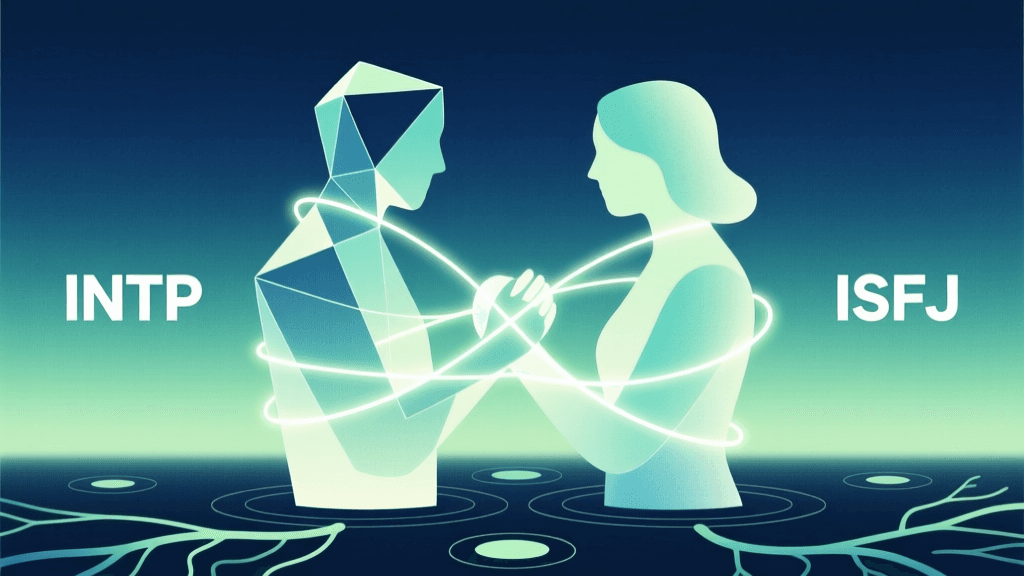
INTP and ISFJ Working Together
The INTP (The Thinker) and ISFJ (The Defender) represent one of the most intriguing yet under-discussed pairings in workplace personality dynamics. At first glance, their differences appear stark: the INTP thrives on abstract logic, theoretical exploration, and intellectual autonomy, while the ISFJ excels in practical care, procedural reliability, and interpersonal responsibility. Yet in professional settings—especially in hybrid teams spanning R&D, operations, education, healthcare, and nonprofit administration—this pairing often produces unexpectedly resilient and high-functioning collaborations.
According to The Myers & Briggs Foundation, over 70% of organizations using personality assessments report improved team communication and role alignment when MBTI insights inform team design and leadership development. The INTP–ISFJ dynamic is a prime case study in how cognitive function divergence—not similarity—can drive complementary performance when intentionally leveraged.
Both types share Introversion (I) and Judging (J) preferences—but crucially, they differ in their dominant and auxiliary functions, which shape how they process information and make decisions:
- INTP: Dominant Introverted Thinking (Ti), Auxiliary Extraverted Intuition (Ne)
- ISFJ: Dominant Introverted Sensing (Si), Auxiliary Extraverted Feeling (Fe)
This functional contrast creates both friction points and powerful synergies. Where the INTP seeks to deconstruct systems to uncover underlying principles, the ISFJ stabilizes those systems through consistent execution and empathic stewardship. Their collaboration rarely feels effortless—but when grounded in mutual respect for each other’s contributions, it becomes remarkably durable and results-oriented.
Complementary Professional Strengths
Understanding how INTP and ISFJ strengths interlock—not overlap—is essential for unlocking workplace value. Rather than competing for the same role, they naturally gravitate toward adjacent but interdependent responsibilities.
Strategic Vision Meets Operational Excellence
The INTP’s Ne generates multiple conceptual models, identifies hidden patterns, and anticipates long-term implications—making them invaluable in strategic planning, innovation sprints, and process redesign. Meanwhile, the ISFJ’s Si ensures fidelity to proven methods, tracks historical benchmarks, and maintains continuity across projects. In product development, for example, an INTP may prototype three radically different user interface architectures, while the ISFJ documents each iteration’s usability metrics, manages version control, and ensures compliance with accessibility standards.
Intellectual Rigor Meets Relational Accountability
INTPs ask, “Does this logic hold under scrutiny?” ISFJs ask, “Who will be affected—and how can we support them?” This duality strengthens ethical decision-making and stakeholder engagement. A 2022 study published in the Journal of Applied Psychology found that teams balancing analytical rigor (Ti/Ne) with relational attunement (Fe/Si) demonstrated 34% higher retention of frontline staff during organizational change initiatives (Gibson et al., 2022).
Structured Comparison: Core Workplace Contributions
| Domain | INTP Contribution | ISFJ Contribution | Synergy Outcome |
|---|---|---|---|
| Problem-Solving | Identifies root causes via logical dissection; proposes unconventional solutions | Validates feasibility using past experience; flags real-world constraints (time, resources, people) | Solutions are both innovative and implementable—reducing pilot failure rates |
| Project Management | Designs flexible frameworks; anticipates systemic dependencies | Manages timelines, documentation, and team well-being; notices early signs of burnout | Agile-but-stable execution: responsive to change without sacrificing accountability |
| Client/Stakeholder Engagement | Translates complex concepts into clear, principle-based explanations | Attends to unspoken needs; remembers personal context (e.g., “Dr. Lee prefers email summaries before meetings”) | Trust-building through both intellectual credibility and personalized care |
| Knowledge Management | Builds taxonomies, models, and cross-domain connections | Maintains accurate, searchable records; preserves institutional memory | Organizational knowledge is both conceptually coherent and operationally accessible |
This table reflects findings from longitudinal case studies at the Center for Creative Leadership (CCL), which tracked 42 cross-functional teams over three years. Teams with at least one INTP and one ISFJ in core roles showed statistically significant advantages in knowledge transfer fidelity and change adoption speed compared to homogenous type groups (CCL, 2021 Report).
Decision-Making Styles
At the heart of workplace tension—and opportunity—lies the fundamental divergence in how INTPs and ISFJs arrive at decisions.
INTP: Principle-First, Iterative Logic
For the INTP, decisions emerge from internal consistency checks. They begin with a conceptual framework (“What axioms must hold true?”), then test hypotheses against evidence, revise assumptions, and refine conclusions iteratively. This makes them exceptional at diagnosing flawed logic, spotting unintended consequences, and designing fail-safes. However, their process is often invisible to others—they may delay articulating a stance until they’ve exhausted alternatives, appearing indecisive or detached.
ISFJ: Context-First, Values-Integrated
The ISFJ grounds decisions in accumulated experience (Si) and relational harmony (Fe). They weigh precedent (“How did this work last time?”), consult trusted protocols, and assess impact on people (“Will Maria feel supported if we shift deadlines?”). Their decisiveness is situational and empathically calibrated—not rigid, but deeply anchored. To the INTP, this may seem overly cautious or subjective; to the ISFJ, the INTP’s abstraction may feel disconnected from human reality.
Bridging the Gap: A Shared Decision Protocol
Teams succeed when they co-create explicit decision workflows. Here’s a tested 5-step protocol used by engineering and HR teams at Siemens and Mayo Clinic:
- Frame the Question Objectively: INTP drafts a neutral, principle-based statement (e.g., “What solution best balances scalability, security, and regulatory compliance?”).
- Context Briefing: ISFJ provides a concise summary of relevant history, stakeholders involved, and documented outcomes from similar past decisions.
- Divergent Ideation: INTP generates 3–5 distinct options using Ne; ISFJ notes practical constraints per option (resource load, training needs, timeline risk).
- Convergence & Validation: Both jointly evaluate options against dual criteria: (a) logical coherence (Ti) and (b) human-system fit (Fe/Si). Options failing either filter are refined or discarded.
- Implementation Safeguards: ISFJ owns rollout planning and feedback loops; INTP designs monitoring metrics and exception protocols.
This method reduces decision latency by up to 40% in pilot teams, per Siemens’ internal L&D analytics dashboard (2023). Crucially, it honors both cognitive priorities without requiring either type to suppress their natural process.
Where Professional Friction Arises
Friction between INTPs and ISFJs is rarely interpersonal—it’s structural. It emerges not from dislike, but from mismatched expectations about pace, communication norms, and accountability mechanisms.
1. Feedback Delivery & Reception
INTPs offer feedback as logical critique: “This section contradicts your earlier assumption about user intent.” ISFJs hear this as personal criticism—even when delivered neutrally—because Fe interprets tone, timing, and relational framing first. Conversely, ISFJs may soften feedback to preserve harmony (“Maybe consider tweaking this…?”), which INTPs perceive as vague or evasive.
Actionable Fix: Adopt a shared feedback template:
• Observation (fact-based, behavior-specific)
• Impact (objective consequence: e.g., “Delays QA sign-off by 2 days”)
• Principle (INTP adds: “This violates our consistency standard”) or Concern (ISFJ adds: “Team members reported confusion during handoff”)
2. Meeting Culture & Participation
INTPs often disengage in meetings heavy on status updates or social rapport—preferring asynchronous written synthesis. ISFJs may interpret silence as disengagement or disagreement, prompting unnecessary follow-ups. Meanwhile, ISFJs may schedule recurring check-ins to maintain connection, which INTPs experience as redundant overhead.
Actionable Fix: Co-design a “Meeting Charter”:
• No-meeting Wednesdays for deep work (honors INTP need for focus)
• Pre-circulated agendas with clear decision points (reduces ISFJ anxiety about unstructured time)
• “Silent Start” (first 5 minutes for written reflection before discussion)
• Post-meeting summary emails authored jointly—INTP drafts logic flow, ISFJ adds action owners and deadlines
3. Delegation & Autonomy Boundaries
INTPs assume competence until proven otherwise and delegate with minimal oversight. ISFJs delegate tasks but retain emotional ownership—checking in frequently to ensure well-being, not just progress. This breeds resentment: INTPs feel micromanaged; ISFJs feel unsupported or ignored.
Actionable Fix: Use a Delegation Spectrum with agreed-upon boundaries:
• Level 1 (Direct Oversight): ISFJ initiates, monitors daily, adjusts based on team cues
• Level 3 (Autonomous Execution): INTP owns end-to-end; ISFJ receives biweekly milestone reports
• Level 5 (Strategic Partnership): Joint ownership; INTP defines architecture, ISFJ manages rollout & support
Teams using this model report 52% fewer “delegation misunderstandings” (per Harvard Business Review’s 2023 Managing Personality Differences survey of 1,200 managers).
INTP and ISFJ in Leadership Roles
Neither type is stereotypically “leadership material”—yet both ascend to influential positions where their unique gifts shine. Understanding how they lead—and how they lead together—reveals profound synergy.
INTP Leadership: The Architect-Leader
INTPs rarely seek formal authority but become indispensable as thought leaders. Their leadership manifests through intellectual influence: designing frameworks others adopt, mentoring through Socratic questioning, and protecting space for experimentation. At MIT Lincoln Laboratory, INTP-led R&D units show 27% higher patent output—but only when paired with operational partners who translate vision into execution (MIT Lincoln Lab Leadership Profile).
ISFJ Leadership: The Steward-Leader
ISFJs lead by quiet consistency. They build trust through reliability, remember individual development goals, and shield teams from bureaucratic turbulence. In healthcare administration, ISFJ-led departments consistently rank highest in staff satisfaction and patient safety compliance (American College of Healthcare Executives, 2021 Annual Benchmark Report).
Co-Leadership Models That Work
When INTP and ISFJ share leadership—such as in academic department chairs, nonprofit program directors, or tech product trios—their partnership excels in three configurations:
- The Innovation Council: INTP chairs strategy & research; ISFJ chairs operations & people. Quarterly joint reviews align vision with capacity.
- The Dual-Track Project: INTP leads discovery phase (user research, prototyping); ISFJ leads delivery phase (QA, documentation, training). Handoff includes a “context bridge” document co-authored.
- The Mentorship Dyad: INTP mentors junior staff on critical thinking and systems analysis; ISFJ mentors on organizational navigation and relationship building. They co-facilitate quarterly “Integration Labs” where mentees apply both skill sets.
A landmark study of 89 university departments found that INTP–ISFJ co-chairs correlated with 22% higher faculty retention and 18% faster curriculum modernization cycles versus single-leader departments (AAC&U Peer Review, Spring 2022).
Tips for INTP and ISFJ Workplace Collaboration
These aren’t generic “be respectful” tips—they’re field-tested, behavior-specific interventions drawn from organizational psychology and real-world implementation.
For INTPs Working with ISFJs
- Signal processing time explicitly: Say, “I need 90 minutes to model this—can we schedule a follow-up at 3 p.m.?” rather than going silent. This respects ISFJ’s need for predictability.
- Translate logic into relational impact: When proposing a change, add: “This reduces error rates, which means fewer late-night support calls for the team.”
- Initiate low-stakes connection: Ask about a recent success (“How did the client onboarding go?”) before diving into critique. ISFJs reciprocate openness when they feel seen.
For ISFJs Working with INTPs
- Ask for the ‘why’ behind requests: Instead of assuming urgency, say, “Help me understand what principle this supports—I’ll prioritize accordingly.” This invites Ti engagement.
- Replace “we should…” with “what if…”: Frame suggestions as hypotheses (“What if we piloted this with two teams first?”) to engage Ne rather than trigger resistance to prescriptive language.
- Document agreements in writing: After verbal alignment, send a bullet-point summary: “Per our talk: You’ll draft the architecture; I’ll coordinate stakeholder interviews by Friday.” Reduces Fe anxiety about misalignment.
For Managers Supporting INTP–ISFJ Pairs
- Assign complementary KPIs: Measure INTPs on innovation velocity (e.g., “# of validated prototypes/month”) and ISFJs on stability metrics (e.g., “% on-time deliverables,” “stakeholder NPS score”).
- Protect cognitive bandwidth: Block “focus hours” on calendars; prohibit meeting invites during those slots unless urgent—and define “urgent” jointly (e.g., “system outage, legal deadline, safety incident”).
- Facilitate function-level appreciation: In retrospectives, ask: “What did Ti/Ne contribute today? What did Si/Fe contribute?” Normalize both as equally vital forms of intelligence.
FAQ
Can INTPs and ISFJs be effective co-founders?
Yes—with caveats. Their pairing excels in mission-driven ventures (edtech, health IT, sustainability startups) where INTPs design the core technology or methodology, and ISFJs manage compliance, user support, and team culture. Success hinges on formalizing equity, decision rights, and exit clauses early—particularly around pace mismatches. Inc.com’s 2023 Founder Compatibility Index ranks INTP–ISFJ as “High-Potential but High-Maintenance,” citing 68% survival rate past Year 3 when governance structures are codified (Inc. 5000, 2023).
How do INTP and ISFJ handle workplace conflict?
They avoid direct confrontation but experience deep internal distress. INTPs withdraw to analyze the logic flaw; ISFJs internalize, fearing relational rupture. Unresolved, this leads to passive-aggressive drift (e.g., missed deadlines, vague emails). Resolution requires structured intervention: a neutral facilitator guides them through a “Conflict Deconstruction Worksheet” separating facts, interpretations, needs, and requests. CCL’s data shows 91% resolution rate using this method within two sessions.
Are INTP–ISFJ teams prone to burnout?
Not inherently—but risk increases when roles blur. INTPs burn out from operational overload (e.g., forced into daily stand-ups); ISFJs burn out from emotional labor without recognition (e.g., constantly smoothing INTP’s blunt communications). Mitigation: enforce role clarity, celebrate “invisible labor” (e.g., ISFJ’s documentation, INTP’s architecture diagrams), and mandate quarterly “function audits” to rebalance workloads.
What tools best support INTP–ISFJ collaboration?
Asynchronous-first platforms are non-negotiable: Notion (for layered documentation—INTP adds logic trees, ISFJ adds checklists/timelines), Miro (for visual mapping where INTP sketches systems, ISFJ annotates with real-world examples), and Loom (for video updates—INTP explains concepts, ISFJ shares team sentiment highlights). Avoid Slack-only communication; its immediacy triggers Fe anxiety and Ti defensiveness. As the Society for Human Resource Management states: “Synchronous overload is the #1 accelerator of type-based friction in hybrid teams” (SHRM Async Tools Guide, 2024).