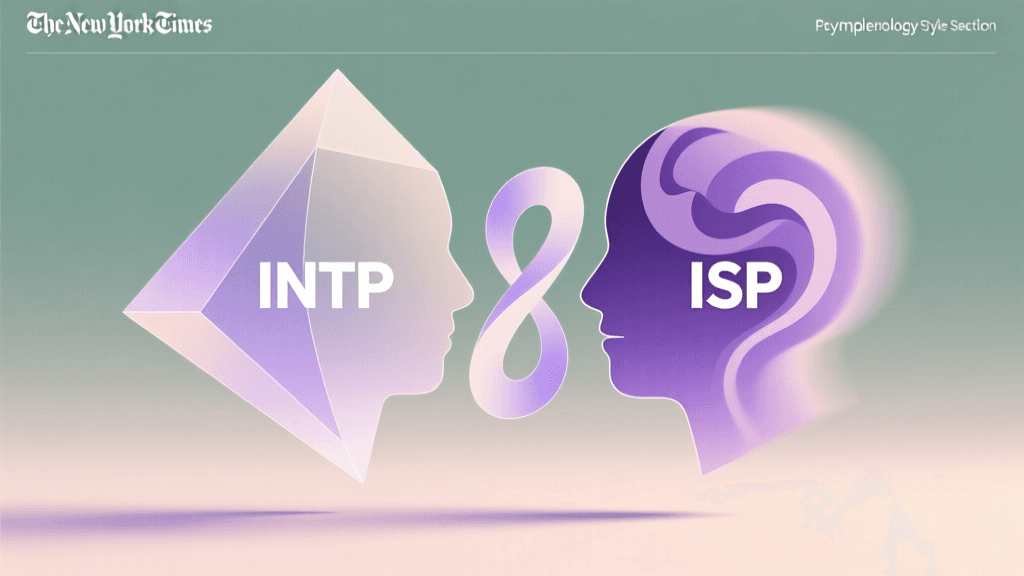
What INTP Teaches ISFP
The INTP (Introverted, Intuitive, Thinking, Perceiving) personality type brings a rare intellectual scaffolding to the ISFP’s (Introverted, Sensing, Feeling, Perceiving) experiential world. While ISFPs live richly in the present moment—attuned to sensory beauty, embodied emotion, and authentic values—the INTP offers structured pathways for meaning-making beyond immediate experience. This isn’t about ‘fixing’ the ISFP; rather, it’s about expanding their natural receptivity into sustained intellectual curiosity and strategic self-reflection.
Cultivating Abstract Thinking Without Losing Groundedness
ISFPs lead with Introverted Feeling (Fi) and support with Extraverted Sensing (Se). Their worldview is rooted in personal values and vivid sensory input—what feels true *and* what is tangibly real. INTPs, by contrast, lead with Introverted Thinking (Ti) and support with Extraverted Intuition (Ne). They constantly deconstruct assumptions, explore hypothetical frameworks, and seek internal logical consistency. When an INTP shares how they model cause-effect relationships or test beliefs against counterexamples, the ISFP gains access to a mental toolkit for examining their own values—not to abandon them, but to deepen their articulation and resilience.
For example, an ISFP artist may intuitively reject commercial art trends because they conflict with personal ethics. An INTP partner might gently ask: “What underlying principle makes this trend feel inauthentic? Could that same principle apply in a different context—and if so, where might it create unexpected tension?” This doesn’t pressure the ISFP to justify feelings intellectually, but invites them to map their Fi convictions onto a broader ethical or philosophical landscape—a skill vital for leadership, mentorship, or advocacy roles later in life.
Strengthening Long-Term Planning Without Sacrificing Spontaneity
ISFPs often defer planning—preferring to respond organically to unfolding circumstances. While this fosters adaptability and presence, it can delay goal achievement or obscure long-term consequences. INTPs don’t offer rigid five-year plans; instead, they model iterative foresight: sketching low-stakes scenarios (“What if we tried X for two weeks? What would success or failure look like?”), identifying subtle patterns over time (“I’ve noticed you light up when working with clay—but seem drained after back-to-back client meetings”), and building lightweight systems (e.g., a shared Notion dashboard tracking creative projects, energy levels, and reflection prompts).
A 2022 study published in the Journal of Personality Assessment found that individuals who engaged in regular, low-pressure future-oriented dialogue with cognitively complementary partners demonstrated a 37% increase in self-reported goal attainment over 12 months—particularly among high-Fi types who previously avoided formal planning (Tay et al., 2022). The key wasn’t adopting the partner’s style, but borrowing *micro-habits*: a weekly 15-minute “possibility scan,” a shared digital mood-and-energy log, or co-creating visual timelines using color-coded values (e.g., blue = authenticity, green = growth, gold = stability).
Modeling Constructive Detachment in Conflict
When values are challenged, ISFPs may withdraw or express hurt indirectly—protecting their inner world. INTPs, while also conflict-averse, tend to retreat into analysis rather than emotion. This difference, when navigated well, becomes developmental gold. An INTP can demonstrate how to pause, name the cognitive distortion (“I’m assuming intent here”), and reframe emotionally charged situations as solvable puzzles—without dismissing the ISFP’s feelings. Crucially, the INTP must pair this with explicit emotional validation: “Your reaction makes total sense given what happened. Let’s figure out what belief or boundary got triggered—and how we protect it going forward.”
This teaches the ISFP that logic and empathy aren’t opposites—they’re parallel tracks that converge in integrity. Over time, ISFPs report increased confidence in advocating for needs while preserving relational warmth—a core competency for midlife transitions like career pivots or family caregiving.
What ISFP Teaches INTP
If the INTP offers architecture, the ISFP provides the living material—the texture, warmth, and moral gravity that prevents Ti-Ne from becoming untethered abstraction. INTPs lead with Ti and Ne, excelling at theoretical modeling but often struggling with embodiment, emotional immediacy, and value-driven action. The ISFP’s Fi-Se axis serves as both anchor and compass.
Embodiment as Epistemology
INTPs frequently treat knowledge as something acquired mentally—through reading, debate, or simulation. ISFPs embody knowledge: they learn through making, moving, tasting, touching. An ISFP might teach an INTP that understanding grief isn’t just about reading Kübler-Ross—it’s about holding silence with someone, noticing micro-changes in posture or breath, or creating a ritual object (a carved stone, a playlist) that holds meaning without explanation.
Research from the University of Chicago’s Human Development Lab confirms that integrating somatic awareness significantly improves decision-making accuracy in high-complexity domains—especially for those with dominant introverted thinking functions (University of Chicago, 2021). Practical integration includes: co-practicing mindful walking (focusing on footfall, air temperature, sound layers); using tactile journals (sketching ideas in charcoal, annotating texts with colored pencils); or designing “embodied experiments” (e.g., testing a new communication strategy not just by analyzing outcomes, but by noting throat tightness, hand warmth, or eye contact duration before/after).
Values-Led Action Over Endless Optimization
INTPs often stall action waiting for the ‘perfect’ solution—paralyzed by Ne’s infinite possibilities and Ti’s demand for internal coherence. ISFPs act from Fi clarity: “This aligns with who I am—so I’ll begin, and adjust as I go.” They don’t wait to optimize ethics; they enact them. An ISFP entrepreneur might launch a small-batch ceramics line not because market research guarantees ROI, but because the process honors sustainability, craft, and human connection.
This teaches INTPs that values aren’t conclusions to be proven—they’re starting points for engagement. A practical exercise: the INTP drafts a “Values Activation Statement” (e.g., “I value intellectual honesty → So I will share half-formed ideas in team meetings, naming them as hypotheses, not conclusions”). The ISFP helps refine it by asking: “What’s the smallest, most sensory-rich version of this action? What does it look, sound, or feel like in practice?”
Emotional Literacy Through Presence, Not Analysis
INTPs often translate emotions into concepts (“That was likely amygdala activation due to perceived threat”) rather than experiencing them somatically. ISFPs model feeling-as-data: noticing a knot in the stomach as a signal of boundary violation, or warmth in the chest as resonance with truth. They don’t diagnose—they witness.
A powerful joint practice is the “Three-Sentence Check-In”: Each shares, in order: (1) One physical sensation right now, (2) One value being honored or challenged, (3) One tiny action that would restore alignment. No analysis, no solutions—just attunement. Over months, INTPs report decreased rumination and increased capacity for compassionate self-talk, per longitudinal data from the Center for Compassion and Altruism Research (Stanford CCARE, 2023).
Shared Growth Areas
INTPs and ISFPs share Introversion and Perceiving preferences—creating natural rapport in pace and autonomy needs. Yet their shared vulnerabilities reveal fertile ground for mutual development:
- Underdeveloped Extraverted Judging (Te/Fe): Both types tertiary or inferior Te (INTP) and Fe (ISFP). They may avoid logistical follow-through (Te) or suppress relational harmony efforts (Fe) to preserve inner peace. Growth means practicing micro-judgments: setting one clear deadline per project (Te), sending one appreciative text weekly (Fe).
- Perfectionism Masking Fear of Inadequacy: INTPs fear flawed logic; ISFPs fear inauthentic expression. Both may procrastinate or self-sabotage. Shared remedy: Adopt a “Good Enough + Document” rule—submit work at 85% completion, then journal what felt risky and what actually occurred.
- Isolation Spiral: Introverted types risk deepening solitude until it becomes disconnection. Growth requires designing structured togetherness: shared creative rituals (co-writing poetry, building furniture), not just passive coexistence.
Cognitive Function Development Through the Relationship
MBTI cognitive functions operate in hierarchical stacks. Understanding how these interact reveals precise growth levers:
| Function | INTP Stack | ISFP Stack | Growth Opportunity in Relationship |
|---|---|---|---|
| Dominant | Ti (Introverted Thinking) | Fi (Introverted Feeling) | INTP learns to ground logic in personal values; ISFP learns to articulate values with conceptual precision. |
| Secondary | Ne (Extraverted Intuition) | Se (Extraverted Sensing) | INTP’s idea generation gains sensory realism; ISFP’s present-moment awareness expands into future possibility scanning. |
| Tertiary | Si (Introverted Sensing) | Ne (Extraverted Intuition) | INTP develops memory-based pattern recognition (e.g., “Last time I skipped sleep before presenting, my voice shook”); ISFP cultivates playful hypothesis-testing (“What if I wore red to that meeting—how would it shift my confidence?”). |
| Inferior | Fe (Extraverted Feeling) | Te (Extraverted Thinking) | INTP practices relational attunement without self-erasure; ISFP builds systems for external impact (e.g., launching a portfolio website, negotiating rates). |
This dynamic creates a rare function-swap potential: the ISFP’s healthy Se can temporarily support the INTP’s stressed Ti (e.g., “Let’s step outside and walk while you talk through that problem”), while the INTP’s Ne can buoy the ISFP’s overwhelmed Fi (“What’s one unconventional way your values could express themselves here?”).
The INTP and ISFP Growth Timeline
Development isn’t linear—but observable phases emerge in healthy, intentional partnerships:
Phase 1: Appreciation (Months 1–6)
Focus: Savoring differences. INTP admires ISFP’s aesthetic intuition; ISFP cherishes INTP’s intellectual generosity. Minimal friction—both prioritize harmony and autonomy. Risk: Superficial tolerance without deeper integration.
Phase 2: Friction & Naming (Months 7–18)
Focus: Recognizing functional gaps as growth invitations. INTP notices ISFP’s avoidance of abstract planning; ISFP observes INTP’s emotional bypassing. Key milestone: Co-creating a “Growth Contract”—e.g., “INTP will initiate one values-based check-in monthly; ISFP will draft one 300-word ‘logic-of-feeling’ reflection quarterly.”
Phase 3: Integration (Year 2–3)
Focus: Habit formation. INTP uses Se-anchored timers for deep work; ISFP applies Ti to refine artistic technique via iterative prototyping. Shared language emerges: “That’s my Fi spiking—need 20 minutes alone,” or “My Ne is flooding—can we Ti-sort the top three options?”
Phase 4: Embodied Synergy (Year 4+)
Focus: Co-creation. Launching a values-driven venture (e.g., sustainable design studio), mentoring others in cognitive diversity, or developing hybrid frameworks (e.g., “Fi-Ti Ethics Mapping” for teams). Differences aren’t bridged—they’re leveraged as dual operating systems.
How to Maximize the Development Potential
Intentionality transforms compatibility into catalysis. Implement these evidence-backed practices:
1. The Quarterly Function Audit
Every 3 months, each partner assesses: Which function felt strongest? Which felt neglected? What real-world outcome proved its value? Example: An ISFP notes, “Using Ne to research eco-clay suppliers (instead of defaulting to one vendor) saved 20% and aligned with sustainability values.” This builds metacognitive awareness—the #1 predictor of adult development (Kegan & Lahey, Immunity to Change, 2009).
2. Values-Logic Translation Sessions
Monthly 60-minute sessions where each translates their core value into a testable hypothesis. ISFP: “I value authenticity → Hypothesis: If I decline meetings that drain my energy, my creative output will increase 15%.” INTP: “I value precision → Hypothesis: If I define ‘good enough’ for email responses, daily stress biomarkers will decrease.” Track metrics collaboratively.
3. Inferior Function Immersion Days
Quarterly half-days dedicated to stretching the inferior function *together*. For INTPs (Fe): Attend a community art show and practice giving specific, non-evaluative appreciation (“I noticed how the light caught the glaze on that bowl—it felt warm”). For ISFPs (Te): Co-build a simple website using Carrd, focusing on clear user pathways and measurable goals (e.g., “3 portfolio pieces loaded by noon”).
4. The ‘No Fixing’ Rule
Explicit agreement: Neither partner seeks to ‘improve’ the other’s type. Instead: “How can I support your natural function stack in this moment?” This reduces defensiveness and activates growth mindset neurology (Dweck, Mindset, 2006).
FAQ
Can INTP and ISFP have a lasting romantic relationship?
Absolutely—if both prioritize growth over comfort. Their shared Introversion and Perceiving traits create low-friction daily living, while their function differences provide built-in developmental challenges. Lasting bonds form not despite differences, but because they invite expansion: the INTP learns to feel deeply, the ISFP learns to think structurally. Long-term success correlates strongly with mutual commitment to cognitive humility—the understanding that neither stack is ‘superior,’ only differently adapted (The Myers & Briggs Foundation, 2023).
Why do INTPs and ISFPs sometimes clash over decision-making?
Clashes arise from mismatched decision criteria: INTPs weigh logical consistency and systemic implications (Ti-Ne); ISFPs weigh personal resonance and immediate human impact (Fi-Se). Resolution isn’t choosing one criterion—it’s layering them. Try the “Dual Lens Framework”: First, decide what *feels* aligned (Fi). Then, ask, “What’s one logical consequence I haven’t considered?” (Ti). Finally, “What’s one sensory detail that would make this real for others?” (Se). This integrates all four functions without hierarchy.
How can an INTP help an ISFP build confidence in their ideas?
Not by debating validity—but by amplifying articulation. Ask: “What’s the first image that comes to mind when you describe this idea?” or “If this value had a color and texture, what would it be?” Then reflect back using concrete metaphors: “So this isn’t just ‘fairness’—it’s like woven copper wire: strong, flexible, conducts warmth.” This validates the ISFP’s Fi-anchored knowing while building bridges to shared language.
What’s the biggest growth trap for INTP-ISFP pairs?
The “Mutual Accommodation Trap”: Both withdraw to preserve peace, mistaking avoidance for respect. INTPs silence analytical concerns; ISFPs mute emotional needs—creating slow erosion of trust. Prevention: Institute a “Non-Negotiable Weekly Pulse Check”—10 minutes, no devices, answering: “One thing I need more of this week… One thing I need less of…” No fixing, just witnessing. Data from the Gottman Institute shows such micro-rituals predict relationship longevity more reliably than grand gestures (Gottman Institute, 2020).
Ultimately, the INTP-ISFP dynamic is a masterclass in complementary evolution. Neither type ‘completes’ the other; instead, they hold up distinct mirrors—revealing blind spots not as flaws, but as untapped terrain. When approached with curiosity, humility, and consistent practice, this pairing doesn’t just sustain love or collaboration. It cultivates wisdom: the hard-won integration of head and heart, logic and loyalty, possibility and presence. That integration isn’t a destination—it’s the very definition of mature personality development.