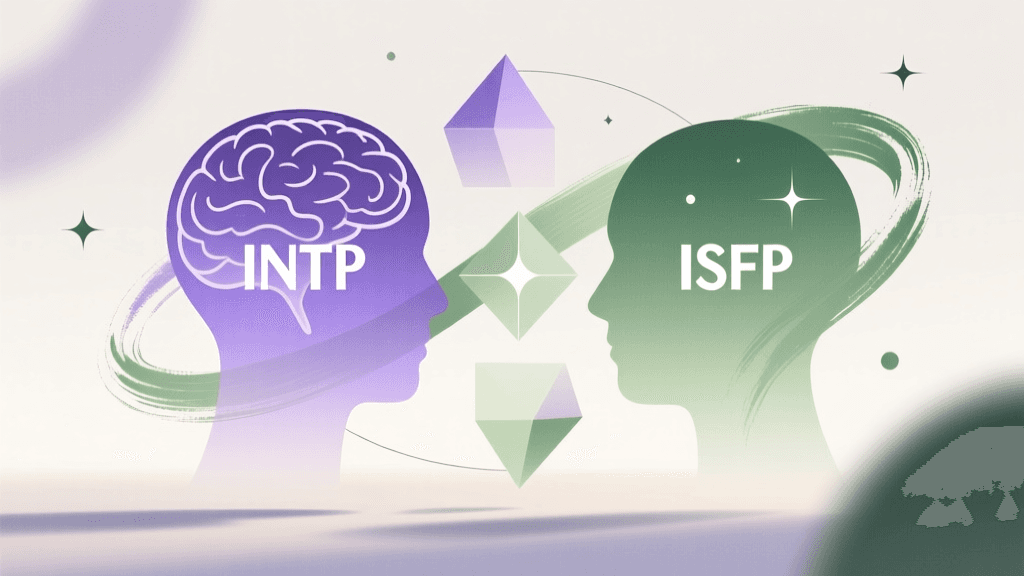
Why INTP and ISFP Click Romantically
The romantic pairing of the INTP (The Logician) and ISFP (The Composer) is often described as an unexpected yet deeply harmonious match—a quiet symphony of intellect and intuition, analysis and artistry. At first glance, their cognitive functions appear divergent: the INTP leads with Introverted Thinking (Ti) and supports with Extraverted Intuition (Ne), while the ISFP leads with Introverted Feeling (Fi) and supports with Extraverted Sensing (Se). Yet it’s precisely this functional complementarity—not similarity—that fuels their romantic magnetism.
Where the INTP seeks internal logical consistency and conceptual coherence, the ISFP cultivates authentic emotional alignment and embodied presence. This creates a rare dynamic: the INTP feels emotionally ‘safe’ because the ISFP rarely demands overt emotional performance or rapid verbal processing; instead, they offer warmth through consistent, gentle presence and sensory attunement—holding space without pressure. Conversely, the ISFP finds intellectual stimulation in the INTP’s curiosity and nonjudgmental openness to ideas, which affirms their inner values without demanding ideological conformity.
Research on attachment and personality suggests that secure or anxious-preoccupied individuals often pair successfully with partners who provide regulatory balance. A 2021 study published in the Journal of Personality found that individuals high in Openness to Experience (a trait strongly associated with both INTP and ISFP types) demonstrated greater relational flexibility and lower defensiveness when navigating emotional differences—especially when one partner emphasized cognitive exploration (INTP) and the other embodied affective authenticity (ISFP).
Crucially, both types share introversion, perceiving orientation, and a deep aversion to artificiality or social performance. They value autonomy, despise manipulation, and reject rigid relationship scripts. This shared foundational ethos—what psychologist John M. Grohol calls the ‘authenticity imperative’ in modern intimate partnerships—creates immediate resonance. As noted by the Myers & Briggs Foundation, perceiving types tend to approach relationships as evolving processes rather than fixed contracts, allowing INTP–ISFP couples room to grow organically without premature commitment pressure.
Their love languages further reinforce compatibility. While neither type naturally defaults to Words of Affirmation (often overused and insincere-feeling), both express devotion through Acts of Service and Quality Time—though interpreted differently. The INTP shows love by solving problems quietly (e.g., fixing a leaky faucet without being asked, researching the best ergonomic chair for their partner’s home office). The ISFP expresses care through tactile, present-moment attentiveness: preparing a favorite meal with mindful attention, arranging wildflowers picked on a walk, or sitting silently side-by-side while sketching or reading. These gestures align seamlessly—neither feels burdened by performative romance nor starved of meaning.
Where Romantic Friction Arises
Despite strong underlying compatibility, INTP–ISFP romantic friction emerges not from incompatibility—but from mismatched pacing, unspoken expectations, and divergent conflict reflexes. Understanding these fault lines is essential to prevent slow erosion of trust.
Emotional Processing Speed & Expression
The INTP processes emotions retrospectively and analytically. When hurt or confused, they withdraw to map cause-effect chains, identify logical inconsistencies in the interaction, and reframe the experience intellectually before returning. To the ISFP, this looks like emotional abandonment—especially if the withdrawal lasts more than 24–48 hours. The ISFP, by contrast, experiences emotion in real time and somatically: a tightening chest, flushed cheeks, or sudden fatigue signal distress long before words form. Their instinct is to seek proximity, gentle touch, or shared silence—not debate. When the INTP responds with a dispassionate analysis (“Let me explain why your comment triggered my inferior Fe…”), the ISFP feels invalidated—not heard.
Attachment Style Tensions
While both types can develop secure attachment, their default tendencies lean toward different insecure patterns under stress. INTPs are prone to avoidant-dismissive attachment, especially when overwhelmed by perceived emotional demands. They may minimize feelings (“It’s not a big deal”), intellectualize pain (“This is just a data point about human irrationality”), or retreat into theoretical abstraction. ISFPs, meanwhile, often exhibit anxious-preoccupied tendencies when insecure—not out of neediness, but because Fi-driven authenticity makes them acutely sensitive to relational misalignment. They may interpret the INTP’s silence as rejection, prompting subtle testing behaviors (e.g., withdrawing affection, making indirect comments about distance).
A landmark longitudinal study by the University of California, Davis, tracked 1,247 couples over seven years and found that partners whose primary coping strategies were cognitively detached versus affectively immersed experienced higher satisfaction only when explicit ‘processing agreements’ were established—such as “I need 90 minutes after a disagreement to reflect; I’ll text you when I’m ready to reconnect.” Without such scaffolding, small ruptures compound.
Decision-Making Dissonance
In daily life, the INTP asks, “What principle applies here?” while the ISFP asks, “What feels true *right now*?” This divergence surfaces in practical domains: choosing where to live (INTP weighs cost-of-living algorithms and transit efficiency; ISFP senses which neighborhood ‘holds breath’), planning vacations (INTP builds multi-layered itineraries with backup options; ISFP prefers open-ended road trips guided by mood and weather), or handling finances (INTP optimizes for long-term systemic stability; ISFP prioritizes present-moment security and aesthetic comfort).
Love Language Misfires
Both value Quality Time—but define it differently. The INTP’s ideal quality time is co-working in parallel silence, punctuated by spontaneous idea-sharing. The ISFP’s is sensory co-presence: cooking together, walking barefoot in grass, listening to vinyl with eyes closed. When the INTP assumes their silent coding session counts as bonding—and the ISFP feels unseen because no shared sensory ritual occurred—resentment accrues invisibly.
INTP and ISFP in a Romantic Relationship: Early, Mid, and Long-Term Stages
Early Stage (0–6 Months): The Quiet Infatuation Phase
This stage thrives on mutual fascination and low-pressure exploration. Initial attraction is often aesthetic and intellectual: the ISFP admires the INTP’s quick wit, dry humor, and unselfconscious eccentricity; the INTP is drawn to the ISFP’s calm intensity, physical grace, and uncanny perceptiveness about unspoken moods. Dates are low-stakes and sensory-rich: visiting indie bookstores, attending experimental film screenings, stargazing with thermoses of herbal tea. Communication is light but meaningful—no forced small talk, no performative dating rituals.
Actionable Tip: Establish a ‘soft check-in’ ritual within the first month—e.g., Sunday morning coffee where each shares one thing they appreciated last week (not praise, but specific observation: “I loved how you noticed my stress and brought me chamomile without asking”). This builds emotional muscle without demanding vulnerability.
Mid-Stage (6–24 Months): Navigating Depth & Differentiation
As intimacy deepens, differences in emotional rhythm surface. The INTP may begin analyzing relationship patterns (“Are we optimizing for mutual growth?”), while the ISFP notices subtle shifts in atmosphere (“You’ve been quieter since your presentation—your shoulders tense when you talk about work”). Conflicts arise less from disagreement and more from temporal mismatch: the INTP needs time to process; the ISFP needs timely attunement. Unresolved, this breeds quiet distance—INTP buries themselves in a new coding project; ISFP immerses in pottery or hiking alone.
This phase demands intentional scaffolding. Couples who succeed implement what therapist Esther Perel calls ‘structured spontaneity’: agreed-upon rhythms that honor both needs. For example:
- ‘Reconnect Windows’: 20-minute phone-free windows twice weekly—no agenda, just presence (ISFP’s need met).
- ‘Processing Pauses’: INTP signals withdrawal with a phrase like, “My brain’s buffering—I’ll circle back in 3 hours,” and follows through (INTP’s need honored).
- ‘Values Alignment Reviews’: Quarterly 90-minute conversations using prompts like, “What’s one value we’re living well? One we’re compromising?” (Leverages Ti + Fi synergy).
Long-Term Stage (2+ Years): Co-Creating a Shared Aesthetic of Meaning
At this stage, successful INTP–ISFP couples don’t ‘resolve’ their differences—they compose with them. Their home becomes a living archive of shared meaning: shelves holding INTP’s annotated philosophy texts beside ISFP’s hand-thrown mugs; playlists blending ambient electronica (INTP) and acoustic folk (ISFP); weekend rituals alternating between museum visits (Ne + Se) and forest bathing (Fi + Se). They develop a hybrid language: the INTP learns to say, “I felt unsettled when X happened—I’m still sorting why,” instead of launching into causal analysis; the ISFP practices naming sensations (“My chest felt tight”) before interpreting meaning.
Longevity hinges on protecting three pillars:
• Autonomy Sanctuaries: Non-negotiable solo time (e.g., INTP’s Tuesday night robotics club; ISFP’s Thursday morning ceramics studio).
• Shared Creation Projects: Low-stakes collaborative acts—building a rain garden, co-writing speculative fiction, restoring vintage furniture.
• Embodied Rituals: Weekly walks without phones, monthly ‘sensory dinners’ (each prepares one dish focusing solely on texture/aroma/color).
INTP and ISFP as Friends
Friendship between INTP and ISFP is often more effortless than romance—precisely because it lacks the pressure of emotional reciprocity expectations. They bond over shared disdain for pretense, love of obscure knowledge (INTP’s deep dives into quantum biology meet ISFP’s fascination with traditional textile dye chemistry), and appreciation for understated beauty.
The INTP admires the ISFP’s perceptual acuity—their ability to notice micro-expressions, architectural details, or shifts in light that others miss. The ISFP treasures the INTP’s intellectual generosity: never condescending, always eager to explore tangents, and utterly non-judgmental of unconventional interests. Their hangouts are inherently low-demand: browsing antique shops, watching documentaries with insightful commentary, or sitting in companionable silence while the INTP sketches logic diagrams and the ISFP sketches the café patrons.
Unlike romantic dynamics, friendship rarely triggers their weaker functions (INTP’s inferior Fe or ISFP’s inferior Te). There’s no expectation to ‘manage’ each other’s emotional states—making this one of the MBTI’s most restorative cross-type friendships.
INTP and ISFP at Work
In professional settings, INTP and ISFP make a quietly formidable pair—especially in creative, research-oriented, or user-centered fields (UX design, environmental science, indie game development, archival restoration). Their collaboration succeeds when roles leverage innate strengths:
| Domain | INTP Contribution | ISFP Contribution | Synergy Example |
|---|---|---|---|
| Problem Analysis | Identifies systemic root causes, models variables, anticipates edge cases | Notices real-world usage friction, emotional impact on users, contextual constraints | Designing accessible public transit: INTP models rider flow algorithms; ISFP observes how elderly riders navigate signage/tactile cues |
| Creative Development | Generates abstract concepts, theoretical frameworks, ‘what-if’ scenarios | Translates concepts into tangible form, refines aesthetics, ensures human resonance | Developing an educational app: INTP designs adaptive learning theory; ISFP crafts intuitive UI animations and empathetic microcopy |
| Execution & Refinement | Optimizes processes, troubleshoots technical flaws, documents logic | Attends to sensory details, user feedback nuance, iterative polish | Launching a sustainable product line: INTP audits supply chain ethics; ISFP sources natural dyes and tests fabric drape/wear |
Friction arises in hierarchical or deadline-driven environments. INTPs may frustrate teams by questioning mandates (“Why does this KPI measure what matters?”); ISFPs may seem ‘unfocused’ when prioritizing human impact over metrics. Together, they’re most effective in flat-structure teams with mission-driven autonomy—where their shared integrity and distaste for bureaucratic theater become assets.
Tips for INTP and ISFP Compatibility
These aren’t generic advice—they’re functionally precise interventions grounded in Ti-Fi-Ne-Se interplay:
1. Build a ‘Feeling Vocabulary’ Together
INTPs rarely practice naming emotions beyond ‘frustrated’ or ‘curious.’ ISFPs feel deeply but may lack frameworks to articulate nuances. Create a shared journal titled “The Texture Dictionary” with entries like:
• ‘Velvet Anxiety’: Soft, persistent unease (ISFP) → INTP maps possible triggers (schedule change? unspoken expectation?)
• ‘Static Clarity’: Sudden insight amid mental noise (INTP) → ISFP translates to sensory anchor (e.g., “That’s the feeling of cold river water on wrists”)
2. Design Dual-Mode Conflict Protocols
Agree on two pathways:
• ‘Fi-First Mode’: For immediate hurts—ISFP speaks first in sensory/emotional terms (“When you canceled plans, my throat tightened and I stared at the rain”). INTP listens without fixing, then reflects: “So you needed reliability and felt unseen.”
• Ti-First Mode’: For systemic issues—INTP writes a brief analysis (“Three incidents suggest our planning system fails under uncertainty”). ISFP responds with embodied impact: “Reading this, my shoulders relaxed—I feel heard in the pattern.”
3. Ritualize ‘Sensory Synchrony’
Weekly 30-minute activities engaging shared Se: blindfolded taste tests, cloud-watching while describing shapes, rearranging a shelf by color temperature. This builds non-verbal attunement—bypassing Ti/Fi translation gaps.
4. Protect Fi Integrity with Ti Boundaries
INTPs must verbally affirm ISFP values *before* proposing changes: “I love how you prioritize kindness in tough calls. If we shift client intake, how do we keep that core intact?” This validates Fi sovereignty while inviting Ti collaboration.
5. Co-Create ‘Future Anchors’
INTPs generate endless possibilities (Ne); ISFPs ground in present reality (Se). Jointly build ‘anchor points’—concrete, sensory-rich visions of desired futures: “Our 5-year cabin has pine-scented air, a library nook with floor cushions, and a porch swing facing west.” Revisiting these prevents Ne overwhelm and honors Fi’s need for authentic direction.
FAQ
Can INTP and ISFP have a secure attachment style together?
Yes—absolutely. Security isn’t about identical attachment histories, but about co-regulation capacity. Research from the Center for Attachment Research confirms that partners with complementary regulation styles (cognitive vs. somatic) achieve secure attachment faster when they learn each other’s ‘repair signals.’ For INTP–ISFP, this means the INTP recognizing the ISFP’s subtle withdrawal as a request for gentle reconnection—not space—and the ISFP learning the INTP’s ‘thinking pause’ as engagement, not rejection. Consistent, predictable responses to distress build earned security over time.
Do INTP and ISFP share similar love languages?
They share two core languages—Quality Time and Acts of Service—but express them through different sensory channels. INTP’s Quality Time is cerebral coexistence; ISFP’s is embodied co-presence. INTP’s Acts of Service solve abstract problems (debugging code, optimizing schedules); ISFP’s attend to physical/emotional comfort (massaging tired shoulders, creating calming playlists). The key is translating—e.g., the INTP accompanies the ISFP on a hike *without headphones*, noticing birdsong; the ISFP helps the INTP organize their research library *by conceptual category*, not just alphabetically.
How do INTP and ISFP handle major life decisions (moving, marriage, kids)?
They thrive when decisions integrate both perspectives: the INTP maps long-term implications (financial sustainability, intellectual stimulation, systemic impact), while the ISFP assesses visceral resonance (“Does this neighborhood feel safe in my bones? Will this school nurture creativity, not just metrics?”). A proven method is the ‘Dual-Column Decision Journal’: left column = INTP’s analysis (pros/cons, risk assessment, values alignment); right column = ISFP’s sensory-emotional inventory (“First image that came to mind: dusty attic or sunlit porch?”). Reviewing both columns reveals hidden misalignments—or profound harmony.
What’s the biggest myth about INTP–ISFP relationships?
The myth is that they’re “too different to last.” In reality, their differences are complementary regulatory systems. As neuroscientist Dr. Dan Siegel explains in The Developing Mind, healthy relationships require partners who can ‘borrow’ each other’s neural strengths—INTPs borrow the ISFP’s somatic awareness to ground anxiety; ISFPs borrow the INTP’s cognitive reframing to soften emotional overwhelm. Their longevity isn’t despite differences—it’s because of them.