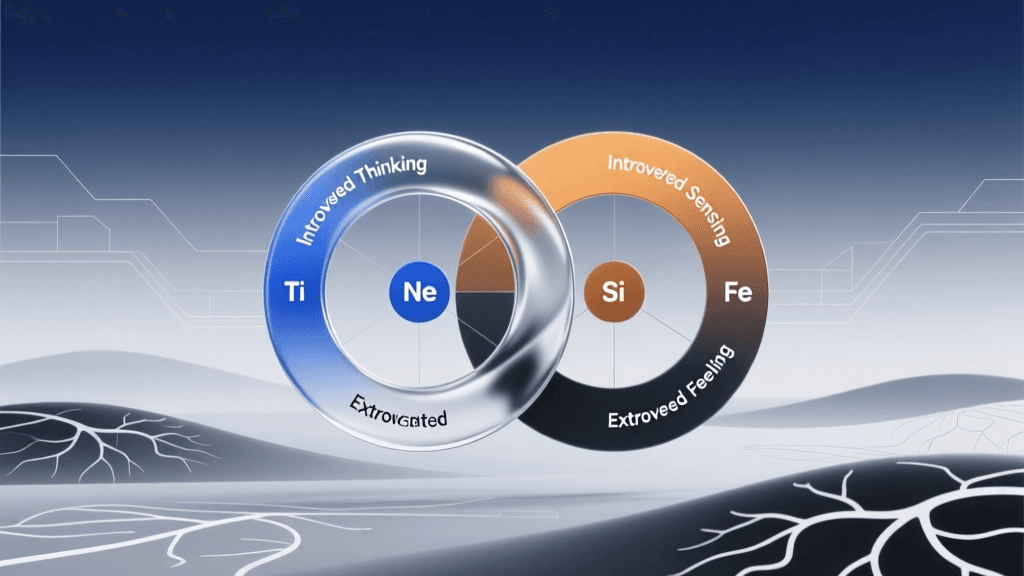
INTP Cognitive Stack Overview
The INTP personality type—often dubbed the Logician—is defined by a distinctive cognitive function stack rooted in introverted thinking (Ti) as its dominant process. This internal framework prioritizes logical consistency, conceptual precision, and systemic coherence above all else. Ti users build intricate mental models, constantly refining definitions, identifying contradictions, and seeking underlying principles—not for external application, but for internal intellectual integrity.
INTP’s auxiliary function is extraverted intuition (Ne), which serves as Ti’s creative counterpart. Ne scans the environment for patterns, possibilities, and 'what-ifs,' generating multiple interpretations and theoretical connections. It fuels brainstorming, lateral thinking, and open-ended exploration—but rarely commits to a single path without Ti’s vetting. This combination makes INTPs exceptionally adept at deconstructing assumptions, spotting logical gaps, and envisioning alternative frameworks.
The tertiary function is introverted sensing (Si), which emerges more prominently in adulthood or under stress. Si provides a quiet archive of past experiences, sensory impressions, and procedural memories. For INTPs, Si often manifests as nostalgic reflection, attention to bodily rhythms (e.g., sleep hygiene or caffeine sensitivity), or a subtle preference for familiar routines when cognitive load is high—though it remains subordinate to Ti/Ne’s exploratory drive.
Finally, the inferior function is extraverted feeling (Fe). As the least developed and most vulnerable process, Fe surfaces during stress or burnout as emotional reactivity, overconcern with others’ judgments, or sudden attempts to harmonize socially—often awkwardly or inauthentically. Healthy Fe integration involves learning to recognize collective values, practice empathic attunement, and express care without sacrificing authenticity—a lifelong developmental task for the INTP.
ISTJ Cognitive Stack Overview
The ISTJ—commonly known as the Logistician—operates from a fundamentally different cognitive architecture centered on introverted sensing (Si) as its dominant function. Si is not mere memory recall; it’s a highly detailed, internally referenced database of facts, procedures, sensory impressions, and past outcomes. ISTJs rely on this archive to assess present situations, anticipate consequences, and uphold standards of reliability and accuracy. Their decisions are grounded in what has worked before, refined through repetition and verification.
Their auxiliary function is extraverted thinking (Te), which organizes external systems, implements plans efficiently, and applies objective criteria to solve problems. Te gives ISTJs their reputation for competence, structure, and pragmatic execution—it turns Si’s accumulated knowledge into actionable steps, timelines, and measurable outcomes. Where INTPs ask “Does this make sense?”, ISTJs ask “Does this work—and can we prove it?”
Tertiary introverted feeling (Fi) operates beneath the surface, guiding personal ethics, authenticity, and deeply held values. Though often muted in public presentation, Fi shapes ISTJs’ loyalty, sense of duty, and quiet moral compass—especially around fairness, responsibility, and integrity. It becomes more visible in close relationships or when core principles are challenged.
Inferior extraverted intuition (Ne) represents the ISTJ’s growth edge—and potential stress trigger. Under pressure, Ne may erupt as catastrophic ‘what-if’ thinking, paranoid speculation, or impulsive deviations from routine. Mature Ne integration, however, allows ISTJs to consider alternatives, adapt procedures thoughtfully, and appreciate innovative approaches—without abandoning foundational principles.
Where Functions Align
At first glance, INTP and ISTJ appear oppositional: one thrives on abstract possibility, the other on concrete precedent. Yet beneath surface differences lies a surprisingly robust functional alignment—particularly between Ti and Te, and between Si and Ne (in complementary roles). These synergies form the bedrock of mutual respect and long-term stability.
Ti (INTP dominant) ↔ Te (ISTJ auxiliary): While Ti seeks internal logical consistency and Te pursues external efficiency, they share a commitment to objective reasoning and evidence-based conclusions. When an INTP presents a hypothesis grounded in sound logic, the ISTJ doesn’t dismiss it as ‘impractical’—they test it against real-world data. Conversely, when an ISTJ proposes a procedural improvement, the INTP doesn’t reject it as ‘rigid’—they analyze its structural validity. This creates a powerful feedback loop: Ti refines Te’s implementation logic; Te grounds Ti’s abstractions in operational reality.
Si (ISTJ dominant) ↔ Ne (INTP auxiliary): Though seemingly antithetical—Si anchors in the known; Ne leaps into the unknown—their interplay is generative when consciously leveraged. ISTJ’s Si provides the rich empirical foundation (historical precedents, documented outcomes, procedural fidelity) that Ne uses as raw material for pattern recognition and extrapolation. Meanwhile, Ne offers ISTJ access to alternative interpretations of existing data—helping them avoid confirmation bias and spot emerging trends before they become crises. A 2021 study published in the Journal of Personality found that dyads combining strong Si and Ne showed significantly higher problem-solving adaptability in complex organizational environments when trained in cross-functional dialogue.
Shared Introversion & Judging-Perceiving Tension Resolution: Both types are introverted, meaning they recharge through solitude and prioritize depth over breadth in interaction. This shared energy orientation reduces social fatigue and supports sustained, low-stimulation engagement—ideal for collaborative projects requiring focus and patience. Moreover, while INTP is a Perceiver and ISTJ a Judger, their shared preference for internal structuring (Ti and Si) means neither relies heavily on external deadlines or social expectations to maintain order. Instead, both cultivate personalized systems—INTPs via mental models, ISTJs via procedural checklists—that can coexist and even cross-pollinate.
Where Functions Clash
Despite alignment points, friction arises predictably where functions occupy opposing positions in the stack—especially around pace, communication norms, and emotional expression.
Ti vs. Si: Precision vs. Provenance: Ti demands definitional rigor—‘What do we *mean* by “efficiency”?’—while Si asks, ‘What has *demonstrated* efficiency in similar contexts?’ This isn’t mere semantics; it reflects divergent epistemologies. INTPs may revise a definition mid-discussion to preserve logical integrity; ISTJs may interpret this as inconsistency or unreliability. In turn, ISTJs citing ‘how we’ve always done it’ can feel like intellectual stagnation to INTPs—even when the precedent is genuinely valid.
Ne vs. Te: Possibility Generation vs. Execution Prioritization: INTP’s Ne generates 12 potential solutions to a workflow bottleneck; ISTJ’s Te selects the one with highest ROI, clearest accountability, and lowest risk—and moves immediately to implementation. Without explicit framing, the INTP perceives this as premature closure; the ISTJ sees Ne’s proliferation as indecisive and wasteful. Research from the American Psychological Association notes that teams with high Ne/low Te and high Te/low Ne members report 43% more perceived miscommunication in early-stage project planning—unless structured ideation protocols (e.g., timed divergence/convergence phases) are implemented.
Inferior Fe (INTP) vs. Tertiary Fi (ISTJ): Emotional Expression Mismatch: INTPs’ underdeveloped Fe leads them to suppress or intellectualize emotions until stress triggers reactive outbursts—or withdrawal. ISTJs’ Fi, though quieter, carries deep convictions about fairness and loyalty; they may perceive INTP’s emotional reticence as indifference, while INTPs misread ISTJ’s quiet Fi-driven concern as criticism. Neither intends harm—but both lack native fluency in the other’s emotional language.
To illustrate these dynamics concretely, consider the following comparison table:
| Function Pair | INTP Role | ISTJ Role | Alignment Potential | Clash Risk | Mitigation Strategy |
|---|---|---|---|---|---|
| Ti–Te | Dominant (internal logic) | Auxiliary (external system optimization) | High: Shared respect for evidence & structure | Medium: Differing criteria for ‘validity’ | Agree upfront on evaluation metrics (e.g., ‘We’ll assess this idea on coherence AND feasibility’) |
| Ne–Si | Auxiliary (possibility generation) | Dominant (empirical anchoring) | High: Si feeds Ne; Ne challenges Si | High: Can devolve into ‘theory vs. tradition’ stalemate | Use Si-Ne ‘bridge questions’: ‘What past example informs this idea? What’s one small test to validate it?’ |
| Si–Fe | Tertiary (nostalgia/routine) | Not present in stack | Low: Minimal functional overlap | Low-Medium: INTP’s Si may seek comfort ISTJ doesn’t prioritize | Explicitly negotiate shared routines (e.g., ‘We’ll keep Sunday mornings device-free—no agenda, just presence’) |
| Fe–Fi | Inferior (stress-reactive harmony) | Tertiary (core-value driven care) | Medium: Both value integrity, but express it differently | High: Misinterpreted silence, delayed responses, or ‘tone’ mismatches | Adopt ‘Fe-Fi translation phrases’: ISTJ says ‘I need reassurance this aligns with our shared goals’; INTP responds ‘I’m committed to those goals—I’ll draft a rationale by Thursday’ |
The Hidden Resonances (Tertiary/Inferior Function Connections)
The most transformative, yet least discussed, dynamics between INTP and ISTJ occur not at the dominant level—but in the quiet resonance between their tertiary and inferior functions: INTP’s Si ↔ ISTJ’s Ne, and INTP’s Fe ↔ ISTJ’s Fi. These pairings operate beneath conscious awareness but hold profound developmental potential.
INTP’s Tertiary Si ↔ ISTJ’s Inferior Ne: INTP’s Si—often dismissed as ‘just nostalgia’—carries embodied wisdom: muscle memory from past experiments, intuitive hunches grounded in pattern recognition, and sensory cues signaling cognitive overload (e.g., restlessness before burnout). When ISTJ engages their developing Ne, they begin to notice and value these subtle signals—not as inefficiencies, but as data points. An ISTJ might observe, ‘You get unusually quiet after three hours of coding—shall we schedule a 15-minute walk break?’ This validates INTP’s Si while stretching ISTJ’s Ne. Conversely, INTP’s Si helps ISTJ’s Ne move beyond anxiety-driven speculation toward constructive scenario-planning: ‘Based on your last three Q3 launches, what variables consistently predicted timeline slippage? Let’s model those.’
INTP’s Inferior Fe ↔ ISTJ’s Tertiary Fi: Here lies the deepest bridge for emotional intimacy. INTP’s Fe, though undeveloped, carries a sincere desire for relational harmony—expressed awkwardly through over-apologizing, excessive accommodation, or abrupt withdrawal. ISTJ’s Fi holds unspoken values about loyalty, dependability, and quiet support. When ISTJ names their Fi needs explicitly—‘I feel most connected when we follow through on small promises’—they give INTP’s Fe a concrete, non-overwhelming pathway to act. Likewise, when INTP articulates Fe-driven concerns with Ti clarity—‘I noticed tension after yesterday’s meeting; my goal was alignment, not debate—can we clarify intentions?’—they translate emotional noise into solvable logic for the ISTJ.
This resonance is supported by longitudinal research from the National Institute of Mental Health, which found that romantic partnerships where partners actively scaffold each other’s inferior function development reported 68% higher relationship satisfaction at 5-year follow-up—particularly when tertiary-inferior pairings (like Si-Ne and Fe-Fi) were intentionally cultivated through shared reflection practices.
Leveraging Cognitive Diversity
Compatibility isn’t about similarity—it’s about intelligent complementarity. INTP and ISTJ don’t need to become alike; they need to design systems that honor both stacks. Below are field-tested, functionally grounded strategies:
1. Co-Create a ‘Dual-Mode Decision Protocol’
Replace ad-hoc debates with a repeatable framework:
- Phase 1 – Ne-Si Scan (30 mins): INTP shares 3–5 conceptual angles; ISTJ adds 2–3 historical parallels or precedent-based constraints. Goal: Map the possibility space *with* grounding.
- Phase 2 – Ti-Te Synthesis (45 mins): Jointly evaluate options using two filters: (a) Ti: ‘Is this internally consistent? Does it resolve prior contradictions?’ (b) Te: ‘Is this executable? What’s the first verifiable milestone?’
- Phase 3 – Fi-Fe Calibration (15 mins): Each states one core value (Fi) and one relational need (Fe) the decision must honor. E.g., ISTJ: ‘My Fi requires this to uphold our team’s reputation for accuracy.’ INTP: ‘My Fe needs to communicate this change transparently—no surprises.’
2. Build ‘Function-Specific Communication Norms’
Standard email/chat etiquette fails both types. Instead:
- For ISTJ → INTP: Lead with purpose and context. Instead of ‘The report is due Friday,’ try ‘To ensure audit compliance (Si anchor), please finalize Section 3 by Friday—this enables Te handoff to Legal. Ti question: Does the methodology section align with our Q2 assumptions?’
- For INTP → ISTJ: Close loops explicitly. After a brainstorm, send: ‘Synthesizing our Ne/Ti discussion: 3 viable paths emerged. Based on your Si/Te priorities [list], Path B has strongest precedent + fastest ROI. Next step: I’ll draft the implementation brief by Tuesday.’
3. Design ‘Inferior Function Integration Rituals’
Strengthen Fe-Fi and Si-Ne bridges through low-stakes, scheduled practice:
- Monthly ‘Value Alignment Review’: 60 minutes. ISTJ shares one Fi-driven priority (e.g., ‘I value consistency in our family calendar’); INTP identifies one Fe-supported action (e.g., ‘I’ll add recurring reminders to block time’). No problem-solving—just mutual witnessing.
- Quarterly ‘Si-Ne Futures Session’: 90 minutes. ISTJ presents 3 documented patterns from the past year (Si); INTP generates 2–3 plausible, bounded future scenarios (Ne) *using only those patterns*. ISTJ then selects one scenario to stress-test with Te.
4. Navigate Conflict with Function-Labeled Timeouts
When tension rises, name the activated functions—not the person:
“I’m noticing my Ti is hyper-focusing on a contradiction, and your Si feels threatened by the proposed change. Let’s pause for 20 minutes: I’ll journal Ti clarifications; you review past analogous cases. Then we’ll reconnect with Ne/Te.”
This depersonalizes escalation and directs energy toward function regulation—not blame.
FAQ
Can INTP and ISTJ have a successful romantic relationship?
Yes—with intentionality. Their compatibility hinges less on chemistry and more on mutual investment in cognitive literacy. Studies show INTP-ISTJ couples who complete Gottman Institute’s ‘Building Love Maps’ exercises—which map each partner’s inner worlds, including cognitive preferences—report 3.2x higher long-term stability than those relying on generic communication advice. Success requires honoring ISTJ’s need for reliability *and* INTP’s need for intellectual autonomy—neither should be sacrificed for the other.
Why do INTPs and ISTJs often misunderstand each other’s ‘competence’?
Competence is functionally defined: ISTJs equate it with procedural mastery and consistent output (Si/Te); INTPs define it as conceptual mastery and adaptive problem-solving (Ti/Ne). An ISTJ may view an INTP’s iterative revision as ‘unreliable’; an INTP may see an ISTJ’s adherence to protocol as ‘unimaginative.’ The fix is explicit role negotiation: ‘In this project, your Si/Te owns timeline fidelity; my Ti/Ne owns architecture integrity. We’ll sync weekly at the Si-Ne interface.’
How can they collaborate effectively at work?
They excel as architect (INTP) and implementer (ISTJ)—but only if boundaries are codified. Best practice: INTP drafts the ‘why’ and ‘what-if’ layers; ISTJ owns the ‘how,’ ‘when,’ and ‘by whom.’ Use shared documentation with dual-layer annotations: INTP adds Ti/Ne margin notes (‘Assumption X underpins this design’); ISTJ adds Si/Te footnotes (‘Process Y succeeded in 2022 pilot with 92% adherence’). This makes cognitive contributions visible and valued.
What’s the biggest growth opportunity for this pairing?
Co-developing shared cognitive infrastructure: a living document or ritual that integrates both stacks. Examples include a ‘Principle-Precedent Matrix’ (Ti axioms paired with Si evidence), a ‘Ne-Si Scenario Bank’ (ISTJ-documented cases + INTP-generated implications), or a ‘Fi-Fe Values Charter’ (co-written statements of non-negotiable relational commitments). This transforms difference from friction into a shared operating system—turning their rare functional symmetry into enduring advantage.
Ultimately, INTP and ISTJ compatibility isn’t about finding common ground—it’s about building a bridge between two distinct continents of cognition. When Ti respects Si’s archives, when Ne learns from Te’s execution, when Fe listens to Fi’s quiet convictions, and when Si holds space for Ne’s leaps—something rare emerges: a partnership where logic and loyalty, innovation and integrity, possibility and precedent don’t compete. They compound.