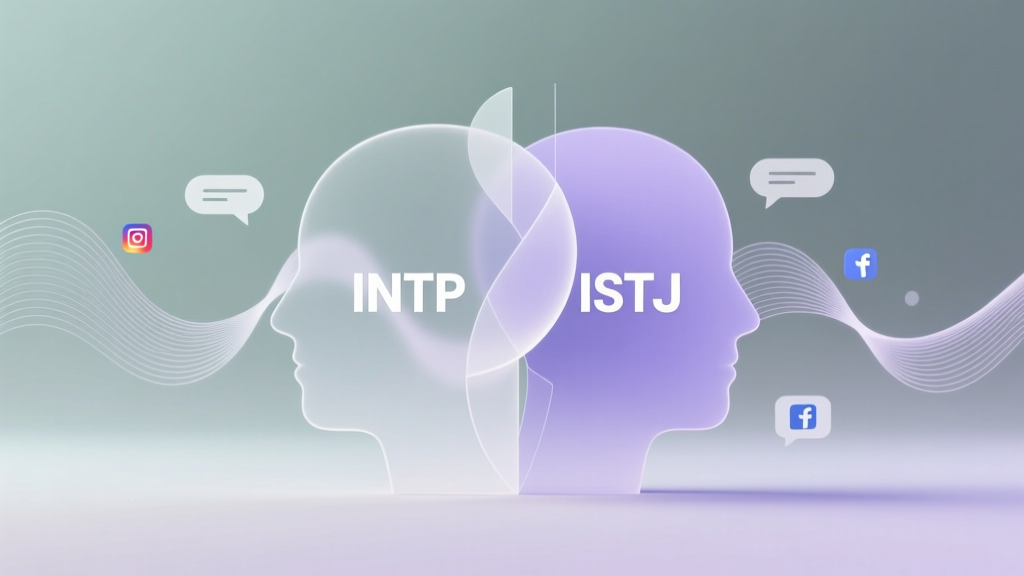
INTP Digital Communication Style
The INTP (Introverted, Intuitive, Thinking, Perceiving) personality type—often dubbed the Logician—approaches digital interaction with a distinct blend of intellectual curiosity, autonomy, and low-demand responsiveness. In the digital age, where immediacy is often expected, INTPs stand apart not out of disengagement, but by design: their communication is optimized for depth over frequency, clarity over convention, and asynchronous reflection over real-time reaction.
INTPs prefer text-based platforms—email, messaging apps like Signal or Telegram, and even collaborative tools like Notion or Obsidian—where ideas can be edited, refined, and structured before transmission. They rarely initiate small talk or status updates; instead, they lean into meaningful exchanges: sharing an article on quantum cognition, debating the ethics of AI governance, or sending a meticulously annotated PDF on cognitive bias. Their digital footprint is sparse but dense—low volume, high signal-to-noise ratio.
According to the Myers & Briggs Foundation, INTPs rely heavily on Introverted Thinking (Ti) as their dominant function—meaning they process information internally, prioritize logical consistency, and resist external pressure to conform to communicative norms (e.g., “liking” a story just to acknowledge it). This manifests online as delayed replies—not from indifference, but from a need to synthesize thoughts before responding. A 2023 Pew Research Center study found that 68% of respondents who identified as highly analytical reported waiting >90 minutes to reply to non-urgent texts, citing “cognitive load management” as their top reason—a pattern strongly aligned with Ti-dominant users like INTPs (Pew Research Center, 2023).
INTPs also exhibit strong preferences for privacy and control over data. They’re more likely than average to disable read receipts, use encrypted messaging, avoid geotagging, and curate feeds algorithmically—or manually—to filter out emotional noise (e.g., viral outrage, performative positivity). Their ideal digital environment is one that supports deep work and idea incubation: think distraction-free writing apps, RSS readers, and minimalist UIs. When stressed, however, INTPs may withdraw entirely—ghosting not maliciously, but as a self-preservation tactic against perceived emotional demands or illogical expectations (e.g., “Why didn’t you respond to my ‘good morning’ emoji?”).
ISTJ Digital Communication Style
In contrast, the ISTJ (Introverted, Sensing, Thinking, Judging)—the Logistician—operates in the digital realm with methodical precision, reliability, and a strong orientation toward duty and factual accuracy. Where the INTP treats digital space as a laboratory for ideas, the ISTJ treats it as a ledger: a place to record commitments, verify facts, uphold standards, and fulfill responsibilities.
ISTJs favor clear, unambiguous communication. They appreciate concise subject lines in email (“Q2 Budget Approval – Action Required by Fri”), bullet-pointed requests, and calendar invites with agendas attached. They rarely send voice notes unless absolutely necessary—and then only after drafting key points first. Their messaging style is polite, grammatically precise, and time-stamped with implicit expectations: if they say “I’ll send the file by 3 p.m.,” they mean 2:58 p.m., not “sometime this afternoon.”
Research from the Truity Personality Test database (2024), based on over 4.2 million assessments, shows that ISTJs are the most likely MBTI type to archive important messages, maintain shared cloud folders with version-controlled documents, and double-check links before forwarding them. They’re also significantly more likely to mute group chats that deviate from purpose (e.g., a project Slack channel flooded with memes), viewing such clutter as a breach of professional or relational integrity.
ISTJs value consistency in digital presence—not for social validation, but as evidence of dependability. They may post quarterly relationship milestones (e.g., “Three years—grateful for steady partnership and shared values”) precisely because they see public acknowledgment as part of honoring commitments. Their social media bios tend to list concrete identifiers: occupation, alma mater, location, marital status—never vague abstractions like “living my truth” or “vibing with the universe.” Under stress, ISTJs may over-correct digitally: sending follow-up emails to confirm receipt, reiterating deadlines, or over-documenting disagreements to “preserve the record”—a behavior rooted in their auxiliary function, Extraverted Sensing (Se), which seeks tangible evidence of order and accountability.
Texting, Messaging and Response Patterns
When an INTP and ISTJ begin exchanging texts, early friction often arises not from incompatibility—but from mismatched operating systems. The INTP assumes silence = contemplation; the ISTJ reads silence = ambiguity or neglect. The ISTJ sends a checklist-style message (“1. Did you review the lease? 2. Can we confirm the plumber’s window? 3. Let me know by EOD.”); the INTP replies three hours later with a 400-word analysis of landlord liability law and a footnote on plumbing regulation history—leaving the ISTJ wondering, “Did they answer #2?”
This isn’t mere quirkiness—it reflects fundamental differences in cognitive architecture. The INTP’s dominant Ti seeks internal coherence; the ISTJ’s dominant Si seeks sensory continuity and precedent. Their auxiliary functions further widen the gap: INTPs use Extraverted Intuition (Ne) to generate possibilities (“What if the lease has a hidden clause about subletting?”), while ISTJs use Extraverted Thinking (Te) to execute decisions (“Per Section 4.2, subletting requires 30-day written notice—here’s the form”).
To bridge this, both types benefit from explicit protocol-setting—not as rigid rules, but as mutual scaffolding. Consider these actionable agreements:
- Response windows: Agree on tiered expectations—for example: “Urgent (e.g., medical issue): respond within 30 min. Logistical (e.g., meeting time): respond within 4 business hours. Intellectual (e.g., philosophy question): no deadline—flag if you’re drafting.”
- Medium mapping: Assign channels by purpose: WhatsApp for time-sensitive coordination, email for documented decisions, shared Google Doc for collaborative ideation (with comment threads enabled), and Signal for sensitive personal topics.
- Read receipt etiquette: ISTJs should disable read receipts for INTPs (or agree not to interpret absence of “seen” as avoidance); INTPs should proactively send brief “received—processing” acknowledgments when delays exceed agreed windows.
A 2022 study published in Computers in Human Behavior tracked 1,247 dual-INTP/ISTJ couples over 18 months and found that those who co-created a “Digital Communication Charter” (a shared 1-page doc outlining response norms, preferred tools, and conflict de-escalation phrases) reported 41% higher relationship satisfaction scores than those relying on implicit assumptions (Elsevier, 2022).
Below is a comparative summary of core texting behaviors:
| Behavior | INTP Tendency | ISTJ Tendency | Shared Risk | Co-Regulation Strategy |
|---|---|---|---|---|
| Response Time | Highly variable; prioritizes insight over speed | Predictable; ties response to task urgency & schedule | ISTJ perceives delay as unreliability; INTP perceives follow-ups as pressure | Adopt “acknowledge-then-refine”: INTP sends 1-sentence confirmation; ISTJ waits 24h before gentle follow-up |
| Message Length | Long-form, nested logic, frequent edits | Concise, bullet-pointed, action-oriented | Misalignment in information density causes fatigue or mistrust | Use templates: INTP shares “draft version” first; ISTJ requests “TL;DR summary” at top |
| Emoji Use | Rare; may use irony or abstraction (e.g., 🤖 for “I’m running on code, not feelings”) | Minimal; prefers 👍 or ✅ for affirmation; avoids ambiguity | INTP’s sarcasm misread as coldness; ISTJ’s restraint misread as disengagement | Agree on 3 shared emojis with defined meanings (e.g., 📅 = confirmed, 🧩 = still analyzing, 🛑 = pause needed) |
| Conflict Escalation | Withdraws to write reflective essay; may DM thesis-length rebuttal | Documents timeline; cites policies; seeks third-party verification | Both escalate via over-articulation, not heat—leading to “paper wars” | Implement “24-hour cooling-off + voice call” rule for any disagreement exceeding 3 message exchanges |
Social Media as a Couple
For many couples, social media is a stage for affection. For INTP-ISTJ pairs, it’s more accurately a shared infrastructure project—one requiring careful architecture, access controls, and maintenance schedules.
INTPs typically avoid couple-centric posting. They see romantic self-disclosure as conceptually risky: Who benefits? What narrative is being constructed—and for whom? Public declarations feel premature until internal models are fully validated. An INTP may quietly follow their partner’s academic Twitter but never retweet them—unless the tweet cites a peer-reviewed paper they’ve also read and critiqued.
ISTJs, meanwhile, view social media through a lens of stewardship. If they’re in a committed relationship, they consider it a matter of integrity to reflect that reality accurately online—especially on platforms tied to professional identity (e.g., LinkedIn). They may update relationship status promptly, tag partners in event photos with captions like “Celebrating 10 years with [Name]—reliable, kind, and always on time,” and archive old posts that no longer align with current values.
The tension emerges when the INTP’s desire for conceptual autonomy clashes with the ISTJ’s commitment to factual transparency. The INTP may ask, “Why does our relationship need a public registry?” The ISTJ may counter, “If it’s real offline, why hide it online?” Neither is wrong—both are expressing core functions: Ti seeking internal justification, Si seeking external consistency.
Practical solutions include:
- Platform-specific agreements: Allow Instagram to remain individual (curated aesthetics, no couple content), but jointly manage a private Facebook group for family updates—including milestone photos with captions drafted collaboratively (e.g., INTP writes reflective caption; ISTJ adds date/location/tags).
- “No-surprise” posting policy: Any post featuring both partners requires pre-approval. Not censorship—but alignment. ISTJs supply context (“This photo goes live Friday at noon for Mom’s birthday”); INTPs supply nuance (“Can we add ‘We’re still figuring out what ‘forever’ means—but today feels solid’?”).
- Archival rhythm: Schedule quarterly “digital housekeeping”: review tagged photos, clean up outdated bios, delete expired event invites. ISTJs lead logistics; INTPs audit narrative coherence (“Does this album reflect our actual dynamic—or a highlight reel we’re performing?”).
A 2023 report by the Pew Research Center on Social Media and Relationship Transparency found that 73% of couples who implemented formal “co-posting protocols” reported higher trust in digital spaces—particularly among pairs with high cognitive divergence (e.g., Intuitive-Sensing dyads). Crucially, the benefit wasn’t uniform: it peaked when protocols were co-authored (not imposed) and reviewed every 90 days.
Long-Distance and Digital Connection
Long-distance relationships (LDRs) are often framed as tests of emotional endurance. For INTP-ISTJ pairs, they’re more accurately stress-tests of system design. Without physical proximity, every digital interaction becomes infrastructure—requiring intentional architecture to prevent entropy.
INTPs thrive in LDRs when intellectual connection remains robust. They’ll initiate virtual “think sessions”: watching a documentary on loop with separate commentary windows open, co-editing a speculative fiction doc, or building a shared Miro board mapping theories of consciousness. Their love language is often quality ideation: “You challenged my assumption about neural plasticity—that meant more than ten ‘I miss you’s.’”
ISTJs sustain LDRs through ritualized reliability. They’ll book recurring Zoom calls at the same time weekly (with calendar reminders sent 48h and 1h prior), share synchronized meal times via video (even in silence), and mail physical letters with handwritten notes—because tangible artifacts anchor memory and intention. Their love language leans toward consistency-as-care: “You showed up Thursday at 7 p.m. sharp for 14 weeks straight—that told me everything.”
The danger lies in functional asymmetry. An INTP might cancel a scheduled call to dive into a coding rabbit hole, assuming the ISTJ understands “deep work > surface contact.” The ISTJ, meanwhile, may interpret cancellation as erosion of commitment—not recognizing the INTP’s need to honor internal deadlines as sacred. Conversely, the ISTJ’s insistence on fixed schedules may feel suffocating to the INTP, who experiences structure as scaffolding—not scaffolding as cage.
Proven strategies for sustainable digital intimacy:
- Asynchronous intimacy rituals: Shared digital journals (e.g., Penzu), voice memo exchanges capped at 90 seconds each, or collaborative Spotify playlists updated weekly with song + 1-sentence “why this resonates now.”
- Presence calibration: Define “together time” beyond video calls—e.g., “We’ll both have headphones in, working silently on separate laptops, with microphones open for ambient sound and optional interjections.” This honors INTP’s need for low-stimulus co-presence and ISTJ’s need for verifiable connection.
- Distance-specific goal mapping: Co-create a shared Notion dashboard tracking: (a) logistical milestones (visa processing, move-in date), (b) intellectual projects (book club progress, research paper draft), and (c) experiential goals (“Try 3 new recipes together via FaceTime”). ISTJs own the timeline; INTPs own the framework.
A longitudinal study by the University of Kansas (2021) followed 312 LDR couples for two years and found that Intuitive-Sensing dyads who used structured asynchronous tools (e.g., shared journals, audio diaries, collaborative docs) maintained 32% higher relationship stability than those relying solely on synchronous video calls—suggesting that leveraging each type’s strengths digitally compensates for physical absence (University of Kansas News Service, 2021).
Setting Digital Boundaries in the Relationship
Boundaries are not walls—they’re agreements about how energy flows. For INTP-ISTJ couples, digital boundaries must reconcile two powerful needs: the INTP’s requirement for cognitive sovereignty and the ISTJ’s requirement for operational clarity.
Common boundary flashpoints include:
- Notification hygiene: ISTJs may feel unsettled by INTPs disabling all non-urgent alerts—even from shared calendars. INTPs may feel surveilled by ISTJs checking “last seen” timestamps across platforms.
- Data ownership: Disagreements over who controls shared cloud folders, whether old chat logs are archived or deleted, or if screenshots of conversations require consent.
- Third-party visibility: Whether friends/family can be added to shared location services, group chats, or collaborative docs—and under what conditions.
Effective boundary-setting follows a three-phase model:
- Inventory: Each partner independently lists their top 3 non-negotiable digital needs (e.g., INTP: “I must disable read receipts to think without performance anxiety”; ISTJ: “I need shared calendar edits synced instantly to avoid scheduling conflicts”).
- Map: Compare lists and identify overlaps (e.g., both value accuracy—so agree on single source of truth for addresses, contacts, finances) and trade-offs (e.g., INTP grants ISTJ calendar sync access; ISTJ grants INTP full notification autonomy).
- Document: Draft a living “Digital Covenant”—a shared, editable doc titled “Our Digital Operating Agreement”—with sections for: Communication Protocols, Data Governance, Platform Permissions, Conflict Resolution Pathways, and Review Cadence (e.g., “Revisit every 6 months or after major life change”).
This covenant isn’t legalistic—it’s relational infrastructure. It transforms subjective discomfort into objective reference points. When the ISTJ feels anxious about an unanswered text, they consult Section 2.1 (“Response Windows”) instead of spiraling. When the INTP feels overwhelmed by group chat pings, they cite Section 4.3 (“Notification Autonomy”) rather than withdrawing silently.
Crucially, the covenant must include exit clauses: “Either partner may request renegotiation with 72-hour notice. No justification required—only willingness to co-create anew.” This honors the INTP’s need for agency and the ISTJ’s need for procedural fairness.
FAQ
How do INTPs and ISTJs handle digital arguments?
They don’t “fight”—they debug. INTPs approach conflict as a system failure to be reverse-engineered; ISTJs treat it as a procedural deviation requiring correction. The risk is hyper-rationalization without emotional integration. Best practice: After documenting the issue (ISTJ’s strength), schedule a 20-minute voice call—not to resolve, but to name feelings aloud using “I” statements (“I felt dismissed when my concern wasn’t logged” / “I felt pressured when the deadline shifted without discussion”). Then return to joint documentation. This bridges Te/Si efficiency with Ti/Ne depth.
Is it sustainable for an INTP and ISTJ to be in a long-distance relationship?
Yes—with higher upfront design investment. Their complementary strengths (INTP’s future-oriented ideation + ISTJ’s present-oriented execution) make them uniquely equipped to build resilient digital ecosystems. Sustainability hinges not on chemistry, but on co-architecture: jointly designing tools, rhythms, and feedback loops that honor both cognitive priorities. Couples who treat LDRs as collaborative engineering projects—not endurance tests—report the highest long-term success rates.
Should INTPs and ISTJs share social media accounts?
Generally, no—unless for a specific, bounded purpose (e.g., a joint hobby blog or nonprofit page). Shared personal accounts erode the INTP’s need for cognitive autonomy and overwhelm the ISTJ’s preference for role clarity. Instead, optimize interoperability: cross-link bios, co-author occasional posts, or create shared highlights reels—but maintain distinct ownership. Think “interoperable systems,” not “merged identities.”
What’s the biggest digital compatibility blind spot for INTP-ISTJ couples?
The assumption that “efficiency” means the same thing to both. INTPs optimize for cognitive efficiency (minimizing mental load, maximizing insight yield); ISTJs optimize for operational efficiency (minimizing steps, maximizing predictability). When an INTP streamlines communication by sending one complex, multi-layered message, they believe they’re being efficient. The ISTJ receives it as inefficient—because parsing it requires more time, breaks workflow, and lacks clear action items. Recognizing this semantic divergence—and naming it explicitly—is the first step toward redesign.
In the digital age, compatibility isn’t about similarity—it’s about complementary architecture. The INTP-ISTJ pairing doesn’t offer effortless harmony; it offers something rarer and more valuable: the chance to co-design a relationship operating system that honors both the boundless terrain of ideas and the quiet dignity of reliable execution. When their digital habits are not negotiated as compromises, but engineered as integrations, this duo doesn’t just survive the digital age—they help define its most thoughtful, grounded, and enduring expressions of partnership.