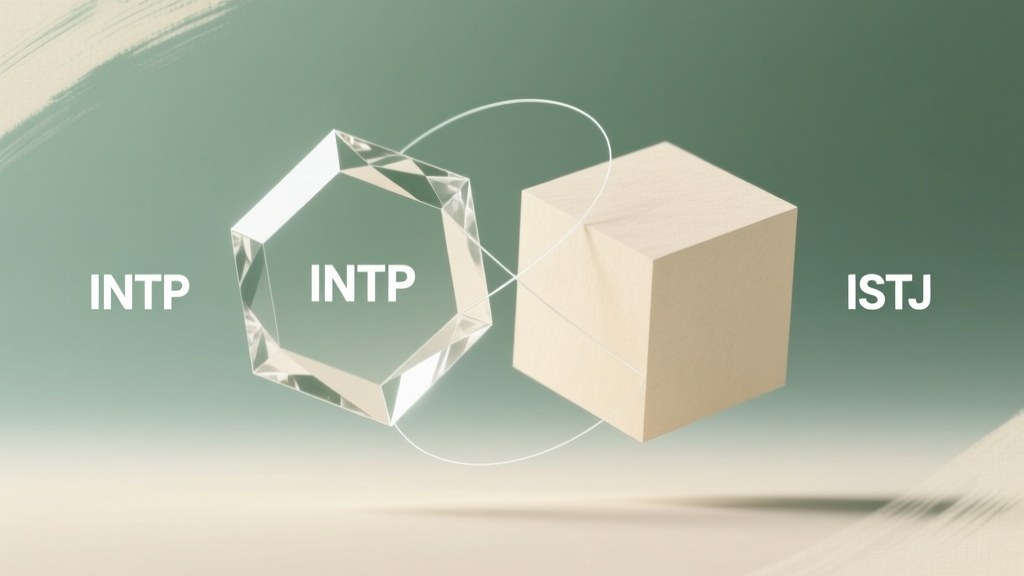
INTP Love Language Profile
The INTP (Introverted, Intuitive, Thinking, Perceiving) personality type — often dubbed the Logician — approaches love with intellectual curiosity, deep authenticity, and a quiet reverence for mutual growth. While commonly stereotyped as emotionally detached, INTPs possess rich inner emotional landscapes — they simply process and express feelings differently than most. Their love languages rarely align with grand romantic gestures or effusive verbal affirmations; instead, they prioritize quality time rooted in meaningful dialogue, acts of service grounded in problem-solving, and gifts that reflect thoughtfulness over expense.
According to Gary Chapman’s The 5 Love Languages, INTPs most frequently identify with Quality Time and Acts of Service, though Words of Affirmation can be highly impactful — if those words are sincere, specific, and intellectually resonant (5 Love Languages). An INTP is far more moved by, “I admire how you restructured that argument — it clarified everything for me,” than by, “You’re so amazing!” The former validates their cognitive identity; the latter feels vague and unearned.
INTPs express love through deep listening, offering nuanced perspectives during a partner’s crisis, or quietly fixing a recurring household issue without being asked. They may spend hours researching the best ergonomic keyboard for their ISTJ partner’s home office — not because it’s flashy, but because it signals, I see your values, I respect your effort, and I want to support your effectiveness. Their emotional vulnerability emerges slowly — often through shared intellectual exploration (e.g., debating philosophy, co-writing a blog post, analyzing a film’s narrative structure). Physical touch is typically low-priority unless initiated in contexts of safety and mutual calm; spontaneous hugs or prolonged hand-holding may feel intrusive before profound trust is established.
A critical nuance: INTPs do not withhold love — they filter it. Their affection is expressed via logic-infused care: optimizing routines to reduce their partner’s stress, remembering obscure preferences (“You prefer unsweetened almond milk in your tea, right?”), or drafting a step-by-step guide for something their partner finds overwhelming. To an outsider, this may look like emotional distance. To the INTP, it’s the highest form of devotion — love made tangible through competence and attention.
ISTJ Love Language Profile
The ISTJ (Introverted, Sensing, Thinking, Judging) — known as the Logistician — expresses love through steadfast reliability, structured care, and tangible demonstrations of commitment. For ISTJs, love is less about abstract declarations and more about consistent presence, practical support, and respect for shared responsibilities. Their dominant function, Introverted Sensing (Si), anchors them in lived experience, tradition, and proven methods — making them deeply loyal, detail-oriented partners who show up — literally and figuratively — every single day.
Chapman’s framework reveals that ISTJs most commonly resonate with Acts of Service and Quality Time — but with a crucial distinction: their version of quality time is shared activity with purpose, not open-ended conversation. Think cooking dinner side-by-side, organizing the garage together, or reviewing next month’s budget. Verbal affirmations matter — but only when paired with observable follow-through. An ISTJ hears, “I appreciate how hard you work,” as hollow unless it’s followed by their partner taking on a chore they’ve shouldered alone for months.
ISTJs give love through routine: packing lunch daily, maintaining the car schedule, remembering anniversaries down to the hour, or quietly covering a shift so their partner can rest. Their physical affection tends toward gentle, predictable gestures — a hand on the shoulder while passing in the kitchen, a brief hug upon returning home, holding hands during walks. These aren’t performative; they’re ritualized expressions of stability and continuity. Emotional expression is often understated, but never absent — it lives in the calendar reminders they set for your dentist appointment, the extra blanket they place on the couch before you sit down, or the way they pause mid-sentence to ask, “Did you sleep okay last night?” — a question loaded with care, not small talk.
Where INTPs seek intellectual resonance, ISTJs seek reliability resonance. They need to know their partner’s word is bond, their commitments are non-negotiable, and their actions consistently reflect stated values. A broken promise — even a minor one — wounds more deeply than harsh words.
Where Love Languages Align and Diverge
At first glance, INTP and ISTJ share strong common ground: both are introverted, thinking-dominant types who value honesty, competence, and privacy. They’re unlikely to engage in performative romance or emotional manipulation. Yet beneath this compatibility lies a subtle but consequential divergence — not in what they love, but how they register, translate, and reciprocate emotional signals.
Consider this comparison of core love language tendencies:
| Love Language Dimension | INTP Expression Style | ISTJ Expression Style | Potential Mismatch Risk |
|---|---|---|---|
| Quality Time | Deep, open-ended conversations; prefers silence with shared focus (e.g., reading in same room); values mental presence over physical proximity | Structured, activity-based time (cooking, planning, organizing); values physical co-presence and shared task completion | INTP may withdraw during ISTJ’s “together time” if it lacks intellectual stimulation; ISTJ may interpret INTP’s silent focus as disengagement |
| Acts of Service | Problem-solving oriented: fixes systemic issues (e.g., automates bill payments), researches solutions, anticipates future friction points | Routine-oriented: handles daily maintenance (laundry, meal prep, scheduling), honors commitments precisely, maintains order | INTP’s big-picture fixes may feel abstract or unnecessary to ISTJ; ISTJ’s daily upkeep may feel mundane or invisible to INTP |
| Words of Affirmation | Needs specificity, intellectual validation, and authenticity; generic praise triggers skepticism | Values sincerity + consistency; appreciates acknowledgment of reliability, diligence, and integrity | ISTJ may offer broad affirmations (“You’re great”) that land flat for INTP; INTP may over-analyze ISTJ’s praise, missing its emotional intent |
| Physical Touch | Low baseline need; initiates only in states of deep comfort; may withdraw during stress or overstimulation | Moderate, ritualized need; uses touch as grounding signal (hand on back, arm around shoulder); may initiate to soothe or reconnect | ISTJ may misread INTP’s touch-aversion as rejection; INTP may perceive ISTJ’s touch as pressure or boundary-crossing during cognitive overload |
| Gifts | Values symbolic, idea-driven gifts (a rare book on chaos theory, a custom-coded app, a museum pass for a niche exhibit) | Values practical, enduring gifts (a high-quality toolset, a subscription to a trusted news service, a well-made watch) | INTP’s gift may seem impractical to ISTJ; ISTJ’s gift may feel impersonal or uninspired to INTP — unless meaning is explicitly shared |
This table illustrates why INTP–ISTJ relationships are often described as “slow-burn soulmates”: initial friction arises not from incompatibility, but from mismatched translation protocols. Both speak love fluently — but in dialects shaped by different cognitive priorities (INTP’s dominant Introverted Thinking (Ti) vs. ISTJ’s dominant Introverted Sensing (Si)). Where Ti seeks internal logical coherence, Si seeks external experiential consistency. Bridging this gap requires conscious bilingualism — learning to decode each other’s emotional syntax.
Emotional Needs of INTP and ISTJ
Understanding love languages is essential, but insufficient without grasping the underlying emotional needs that fuel them. These needs operate at a pre-verbal, neurocognitive level — shaping what feels safe, seen, and sustaining.
INTP Core Emotional Needs:
- Cognitive Autonomy: Freedom to explore ideas without judgment or demand for immediate application. An INTP feels loved when their partner respects their need to “think aloud” — even if conclusions shift hourly.
- Intellectual Validation: Recognition not just of what they think, but how they think — their rigor, curiosity, and willingness to revise beliefs. As psychologist Dr. Elaine Aron notes in her research on highly sensitive people (many INTPs identify strongly with HSP traits), deep thinkers require environments where complexity is honored, not simplified (HSPerson.com).
- Non-Intrusive Presence: The ability to be physically near without social performance. Silence isn’t emptiness — it’s shared mental space. An INTP feels safest when their partner doesn’t fill quiet with chatter, but matches their energy with calm attentiveness.
- Emotional Patience: Space to process feelings cognitively before articulating them. Pushing for “How do you feel?” before they’ve modeled the emotion internally can trigger shutdown.
ISTJ Core Emotional Needs:
- Dependability Assurance: Consistent evidence that their partner’s actions align with their words — across time, context, and stress. This isn’t control; it’s the bedrock of ISTJ security. As noted by the Myers & Briggs Foundation, ISTJs derive profound comfort from “predictable, principled behavior” (Myers & Briggs Foundation).
- Respect for Tradition & Structure: Acknowledgement that their systems (routines, schedules, organizational methods) serve emotional regulation and care — not rigidity for its own sake.
- Appreciation of Diligence: Recognition of effort invested in maintenance, preparation, and responsibility — the unseen labor that keeps life functioning smoothly.
- Stable Emotional Climate: Low-drama environments where conflicts are resolved factually and respectfully. ISTJs are not averse to emotion — they’re averse to unpredictability masquerading as emotion.
The convergence point? Both types crave authenticity anchored in integrity. But authenticity means different things: for the INTP, it’s intellectual honesty and freedom from pretense; for the ISTJ, it’s behavioral consistency and fidelity to shared agreements. When these definitions collide — e.g., an INTP changes plans last-minute to pursue a sudden insight, violating an ISTJ’s need for dependability — the rupture isn’t about selfishness. It’s about incompatible definitions of what “keeping faith” requires.
Building Emotional Fluency Between INTP and ISTJ
Emotional fluency isn’t about becoming the same person — it’s about developing a shared dialect. For INTP–ISTJ couples, this means cultivating three interlocking skills: translation, calibration, and co-regulation.
1. Translation: Decoding Each Other’s Emotional Syntax
Start by naming your native emotional language. INTPs might say: “When I retreat to my study after work, it’s not rejection — it’s cognitive recharging. I’ll rejoin you in 90 minutes, and I’d love to hear about your day then.” ISTJs might respond: “When I ask if you’ve eaten, it’s not nagging — it’s my way of checking in on your basic care. If you’d rather I text that once daily, I’m happy to adjust.” This practice transforms assumptions into shared reference points.
2. Calibration: Matching Emotional Intensity and Timing
INTPs often need time to process emotions before discussing them; ISTJs often need resolution within the same emotional “cycle.” A powerful calibration tool is the 24-hour buffer agreement: when tension arises, either partner can request 24 hours to reflect — with a firm commitment to revisit the topic at a pre-set time. During the buffer, ISTJs practice trusting the process (not the silence); INTPs practice containing urgency to analyze and commit to showing up prepared.
3. Co-Regulation: Creating Shared Anchors
Develop rituals that satisfy both needs simultaneously. Examples:
- The Weekly Sync: 45 minutes, scheduled, no devices. First 15 mins: ISTJ shares logistics (upcoming deadlines, household updates). Next 15: INTP shares ideas/insights (a concept they’re exploring, a book that shifted their thinking). Final 15: Joint planning — choosing one small act of service for the week (e.g., INTP researches a better home Wi-Fi router; ISTJ schedules the installation).
- The “Silent Together” Hour: Daily, uninterrupted time sharing physical space with independent focus (reading, sketching, coding) — no expectation to converse. Validates INTP’s need for quiet presence and ISTJ’s need for reliable companionship.
- The Affirmation Exchange: Every Sunday, each writes one specific, behavior-based affirmation for the other: ISTJ might write, “Thank you for debugging my spreadsheet yesterday — your patience saved me 3 hours.” INTP might write, “I noticed you refilled the printer paper without being asked — that kind of proactive care makes me feel deeply supported.”
These practices don’t eliminate differences — they transform them into collaborative infrastructure. As relationship researcher Dr. John Gottman emphasizes, lasting partnerships aren’t built on agreement, but on repairable conflict and mutual influence (The Gottman Institute). INTP–ISTJ pairs excel here — if they treat their cognitive differences as design features, not bugs.
Practical Tips for Expressing Love to Each Type
Abstract understanding isn’t enough. Here’s exactly how to translate insight into action — with concrete, field-tested examples.
How to Love an INTP (Practically):
- Instead of: “You’re so smart!”
Try: “The way you explained quantum decoherence using baking analogies made it click for me — that’s a rare skill.” (Specific + intellectual validation) - Instead of: Planning a surprise weekend trip.
Try: Sending a curated list of 3 local observatories with opening hours, telescope specs, and a note: “Saw this and thought of your Mars rover project — which one feels most intriguing to visit?” (Autonomy + intellectual invitation) - Instead of: Pressing for feelings during an argument.
Try: “I’d value your perspective on what’s happening here when you’re ready — no rush. I’ll be here.” Then give literal space (e.g., go for a walk, work on a separate task). (Honoring processing time) - Instead of: Expecting daily physical touch.
Try: Establishing a low-pressure ritual: “High-five when we both finish our morning coffee?” or “Hand squeeze before bed — no words needed.” (Predictable, non-intrusive connection)
How to Love an ISTJ (Practically):
- Instead of: “Let me handle that — it’ll be faster.”
Try: “I admire how systematically you manage the family calendar. Can I help input the new school dates?” (Affirming competence + offering collaborative support) - Instead of: Forgetting to confirm plans.
Try: Using shared digital tools with notifications: “Added our dinner reservation to Google Calendar — reminder set for 1 hour prior. Let me know if you’d like me to add anything else.” (Demonstrating dependability) - Instead of: Vague promises (“I’ll fix the leaky faucet soon”).
Try: “I’ve ordered the washer kit — it arrives Tuesday. I’ll install it Wednesday after work. If that timing doesn’t work, let’s pick another slot now.” (Specificity + accountability) - Instead of: Dismissing routines (“Why do you always check the locks twice?”).
Try: “I notice you check the locks — is there a particular reason that feels important for safety? I want to understand.” (Curiosity over correction)
Crucially, both partners must practice love language reciprocity: ISTJs can stretch into intellectual engagement (asking open-ended questions about INTP’s current fascination), while INTPs can stretch into logistical partnership (taking ownership of one recurring household system — e.g., managing the medication schedule or filing tax documents). Growth happens at the edge of comfort — not by erasing differences, but by expanding capacity to hold them.
FAQ
Can INTP and ISTJ have a successful long-term relationship?
Yes — and many do, with exceptional longevity and depth. Research from the Center for Applications of Psychological Type (CAPT) shows that Judging-Perceiving (J-P) pairs — like ISTJ (J) and INTP (P) — face initial friction in lifestyle coordination, but develop remarkable resilience when both commit to mutual adaptation. Their shared Introversion and Thinking functions create a stable foundation of mutual respect, while their complementary auxiliary functions (ISTJ’s Extraverted Thinking and INTP’s Extraverted Intuition) foster balanced problem-solving — ISTJ grounds INTP’s ideas in reality; INTP helps ISTJ anticipate future implications (CAPT.org). Success hinges not on similarity, but on valuing each other’s contributions as essential.
Why does my ISTJ partner seem hurt when I change plans last-minute?
For ISTJs, plans aren’t arbitrary — they’re trust contracts. Changing them without advance notice violates their core need for dependability, triggering anxiety about unpredictability and unreliability. It’s not about controlling you; it’s about preserving their sense of safety in the world. The fix isn’t abandoning flexibility — it’s implementing change protocols: giving 24+ hours’ notice when possible, explaining the why (e.g., “A breakthrough in my project requires immediate testing — can we reschedule to Thursday?”), and offering a concrete alternative.
How do I get my INTP partner to open up emotionally?
You don’t “get” them to open up — you create conditions where opening feels safe and worthwhile. Stop asking, “How do you feel?” Start asking, “What’s your take on what happened?” or “What would make this situation feel more workable?” Frame emotions as data points within a larger system. Share your own feelings using cause-effect language: “When X happened, I felt Y because Z mattered to me.” This models vulnerability without demanding reciprocity. Patience is non-negotiable — INTPs integrate emotion cognitively, and that process cannot be rushed.
Are INTP–ISTJ couples prone to neglecting romance?
They’re prone to neglecting conventional romance — candlelit dinners, love notes, grand gestures — not intimacy itself. Their romance lives in co-created systems: the perfect home office setup, the meticulously planned hiking route with geological notes, the shared spreadsheet tracking favorite indie films. To nurture romance, intentionally inject novelty within structure: try a new board game (ISTJ enjoys rules; INTP enjoys strategy), attend a lecture on a topic neither knows well (intellectual adventure), or recreate a childhood meal together (tapping ISTJ’s Si nostalgia and INTP’s curiosity about cultural context). Romance for them is synergy — not spectacle.
In conclusion, the INTP–ISTJ bond is a masterclass in complementary love. It asks neither to become the other — only to learn the other’s grammar of care. When an INTP’s relentless curiosity meets an ISTJ’s unwavering fidelity, something rare emerges: a relationship where logic and loyalty aren’t opposing forces, but twin pillars holding up a life of profound, quiet devotion. Their love language isn’t spoken in clichés — it’s written in shared calendars, annotated textbooks, and the comfortable silence of two minds, deeply different, finally understood.