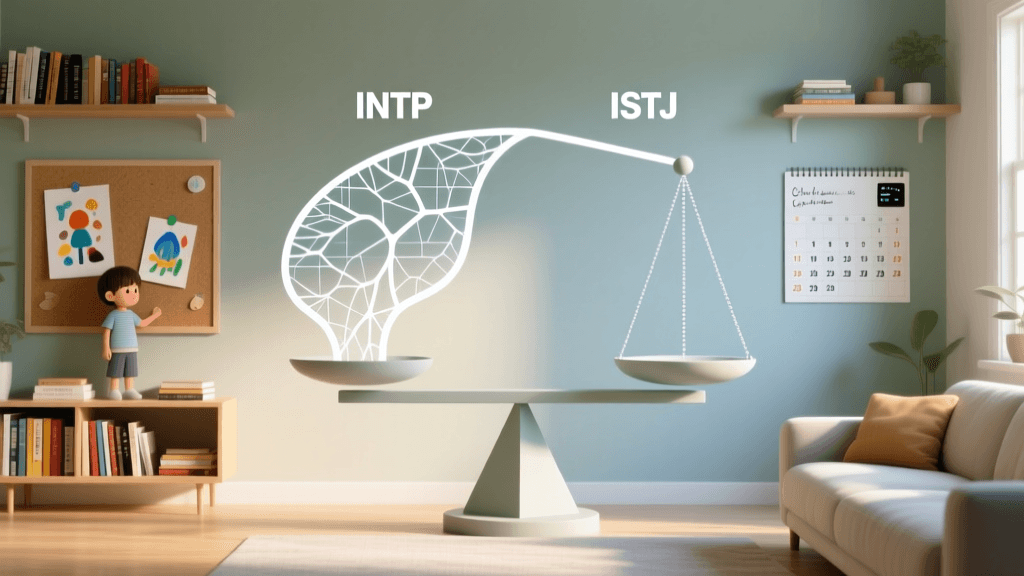
INTP as a Parent
The INTP (Introverted, Intuitive, Thinking, Perceiving) parent brings intellectual curiosity, flexibility, and deep respect for autonomy to family life. Often described as the 'Architect' or 'Thinker,' the INTP approaches parenting not as a set of rigid rules but as an evolving experiment grounded in logic, observation, and empathy. Their parenting style is characterized by low emotional reactivity, high tolerance for ambiguity, and a strong desire to nurture independent thought in their children.
INTPs typically avoid authoritarian discipline. Instead of imposing consequences arbitrarily, they prefer to explain the 'why' behind expectations — often engaging children in Socratic dialogue about fairness, cause-and-effect, or ethical reasoning. For example, rather than saying, 'Clean your room because I said so,' an INTP parent might say, 'Let’s consider how clutter affects our ability to find things quickly, focus on homework, or invite friends over comfortably. What system would make sense to you?'
This approach fosters critical thinking but can sometimes leave children — especially younger or more concrete-minded ones — uncertain about boundaries. INTPs may struggle with consistency in routines (e.g., bedtime rituals or chore enforcement) because they’re naturally open to renegotiation when new information arises. Their introversion means they recharge through solitude, which can lead to unintentional emotional distance if not consciously mitigated. They may also delay addressing behavioral issues until patterns become logically undeniable — a lag that can allow small concerns to escalate.
Research from the Myers & Briggs Foundation confirms that Perceiving types like INTP tend to prioritize adaptability over structure, which supports their fluid parenting approach but may conflict with developmental needs for predictability in early childhood. A 2022 study published in Journal of Family Psychology found that children with at least one highly flexible, intellectually engaged parent showed higher scores in creative problem-solving by age 10 — yet also exhibited slightly elevated anxiety when household routines lacked sufficient scaffolding (American Psychological Association, 2022).
Practically, INTP parents thrive when given space to reflect and plan. They benefit from tools like shared digital calendars with editable notes, open-ended weekly family meetings (rather than top-down directives), and resources that emphasize developmental psychology over prescriptive 'how-to' guides. One effective strategy is assigning them the role of 'Family Learning Coordinator' — researching educational philosophies, evaluating homeschool curricula, or designing science-based weekend projects — allowing them to contribute meaningfully without shouldering logistical execution.
ISTJ as a Parent
The ISTJ (Introverted, Sensing, Thinking, Judging) parent embodies reliability, conscientiousness, and quiet devotion. Known as the 'Logistician' or 'Duty-Fulfiller,' the ISTJ approaches parenting as a solemn responsibility grounded in duty, tradition, and tangible results. Their strength lies in creating stable, predictable, and ethically coherent home environments where expectations are clear, promises are kept, and effort is consistently recognized.
ISTJs excel at establishing and maintaining routines — from morning hygiene checklists to quarterly academic goal reviews. They value punctuality, accuracy, and follow-through, and often model these traits visibly: paying bills on time, keeping medical records meticulously filed, ensuring school permission slips are signed and returned promptly. Discipline tends to be fair, consistent, and rule-based; consequences are tied directly to observable behavior and applied without emotional volatility. An ISTJ parent might say, 'You agreed to finish your math worksheet before screen time. Since it’s incomplete, screen time is paused until it’s done — just as we discussed Monday.'
However, this strength can become a challenge when rigidity overrides compassion. ISTJs may misinterpret a child’s emotional outburst as willful disobedience rather than unmet need, especially if the child expresses feelings abstractly or nonverbally. Because ISTJs process information through concrete sensory data (Sensing), they may overlook subtle cues — like a withdrawn teen’s shift in posture or tone — unless those cues manifest in measurable behaviors (e.g., missed assignments, declining grades). Their preference for Thinking over Feeling doesn’t mean they lack care — quite the opposite — but their love language is often expressed through acts of service and steadfast presence, not effusive verbal affirmation.
A landmark longitudinal study by the University of Minnesota’s Institute of Child Development tracked over 400 families for 15 years and found that children raised primarily by Judging-dominant parents (like ISTJs) demonstrated stronger executive functioning skills by adolescence — particularly in planning, task initiation, and self-monitoring — but were also more likely to report feeling 'pressured to perform' during middle school (University of Minnesota Institute of Child Development, 2021). This underscores the importance of balancing structure with emotional attunement.
For ISTJ parents, practical support includes pre-built templates (e.g., printable chore charts with checkboxes), step-by-step guides for handling common scenarios (tantrums, sibling rivalry, homework resistance), and scheduled 'unstructured reflection time' — perhaps 15 minutes after dinner — to intentionally tune into emotional undercurrents rather than defaulting to procedural fixes.
Co-Parenting Dynamics for INTP and ISTJ
At first glance, INTP and ISTJ appear mismatched: one thrives in theoretical possibility; the other anchors in proven reality. Yet their pairing is among the most functionally complementary in the MBTI matrix — precisely because their cognitive stacks form a natural feedback loop. The INTP’s dominant Introverted Thinking (Ti) seeks internal logical coherence, while the ISTJ’s dominant Introverted Sensing (Si) safeguards accumulated experience and factual accuracy. Their auxiliary functions — INTP’s Extraverted Intuition (Ne) and ISTJ’s Extraverted Thinking (Te) — create a powerful synergy: Ne generates options and future implications; Te evaluates, prioritizes, and implements the most viable path.
In co-parenting, this manifests as a dynamic division of labor rooted in mutual respect:
- INTP identifies emerging patterns (e.g., 'Our daughter seems unusually resistant to piano practice — could it be linked to her recent switch to a stricter instructor?'), proposes alternatives ('What if we trial a composition-based curriculum instead?'), and explores developmental research on motivation.
- ISTJ assesses feasibility ('The new curriculum costs $120/month and requires biweekly studio access — here’s a comparison of local providers'), ensures continuity ('We’ll keep her current teacher through semester-end to avoid disruption'), and documents outcomes ('I’ve logged her practice time and mood ratings for three weeks to measure impact').
This interplay prevents both analysis paralysis (INTP’s risk) and premature closure (ISTJ’s risk). However, friction arises when their core differences aren’t named and negotiated. Common flashpoints include:
- Decision speed vs. decision depth: ISTJs prefer timely, evidence-informed choices; INTPs may request additional data or hypothetical modeling, causing perceived stalling.
- Rule interpretation: ISTJs view household policies as binding agreements; INTPs see them as provisional frameworks subject to revision based on new insight.
- Emotional expression: ISTJs may interpret INTP’s calm neutrality as disengagement; INTPs may perceive ISTJ’s quiet concern as criticism.
Practical strategies to strengthen co-parenting:
- Establish a 'Decision Tier System': Categorize parenting decisions by urgency and impact (e.g., Tier 1 = immediate safety; Tier 2 = weekly routines; Tier 3 = long-term values). Agree that Tier 1 defaults to ISTJ’s Te-driven action, Tier 2 uses ISTJ’s Si for consistency, and Tier 3 invites INTP’s Ne/Ti for collaborative redesign.
- Create a Shared Values Charter: Co-write 5 non-negotiable family values (e.g., 'Honesty means speaking truthfully *and* kindly'; 'Learning includes making mistakes safely'). Revisit quarterly — ISTJ drafts the initial version; INTP refines nuance and edge cases.
- Use Structured Debriefs: After emotionally charged incidents, pause for 20 minutes, then meet with this protocol: ISTJ shares observed facts first; INTP articulates underlying assumptions; together, they co-draft one actionable adjustment for next time.
Crucially, both types must guard against their inferior functions — INTP’s inferior Extraverted Feeling (Fe) and ISTJ’s inferior Extraverted Intuition (Ne). Under stress, INTPs may suddenly overcorrect with forced cheerfulness or people-pleasing (Fe grip), undermining authenticity. ISTJs may catastrophize worst-case scenarios (Ne grip), eroding their usual steadiness. Recognizing these states allows intentional recalibration — e.g., INTP stepping into quiet reading; ISTJ reviewing a trusted checklist.
Family Traditions and Values
INTP and ISTJ couples rarely adopt traditions uncritically — but when they do, those rituals carry profound intentionality. Rather than inheriting holiday customs wholesale, they’ll deconstruct them: 'What human need does Thanksgiving address? Gratitude? Intergenerational connection? Abundance signaling? How might we fulfill that need more authentically?' This shared reverence for meaning — albeit expressed differently — becomes the bedrock of their family culture.
ISTJs anchor traditions in continuity and sensory richness: the same cinnamon roll recipe every Christmas morning, photo albums organized chronologically, handwritten birthday letters archived annually. These practices satisfy Si’s need for stability and provide children with embodied memories — the smell of pine needles, the weight of a well-worn storybook, the sound of a grandfather clock chiming midnight on New Year’s Eve.
INTPs enrich traditions with conceptual layers: turning Easter egg hunts into probability experiments ('What’s the optimal search pattern given terrain variables?'), framing summer road trips as cultural anthropology fieldwork ('Document regional dialect shifts and architectural styles'), or transforming weekly dinners into 'Philosophy Night' where each person poses one open-ended question ('Is fairness always equal treatment?').
Together, they craft hybrid traditions that honor both dimensions. Consider their 'Annual Family Systems Review' — held each January:
| Component | ISTJ Contribution | INTP Contribution | Shared Outcome |
|---|---|---|---|
| Routine Audit | Reviews calendar logs, chore completion rates, appointment adherence | Maps energy flow: When do family members seem most/least engaged? Where do bottlenecks occur? | Revised weekly schedule balancing predictability (ISTJ) and cognitive load distribution (INTP) |
| Values Alignment Check | Compares current practices against original Values Charter | Proposes refinements: e.g., '“Respect” now includes neurodivergent communication styles' | Updated Charter with annotated examples and implementation timeline |
| Tradition Inventory | Documents origins, participants, materials, and emotional resonance of each ritual | Identifies implicit assumptions and potential exclusions (e.g., 'Does our “Back-to-School BBQ” assume all kids attend traditional schools?') | Curated tradition list: Keep (with enhancements), Adapt, Retire, or Pilot New |
This ritual models for children how values evolve without losing integrity — a masterclass in principled adaptability. It also prevents tradition from becoming dogma: the ISTJ ensures roots remain nourished; the INTP ensures branches reach toward new light.
Raising Children with Different Personality Types
No two children share identical MBTI types — and an INTP/ISTJ household offers a unique laboratory for understanding type diversity. With their combined cognitive lenses, these parents are exceptionally equipped to recognize and honor neurological differences — but only if they avoid projecting their own preferences onto their children.
Consider how they might support four common child types:
- ESTJ Child: Thrives on ISTJ’s structure and INTP’s intellectual validation. May clash with INTP’s flexibility — e.g., 'Why did you change the bedtime rule *again*?' Solution: ISTJ defines non-negotiables (e.g., 'Sleep is 8 hours'); INTP co-designs reward systems (e.g., 'If you maintain bedtime for 10 nights, we’ll build a Rube Goldberg machine together').
- ENFP Child: Energized by INTP’s imaginative play and ISTJ’s dependable safety net. May overwhelm ISTJ with rapid idea shifts; may frustrate INTP with emotional intensity. Solution: Designate 'Idea Incubation Time' (INTP-led, unstructured brainstorming) and 'Implementation Hours' (ISTJ-led, turning top 3 ideas into step-by-step plans).
- ISTP Child: Respects ISTJ’s competence and INTP’s hands-off trust. May test boundaries through silent withdrawal. Solution: ISTJ provides toolkits and safety protocols; INTP offers open-ended challenges ('How would you repair this broken hinge using only items in the garage?').
- INFJ Child: Deeply values INTP’s authenticity and ISTJ’s loyalty. May feel unseen if parents prioritize logic over feeling. Solution: Institute 'Heart-to-Heart Thursdays' — no problem-solving, just listening with prompts like 'What’s something beautiful you noticed today?' (ISTJ) and 'What’s a quiet hope you’re holding?' (INTP).
A critical insight from child development research: Type expression emerges clearly around age 12–14, but behavioral tendencies appear much earlier. The Child Mind Institute emphasizes that temperament — biologically based reactivity and self-regulation — interacts powerfully with environment. An INTP/ISTJ home that balances intellectual freedom with emotional safety gives children maximum room to differentiate.
One actionable framework is the 'Type-Responsive Feedback Loop':
- Observe how child processes information (Do they ask 'What’s the principle?' [N] or 'What happened first?' [S]?)
- Validate their natural mode ('It makes sense you’d want to understand the big picture before acting')
- Scaffold the less-preferred function ('Let’s list three concrete steps to test your theory')
- Reflect together ('How did blending both approaches work?')
This teaches metacognition — helping children not just be their type, but use their type intentionally.
Navigating Extended Family as INTP and ISTJ
Extended family gatherings often expose the INTP/ISTJ couple’s greatest point of alignment — and tension. Both types are introverted and value authenticity, yet express it differently: ISTJs demonstrate loyalty through meticulous preparation (e.g., bringing exactly the requested dish, arriving 5 minutes early), while INTPs show care through intellectual engagement (e.g., researching a relative’s obscure hobby, asking nuanced questions about their work).
Common challenges include:
- Grandparent expectations: Traditional grandparents may view ISTJ’s diligence as 'responsible' but INTP’s questioning as 'disrespectful.' Counter this by jointly preparing talking points: 'We admire your dedication to family history — could you tell us about how your parents handled discipline? We’re gathering perspectives to inform our own approach.'
- Family event fatigue: ISTJs may feel obligated to host or attend every gathering; INTPs may withdraw entirely. Compromise: Rotate hosting duties, cap visits at 90 minutes, assign 'observation roles' (ISTJ manages logistics; INTP documents stories for a future family archive).
- Conflict mediation: When relatives criticize parenting choices, ISTJs may suppress discomfort to preserve harmony; INTPs may detach intellectually, missing relational repair opportunities. Practice 'Unified Response Drills': Agree on one calm, values-based phrase ('We’re committed to raising thoughtful, resilient kids — we appreciate your care') and follow with a graceful exit or topic pivot.
Proactively, the couple can transform extended family interactions into intergenerational learning. Launch a 'Family Oral History Project': ISTJ organizes interview schedules and transcribes recordings; INTP designs open-ended questions and analyzes thematic patterns across generations. This honors ISTJ’s Si (preserving the past) and INTP’s Ne (finding connections across time) — turning potential stressors into legacy-building.
FAQ
How do INTP and ISTJ parents handle disagreements about discipline?
They leverage their cognitive synergy: ISTJ defines the behavioral standard and consistent consequence; INTP examines whether the rule serves the child’s developmental stage and long-term growth. Disagreements become data-gathering opportunities — e.g., 'Let’s track this approach for two weeks, then compare notes on compliance, emotional regulation, and skill acquisition.' Avoid ultimatums; use joint journaling to document observations objectively.
What if our child tests as a completely different type — like ESFP or ENTP?
Celebrate it. Your INTP/ISTJ pairing uniquely equips you to raise a child whose preferences differ radically from yours. ISTJ provides the grounding stability ESFPs need; INTP offers the intellectual stimulation ENTPs crave. Focus on 'type bridging' — teaching your child to access their less-preferred functions (e.g., helping an ESFP develop Ti through journaling reflections; guiding an ENTP to strengthen Si via routine-building games). Remember: Type is preference, not destiny.
Can INTP and ISTJ successfully homeschool or unschool?
Absolutely — and their combination may be ideal. ISTJ ensures curriculum alignment, record-keeping, and standardized assessment; INTP designs interdisciplinary projects, facilitates deep dives into passions, and adapts pacing to individual cognition. Key: Formalize roles (ISTJ = Accreditation Liaison; INTP = Curriculum Architect) and schedule regular 'Pedagogy Reviews' using their Annual Systems Review framework. The U.S. Department of Education reports that 3.4% of U.S. students were homeschooled in 2022, with flexibility and personalized learning cited as top motivators (National Center for Education Statistics, 2023).
How do we prevent our child from adopting only one parent’s approach — e.g., becoming overly rigid like ISTJ or overly detached like INTP?
Model integration explicitly. Narrate your collaboration: 'Mom noticed your math grade dipped, so she made a study schedule. I helped you understand *why* the concepts felt confusing — and we combined both ideas into your new plan.' Create 'Balance Challenges': e.g., 'Design a weekend activity that includes ISTJ’s love of planning AND INTP’s love of spontaneity.' Most importantly, affirm contradictions in your child: 'It’s okay to love routine *and* hate boredom — that tension is where creativity lives.'
Ultimately, the INTP/ISTJ parenting partnership isn’t about achieving perfect harmony — it’s about cultivating a family ecosystem where logic and loyalty, innovation and integrity, curiosity and constancy don’t compete, but converse. In doing so, they don’t just raise children. They raise thinkers who know their boundaries, feel their feelings, question their assumptions, and honor their commitments — the rarest and most resilient kind of human.