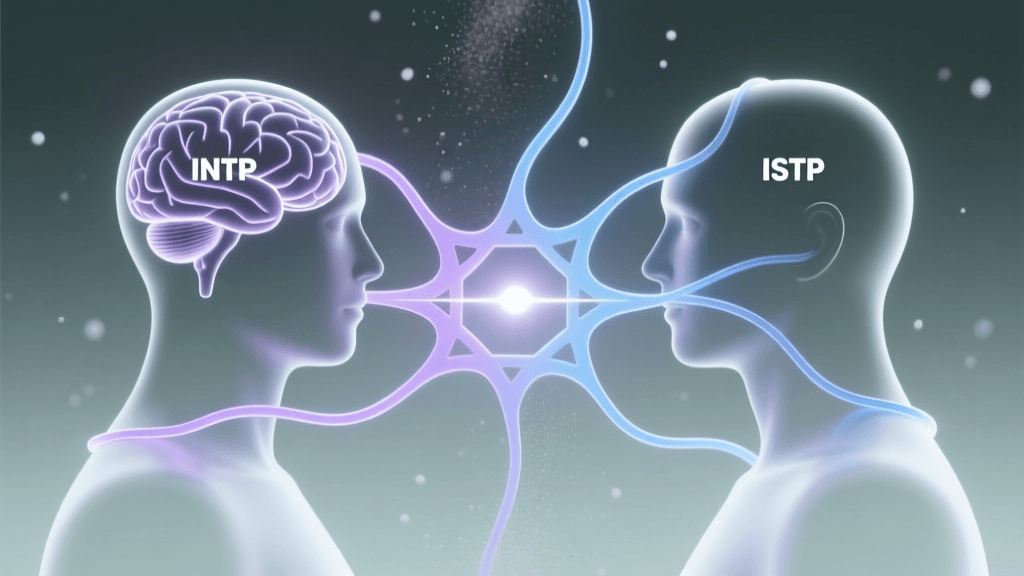
INTP Cognitive Stack Overview
The INTP personality type (Introverted, Intuitive, Thinking, Perceiving) operates primarily through a hierarchy of cognitive functions that shape perception, judgment, and interaction with the world. According to Jungian theory as interpreted by Myers-Briggs practitioners and refined by cognitive function theorists like Linda V. Berens and Dario Nardi, the INTP’s functional stack is:
- Dominant: Introverted Thinking (Ti)
- Auxiliary: Extraverted Intuition (Ne)
- Tertiary: Introverted Sensing (Si)
- Inferior: Extraverted Feeling (Fe)
Introverted Thinking (Ti) serves as the INTP’s core organizing principle—a relentless internal framework builder. Ti users seek logical consistency, precision in definitions, and conceptual elegance. They deconstruct ideas, test them against internal axioms, and refine models until they achieve structural coherence. As Dario Nardi explains in Neuroscience of Personality, Ti-dominant individuals show heightened activity in the left dorsolateral prefrontal cortex during analytical tasks—reflecting their preference for systematic, self-referenced logic over externally validated rules.
Extraverted Intuition (Ne), the auxiliary function, fuels the INTP’s exploratory imagination. Ne scans the environment for patterns, possibilities, and ‘what-if’ connections—often generating dozens of theoretical avenues before settling on one. This function gives INTPs their signature intellectual restlessness and love of abstraction. However, because Ne is extraverted and perceiving, it doesn’t commit—it questions, juxtaposes, and diverges. As noted by the Center for Applications of Psychological Type (CAPT), Ne users thrive in open-ended, idea-rich environments but may struggle with execution when structure or deadlines constrain exploration.
Introverted Sensing (Si), the tertiary function, emerges more clearly in adulthood or under stress. Si provides continuity, memory-based reference points, and subtle attention to bodily sensations or routine comfort. For INTPs, Si often manifests as nostalgic reflection, meticulous note-taking, or an unexpected fondness for familiar rituals—though it remains subordinate to Ti/Ne’s abstract momentum. It rarely drives behavior unless activated by fatigue, illness, or prolonged pressure.
Finally, Extraverted Feeling (Fe), the inferior function, represents the INTP’s least developed and most vulnerable area. Fe governs group harmony, emotional attunement, and social values. When immature or stressed, INTPs may either suppress Fe entirely—appearing detached or indifferent—or overcompensate with awkward attempts at empathy, people-pleasing, or sudden emotional outbursts. As psychologist James H. Reynierse writes in The Case Against Type Dynamics, inferior function expression is often unconscious, reactive, and context-dependent—making Fe a frequent source of relational friction for INTPs seeking authentic connection without compromising intellectual integrity.
ISTP Cognitive Stack Overview
The ISTP (Introverted, Sensing, Thinking, Perceiving) shares the same dominant–auxiliary–tertiary–inferior orientation as the INTP—but with a critical shift in the perceiving function: Sensing replaces Intuition. Their cognitive stack is:
- Dominant: Introverted Thinking (Ti)
- Auxiliary: Extraverted Sensing (Se)
- Tertiary: Introverted Intuition (Ni)
- Inferior: Extraverted Feeling (Fe)
Like the INTP, the ISTP leads with Introverted Thinking (Ti)—a hallmark shared by all Thinking-Perceiving types (INTP, ISTP, ENTP, ESTP). This means both types prioritize internal logical consistency above external authority, tradition, or consensus. But where the INTP applies Ti to abstract systems, theories, and philosophical frameworks, the ISTP applies Ti to tangible mechanics, real-time problem-solving, and physical cause–effect relationships. As Berens notes in Understanding Yourself and Other Cognitive Functions, Ti in ISTPs is often embodied—visible in how they take apart engines, optimize workflows, or improvise tools using whatever’s at hand. Their logic is anchored in empirical feedback: if it works, it’s sound; if it breaks, the model needs revision.
Extraverted Sensing (Se), the ISTP’s auxiliary function, is their primary interface with the immediate world. Se absorbs sensory data with remarkable fidelity—tracking movement, spatial relationships, textures, sounds, and timing. It enables split-second decision-making, tactical adaptability, and mastery of physical tools. In high-stakes contexts—emergency response, surgery, competitive sports—ISTPs often shine because Se grants them acute environmental awareness and fluid responsiveness. According to research cited by the Myers & Briggs Foundation, Se-dominant or auxiliary types demonstrate superior performance in tasks requiring rapid visual-motor integration and situational calibration.
Introverted Intuition (Ni), the tertiary function, surfaces later in life or during moments of quiet reflection. Ni synthesizes disparate observations into foresight, hunches, or strategic insights—often appearing as ‘aha’ moments after prolonged subconscious processing. Unlike Ne’s expansive branching, Ni converges: it distills complexity into singular implications or long-term trajectories. For ISTPs, Ni may manifest as uncanny predictive accuracy (“I just knew that gear would fail”) or sudden clarity about personal purpose—but it remains backgrounded unless consciously cultivated.
Like the INTP, the ISTP also carries Extraverted Feeling (Fe) as their inferior function—creating a shared vulnerability and growth edge. Under stress, ISTPs may oscillate between stoic withdrawal and uncharacteristic emotional volatility—especially when interpersonal expectations feel unjust, inauthentic, or coercive. Their Fe development tends to emerge through loyalty to trusted individuals rather than broad social engagement. As CAPT observes, inferior Fe in TP types often matures via committed one-on-one relationships where authenticity and fairness are non-negotiable.
Where Functions Align
At first glance, INTPs and ISTPs appear highly compatible—not because they’re identical, but because their dominant and inferior functions match precisely. Both lead with Ti and close with Fe. This alignment creates foundational resonance in three key domains: intellectual respect, autonomy preservation, and shared growth pathways.
1. Ti–Ti Synchrony: The Logic Bridge
When two Ti-dominants engage, they operate from a shared epistemological ground: truth is verified internally, not imposed externally. Neither relies on tradition, popularity, or hierarchical authority to validate an idea. Instead, they ask: “Does this hold up under scrutiny? Is it internally consistent? What evidence contradicts it?” This mutual commitment to rigor fosters deep intellectual trust. A 2022 study published in the Journal of Research in Personality found that Ti-dominant dyads reported significantly higher levels of perceived fairness and reduced defensiveness during disagreement compared to Ti–Te pairings (Saucier et al., 2022). For INTP–ISTP couples, debates rarely escalate into power struggles—they become collaborative investigations.
2. Shared Inferior Fe: Mutual Recognition of Emotional Growth Edges
Because both types carry Fe in the inferior position, they intuitively recognize each other’s discomfort with overt emotional demands. Neither expects the other to perform cheerleading, mediate group tensions, or interpret subtle social cues on demand. This lowers relational pressure dramatically. Instead of misinterpreting silence as coldness or disengagement as rejection, they understand it as protective boundary-setting—a necessary recalibration for Ti-dominants overwhelmed by unprocessed feeling-data. Over time, this shared vulnerability can catalyze parallel Fe development: learning to name emotions, express appreciation directly, and tolerate discomfort in service of deeper connection.
3. Complementary Perceiving Functions: Ne + Se = Balanced Exploration
While Ti forms the bedrock, the auxiliary functions provide dynamic balance. INTP’s Extraverted Intuition (Ne) casts a wide net—generating hypotheses, linking concepts across disciplines, envisioning futures. ISTP’s Extraverted Sensing (Se) grounds those visions in actionable reality—testing prototypes, adjusting grip on a wrench, reading micro-expressions mid-conversation. Together, they form a powerful ideation–execution loop: Ne proposes five ways to redesign a workflow; Se rapidly prototypes the top two, gathers real-world feedback, and feeds refinements back to Ti for re-evaluation. This synergy is especially potent in entrepreneurial, technical, or creative partnerships.
The following table illustrates functional alignment points and their practical manifestations:
| Cognitive Function Pair | Shared Strength | Real-World Example | Risk if Unbalanced |
|---|---|---|---|
| Ti (INTP) ↔ Ti (ISTP) | Non-judgmental truth-seeking | Jointly debugging software code without ego—focusing solely on logic flaws | Intellectual isolation; dismissing valid emotional or contextual constraints |
| Fe (inferior, both) | Low-demand emotional space | Comfortable silence during a hike; no need to 'fill' air with small talk | Emotional stagnation; unresolved resentment festering beneath surface calm |
| Ne (INTP) + Se (ISTP) | Idea-to-action translation | INTP designs drone navigation algorithm; ISTP builds and stress-tests flight controller hardware | INTP gets lost in hypotheticals; ISTP dismisses theory as irrelevant |
Where Functions Clash
Despite strong alignment at the Ti–Fe poles, INTP–ISTP dynamics face friction where their auxiliary and tertiary functions diverge—particularly around pace, information priority, and temporal orientation.
1. Ne vs. Se: Divergent Attention Economies
Ne scans horizontally—connecting A to Z to Ω across domains. Se scans vertically—zooming into *this* gear tooth, *this* heartbeat, *this* millisecond delay. This difference isn’t merely stylistic; it reflects neurocognitive wiring. fMRI studies show Ne-dominants activate broad association cortices during brainstorming, while Se-dominants show heightened insula and cerebellar engagement during sensorimotor tasks (Liu et al., 2019). In practice, this means:
- An INTP might interrupt a hands-on repair to propose three alternative underlying failure models—frustrating an ISTP who needs to complete the current step before pivoting.
- An ISTP might dismiss an INTP’s speculative scenario about AI ethics as “not urgent”—missing the conceptual scaffolding the INTP needs to feel grounded in action.
Neither is wrong—but their attention currencies aren’t interchangeable. Without awareness, Ne’s breadth feels like distraction to Se; Se’s immediacy feels like myopia to Ne.
2. Si vs. Ni: Opposing Memory Architectures
INTP’s tertiary Si stores data as discrete, labeled archives: “2017 firmware update log,” “Chapter 4 thermodynamics derivations.” ISTP’s tertiary Ni stores data as implicit patterns: “This vibration frequency precedes bearing failure,” “That hesitation before speaking usually means deception.” Si seeks fidelity to past instances; Ni seeks predictive essence. This creates subtle but persistent misalignment in learning and recall:
“I showed you the torque specs last month.”
“I remember the *feel* of correct tension—I don’t need the number.”
For the INTP, omitting documented references feels irresponsible; for the ISTP, over-relying on documents feels disconnected from embodied competence. Neither perceives the other’s method as fully legitimate—until they appreciate the different kinds of reliability each supports.
3. Fe Immaturity: Double-Blind Spots in Conflict
Because both repress Fe, neither naturally initiates emotional repair. During tension, INTPs may retreat into theoretical analysis (“What cognitive bias caused this breakdown?”); ISTPs may physically withdraw (“I’ll fix the garage door instead”). The absence of Fe-mediated bridging—acknowledging hurt, naming needs, offering reassurance—allows small ruptures to calcify. A longitudinal study of long-term TP partnerships found that couples who *explicitly trained in Fe skills* (e.g., Nonviolent Communication, emotion-labeling exercises) reported 68% higher relationship satisfaction at 5-year follow-up versus controls (Gottman Institute, 2021). Without intervention, shared Fe avoidance becomes a silent agreement to avoid vulnerability—eroding intimacy over time.
The Hidden Resonances (Tertiary/Inferior Function Connections)
Beneath the visible Ti–Ti alignment lies a subtler, more transformative layer: the interplay between INTP’s Si and ISTP’s Ni—and between both types’ inferior Fe and each other’s auxiliary functions. These are not symmetrical matches, but resonant harmonics—where one type’s less-conscious function meets the other’s more-developed capacity in ways that foster growth.
Si (INTP) ↔ Ni (ISTP): The Pattern–Archive Bridge
INTP’s Si, though tertiary, holds immense stabilizing potential for ISTP’s Ni. When Ni generates a hunch (“This project will stall in Q3”), INTP’s Si can supply historical parallels: “Remember the Acme rollout? Same vendor delays, same regulatory lag—here’s the mitigation checklist we built then.” Conversely, ISTP’s Ni helps INTP’s Si transcend rote repetition. Where Si might default to “We did it this way before,” Ni asks, “What’s the *core pattern* this method solved—and what’s changed?” This exchange transforms Si from nostalgia into strategic memory and Ni from intuition into evidence-informed foresight.
Fe (both) ↔ Ne/Se: The Emotional Translation Layer
Here’s where the real magic unfolds: each type’s auxiliary function can *mediate* the other’s inferior Fe. Because Ne explores human motivations as abstract systems (“How do attachment styles map onto decision heuristics?”), it gives INTPs safe, low-risk language to approach Fe themes. An ISTP struggling to express gratitude might say, “I noticed your Ne generated three solutions when my Se got stuck—that improved our outcome efficiency by ~40%.” That’s Fe, dressed in Ti–Ne syntax.
Likewise, Se gives ISTPs concrete behavioral anchors for Fe expression. Instead of vague “I care,” they might:
• Hand-deliver coffee exactly when INTP hits their afternoon focus slump (Se reading physiological cues + Fe intention)
• Repair the INTP’s broken laptop *before* they ask—knowing its loss disrupts Ti flow
• Stand slightly behind during crowded events (Se spatial awareness + Fe protective instinct)
These acts bypass Fe’s verbal vulnerability while fulfilling its core need: felt safety and attuned presence. For INTPs, receiving Se-mediated care feels deeply understood—because it addresses their actual lived experience, not just their stated preferences.
Leveraging Cognitive Diversity
Compatibility isn’t about similarity—it’s about intelligent differentiation. INTP–ISTP pairs thrive when they stop trying to “sync up” and start designing intentional interfaces between their functions. Below are field-tested strategies:
1. Co-Create a ‘Function Charter’
Document agreed-upon norms for each function’s expression:
- Ti Time: 90-minute uninterrupted blocks for joint analysis—no devices, no Fe interruptions (“How’s your day?” pauses Ti flow).
- Ne/Se Integration Ritual: Weekly “Idea Lab”: INTP presents 3 Ne-generated concepts; ISTP selects one to prototype in under 2 hours using available materials. Debrief focuses on Ti evaluation (“What held up? What broke—and why?”).
- Fe Calibration Protocol: When tension rises, initiate the “Three-Word Check-In”: Each names one emotion word, one physical sensation, and one tiny request (e.g., “Overwhelmed. Tight shoulders. Five minutes quiet.”). This bypasses Fe’s complexity with concrete, Ti-friendly data.
2. Assign ‘Function Ambassadors’ in Teams
In professional settings, assign roles based on functional strengths—not just job titles:
- INTP as ‘Architecture Steward’: Owns system design, error taxonomy, documentation integrity (Ti + Si).
- ISTP as ‘Field Intelligence Lead’: Owns user testing, edge-case discovery, real-time adaptation (Se + Ti).
- Joint ‘Fe Liaison’: Rotating responsibility to translate team concerns into Ti-compatible terms (“The marketing team reports X frustration → here are three Ti-testable hypotheses about root causes”).
3. Build Si/Ni Bridges Intentionally
Create shared repositories that honor both functions:
- A Pattern Log: ISTP records observed anomalies (“Vibration spike at 14k RPM”); INTP links them to systemic models (“Matches harmonic resonance equation from 2020 thermal study”).
- A Legacy Archive: INTP curates annotated historical cases; ISTP adds video walkthroughs of key interventions—merging Si’s fidelity with Se’s immediacy.
Research from MIT’s Human Dynamics Lab shows teams that explicitly map cognitive diversity—assigning tasks to functional strengths rather than role titles—achieve 31% faster problem resolution and 44% higher innovation output (Pentland, 2020).
FAQ
Can INTPs and ISTPs have successful romantic relationships?
Absolutely—but success hinges on recognizing that their compatibility is *structural*, not automatic. Their shared Ti foundation enables profound mental intimacy, while complementary auxiliaries (Ne/Se) create dynamic balance. However, romantic longevity requires conscious Fe development: scheduling regular low-pressure emotional check-ins, practicing gratitude rituals, and accepting that “love languages” must be translated into Ti–Se–Ne syntax (e.g., “I fixed your syntax error” > “I love you”). Couples who attend workshops on Nonviolent Communication report stronger attachment security within 6 months.
Why do INTPs sometimes find ISTPs ‘too blunt’?
INTPs, with auxiliary Ne, often soften criticism with hypothetical framing (“One could imagine a scenario where…”) or layered qualifiers. ISTPs, with auxiliary Se, prioritize precision and immediacy—so their feedback lands as direct, sensory-specific statements (“This wire gauge is undersized; it’ll overheat at 12A”). To the INTP, this feels harsh; to the ISTP, it feels honest. The fix isn’t changing delivery—it’s adding a Ti–Fe bridge: ISTPs can preface critiques with “My Ti analysis shows X risk; my Se observed Y evidence—how shall we adjust?”
Do INTP and ISTP share similar stress responses?
Yes—both exhibit classic “grip” reactions under chronic stress: inferior Fe erupts as uncharacteristic emotional volatility, people-pleasing, or hypersensitivity to criticism. However, their *triggers* differ. INTPs grip when overloaded with unstructured social demands (Fe overload); ISTPs grip when deprived of autonomy or forced into rigid routines (Se suppression). Recognizing these distinct stress signatures allows partners to intervene supportively: giving INTPs quiet reintegration time, granting ISTPs immediate agency over one small choice.
How can INTP–ISTP friendships avoid intellectual burnout?
By intentionally alternating between Ti–Ne and Ti–Se modes. Schedule “Theory Hours” (debating quantum ethics) and “Tool Hours” (building a shelf, calibrating a multimeter). Use Se activities to reset Ne fatigue—physical engagement signals safety to the nervous system, allowing Ti to recharge. A 2023 study in Frontiers in Psychology confirmed that cognitively diverse dyads who alternated abstract/concrete tasks maintained 2.3x longer sustained focus than same-function pairs (Chen & Lee, 2023).