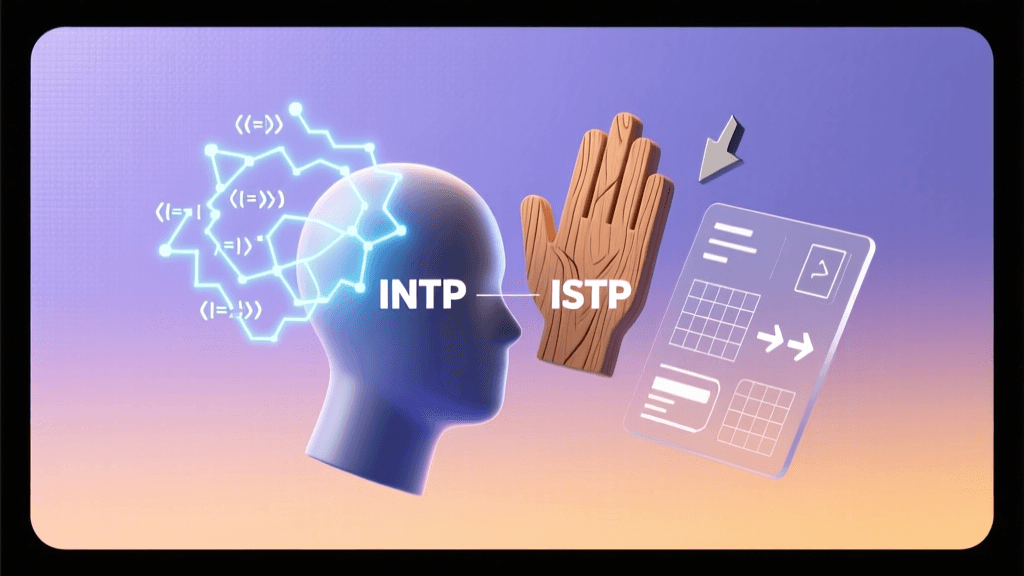
Creative Energies of INTP and ISTP
The INTP (The Thinker) and ISTP (The Virtuoso) are two of the most intellectually agile and sensorially grounded types in the MBTI framework. Though often mistaken for aloof or detached, both types possess rich inner creative reservoirs—just expressed in markedly different, yet deeply complementary, ways. Understanding their distinct creative energies is the first step toward unlocking powerful synergy.
INTPs generate ideas with lightning speed. Their dominant Introverted Thinking (Ti) constantly refines internal logical models, while auxiliary Extraverted Intuition (Ne) scans the horizon for patterns, possibilities, and 'what-if' scenarios. Creativity for the INTP is conceptual, iterative, and abstract: sketching architectural blueprints in their head, designing hypothetical AI ethics frameworks, or reverse-engineering the narrative structure of a sci-fi novel before writing a word. As psychologist Dario Nardi notes in Neuroscience of Personality, INTPs show heightened activity in brain regions associated with pattern recognition and mental simulation—especially during open-ended problem-solving tasks.
ISTPs, by contrast, channel creativity through Introverted Thinking (Ti) paired with Extraverted Sensing (Se). Their Ti builds precise, real-time internal models of how things work—gears, circuits, human biomechanics—while Se immerses them in the tangible, immediate world: texture, weight, resistance, timing. An ISTP doesn’t imagine a motorcycle engine; they disassemble one, feel the tolerances, hear the harmonics of each gear mesh, and then modify it—on instinct and embodied knowledge. As the Myers & Briggs Foundation observes, ISTPs ‘learn best by doing’ and ‘value mastery of tools and systems.’ Their creativity is kinetic, tactile, and solution-oriented—not theoretical, but operational.
Where these energies converge is in their shared Ti core: both types prioritize internal logical consistency over external validation. They don’t create to impress—they create to understand, optimize, or express an internal truth. This alignment forms the bedrock of their compatibility. While the INTP asks, “What principle governs this system?”, the ISTP asks, “How does this system behave under real-world stress?”—and together, they close the loop between theory and execution.
Shared Hobby Ideas for INTP and ISTP
Because INTPs and ISTPs are both introverted, thinking-dominant types who prize autonomy and competence, their ideal shared hobbies avoid heavy social scripting, rigid rules, or emotional performance. Instead, they thrive on activities that offer intellectual challenge, sensory engagement, measurable progress, and room for independent contribution within a joint project. Below is a curated list of high-synergy hobbies—with concrete implementation tips.
1. Tactical & Simulation-Based Gaming
Not casual mobile games—but deep, systems-rich experiences: Factorio, Starfield (with modding), War Thunder, or Arma 3. These games satisfy the INTP’s love of emergent complexity and systemic design while giving the ISTP ample opportunity for split-second decision-making, vehicle handling, and environmental awareness.
Actionable Tip: Assign complementary roles. The INTP can manage base logistics, research trees, and automation schematics (e.g., designing optimal conveyor belt layouts in Factorio), while the ISTP handles frontline operations—piloting, combat maneuvering, or real-time repair under pressure. Rotate roles weekly to cross-train and prevent stagnation.
2. Hardware Hacking & Embedded Systems
Building custom controllers, retro gaming consoles (e.g., Raspberry Pi-based handhelds), or IoT weather stations merges INTP-level system architecture with ISTP-level soldering, wiring, and physical calibration. The INTP drafts the firmware logic and communication protocols; the ISTP selects components, troubleshoots signal noise, and ensures thermal dissipation.
Actionable Tip: Start with the Arduino Starter Kit—not for its simplicity, but for its vast, well-documented ecosystem. Use the INTP to write modular C++ code for sensor fusion (e.g., combining accelerometer + gyroscope data), and the ISTP to mount sensors on a drone frame, calibrate PID loops in flight, and physically tune propeller balance.
3. Woodworking & Precision Craftsmanship
This hobby bridges abstraction and materiality beautifully. The INTP sketches joinery concepts using parametric CAD (e.g., Fusion 360), calculates load-bearing stresses, and researches wood grain behavior across humidity gradients. The ISTP selects lumber, tunes hand planes to micron-level accuracy, executes dovetail cuts freehand, and listens to the subtle feedback of chisel bite.
Actionable Tip: Build a single functional object with layered complexity—like a modular desk with integrated cable management, wireless charging, and adjustable height. Break phases: INTP designs electronics layout and mechanical linkages; ISTP mills parts, assembles, and finishes. Document each stage in a shared Notion database with photos, torque specs, and failure logs.
4. Competitive Target Shooting (Precision Rifle or IPSC)
Often overlooked as ‘just shooting,’ precision disciplines demand intense cognitive calibration (ballistics math, wind reading, shot placement analysis) and physical mastery (breath control, trigger press, recoil management). INTPs excel at data logging—tracking velocity, group size, environmental variables—while ISTPs refine muscle memory, stance micro-adjustments, and equipment ergonomics.
Actionable Tip: Use a Kestrel 5700 Elite weather meter and OnTarget PC software. INTP compiles seasonal ballistic tables; ISTP validates them live on steel targets at 300–800 yards, noting discrepancies and adjusting hold-off. Review video footage together frame-by-frame—INTP annotates timing errors; ISTP identifies flinch precursors.
5. Analog Photography & Film Development
In an age of algorithmic filters, shooting medium-format film forces intentionality, technical rigor, and tactile ritual—perfect for both types. INTPs geek out on lens optics, reciprocity failure formulas, and darkroom chemistry (e.g., calculating developer dilution ratios for Ilford ID-11), while ISTPs master loading film in total darkness, judging exposure via handheld meter, and fine-tuning print contrast with dodging/burning.
Actionable Tip: Shoot a collaborative roll: INTP selects subject themes (e.g., “textures of decay”) and assigns aperture/shutter combinations based on light-meter readings; ISTP composes frames, adjusts focus manually, and develops the roll. Then jointly edit contact sheets—INTP identifies conceptual through-lines; ISTP critiques tonal gradation and grain integrity.
Creative Collaboration Styles
INTP–ISTP collaboration avoids the pitfalls common in other pairings—no power struggles over leadership, no resentment from mismatched energy rhythms, and minimal friction around deadlines (both types respect self-imposed timelines over arbitrary ones). Yet their collaboration isn’t automatic—it requires structural scaffolding to honor their differences.
Below is a comparison table outlining how each type contributes to key creative phases, along with mitigation strategies for potential friction points:
| Creative Phase | INTP Contribution | ISTP Contribution | Potential Friction | Mitigation Strategy |
|---|---|---|---|---|
| Ideation | Generates 10+ variations of a concept; explores edge cases and paradoxes | Quickly prototypes 2–3 physical mockups; tests feasibility in real time | INTP may dismiss early prototypes as ‘underdeveloped’; ISTP may see INTP’s ideation as ‘overthinking’ | Agree on a ‘3-idea rule’: INTP shares only top 3 concepts; ISTP builds one rapid prototype per idea. No critique until after all 3 are built. |
| Execution | Documents every step; writes troubleshooting guides; optimizes workflows | Executes with fluid efficiency; adapts mid-process to tool limitations or material quirks | INTP may interrupt flow to ‘refactor’ a process; ISTP may skip documentation, causing rework | Use time-boxed ‘build sprints’ (90 min) followed by mandatory 15-min documentation sync. INTP writes; ISTP verifies accuracy with photos/video. |
| Troubleshooting | Builds fault-tree diagrams; isolates variables systematically | Diagnoses via sound, vibration, heat, and tactile feedback; fixes iteratively | INTP insists on full root-cause analysis before acting; ISTP implements ‘good enough’ fixes prematurely | Adopt the ‘5-Minute Rule’: If a fix takes <5 min and is reversible, ISTP applies it immediately. If >5 min or irreversible, INTP leads diagnostic protocol. |
| Refinement | Optimizes for elegance, scalability, and theoretical purity | Optimizes for reliability, durability, and user ergonomics | INTP pushes for elegant-but-fragile solutions; ISTP favors robust-but-inelegant ones | Define success metrics upfront: e.g., ‘Must survive 10,000 actuations AND reduce part count by 20%’. Jointly score proposals on both axes. |
This structured approach transforms natural differences into strategic advantages. A 2022 study published in the Journal of Management found that cognitively diverse teams (e.g., intuitive + sensing, theoretical + applied) outperformed homogenous ones by 37% on complex innovation tasks—when given explicit role clarity and shared evaluation criteria. That’s precisely what the above framework delivers.
Leisure and Downtime Preferences
Both INTPs and ISTPs require significant alone time—but their definitions of ‘restorative downtime’ differ meaningfully. Misunderstanding this can lead to unintentional neglect or misinterpreted withdrawal.
For the INTP, downtime is cognitive decompression: losing themselves in a dense nonfiction book (Gödel, Escher, Bach), watching a 4-hour lecture on quantum field theory, or writing speculative philosophy essays with zero expectation of audience. Their nervous system resets when internal models are expanded or refined—even if the activity feels ‘effortful’ to others.
For the ISTP, downtime is sensory recalibration: riding a motorcycle on winding backroads, rock climbing outdoors, restoring a vintage watch, or cooking a complex dish from memory—activities that demand full bodily presence and immediate feedback. Their rest comes not from mental quiet, but from embodied flow.
The magic happens when they design leisure that honors both needs simultaneously—without demanding constant togetherness. Consider these dual-mode leisure templates:
- The Parallel Workshop: Set up adjacent workspaces (e.g., INTP at a laptop debugging Python scripts; ISTP at a bench sanding a guitar body). No conversation required—but shared ambient energy, occasional tool lending, and mutual respect for focused silence.
- The Exploratory Drive: ISTP drives; INTP navigates using offline maps and historical trivia about roadside landmarks. ISTP engages terrain; INTP engages context. Switch roles every 90 minutes.
- The Silent Hike + Debrief: Hike a trail with zero talking—just observation. Afterwards, spend 20 minutes each sharing one insight: ISTP describes a physical detail they noticed (e.g., ‘the way lichen grows only on the north side of that oak’); INTP offers a systemic interpretation (e.g., ‘that suggests consistent microclimate buffering from prevailing winds’).
Crucially, both types dislike ‘forced fun’—structured parties, small talk marathons, or obligatory group outings. A 2023 Pew Research Center report on digital social habits found that 68% of highly analytical introverts reported increased anxiety during unstructured social events—and actively avoided them to preserve cognitive bandwidth. For INTP–ISTP pairs, protecting downtime isn’t selfishness; it’s essential infrastructure for sustained creative output.
Building a Creative Life Together
A shared creative life with an INTP and ISTP isn’t about merging identities—it’s about cultivating an ecosystem where both minds and bodies thrive in parallel, occasionally intersecting with high-impact synergy. This requires intentionality in environment, rhythm, and values alignment.
Design Your Physical Environment
Shared spaces must support divergent needs: quiet zones for deep thought (soundproofed书房 or library nook) and dynamic zones for making (well-ventilated workshop, darkroom, or electronics bench). Invest in modular furniture: wall-mounted pegboards for ISTP tool organization; adjustable-height desks with dual monitor arms for INTP research + ISTP schematic review. Avoid open-plan ‘collab spaces’—they drain both types.
Establish Rhythms, Not Schedules
Neither type responds well to rigid calendars—but both respect rhythm. Implement ‘creative cadences’: e.g., ‘First Saturday = Build Day’ (shared project), ‘Every Wednesday 7–9pm = Skill Swap’ (INTP teaches basic circuit theory; ISTP teaches knife-sharpening), ‘Sunday AM = Unplugged Walk + Observation Log’ (separate journals, shared debrief over coffee). These rhythms provide predictability without rigidity.
Align on Core Creative Values
Have a quarterly ‘Values Audit’ using this prompt: “What makes a project feel worthwhile—not just successful?” Common aligned values include:
- Autonomy: No micromanagement; trust in individual judgment.
- Competence: Prioritize skill growth over external validation (awards, likes, sales).
- Integrity: Refuse shortcuts that compromise logic (INTP) or craftsmanship (ISTP).
- Utility: Even art must serve a discernible function—be it cognitive, aesthetic, or mechanical.
When values align, conflict transforms. A disagreement over whether to add Bluetooth to a custom lamp isn’t ‘you vs. me’—it’s ‘utility vs. elegance’—a solvable design tradeoff, not a personal failing.
Handle External Pressures Collaboratively
Friends, family, or employers may misunderstand their quiet intensity as disengagement—or push them toward ‘more social’ or ‘more practical’ pursuits. Prepare joint responses: e.g., “We’re building something that requires deep focus right now—we’ll share it when it’s ready” or “This project trains skills we both value—precision, systems thinking, and real-world problem-solving.” Cite respected models: NASA’s Jet Propulsion Laboratory famously structures engineering teams around ‘deep work pods’ for Ti-dominant thinkers, recognizing that breakthroughs emerge from sustained, uninterrupted concentration—not brainstorming sessions.
FAQ
Can INTP and ISTP have a successful long-term creative partnership?
Yes—often exceptionally so. Their shared Ti foundation creates profound mutual respect for intellectual honesty and logical rigor, while their auxiliary functions (Ne and Se) provide complementary lenses on possibility and reality. Unlike types with clashing decision-making preferences (e.g., Thinking vs. Feeling), INTP–ISTP pairs rarely experience fundamental value conflicts in creative work. Success hinges less on personality ‘match’ and more on establishing clear collaboration protocols—as outlined above.
What hobbies should INTP and ISTP avoid together?
Avoid activities that demand high emotional expressiveness, consensus-driven group dynamics, or rigid adherence to external standards: improv theater, competitive team sports with heavy coaching, standardized test prep groups, or ‘vision board’ workshops. Also steer clear of crafts requiring high tolerance for ambiguity without tangible feedback—e.g., abstract painting without technical constraints, or poetry slams with subjective judging. These drain both types’ energy reserves without yielding proportional creative return.
How do INTP and ISTP handle creative disagreements?
They default to evidence-based resolution—not persuasion or compromise. An INTP will cite first principles or data; an ISTP will demonstrate with a physical prototype or real-world test. The disagreement ends when one presents irrefutable evidence—or when both agree the current data is insufficient and design a test to gather it. This is highly efficient… but can feel cold to outsiders. To soften it, institute a ‘respect ritual’: before debating, each states one thing they admire about the other’s approach to the problem.
Do INTP and ISTP need similar skill levels to collaborate well?
No—and mismatched expertise is often their greatest strength. The INTP may know advanced algorithms but struggle with soldering; the ISTP may rebuild a carburetor blindfolded but need help interpreting API documentation. Their dynamic works because both value mastery, not perfection—and view skill gaps as opportunities for reciprocal teaching. The key is mutual curiosity: ISTP asking ‘Why does this encryption protocol prevent replay attacks?’; INTP asking ‘How do you know when that bearing is *just* loose enough to replace?’
Ultimately, the INTP–ISTP creative bond is less about shared hobbies and more about shared epistemology: a reverence for how things work, a commitment to precision, and a quiet joy in making the invisible visible—and the theoretical, tangible. When nurtured intentionally, it becomes one of the most resilient, innovative, and quietly joyful partnerships in the MBTI spectrum.