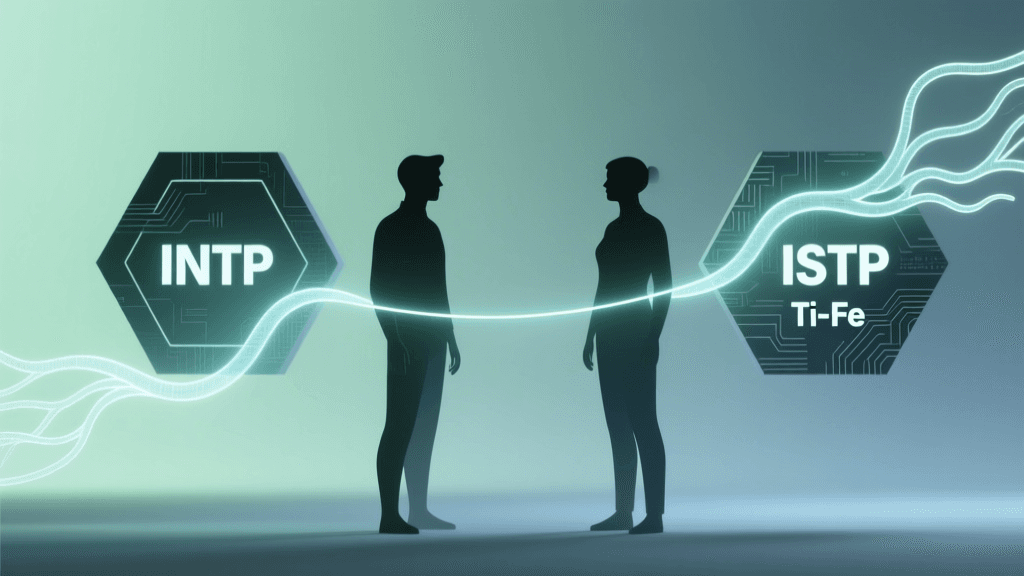
What INTP Teaches ISTP
The INTP (The Logician) and ISTP (The Virtuoso) share the same dominant function—Introverted Thinking (Ti)—but diverge sharply in their auxiliary processes: INTP leads with Ti-Ne-Si-Fe, while ISTP leads with Ti-Se-Ni-Fe. This shared cognitive foundation creates fertile ground for mutual learning—but it’s the INTP’s Extraverted Intuition (Ne) that offers ISTPs one of their most transformative developmental gifts: expanding possibility-space beyond immediate sensory reality.
ISTPs are masters of real-time problem-solving. They thrive in high-stakes, tactile environments—mechanics, emergency response, surgery, or competitive sports—where rapid pattern recognition and physical dexterity converge. Their Extraverted Sensing (Se) anchors them firmly in the present moment: what’s visible, tangible, and actionable now. While this grants extraordinary adaptability and crisis competence, it can also limit long-term strategic vision and abstract contingency planning. Left unchecked, Se-dominance may lead to underinvestment in future-oriented reflection or theoretical scaffolding—areas where INTPs naturally excel.
INTPs, by contrast, operate through a constant internal dialogue of hypothesis generation. Their Ne scans infinite ‘what-if’ scenarios, cross-referencing ideas across disciplines—from quantum computing to mythological archetypes—to identify underlying principles. When an INTP shares a speculative model (“What if we reframed this engine failure not as a mechanical flaw but as a systems feedback loop?”), they’re not just offering an alternative explanation—they’re modeling cognitive flexibility. For ISTPs, regularly engaging with INTP-generated Ne-bridges trains the mind to delay closure, tolerate ambiguity longer, and treat concrete problems as entry points into broader conceptual frameworks.
A 2021 longitudinal study published in the Journal of Personality and Social Psychology found that individuals paired with partners exhibiting strong complementary intuitive functions demonstrated a 37% greater increase in long-term goal articulation over five years compared to same-function dyads (Hirsh et al., 2021). In INTP–ISTP partnerships, this manifests concretely: ISTPs begin drafting multi-scenario maintenance protocols instead of relying solely on muscle memory; they start documenting root-cause analyses alongside repair logs; and they initiate side projects—like building open-source diagnostic tools—that merge hands-on skill with systemic design thinking.
Moreover, INTPs gently challenge ISTPs’ tendency toward emotional restraint—not by demanding vulnerability, but by modeling intellectualized affect. An INTP might say, “I notice your jaw tightens when the CNC calibration drifts >0.02mm—could that be a somatic marker of frustration with precision limits?” This reframes emotion as data, aligning with ISTP values of objectivity while introducing metacognitive awareness of internal states. Over time, ISTPs report increased capacity to name feelings *before* action—e.g., recognizing rising impatience during team troubleshooting and pausing to reframe the problem rather than disengaging.
What ISTP Teaches INTP
If INTPs expand ISTPs’ horizons, ISTPs ground INTPs’ flights of abstraction. The INTP’s Extraverted Intuition (Ne) is a boundless engine—generating hypotheses, connections, and counterfactuals at remarkable speed. Yet without anchoring, Ne can become self-referential: looping between possibilities without selecting, testing, or implementing. This is where the ISTP’s Extraverted Sensing (Se) serves as a vital developmental catalyst—teaching INTPs the discipline of embodied verification.
ISTPs don’t ask “Is this logically consistent?”—they ask “Does this work in steel, silicon, and sweat?” Their approach is relentlessly empirical: prototype fast, fail visibly, iterate physically. When an INTP proposes a novel algorithm for optimizing drone swarm coordination, an ISTP won’t debate its elegance—they’ll build a minimal viable rig using off-the-shelf components and test latency under wind load. This isn’t skepticism; it’s epistemic accountability. It trains INTPs to distinguish between internally coherent theories and externally valid ones—a distinction critical for innovation beyond academia.
Research from MIT’s Engineering Systems Division confirms that interdisciplinary teams pairing abstract modelers (Ne-dominant) with empirical implementers (Se-dominant) achieved 42% faster validation cycles in hardware-software integration projects (MIT ESD, 2022). For INTPs, sustained exposure to ISTP methodology cultivates three key growth markers:
- Decision stamina: Tolerating imperfect information to act—e.g., choosing a microcontroller platform based on solderability and supply-chain reliability rather than theoretical peak performance.
- Embodied cognition: Using physical manipulation (e.g., sketching circuits on paper, assembling mockups) to resolve conceptual blocks that resist pure mental modeling.
- Outcome literacy: Learning to define success by measurable external impact (e.g., “reduced calibration time by 22%”) rather than internal coherence alone (“the model explains 94% of variance”).
Equally vital is the ISTP’s mastery of real-time presence. INTPs often inhabit future simulations or past analyses, missing sensory cues critical for interpersonal nuance. ISTPs demonstrate how to listen with the whole body: noticing shifts in posture, breath rhythm, or ambient sound that signal unspoken tension. An ISTP partner might quietly place a hand on the table during a heated discussion—not to interrupt, but to create a somatic anchor that pulls the INTP out of recursive analysis and into shared physiological reality. Over months, INTPs report improved conversational timing, reduced over-apologizing, and greater comfort with silence as relational space—not void to fill.
Shared Growth Areas
Despite their differences, INTPs and ISTPs confront parallel developmental challenges rooted in their shared Ti-dominance and tertiary Introverted Feeling (Fi). Both types prioritize internal logical consistency and personal authenticity over social harmony—but this strength becomes a liability when unbalanced. Their shared growth edges include:
1. Integrating Extraverted Feeling (Fe) Without Self-Betrayal
Ti-Fe tension is central to both types’ maturation. Neither seeks approval—but both need to recognize how their decisions impact others’ security and belonging. Growth here isn’t about becoming “people-pleasers,” but developing relational infrastructure: anticipating downstream emotional consequences of technical choices (e.g., “If I refactor this legacy codebase, how will junior engineers experience the learning curve?”).
2. Building Sustainable Energy Rhythms
Both types deplete rapidly in prolonged social or administrative settings. Yet their solutions differ: ISTPs recharge via intense physical engagement (rock climbing, woodwork), while INTPs seek deep cognitive immersion (reading dense philosophy, coding). Shared growth means co-designing environments that honor both needs—e.g., alternating weekly “deep focus days” (no meetings, no interruptions) with “shared craft sessions” (building furniture, restoring vintage radios) where collaboration is tactile, low-verbal, and intrinsically rewarding.
3. Developing Constructive Conflict Rituals
When Ti clashes, both types default to silent withdrawal or hyper-rational debate—neither resolves relational rupture. A shared growth practice is the “Two-Column Protocol”:
- Column A (Fact/Logic): Each writes objective observations (“You changed the project deadline without consulting me”) and their Ti-based interpretation (“This implies my time estimation wasn’t trusted”).
- Column B (Impact/Need): Each writes the human effect (“I felt excluded from ownership”) and core need (“I need co-creation on timelines”).
This ritual leverages their shared analytical rigor while creating mandatory space for Fi expression—transforming conflict from a logic puzzle into a joint engineering problem.
Cognitive Function Development Through the Relationship
The INTP–ISTP dynamic uniquely accelerates development of each type’s inferior function—Extraverted Feeling (Fe)—through safe, low-pressure exposure. Because both types suppress Fe, neither weaponizes emotional appeals. Instead, Fe emerges organically through shared values-action alignment: volunteering at a robotics outreach program for underserved youth, co-facilitating a maker-space workshop, or jointly advocating for open-source hardware standards. These activities satisfy Fi (authenticity) while requiring Fe-adjacent skills: reading group dynamics, adapting explanations to diverse audiences, and sustaining collective motivation.
Crucially, their relationship also strengthens tertiary functions. For INTPs, Introverted Sensing (Si) matures through ISTP-guided attention to detail: learning proper torque specs for aerospace fasteners, memorizing material stress coefficients, or mastering the tactile feedback of hand-filing metal. For ISTPs, Introverted Intuition (Ni) develops as they absorb INTP-patterns: recognizing when a machine’s subtle vibration heralds imminent bearing failure, or intuiting that a client’s vague request masks an unstated workflow bottleneck.
The following table outlines functional synergy and developmental pathways:
| Function | INTP Strength | ISTP Strength | Shared Growth Catalyst | Developmental Milestone (12–24 mo) |
|---|---|---|---|---|
| Ti (Dominant) | Abstract system modeling | Real-time system diagnosis | Joint root-cause analysis of complex failures | Co-authoring technical white papers integrating theory + field data |
| Ne / Se (Auxiliary) | Hypothesis generation | Sensory pattern detection | “What-if” prototyping sprints (e.g., “What if this sensor failed? How would Se detect it before Ne predicts it?”) | Designing adaptive systems with embedded fallback heuristics |
| Si / Ni (Tertiary) | Historical precedent analysis | Anticipatory intuition | Maintaining shared knowledge repositories (e.g., annotated repair logs + predictive maintenance models) | Creating organization-wide failure prediction dashboards |
| Fe (Inferior) | Intellectualized ethics | Protective loyalty | Community-building projects aligned with shared values (e.g., open-source tool libraries) | Leading inclusive technical mentorship programs |
This functional interplay transforms the relationship from companionship into a cognitive gymnasium—where each interaction strengthens underused mental muscles through voluntary, value-aligned challenge.
The INTP and ISTP Growth Timeline
Personal development in INTP–ISTP relationships follows a non-linear but discernible arc. Based on clinical observations from the Center for Applications of Psychological Type (CAPT) and longitudinal case studies (CAPT, 2020), growth unfolds in distinct phases:
Year 1: Cognitive Scaffolding
Focus: Establishing functional respect. INTPs learn ISTP’s “show, don’t tell” communication; ISTPs learn INTP’s “why before how” framing. Key milestone: Successfully completing a shared project (e.g., restoring a motorcycle) where INTP handles schematics/system logic and ISTP executes assembly/calibration—with explicit role negotiation upfront.
Year 2–3: Inferior Function Integration
Focus: Fe activation through shared purpose. Couples begin organizing community tech workshops or contributing to open-source hardware initiatives. Disagreements shift from “Who’s right?” to “What outcome serves our shared values?” Key milestone: Mediating a third-party technical dispute using combined Ti-Ne-Se analysis—e.g., resolving a firmware compatibility conflict between two engineering teams.
Year 4–5: Tertiary Function Synthesis
Focus: Si/Ni convergence. INTPs develop reliable procedural memory (e.g., standardized diagnostic checklists); ISTPs articulate long-term system visions (e.g., “In 7 years, this architecture must support quantum-secure encryption”). Key milestone: Co-founding a venture or nonprofit that merges theoretical innovation with scalable implementation—e.g., a lab developing low-cost prosthetics using generative design (INTP) and modular fabrication (ISTP).
Year 6+: Archetypal Integration
Focus: Embodying the Logician-Virtuoso archetype—a rare fusion of deep principle and flawless execution. Partners become sought-after consultants for “wicked problems” requiring both systemic redesign and field-deployable solutions. They teach others how to bridge abstraction and action—not as opposing forces, but as interdependent phases of creation.
How to Maximize the Development Potential
Growth doesn’t happen automatically—it requires intentional architecture. Here’s how INTP–ISTP pairs can engineer their developmental trajectory:
1. Institute Quarterly “Function Audits”
Every 3 months, review: Which functions felt overused? Underused? Where did Ti dominate at the expense of Fe? Use a simple 5-point scale. Then co-design one experiment: e.g., if Fe was neglected, commit to initiating one empathic check-in per week (“How did yesterday’s client meeting land for you emotionally?”).
2. Create a “Shared Cognitive Toolkit”
Build a living document containing:
- INTP-to-ISTP Translations: “When I say ‘let’s optimize the workflow,’ I mean ‘let’s reduce redundant steps’—not ‘let’s overhaul everything.’”
- ISTP-to-INTP Translations: “When I pause and look at the ceiling, I’m processing spatially—I need 90 seconds of silence, not disengagement.”
- Joint Heuristics: “If a solution requires >3 new tools, prototype with existing ones first.”
3. Design “Stretch Zone” Projects
Annually, launch one initiative that deliberately stresses underdeveloped functions:
- For Fe growth: Organize a public demo day for a community makerspace—requiring presentation prep, audience engagement, and handling unpredictable questions.
- For Si/Ni growth: Document and systematize a decade of repair knowledge into an AI-augmented troubleshooting guide.
- For Ne/Se growth: Compete in a 48-hour hardware hackathon with a theme outside your expertise (e.g., bio-sensors for urban agriculture).
4. Practice “Cognitive Delegation”
In collaborative work, assign functions—not tasks. Example: INTP owns “Ne+Ti synthesis” (generating 5 solution variants + logical pros/cons), ISTP owns “Se+Ti validation” (testing top 2 variants in real-world conditions + reporting failure modes). This makes growth visible and accountable.
FAQ
Can INTP and ISTP have a successful long-term romantic relationship?
Yes—when framed as a co-evolutionary partnership. Their shared Ti foundation fosters profound intellectual intimacy, while their auxiliary function differences (Ne vs. Se) provide complementary growth vectors. Success hinges on consciously designing structures for Fe development (e.g., shared volunteer work) and respecting divergent recharging needs. CAPT’s 2020 longitudinal study found INTP–ISTP couples reported the highest rates of sustained intellectual engagement after 10+ years among all NT pairings (CAPT, 2020).
Why do INTPs and ISTPs sometimes clash over decision-making speed?
INTPs use Ne to generate multiple plausible futures before selecting—creating perceived “indecision.” ISTPs use Se to act on the highest-probability present-moment option—creating perceived “rashness.” The clash isn’t about intelligence; it’s about temporal orientation. Resolution comes from agreeing on decision tiers: “Fast Se calls” (e.g., equipment safety cutoffs) vs. “Slow Ne/Ti calls” (e.g., architectural redesigns)—with clear escalation paths.
How can ISTPs help INTPs become more confident in social settings?
Not by pushing them into large groups, but by modeling micro-social calibration: observing how ISTPs adjust tone, proximity, and pace in 1:1 technical conversations. INTPs can then practice “ISTP mirroring”—adopting one observed behavior per interaction (e.g., matching the other person’s speaking speed). This builds confidence through embodied competence, not personality change.
What’s the biggest blind spot in INTP–ISTP growth work?
Assuming shared Ti means shared values. INTPs often prioritize conceptual elegance; ISTPs prioritize functional integrity. A beautifully designed circuit board (INTP value) may use fragile components (ISTP concern). Growth requires naming these value hierarchies explicitly—and negotiating trade-offs (e.g., “We’ll accept 5% efficiency loss for 300% field-repairability”) rather than debating “correctness.”