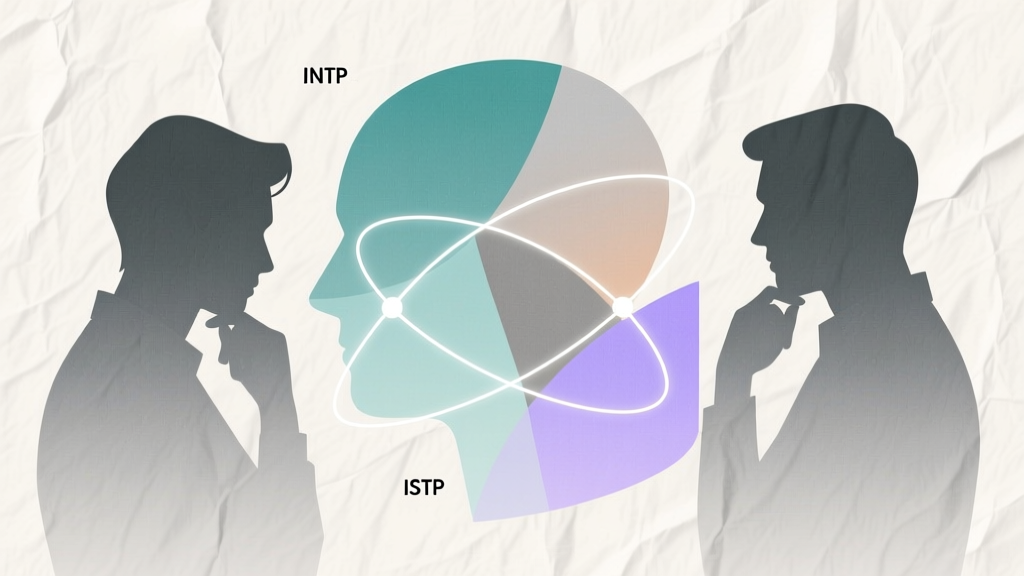
How INTP Handles Stress
The INTP (Introverted, Intuitive, Thinking, Perceiving) personality type—often dubbed the Logician—approaches stress with a distinct cognitive rhythm rooted in their dominant function, Introverted Thinking (Ti), supported by auxiliary Extraverted Intuition (Ne). Under pressure, INTPs retreat inward to analyze, deconstruct, and reframe problems logically. However, when stress intensifies beyond manageable thresholds, their inferior function—Extraverted Feeling (Fe)—emerges in unhealthy ways: emotional volatility, hypersensitivity to criticism, social withdrawal, or sudden outbursts of uncharacteristic sentimentality.
Common stress responses include:
- Over-analysis paralysis: Replaying scenarios endlessly without reaching closure;
- Intellectual detachment: Dismissing emotions as ‘irrational noise’ while ignoring physical fatigue or relational strain;
- Ne-driven catastrophizing: Jumping from one hypothetical worst-case scenario to another (“If this fails, then my entire worldview collapses…”);
- Withdrawal into abstraction: Escaping into theoretical frameworks, obscure research, or niche hobbies to avoid real-world demands.
Crucially, INTPs rarely signal distress overtly. Their stress is often silent—marked not by anger but by prolonged silence, missed deadlines, or a subtle flattening of tone and expression. As psychologist Dario Nardi notes in Neuroscience of Personality, INTPs show heightened activity in the prefrontal cortex during problem-solving—but under chronic stress, this same region becomes hyperactive and inefficient, leading to mental exhaustion rather than clarity (ResearchGate, 2017).
Without external grounding, INTPs risk spiraling into what Myers-Briggs experts call the Ti-Ne loop: a self-reinforcing cycle where internal logic feeds speculative possibilities, which in turn demand more logic—leaving no room for embodied presence or emotional calibration.
How ISTP Handles Stress
The ISTP (Introverted, Sensing, Thinking, Perceiving)—the Virtuoso—processes stress through their dominant function, Introverted Thinking (Ti), paired with auxiliary Extraverted Sensing (Se). Where the INTP retreats into abstract models, the ISTP responds to stress with acute sensory engagement: fixing things, taking action, testing limits, or physically removing themselves from triggering environments. Their stress response is kinetic, pragmatic, and grounded in the immediate, tangible world.
Under pressure, ISTPs may exhibit:
- Hyper-focus on mechanics: Disassembling gadgets, tuning cars, or mastering new tools as a way to regain control;
- Sensory escapism: Extreme sports, late-night drives, or immersive hands-on projects to discharge nervous energy;
- Emotional shutdown: A visible ‘cooling off’—reduced eye contact, clipped speech, avoidance of discussion about feelings;
- Ti-dominant rigidity: Insisting on ‘what works’ while dismissing alternative approaches—even supportive ones—as inefficient or irrelevant.
Like INTPs, ISTPs suppress their inferior function—Extraverted Feeling (Fe)—but its eruption manifests differently: not as tearful overwhelm, but as blunt criticism, sarcasm, or abrupt disengagement from people they care about. According to the Myers & Briggs Foundation, ISTPs under chronic stress may misinterpret empathetic gestures as intrusions, perceiving concern as condescension or interference (MyersBriggs.org, Stress and the MBTI Type).
Unlike INTPs, ISTPs rarely overthink outcomes—they under-think them. Their blind spot lies not in abstraction but in long-term emotional consequence: they may solve the immediate crisis flawlessly while inadvertently damaging trust, missing relational cues, or overlooking cumulative strain on their partner.
The INTP and ISTP Stress Dynamic
At first glance, INTPs and ISTPs appear highly compatible: both are analytical, independent, low-drama thinkers who value competence, autonomy, and intellectual honesty. Yet their shared Ti-dominance creates a unique stress synergy—one that can either reinforce resilience or deepen isolation if left unexamined.
When both types are stressed simultaneously, their natural coping mechanisms can unintentionally clash:
- The INTP seeks quiet space to rethink the situation—mapping variables, identifying logical inconsistencies, and seeking conceptual resolution.
- The ISTP seeks active space to reset the situation—moving their body, fixing something broken, or changing scenery to restore equilibrium.
This divergence often leads to misunderstanding. The ISTP may interpret the INTP’s silence as disengagement or passive aggression; the INTP may read the ISTP’s sudden departure or hands-on distraction as avoidance or emotional immaturity. Neither is true—but both perceptions erode connection unless named and navigated intentionally.
A telling pattern emerges in high-stress dyads: the INTP begins asking ‘Why did this happen? What underlying principle was violated?’ while the ISTP asks ‘What can I do right now to make it work again?’ Without translation between these frames, dialogue stalls. The INTP feels unheard because their need for causal coherence isn’t met; the ISTP feels frustrated because their offer of practical help is dismissed as superficial.
Compounding this is their shared aversion to Fe-expression. Both types instinctively mute emotional signaling—not out of indifference, but because expressing vulnerability feels cognitively inefficient or socially risky. Over time, this mutual suppression can create an emotional vacuum: neither initiates reassurance, neither names fear or fatigue, and small tensions accumulate beneath a surface of calm competence.
To illustrate these complementary yet potentially conflicting stress behaviors, consider the following comparison table:
| Stress Dimension | INTP Response | ISTP Response | Potential Friction Point |
|---|---|---|---|
| Time Orientation | Future-focused: analyzes ripple effects, long-term implications, systemic flaws | Present-focused: attends to immediate stimuli, physical environment, actionable levers | INTP perceives ISTP as short-sighted; ISTP sees INTP as paralyzed by hypotheticals |
| Energy Restoration | Deep solitude + abstract immersion (reading, coding, theoretical writing) | Physical movement + tactile engagement (mechanics, hiking, cooking, DIY) | One’s rest feels like the other’s avoidance—or vice versa |
| Communication Style Under Duress | Withdrawn, indirect, uses irony or dense metaphors to veil discomfort | Blunt, terse, may use humor or sarcasm to deflect emotional weight | Misinterpretation of tone escalates conflict; neither hears the care beneath the words |
| Trust-Repair Strategy | Needs logical consistency restored—explanations, transparency, alignment of values | Needs demonstrated reliability—follow-through, competence, tangible proof of commitment | INTP waits for an apology framed in principle; ISTP offers repair via action, not articulation |
This dynamic isn’t inherently dysfunctional—it’s simply untranslated. When both partners understand that their stress languages differ not in intent but in architecture, they gain access to a powerful mutual support system: the INTP’s capacity for structural insight complements the ISTP’s talent for real-time adaptation.
Supporting Each Other During Hard Times
Effective mutual support between INTPs and ISTPs doesn’t require becoming more like each other—it requires functional bilingualism in stress communication. Below are concrete, field-tested strategies, organized by role and timing.
For the INTP: Supporting Your ISTP Partner
- Respect the ‘action buffer’: If your ISTP disappears to rebuild a motorcycle or go trail running after a stressful meeting, don’t assume abandonment. Ask once—gently—“Do you need space to reset, or would it help to talk it through?” Then honor their answer without negotiation. This respects their Se need for sensory recalibration.
- Translate your insights into executable steps: Instead of saying, “Our budget shortfall reflects deeper misalignment in our financial values,” try: “Here’s a spreadsheet showing three options—Option A fixes cash flow in 2 weeks; Option B requires one call to our accountant tomorrow.” ISTPs engage most readily with clear cause-effect chains and defined next actions.
- Offer low-pressure presence, not interrogation: Sit beside them while they tinker or sketch—not to talk, but to share quiet attunement. ISTPs feel safest when support is embodied, not verbalized. A shared cup of coffee while they solder a circuit board communicates more than ten ‘How are you?’ texts.
For the ISTP: Supporting Your INTP Partner
- Create ‘thinking containers’: Designate a physical or temporal space where the INTP can retreat without guilt—e.g., “The library desk is yours until 7 p.m.,” or “I’ll take the dog out solo tonight so you can write uninterrupted.” Protecting cognitive bandwidth is an act of love.
- Ask open-ended, non-judgmental questions: Replace “What’s wrong?” with “Want to walk through your reasoning on this?” or “Is there a piece of this puzzle you’d like me to help test?” This validates their Ti process without demanding emotional disclosure.
- Signal safety before diving deep: Before initiating a vulnerable conversation, ground it in shared reality: “I noticed you’ve been quiet since yesterday’s call. I’m not trying to fix it—I just want to understand your take. No pressure to respond now.” This lowers the Fe-inferior activation threshold.
Joint Practices for Shared Stress Resilience
- The 15-Minute Sync: Once weekly, schedule 15 minutes—no devices, no agenda—to exchange one thing each is proud of having figured out (INTP) and one thing each successfully fixed or built (ISTP). This reinforces mutual competence and positive neurochemical feedback loops.
- Stress-Response Mapping: Co-create a shared document titled “Our Stress Signals.” List observable behaviors (e.g., INTP: stops initiating plans; ISTP: starts cleaning obsessively) and agreed-upon responses (e.g., “If I close my notebook and stare at the wall for >5 min, bring me tea and say nothing”). Normalize stress as data—not failure.
- Externalize the Loop: When you sense either of you entering Ti-Ne overanalysis or Ti-Se impulsivity, name it aloud: “I think we’re in the loop—want to pause and breathe for 60 seconds?” or “Let’s table this for 90 minutes and come back with fresh input.” External naming disrupts automatic patterns.
These practices succeed because they honor core needs without demanding personality change. As clinical psychologist Dr. Elaine Aron affirms in her research on highly sensitive individuals—and by extension, deeply thinking types—safe, predictable support structures reduce cortisol spikes and improve cognitive flexibility (HSPerson.com Research Archive).
Caregiver and Receiver Patterns
In INTP–ISTP relationships, traditional ‘caregiver’ roles rarely apply—and that’s a strength. Neither type naturally assumes the nurturing, emotionally expressive archetype associated with Fe-dominant types (e.g., ENFJ or ESFJ). Instead, caregiving emerges through competence-based stewardship: protecting cognitive freedom, ensuring physical safety, and maintaining environmental order.
Consider these real-world caregiver expressions:
- The ISTP as Cognitive Guardian: Notices when the INTP hasn’t slept well, quietly reorganizes their workspace to eliminate friction points, or handles household logistics (bills, repairs, scheduling) so the INTP’s mental bandwidth stays intact. Their care is operational, not performative.
- The INTP as Integrity Steward: Researches evidence-based health protocols before the ISTP undergoes a medical procedure, drafts clear boundary statements for shared family communications, or designs a personalized productivity system that honors the ISTP’s need for autonomy and mastery. Their care is architectural.
Receiver patterns follow similar logic. An ISTP receiving care doesn’t want pep talks—they want their tools sharpened, their schedule protected, and their autonomy affirmed. An INTP receiving care doesn’t want platitudes—they want their ideas taken seriously, their contradictions held without judgment, and their need for silence treated as sacred.
Where tension arises is in mismatched expectations. For example:
“I changed the oil in his car and fixed the leaky faucet—why does he still seem distant?”
—ISTP, expecting appreciation for tangible labor
“I spent hours mapping every variable in our decision—why does she keep asking if I’m ‘sure’?”
—INTP, expecting validation of intellectual rigor
The resolution lies not in changing behavior—but in annotating intention. After completing a task, the ISTP can add: “I did this because I wanted you to have bandwidth for your project.” The INTP, after sharing analysis, can clarify: “I’m not asking you to agree—I’m sharing this so we’re operating from the same map.” These micro-translations build relational literacy.
Importantly, both types must guard against the competence trap: equating caregiving solely with problem-solving. True support includes tolerating uncertainty, sitting with unanswerable questions, and holding space for feelings that defy logic. As licensed marriage and family therapist Esther Perel observes, “Intimacy begins where certainty ends” (EstherPerel.com, Mating in Captivity). For INTP–ISTP pairs, practicing non-instrumental presence—just being together without agenda—is perhaps the most radical act of care.
Building a Resilient Partnership
Resilience in INTP–ISTP partnerships isn’t forged in grand gestures—it’s woven through thousands of micro-coordinations: the ISTP handing the INTP a notebook without speaking; the INTP pausing mid-theory to ask, “Want me to heat up soup?”; the shared glance across a crowded room that says, I see your stress, and I trust your process.
Three pillars sustain long-term resilience:
1. Cognitive Scaffolding
Design shared systems that reduce decision fatigue and honor divergent processing styles. Examples:
- A rotating ‘decision authority’ calendar: For one week, INTP owns strategic choices (e.g., career moves, investments); ISTP owns tactical execution (e.g., home maintenance, travel logistics). Roles swap weekly.
- A ‘low-bandwidth’ communication channel: A shared note app where each drops brief, unedited updates (“Ran diagnostics—issue is X”; “Drafted three solutions—leaning toward Y”). No expectation of reply.
2. Embodied Co-Regulation
Because both types default to cognitive regulation, intentional somatic practices counterbalance stress physiology. Try:
- Walking debates: Discuss complex topics while walking side-by-side—not face-to-face—to lower defensiveness and stimulate bilateral brain integration.
- Tool-passing rituals: The ISTP teaches the INTP to use a multimeter; the INTP teaches the ISTP basic Python scripting. Skill-sharing builds mutual respect and activates mirror neuron pathways linked to empathy (NIH, 2013).
3. Values-Based Anchoring
Clarify and codify shared core values—not as abstract ideals, but as behavioral commitments. For example:
- Autonomy: “We will never schedule overlapping obligations without explicit consent.”
- Truthfulness: “We commit to naming discomfort within 24 hours—even if only to say, ‘I need time to process.’”
- Competence: “We will celebrate skill acquisition—not just outcomes. Learning matters more than perfection.”
Revisit these anchors quarterly—not to judge adherence, but to refine language and deepen shared meaning. This transforms stress from a threat to a catalyst for alignment.
Ultimately, the INTP–ISTP bond thrives not despite their shared Ti dominance—but because of it. Two strong, independent minds, when equipped with mutual translation tools, form a uniquely stable platform: one that thinks deeply, acts decisively, and holds space for complexity without collapsing into chaos.
FAQ
How do INTPs and ISTPs apologize to each other effectively?
An effective apology between INTPs and ISTPs avoids emotional theatrics and centers on causal accountability and tangible redress. The INTP should name the specific logic gap or oversight (“I failed to account for the timeline impact—that was a Ti error”) and propose a structural fix (“I’ll build a dependency map for future projects”). The ISTP should specify the action that caused rupture (“I shut down during your presentation instead of asking clarifying questions”) and demonstrate correction (“I’ve scheduled 30 minutes tomorrow to review your slides with focused questions”). Neither needs to say “I’m sorry I hurt you”—they show repair through precision and follow-through.
Can INTP–ISTP couples handle major life stressors like illness or job loss?
Yes—with higher success rates than many type pairings, provided they leverage their complementary strengths. Research from the American Psychological Association shows that couples with strong problem-solving cohesion and low emotional reactivity recover faster from acute stressors (APA Resilience Resources). INTPs excel at scenario planning and resource optimization; ISTPs shine in crisis execution and adaptive improvisation. Their challenge lies in synchronizing pace: the INTP may need days to model recovery pathways; the ISTP may act within hours. Bridging this requires pre-agreed protocols—e.g., “In emergencies, ISTP takes first 48-hour lead; INTP delivers strategic plan by Day 3.”
What’s the biggest misconception about INTP–ISTP stress compatibility?
The biggest misconception is that their similarity makes support effortless. In truth, shared Ti dominance is a double-edged sword. It enables rapid intellectual rapport—but also creates blind spots around emotional signaling, mutual withdrawal escalation, and unspoken expectations. Compatibility isn’t automatic; it’s co-created through deliberate stress-language education. As MBTI researcher Linda V. Berens writes, “Type similarity increases efficiency—but difference increases adaptability. The most resilient partnerships cultivate both” (CognitiveProcesses.com).
How can we prevent stress from eroding our intimacy over time?
Intimacy erosion occurs not from stress itself—but from untranslated stress signals. Prevent it by instituting two non-negotiable habits: (1) Weekly Calibration: 20 minutes to review: “What drained my cognitive/emotional reserves this week? What restored them? What did I misread in you?” (2) Shared ‘Low-Stakes’ Creation: Build, code, write, or design something trivial together—no outcome required. The act of co-creating without performance pressure rebuilds neural pathways associated with safety and play. Neuroscience confirms that collaborative creation triggers oxytocin release and dampens amygdala reactivity (Neuroscience & Biobehavioral Reviews, 2021).