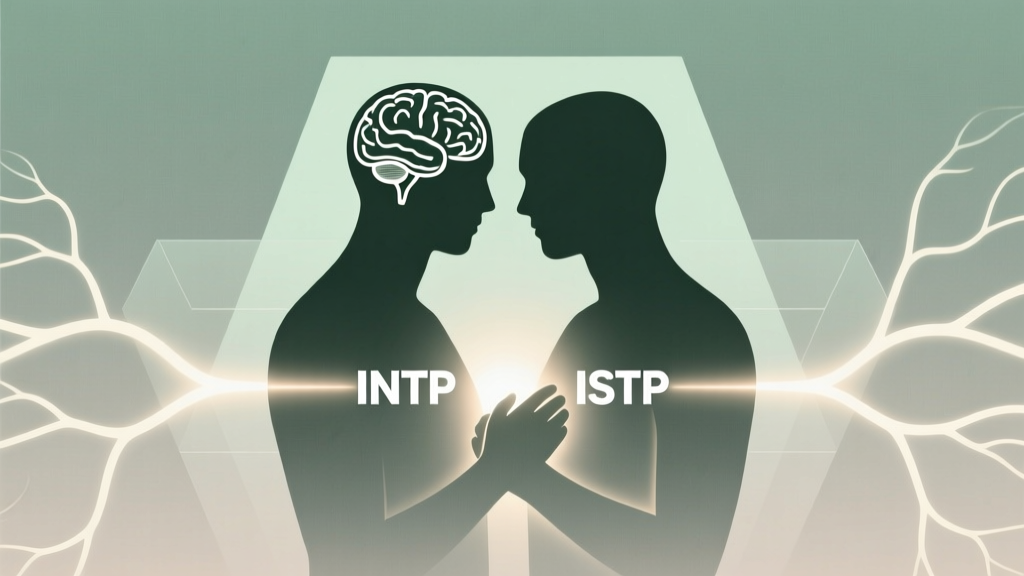
How INTP Builds Trust
For the INTP—the quiet architect of ideas—trust is not granted through charisma, shared experiences, or even consistent affection. It is earned through intellectual coherence, reliability in logic, and demonstrated respect for autonomy. INTPs are described by The Myers & Briggs Foundation as deeply skeptical of unexamined claims, emotionally reserved, and highly attuned to internal consistency. Their trust-building process is slow, deliberate, and fundamentally cognitive before it becomes emotional.
An INTP begins assessing trustworthiness by observing whether a person’s words align with their actions—and whether those actions follow an internally logical pattern. If someone says they value honesty but repeatedly avoids difficult conversations, the INTP registers dissonance—not as moral failure, but as evidence of unreliable reasoning. This isn’t judgmental; it’s diagnostic. As psychologist Dario Nardi explains in Neuroscience of Personality, INTPs show heightened activity in the brain’s prefrontal cortex during social evaluation—meaning they literally think through trust before feeling it.
Emotionally, INTPs build trust incrementally through low-stakes disclosures. They may share a nuanced critique of a film or a theoretical paradox before revealing personal insecurities. Each disclosure functions like a test: Will this person engage thoughtfully? Will they misinterpret my intent? Will they use this information to define me rather than understand me? When responses are curious, non-reactive, and respectful of ambiguity, the INTP feels safer. But if met with premature advice, emotional pressure, or attempts to “fix” their thoughts, they retreat—not out of coldness, but self-preservation.
Crucially, INTPs do not equate time spent together with trust earned. A year of casual friendship may yield less trust than three meaningful, idea-rich conversations that reveal integrity, humility, and intellectual generosity. Their loyalty, once secured, is profound—but it must be anchored in mutual respect for mental sovereignty.
How ISTP Builds Trust
The ISTP—the pragmatic explorer—builds trust through competence, authenticity, and tangible proof. According to The Center for Applications of Psychological Type (CAPT), ISTPs rely heavily on Sensing (S) and Thinking (T), grounding their judgments in observable reality and cause-effect relationships. For them, trust is less about abstract alignment and more about demonstrable reliability: Can you handle a flat tire at midnight? Do you follow through on what you say you’ll do? Do you speak plainly—or hedge and perform?
ISTPs distrust performative warmth. A smile that doesn’t match eye contact, overpromising without follow-through, or emotional grandstanding all register as red flags—not because ISTPs dislike emotion, but because such behaviors violate their core value of authenticity. As noted in the Journal of Personality Assessment, ISTPs score significantly higher than average on measures of behavioral consistency and lower on impression management—meaning they prioritize being real over being liked.
They build trust through shared action: fixing something together, navigating an unfamiliar city without GPS, surviving a sudden rainstorm with improvised shelter. In these moments, competence speaks louder than compliments. An ISTP notices whether their partner remains calm under pressure, adapts without panic, and respects boundaries—even when adrenaline is high. Verbal affirmations matter less than steady presence and functional collaboration.
Emotionally, ISTPs disclose vulnerability only after establishing safety via physical or practical co-regulation. They might reveal a childhood fear while teaching someone to ride a bike—not in a therapy session, but mid-pedal, when laughter and motion lower defenses. Their emotional language is often metaphorical (“I felt like my brakes failed”) or embodied (“My shoulders locked up”). They rarely lead with feelings—but when they do, it’s because the context has proven safe enough for risk.
The Trust Timeline for INTP and ISTP
While both types are introverted, thinking-dominant, and judging-averse (Perceiving), their pathways to trust unfold on markedly different timelines—and at different speeds. Understanding this mismatch is essential to avoiding mutual frustration.
Below is a comparative timeline illustrating typical trust milestones for each type—and how they intersect in a dyad:
| Stage | INTP Trust Milestone | ISTP Trust Milestone | Joint Indicator of Progress |
|---|---|---|---|
| Weeks 1–4 | Evaluates logical consistency in conversation; notes contradictions or evasiveness | Observes reliability in small commitments (e.g., showing up on time, returning a borrowed tool) | Both engage in low-stakes, skill-based interaction (e.g., assembling furniture, debugging software) |
| Months 2–3 | Shares a mildly personal theory (e.g., “I think grief is just cognitive restructuring”) | Allows partner to witness a minor stress response without masking (e.g., sighing, stepping outside to reset) | First unplanned joint problem-solving moment—no agenda, no performance, just mutual focus on a shared challenge |
| Months 4–6 | Asks for genuine feedback on an idea—not for validation, but for refinement | Invites partner into a personal ritual (e.g., weekly trail run, garage tinkering session) | Comfort with comfortable silence; ability to sit side-by-side doing separate tasks without tension |
| Months 7–12 | Discloses a past failure with analytical reflection—not shame, but learning | Shares a memory tied to sensory detail (e.g., “The smell of pine resin reminds me of when I rebuilt my first motorcycle”) | Willingness to co-create something new—e.g., designing a custom app interface, drafting a zine, building a piece of furniture from scratch |
| Year 2+ | Initiates vulnerable questions about values, ethics, or identity without framing them as hypotheticals | Expresses care through acts of functional support (e.g., optimizing partner’s workflow, quietly fixing a recurring tech issue) | Shared language emerges—inside references, hybrid metaphors (“That meeting was like debugging legacy code”), intuitive rhythm in conflict resolution |
This timeline reveals a critical insight: INTPs begin with cognition and gradually descend into embodiment; ISTPs begin with embodiment and gradually ascend into abstraction. Their convergence happens not at the midpoint—but in the shared space of applied meaning: where ideas meet action, and action reveals intention.
Vulnerability Patterns and Emotional Walls
INTPs and ISTPs both guard their inner worlds fiercely—but their emotional walls are constructed from different materials and defended with distinct strategies.
INTP Walls: Built from layers of conceptual insulation. The INTP’s primary defense is intellectual displacement—reframing emotional discomfort as a puzzle to solve, a system to model, or a paradox to hold. When hurt, they may write a 2,000-word essay on attachment theory instead of saying, “I felt abandoned.” Their wall isn’t silence—it’s verbosity with emotional bypassing. As clinical psychologist Dr. Dan Siegel observes in Mindsight, this pattern reflects underdeveloped interoceptive awareness—the ability to sense and name internal states. Without that anchor, emotion becomes data to analyze, not experience to inhabit.
ISTP Walls: Constructed from functional pragmatism. The ISTP’s default shield is behavioral compartmentalization: separating emotion from operation. They’ll calmly change a flat tire while suppressing panic, then later report, “My hands were shaking, but the lug nuts came off fine.” Their wall isn’t denial—it’s decoupling. Emotions are acknowledged only when they interfere with function. This stems from strong somatic awareness paired with low affective labeling—a trait validated in a 2019 study published in Frontiers in Psychology linking Sensing dominance to superior bodily signal detection but reduced verbal emotional granularity.
When these walls interact, friction arises not from opposition—but from misalignment:
- The INTP analyzes the ISTP’s stoicism as emotional avoidance—missing its role as regulatory strategy.
- The ISTP interprets the INTP’s theoretical tangents as evasion—overlooking their function as scaffolding for emotional risk.
- Both mistake each other’s processing styles for disengagement, when in fact they’re deeply engaged—just in non-overlapping bandwidths.
The breakthrough occurs when each learns to translate the other’s language:
- For the INTP: Replace “What do you feel?” with “What did your body do just now?” or “What action would make this situation feel more workable?”
- For the ISTP: Replace “Just tell me what’s wrong” with “Would it help to walk through the sequence of what happened?” or “Is there a part of this you’d want to prototype or test?”
These reframes honor both types’ native intelligences—cognitive architecture for the INTP, kinesthetic logic for the ISTP—while creating bridges into shared emotional territory.
Deepening Intimacy Between INTP and ISTP
Intimacy between INTP and ISTP flourishes not in confessional dialogue or romantic grand gestures—but in co-created competence. This is where their shared Perceiving (P) preference becomes a superpower: both resist rigid scripts, embrace iterative learning, and find joy in emergent understanding.
Actionable Strategies for Deepening Intimacy:
1. Design Shared Micro-Experiments
Instead of committing to vague goals like “be more open,” co-design tiny, reversible experiments grounded in both types’ strengths:
- “Curiosity Swap” (15 mins/week): Each writes one non-emotional question they’ve been pondering (e.g., “Why do analog watches still feel ‘real’?” or “What’s the optimal torque for a carbon-fiber bolt?”). They exchange and respond—not to answer, but to explore assumptions, exceptions, and implications.
- “Silent Build Session” (biweekly): Choose a small physical project (e.g., soldering a circuit board, restoring a vintage lamp). No talking required—just parallel focus. Afterwards, debrief with one sentence each: “What surprised me was…”
2. Create a “Functional Affection” Lexicon
Develop personalized, action-based expressions of care that bypass emotional pressure:
- INTP → ISTP: “I optimized your bookmark folder. Here’s the logic tree I used.” (Demonstrates attention + utility)
- ISTP → INTP: “I replaced the thermal paste on your laptop. Benchmark results attached.” (Demonstrates care + precision)
Over time, these acts accrue emotional weight—not because they’re labeled “love,” but because they prove sustained, attentive regard.
3. Practice “Embodied Hypothesis Testing”
Leverage the INTP’s love of theory and the ISTP’s mastery of sensation:
“Let’s test the hypothesis: Mindful breathing changes reaction time during surprise stimuli. You design the protocol; I’ll execute the trials and log biometrics.”
This merges abstract inquiry with somatic engagement—making vulnerability collaborative, measurable, and low-risk.
4. Establish “Non-Negotiable Neutral Zones”
Agree on spaces/times where neither must perform emotional labor:
- No expectations to “check in” during solo coding sessions or mechanical work
- A shared playlist titled “No Interpretation Zone”—music chosen purely for texture, not lyrical meaning
- A physical object (e.g., a specific notebook, wrench, or mug) that signals: This is for pure function. No translation required.
These zones reduce ambient anxiety—freeing energy for intentional connection elsewhere.
Research from the Gottman Institute confirms that stable relationships aren’t defined by constant emotional transparency, but by “bids for connection” that are consistently honored—even in minimalist forms. For INTP/ISTP pairs, a well-timed tool handed across a workbench or a single annotated paragraph emailed at 2 a.m. can carry more relational weight than hours of forced heart-to-hearts.
Rebuilding Trust After a Breach
When trust fractures between INTP and ISTP, repair requires honoring both types’ non-negotiables: the INTP’s need for causal clarity and the ISTP’s need for functional restitution.
Step 1: Deconstruct the Breach—Together, Not Alone
The INTP will want to map the logical chain: What assumption was violated? What precedent was broken? What systemic flaw enabled it? The ISTP will want to identify the operational failure: What action was missing? What boundary was crossed? What tangible consequence followed? Rather than debating “who’s right,” co-author a Breach Anatomy Report:
- Fact Layer: What objectively occurred? (e.g., “You missed our scheduled call and didn’t reschedule.”)
- Function Layer: What practical impact did it have? (e.g., “Delayed prototype testing by 48 hrs; increased my cognitive load tracking dependencies.”)
- Framework Layer: What underlying principle felt threatened? (e.g., “Reliability as a foundation for autonomous collaboration.”)
Step 2: Co-Design a Restitution Protocol
Abstract apologies stall progress. Instead, agree on concrete, repeatable actions:
- If the breach involved unreliability: Implement a shared digital “commitment ledger” with auto-reminders and transparent status updates.
- If it involved emotional dismissal: Introduce a “pause token”—a physical object either can place on the table to halt conversation and initiate a 10-minute sensory reset (e.g., cold water, tactile object, timed breathwork).
- If it involved boundary violation: Draft a “Collaboration Charter” outlining decision rights, information access levels, and escalation paths—reviewed quarterly.
Step 3: Measure, Don’t Assume
Both types distrust subjective reassurance. Replace “I’ll do better” with verifiable metrics:
- “I will send a 3-word status update (e.g., ‘On track,’ ‘Delayed,’ ‘Blocked’) by 5 p.m. daily for next 14 days.”
- “I will initiate one ‘Curiosity Swap’ per week for the next month—no analysis required, just exchange.”
Gottman’s research shows that couples who rebuild trust fastest don’t focus on erasing the past—but on creating new, reliable neural pathways through repeated, predictable positive interactions. For INTP/ISTP pairs, those pathways are built in the workshop, the lab, the hiking trail—not the living room couch.
FAQ
Why does my INTP partner withdraw after I share something emotional?
Not as rejection—but as cognitive recalibration. INTPs process emotion through analysis, not immediate resonance. When you say, “I’m scared about the job interview,” their mind races to variables: What’s the success probability? What preparation gaps exist? What’s the worst-case scenario’s actual cost? Their silence isn’t indifference—it’s active modeling. Wait 20–90 minutes, then ask: “What’s one variable you’d want to optimize first?” That invites collaboration, not interrogation.
How do I know if my ISTP truly trusts me?
Look for functional invitations—not verbal declarations. Trust manifests as:
- Sharing tools without instruction (implying confidence in your competence)
- Letting you navigate during a drive (ceding control of spatial execution)
- Leaving half-finished projects accessible (signaling belief in your respect for process)
As CAPT notes, ISTPs express commitment through “demonstrated capability, not stated devotion”.
Can INTP/ISTP relationships sustain long-term emotional depth?
Yes—but depth looks different. It’s not cathartic confessionals; it’s layered understanding built over years of co-problem-solving. Think of it like a well-engineered bridge: invisible stresses distribute across thousands of rivets, not one dramatic arch. Studies on long-term partnerships show that shared competence predicts relationship longevity more strongly than shared values or personality similarity. INTP/ISTP pairs excel here—when they recognize their synergy as a feature, not a flaw.
What’s the biggest threat to INTP/ISTP trust?
Well-intentioned emotional pressure. Pushing for “more sharing,” scheduling “vulnerability dates,” or interpreting silence as disconnection activates both types’ defenses. The greatest act of trust you can offer is respecting their native languages—giving the INTP space to think, the ISTP space to act, and creating rituals where those languages converge: a shared sketchbook, a collaborative GitHub repo, a garden plot tended in parallel silence. In that convergence, intimacy isn’t declared—it’s engineered, tested, and refined.