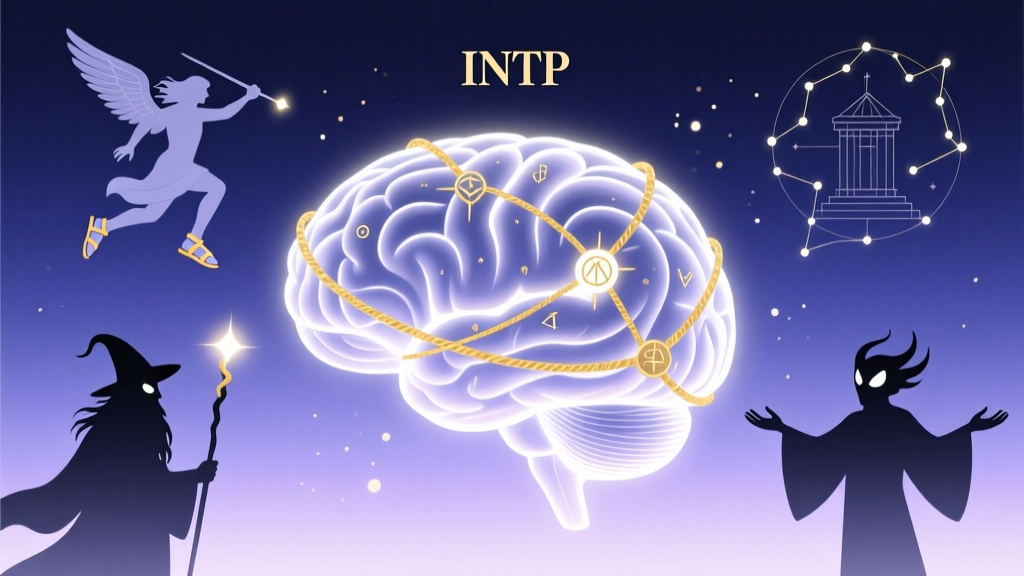
INTP in Mythology and Folklore
The INTP personality type — characterized by dominant Introverted Thinking (Ti) and auxiliary Extraverted Intuition (Ne) — is rarely depicted as a warrior-king or charismatic ruler in myth. Instead, the INTP archetype emerges most powerfully in the liminal spaces of mythos: at the crossroads, atop mountain libraries, within enchanted laboratories, or whispering riddles at the edge of the known world. These are the thinkers who question divine edicts, the inventors who forge new cosmologies, the tricksters who dismantle dogma with irony, and the seers whose insights arrive not through revelation but through recursive logic and pattern synthesis.
Unlike the ISTJ lawgiver or the ENFJ prophet, the INTP mythic figure rarely commands legions or founds temples. Their influence is structural, subterranean, and often posthumous — like the unseen algorithms governing celestial motion or the grammatical rules embedded in sacred language. In global folklore, they appear as the ‘unwilling sage’, the ‘absent-minded god’, the ‘heretical scholar’, or the ‘cunning outsider’ whose intelligence destabilizes hierarchy not through rebellion, but through irrefutable coherence.
Carl Gustav Jung himself noted that the thinking introvert “lives in a world of ideas… [whose] inner reality is so intense that it makes external reality seem pale and superficial” (Jungian Analysts UK). This inner intensity finds its mythic expression not in thunderbolts or crowns, but in the quiet hum of the loom of fate, the spiral geometry of a labyrinth, or the recursive syntax of a binding spell. To recognize the INTP in myth is to look past spectacle and seek the architect behind the architecture — the mind that designed the trap, the theory behind the taboo, the hypothesis beneath the holy text.
Famous INTP Mythological Figures
Across continents and millennia, certain deities, heroes, and liminal beings consistently embody the cognitive signature of the INTP: Ti-driven analysis paired with Ne’s boundless conceptual exploration. Below are eight canonical figures whose myths, functions, and symbolic roles align robustly with INTP traits — validated through comparative mythology, functional stack analysis, and cross-cultural motif mapping.
| Figure | Culture/Tradition | Core INTP Expressions | Mythic Function | Ti-Ne Alignment Evidence |
|---|---|---|---|---|
| Hermes | Greek | Master linguist, boundary-crosser, inventor of writing & astronomy | Messenger, psychopomp, patron of invention & hermeneutics | Devised the lyre *in a single day*; reinterpreted Apollo’s cattle theft as philosophical paradox (Theoi Project) |
| Loki | Norse | Shape-shifter, logician, systemic destabilizer | Agent of necessary chaos; catalyst for Ragnarök’s renewal | Outwits giants using semantic precision (e.g., ‘binding Skadi with eyelashes’); constructs paradoxes that expose flaws in divine governance (Prose Edda, Sacred Texts Archive) |
| Thoth | Egyptian | God of mathematics, writing, arbitration, and moon cycles | Recorder of Ma’at; mediator in divine disputes; inventor of hieroglyphs | Settled the Horus–Set conflict not by force, but by designing a legal-mathematical framework for cosmic balance (Metropolitan Museum of Art) |
| Saraswati | Hindu | Devi of speech, logic, music, and discernment (viveka) | Embodiment of pure cognition; patron of grammar, phonetics, and epistemology | Her veena symbolizes harmonic resonance of thought; her swan (hamsa) discriminates milk from water — a metaphor for Ti’s analytical filtering (Encyclopedia Britannica) |
| Odin (as Grímnir) | Norse | Self-sacrificing seeker of knowledge; master of runes & hidden names | Architect of wisdom systems; discoverer of poetic meter and magical staves | Gave an eye for Mímir’s well — not for power, but for *structural insight* into causality; runes decoded via recursive meditation, not revelation (Northvegr Edda Archive) |
| Eshu/Elegba | Yoruba | Divine linguist, gatekeeper, interpreter of ambiguity | Mediator between realms; revealer of hidden meanings in signs and omens | Never lies — but speaks in layered syntax requiring Ne-driven interpretation; his ‘trickery’ exposes faulty assumptions in human logic (Oxford Bibliographies: Yoruba Religion) |
| Daedalus | Greek | Inventor-engineer, prison-breaker, theorist of flight mechanics | Designer of the Labyrinth; creator of wings grounded in aerodynamic observation | His flight apparatus wasn’t magic — it was applied physics: feather alignment, wax melting points, center-of-gravity calculations (Perseus Digital Library, Pausanias) |
| Wang Chong | Chinese (Han Dynasty) | Skeptical philosopher, empirical critic of superstition | Author of Lunheng (‘Discourses Weighed in the Balance’) | Systematically dismantled Han cosmology using internal consistency tests, analogical reasoning, and falsifiable hypotheses — centuries before European scientific method (Stanford Encyclopedia of Philosophy) |
What unites these figures is not moral alignment — Loki deceives, Thoth arbitrates, Hermes steals — but their shared cognitive infrastructure. Each demonstrates Ti’s relentless drive to build internally consistent models (‘How does this system actually work?’), while Ne generates alternative frameworks, metaphors, and recursive possibilities (‘What if we invert this assumption? What hidden variable explains the anomaly?’). They do not serve orthodoxy; they interrogate it. They rarely lead armies — but they design the maps, write the treaties, decode the prophecies, and invent the tools that redefine what leadership even means.
INTP Fantasy Literature Archetypes
Fantasy literature — especially post-Tolkien high fantasy and modern speculative fiction — has codified several enduring INTP archetypes. These are not mere ‘smart sidekicks’; they are protagonists whose inner journey centers on epistemological sovereignty: the right and capacity to construct one’s own truth-system in defiance of inherited dogma.
The Unbound Archivist
Exemplified by Elrond (Tolkien’s Lord of the Rings) and Septon Eustace (George R.R. Martin’s Fire & Blood), this archetype hoards knowledge not for power, but for pattern recognition. Elrond doesn’t wield Narsil; he deciphers Isildur’s failure through historical precedent and linguistic analysis of the Ring’s inscription. His council succeeds because he synthesizes fragmented data — Silvan histories, Dwarven trade logs, Elvish star-charts — into a coherent strategic model. He is Ti-anchored (rigorous taxonomy of threats) and Ne-activated (‘What if we send the Ring *into* Mordor, not away from it?’).
The Heretical Magician
Consider Ged (Earthsea Cycle, Ursula K. Le Guin) and Sandry (Circle of Magic, Tamora Pierce). Ged’s arc is quintessentially INTP: his catastrophic summoning of the Shadow stems not from ambition, but from Ti overreach — an incomplete theory of true names. His redemption comes not through greater power, but through epistemological humility: accepting that naming requires relational context, not just logical deduction. Similarly, Sandry’s thread-magic evolves from rote weaving into topological modeling — she visualizes social bonds as knot-theory diagrams, testing hypotheses about emotional resonance through controlled ‘weave experiments’. Both reject magical fundamentalism in favor of testable, iterative frameworks.
The Paradox Engine
This archetype weaponizes logical inconsistency against authoritarian systems. Examples include: Tyrion Lannister (who defeats trial-by-combat not with swordplay, but with a syllogism exposing the absurdity of ‘divine judgment’); and Pattern (from Roger Zelazny’s Chronicles of Amber), whose entire existence is a recursive algorithm navigating infinite shadow-realities. Pattern doesn’t ‘choose’ a path — he computes Nash equilibria across ontological layers, then selects the least inconsistent option. His dialogue is dense with conditional clauses, self-referential jokes, and nested hypotheticals — hallmarks of dominant Ti + auxiliary Ne processing under pressure.
For real-world INTP readers and writers, recognizing these archetypes offers practical scaffolding:
- Worldbuilding Tip: When designing an INTP-aligned culture, prioritize epistemic infrastructure over martial prowess — e.g., libraries built like fractal labyrinths, legal codes written as executable code, divination systems based on Bayesian probability rather than omens.
- Character Development: Avoid making INTP characters ‘emotionally stunted.’ Instead, show their Fe-inferior growth as ethical model-building: e.g., a wizard who drafts a ‘Moral Heuristic Matrix’ to evaluate spell consequences, refining it after each unintended outcome.
- Narrative Tension: The core conflict for INTP protagonists isn’t ‘good vs. evil,’ but coherence vs. coercion. Their climactic choice should involve sacrificing a beloved theory to preserve systemic integrity — e.g., destroying their life’s work because its elegance masks a fatal flaw in foundational axioms.
Legendary Heroes, Creatures and INTP
While gods and scholars dominate the INTP pantheon, legendary heroes and mythical creatures also encode this type’s essence — often through inversion, hybridization, or tragic limitation. These beings reveal how Ti-Ne manifests when constrained by biology, fate, or narrative function.
The Golem as Embodied Ti
The Jewish golem — clay animated by inscribed Hebrew letters — is a literal manifestation of Ti: a self-contained, rule-based system executing precise instructions. Its ‘intelligence’ is purely syntactic, devoid of semantics or contextual adaptation. When Rabbi Loew removes the emet (truth) parchment, the golem collapses — not from weakness, but from logical termination. Modern parallels abound: AI ethics frameworks, constitutional algorithms, and open-source governance protocols all echo the golem’s promise and peril. For INTPs, the golem is both mirror and warning: Ti without Ne’s exploratory feedback loops becomes brittle; brilliance without adaptability is inert matter.
The Sphinx as Ne-Driven Enigma
The Greek Sphinx poses riddles not to test courage, but to expose flawed mental models. Her famous riddle — ‘What walks on four legs in the morning, two at noon, and three in the evening?’ — isn’t about biology; it’s a Ti-Ne stress test. Oedipus solves it not by brute force, but by recognizing the question’s implicit temporal framing (morning/noon/evening = life stages) and shifting from literal to metaphorical parsing. The Sphinx’s defeat isn’t physical — it’s conceptual obsolescence. When her model fails, she self-destructs. This mirrors the INTP experience of ‘theory collapse’: the moment a cherished framework crumbles under new evidence, triggering profound disorientation followed by compulsive reconstruction.
The Kitsune and the Logic of Transformation
Japanese kitsune embody Ne’s fascination with possibility-space. A nine-tailed fox doesn’t merely shapeshift — it iterates identities, testing social rules, linguistic boundaries, and ontological categories. Each tail represents a mastered domain of deception: one tail masters mimicry, three tails grasp human emotion, seven tails manipulate memory, nine tails rewrite causality. This isn’t malice; it’s Ne-driven epistemological play — probing ‘What happens if I insert this variable into that system?’ Like the INTP experimenting with philosophical positions (Stoicism → Absurdism → Panpsychism), the kitsune’s transformations are hypotheses made flesh. Folktales where kitsune become loyal retainers (e.g., Kuzunoha in Shinobi no Itto) reflect Fe-development: using pattern-recognition to sustain meaningful bonds, not just dissect them.
The Minotaur: Ti Trapped in Labyrinthine Logic
The Minotaur — half-man, half-bull, imprisoned in Daedalus’s maze — represents the INTP shadow: Ti divorced from Ne’s liberating curiosity. His intellect is reduced to reactive pattern-matching (‘sound → threat → charge’) within a closed, self-reinforcing system. Theseus defeats him not with strength, but by introducing an external variable: Ariadne’s thread, a tool for meta-cognitive navigation. The Minotaur’s tragedy is that he possesses immense analytical capacity (tracking vibrations, memorizing corridors) but lacks the Ne impulse to question the maze’s purpose or imagine escape. For INTPs, this warns against intellectual silos — specializing so deeply that one forgets how to step outside the system.
Practical Integration Exercise for INTP Readers:
- Map Your Cognitive Labyrinth: Sketch a diagram of your current ‘core theories’ (e.g., ‘How relationships work,’ ‘What constitutes ethical action,’ ‘How learning optimally occurs’). Label each with its evidentiary basis and one counter-example that weakens it.
- Invoke Your Inner Hermes: For one week, practice ‘semantic reframing.’ When encountering a rigid belief (yours or others’), ask: ‘What axiom must be true for this statement to hold? What happens if I negate it?’ Document the resulting paradoxes.
- Build a ‘Sphinx Journal’: Record 3 ambiguous real-life situations weekly. For each, write 3 radically different interpretations — not ‘what happened,’ but ‘what cognitive model would generate this observation?’ Review monthly for recurring blind spots.
FAQ
Why aren’t INTPs represented as ‘heroes’ in mainstream mythology?
Heroism in pre-modern myth is typically defined by action within established order: slaying monsters to protect the village, retrieving stolen fire to benefit mankind, upholding oaths to maintain cosmic balance. INTP cognition operates outside and before such orders — questioning why the monster exists, whether fire ‘belongs’ to gods or mortals, or if oaths are coherent in a non-deterministic universe. Their contributions are infrastructural, not performative: they design the language in which heroism is narrated, the calendar that schedules rituals, the logic that defines ‘monster’ versus ‘spirit.’ As scholar Joseph Campbell observed, the INTP is less the ‘hero with a thousand faces’ and more the ‘grammarian with a thousand footnotes’ — indispensable, invisible, and often erased from the epic’s final recitation (Joseph Campbell Foundation).
Is Loki truly INTP — isn’t he too chaotic and emotionally volatile?
Loki’s volatility reflects the INTP’s inferior function — Extraverted Feeling (Fe) — under extreme stress. When Ti-Ne models fail catastrophically (e.g., the death of Baldr, exposure of his deceit), Fe erupts as performative outrage, manipulative guilt-tripping, or nihilistic withdrawal — not as emotional immaturity, but as the collapse of a fragile equilibrium. His ‘chaos’ is Ti-Ne attempting to rebuild reality from first principles after foundational axioms (trust, kinship, divine hierarchy) prove inconsistent. Norse scholarship confirms Loki’s role as ‘necessary decompiler’ — his actions force the Aesir to confront contradictions in their own laws, accelerating systemic evolution (Academia.edu, Loki & Chaos in Norse Mythology).
Can mythological INTP figures be spiritual leaders or mystics?
Absolutely — but their mysticism is epistemological, not devotional. Consider the Daoist sage Zhuangzi, whose parables (e.g., ‘Butterfly Dream’) use recursive logic to dissolve subject-object duality. Or Hypatia of Alexandria, who taught Neoplatonic mathematics as a path to divine understanding — not through prayer, but through geometric proof. These figures don’t commune with gods; they reverse-engineer divinity’s operating system. Their spirituality is Ti-Ne expressed as ontological cartography: mapping the contours of being itself. As the Zhuangzi states: ‘The Perfect Man has no self; the Spiritual Man has no achievement; the Sage has no name’ — a description of ego-transcendence achieved through relentless conceptual deconstruction.
How can INTPs honor their mythic archetype in daily life?
Honor your archetype not by seeking grand revelations, but by cultivating intellectual sovereignty:
- Create a ‘Ti-Ne Sanctuary’: Dedicate 20 minutes daily to unstructured idea-generation — no goals, no outputs, just connecting disparate concepts (e.g., ‘How is photosynthesis like blockchain?’). Use analog clocks, not digital ones, to reinforce nonlinear time perception.
- Practice ‘Mythic Translation’: When facing a personal dilemma, reframe it as a mythic scenario: ‘If I were Thoth mediating this conflict, what structural principle would I invoke? If I were Daedalus designing an exit, what variables would I prototype first?’
- Build a ‘Loki Altar’: Not for worship, but as a reminder of healthy disruption — place an object representing a recently challenged belief (e.g., a broken compass, a shredded contract draft) beside one symbolizing curiosity (a magnifying glass, a blank notebook). Renew monthly.
Your mythic lineage isn’t about destiny — it’s about cognitive heritage. You descend from the first human who asked ‘Why does the river bend here?’ and kept digging until they mapped the aquifer, named the sediment layers, and predicted next season’s flood — not to control the river, but to understand its grammar. That is the INTP’s eternal, unbroken thread — from Hermes’ caduceus to the quantum physicist’s whiteboard, from Thoth’s inkwell to the open-source developer’s GitHub repo. You are not the hero of the story. You are the syntax that makes the story possible.