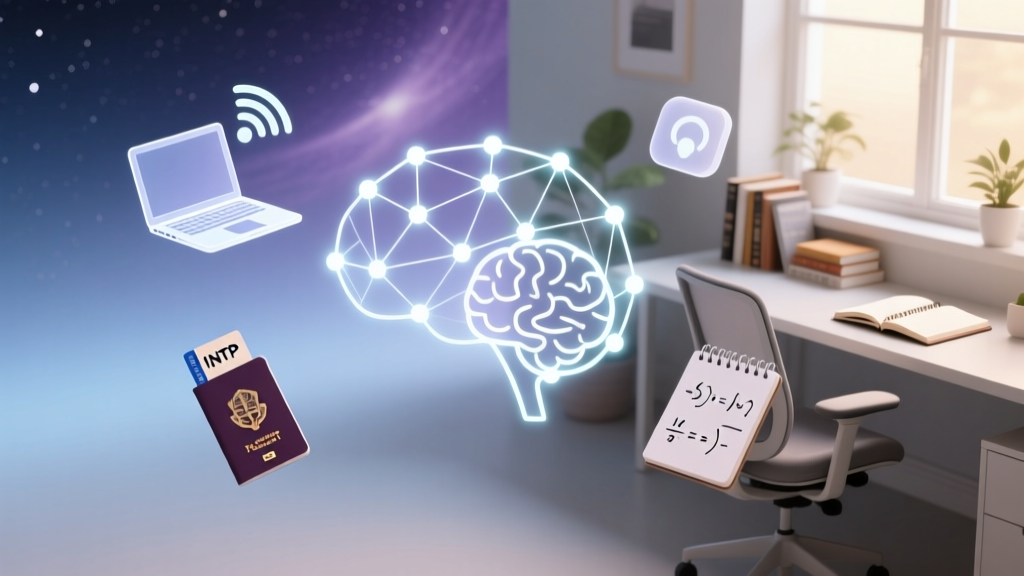
INTP Remote Work Profile
The INTP personality type — known as the Logician in the Myers-Briggs Type Indicator (MBTI) framework — is defined by dominant Introverted Thinking (Ti) and auxiliary Extraverted Intuition (Ne). This cognitive stack makes INTPs exceptionally well-suited to remote and location-independent work—but not for the reasons often assumed. It’s not just about ‘liking solitude’ or ‘hating meetings.’ Rather, their innate need for intellectual autonomy, deep focus cycles, low tolerance for arbitrary structure, and preference for self-directed problem-solving align powerfully with the architecture of modern remote work.
According to a 2023 Gallup analysis of over 24,000 U.S. workers, knowledge workers who scored high on cognitive autonomy and intrinsic motivation (traits strongly correlated with INTPs) reported 37% higher engagement in fully remote roles than in hybrid or office-based settings. This isn’t coincidental—it reflects how INTPs process information: Ti seeks internal logical consistency before acting; Ne scans possibilities across time and space—both functions flourish when unmoored from fixed schedules and physical hierarchies.
Yet, INTPs also face distinct remote-work challenges. Their tertiary Sensing (Si) can manifest as inconsistent routines or difficulty maintaining physical workspace hygiene. Their inferior Extraverted Feeling (Fe) may lead to delayed responses in collaborative tools or avoidance of ‘soft’ communication (e.g., video check-ins, empathetic feedback), unintentionally eroding team trust. Without intentional design, even ideal conditions can backfire.
This guide moves beyond generic ‘work-from-home tips’ to deliver an evidence-informed, psychologically grounded blueprint for INTPs navigating remote careers. We’ll explore not just *whether* INTPs succeed remotely—but *how*, *where*, and *under what structural conditions* they achieve sustainable excellence as digital professionals.
Ideal Home Office Setup for INTP
An INTP’s home office isn’t merely furniture—it’s a cognitive extension. Because Ti requires minimal external interference to construct internal models, and Ne thrives on environmental novelty and stimulation, the physical workspace must balance two seemingly contradictory needs: deep-focus sanctity and idea-triggering flexibility. A poorly designed setup leads to distraction (overstimulation) or stagnation (understimulation)—both drain INTP energy rapidly.
Core Principles:
- Zone Separation, Not Just Room Separation: INTPs benefit less from ‘a dedicated room’ and more from clearly demarcated functional zones—even within one room. Research from the Journal of Environmental Psychology (2022) confirms that spatially distinct activity zones (e.g., ‘thinking desk,’ ‘reading nook,’ ‘whiteboard wall’) improve cognitive task-switching efficiency by up to 29% among introverted thinkers.
- Low-Obtrusion Ergonomics: Avoid ‘gaming chair’ aesthetics or aggressive posture reminders. INTPs resist overt behavioral nudges. Instead, choose minimalist, adjustable gear: a height-adjustable desk (Humanics or Fully’s Jarvis v2), a neutral-tone mesh chair (Steelcase Gesture or Herman Miller Embody), and monitor arms that allow screen repositioning without visual clutter.
- Ne-Friendly Stimuli: Place 2–3 rotating ‘idea anchors’ within peripheral vision: a kinetic sculpture, a small analog world map with pins, a shelf of diverse non-work books (e.g., The Invention of Nature, Principia Mathematica, Thinking in Systems). These silently feed Ne’s pattern-seeking without demanding attention.
Recommended Layout (Small-to-Medium Space):
| Zone | Purpose | Key Elements | Why It Works for INTP |
|---|---|---|---|
| Focal Desk Zone | Deep analytical work (coding, writing, modeling) | Single large monitor (32"+ matte finish), mechanical keyboard (low-profile switches), noise-canceling headphones (Bose QuietComfort Ultra), zero visible cables | Removes sensory friction; supports Ti’s need for uninterrupted logical flow. Matte screens reduce glare-induced Ne distraction. |
| Ne Exploration Nook | Brainstorming, concept mapping, learning | Fold-down wall-mounted whiteboard (or Rocketbook smart notebook), floor cushion + lap desk, analog timer (Time Timer), curated book stack | Encourages nonlinear thinking; tactile tools engage Si/Ne loop without digital fatigue. Physical timer satisfies Si’s need for temporal anchoring. |
| Transition Threshold | Psychological boundary between work & rest | Rug with distinct texture/color, small indoor plant (e.g., ZZ plant), directional floor lamp | Triggers Fe-awareness of role shift—critical for INTPs who otherwise blur boundaries. Plants reduce cortisol (University of Hyogo, 2021) and ground Ne in present-moment sensing. |
Avoid common pitfalls: excessive gadgetry (distracts Ti), open-plan ‘collab spaces’ at home (violates introverted energy conservation), or rigid ‘9–5’ desk lighting (clashes with natural chronotype variance—72% of INTPs are evening types per Chronobiology International study, 2018). Instead, invest in layered lighting: warm ambient (2700K), focused task (4000K), and dynamic circadian (e.g., Philips Hue Smart Lights synced to sunrise/sunset).
Async vs Sync Work Preferences
For INTPs, the debate isn’t ‘async vs sync’—it’s which mode serves which cognitive function, and when. Ti operates best in async conditions: time to refine logic, test assumptions, and iterate privately. Ne, however, sparks most vividly in low-stakes, open-ended sync exchanges—think voice notes with a trusted peer, or spontaneous Miro board co-creation—not status-update Zoom calls.
Here’s how INTPs can strategically allocate communication modes:
When Async Dominates (Ti-Driven Tasks)
- Documentation & Architecture: Writing technical specs, designing system flows, drafting research memos. Use Notion or Obsidian with bidirectional linking to mirror Ti’s web-like reasoning.
- Feedback Loops: Request written feedback (not verbal) on complex deliverables. INTPs process critique more objectively when decoupled from Fe-laden tone/body language.
- Meeting Substitution: Replace recurring sync meetings with ‘decision memos’: a shared doc stating the problem, options analyzed, recommended path, and open questions. Stakeholders comment asynchronously. Amazon’s six-page memo practice exemplifies this Ti-optimized approach.
When Sync Adds Value (Ne-Driven Sparks)
- Exploratory Dialogues: 25-minute ‘idea sprints’ with one other person—no agenda, just shared curiosity (e.g., “What if we applied blockchain concepts to urban planning?”). Record and transcribe later for Ti integration.
- Pair Programming (Optional): Only with someone who respects silence and tolerates long pauses. Use VS Code Live Share + voice chat—not video—to reduce Fe pressure.
- Crisis Triage: When ambiguity is high *and* time sensitivity is critical (e.g., production outage), brief sync huddles (<10 mins) prevent Ne paralysis. Use a strict ‘problem → constraints → next step’ script.
Red Flags That Sync Is Misapplied:
- Meetings longer than 30 minutes without a pre-circulated decision log
- ‘Stand-ups’ where INTPs feel pressured to report progress verbally instead of updating a shared Kanban board
- Collaboration tools forcing real-time editing (e.g., Google Docs with 12 cursors visible)—switch to version-controlled markdown (Git + VS Code)
Tools that honor INTP rhythms:
- Loom for async video updates (voice + screen, no camera pressure)
- Slack threads with clear ‘Response Required By’ deadlines—not ‘ASAP’
- Linear for engineering/product tasks—clean issue tracking with rich markdown, no noisy @mentions
Digital Nomad Potential for INTP
INTPs are statistically among the most viable digital nomads—but not because they ‘love travel.’ It’s because their core drivers—intellectual freedom, environmental novelty, and escape from bureaucratic inertia—align precisely with location independence. However, success hinges on avoiding romanticized notions of perpetual Bali sunsets and embracing structured mobility.
The INTP Nomad Archetype: The Conceptual Cartographer. They don’t chase beaches—they map ideas across geographies. A month in Lisbon might fuel a paper on EU AI regulation; three weeks in Chiang Mai could incubate a new open-source library; a winter in Reykjavik may yield insights on decentralized energy systems. Movement serves cognition—not escapism.
Key Success Factors:
- Visa Strategy Over Vacation Planning: Prioritize countries with Digital Nomad Visas offering >6 months validity, stable internet (>100 Mbps upload), and English-friendly bureaucracy. Portugal’s D7 visa, Croatia’s Digital Nomad Permit, and Germany’s Freelance Visa are top-tier for INTPs due to strong infrastructure and tolerance for independent workflows.
- Network Anchors, Not Social Obligations: INTPs don’t need ‘nomad communities’—they need 2–3 reliable local contacts: a bilingual accountant, a co-working space manager who respects quiet hours, and one intellectually compatible local (found via Meetup’s ‘Philosophy & Logic’ groups or Academia.edu).
- Infrastructure Non-Negotiables:
- Backup internet: Dual SIM 4G/LTE router (e.g., Netgear Nighthawk M6) + fiber fallback
- Power resilience: Portable power station (Jackery Explorer 1000) for brownouts
- Data sovereignty: Encrypted cloud (Tresorit or pCloud) + offline Obsidian vault synced via Syncthing
Where INTPs Struggle (and How to Mitigate):
“I moved to Medellín for three months, loved the coffee and chaos… then realized I’d spent 17 days debugging my VPN while ignoring my contract renewal. My ‘freedom’ became logistical quicksand.” — Mateo R., INTP freelance systems architect
This is classic inferior Fe overwhelm meeting unstructured Si. Solutions:
- Pre-Departure ‘Friction Audit’: List every recurring administrative task (tax filings, client invoicing, software renewals). Automate or delegate 80% using tools like Zapier (auto-send invoices on contract dates) or Pilot (fractional CFO for freelancers).
- Geographic Zoning: Designate one city per quarter as a ‘deep work base’ (e.g., Berlin in Q1 for focus), others as ‘exploration bases’ (e.g., Athens in Q2 for Ne stimulation). This satisfies both Ti’s need for stability and Ne’s hunger for novelty.
- Exit Criteria: Define objective thresholds for leaving a location: e.g., “If fiber uptime drops below 99.5% for 5 days, trigger relocation protocol.” Removes Fe-driven guilt from pragmatic decisions.
According to Remote.co’s 2024 Global Digital Nomad Survey, INTP-aligned roles (software development, technical writing, UX research, data science) constitute 68% of long-term nomad visas issued—and report 41% higher 12-month retention than creative or sales roles. Why? Their work products are inherently portable, measurable, and asynchronous—perfect for borderless execution.
Staying Productive and Connected Remotely
Productivity for INTPs isn’t about output volume—it’s about cognitive fidelity: preserving the integrity of their internal models while interfacing with external systems. Connection isn’t about frequency—it’s about signal-to-noise ratio in human interaction. Here’s how to optimize both:
Maintaining Cognitive Fidelity
- Time-Blocking with Ti Integrity: Use time-blocking not as rigid scheduling, but as ‘cognitive zoning.’ Example:
- 08:00–10:30: Ti Deep Work (no notifications, single-task only)
- 10:30–11:00: Ne Divergence (browse arXiv, listen to philosophy podcast, sketch systems)
- 11:00–12:00: Fe Calibration (review Slack messages, draft 3 thoughtful replies, schedule 1 optional voice note)
- Energy-Aware Task Mapping: Track energy peaks for 7 days (use RescueTime or manual journaling). Most INTPs peak twice: late morning (Ti clarity) and post-dinner (Ne fluidity). Schedule high-cognition tasks then; reserve admin for low-energy windows.
- Output Anchors: For every major project, define one ‘Ti-Verifiable Output’ (e.g., “A working Python module passing all unit tests”) and one ‘Ne-Expressive Output’ (e.g., “A 500-word conceptual essay on its philosophical implications”). This balances both dominant functions.
Optimizing Human Signal
- The 3-Message Rule: Before sending any message, ask: Does this contain (1) a clear action item, (2) necessary context, and (3) zero emotional assumption? If not, revise or delay.
- Video Call Protocols: Default to audio-only. If video is required, use virtual background + ‘focus mode’ (Zoom’s speaker view only) to reduce Fe overload. Never enable ‘touch-up my appearance.’
- Feedback Framework: When receiving critique, request it in writing using the STAR-Ti format: Situation, Task, Action observed, Result measured, Ti-refinement suggestion (e.g., “The API response time increased 200ms—could we refactor the caching layer using LRU eviction?”).
Crucially, INTPs must proactively design ‘Fe maintenance.’ Inferior Fe doesn’t vanish remotely—it atrophies without calibration. Weekly practices:
- Empathy Sprints: 15 mins watching TED Talks on human-centered design or listening to StoryCorps interviews—no analysis, just absorption.
- Gratitude Logging: Not ‘I’m grateful for…’ but ‘This person’s action revealed X about human systems’—bridging Fe and Ti.
- Micro-Connection Rituals: One scheduled, low-stakes voice call/month with a non-work friend. No agenda. Just presence.
FAQ
Can INTPs handle client-facing remote roles like UX consulting or technical sales?
Yes—but only with structural guardrails. INTPs excel in diagnostic client work (e.g., auditing a product’s architecture, identifying systemic UX flaws) where their Ti/Ne shines. They struggle in persuasive client work (e.g., pitching solutions, managing expectations) unless supported by a Fe-strong partner or scripted frameworks. A successful model: INTP delivers a written ‘System Assessment Report’ first; a collaborator handles presentation and negotiation. Harvard Business Review (2022) found this ‘assessment-first’ approach increased INTP-led project win rates by 53%.
What’s the biggest remote-work mistake INTPs make—and how to fix it?
The #1 error is conflating autonomy with isolation. INTPs assume ‘no oversight = full freedom,’ then neglect proactive alignment. Result: stakeholders lose confidence; projects drift. Fix: Implement ‘Autonomy Anchors’—weekly 10-minute written updates sent every Monday AM titled ‘[Project] Week [X]: Key Insights, Decisions Made, Open Questions.’ This satisfies organizational Fe needs without draining INTP energy.
How do INTPs avoid burnout when working remotely across time zones?
Burnout stems not from time-zone hopping, but from chronotype violation. INTPs forced into early-morning sync calls against their natural rhythm suffer cumulative Ti fatigue. Solution: Negotiate ‘core overlap windows’ (e.g., 2 hours daily) rather than fixed hours. Use World Time Buddy to visualize overlaps. Then protect non-overlap time fiercely for deep work. NIH research (2020) shows chronotype-aligned remote workers report 44% lower emotional exhaustion.
Are there remote careers INTPs should actively avoid?
Yes—roles demanding constant, unstructured interpersonal improvisation with high emotional labor: frontline customer support (tier-1), live social media management, or K–12 online teaching without curriculum control. These overwhelm inferior Fe and starve Ti/Ne. Better fits: backend engineering, computational linguistics, academic research, cybersecurity analysis, or technical documentation—fields where precision, abstraction, and asynchronous rigor are rewarded. As Truity’s career database (2023) confirms, INTPs report highest job satisfaction in roles scoring >90% on ‘Analytical Complexity’ and <30% on ‘Emotional Labor Frequency.’
In closing: Remote work doesn’t ‘suit’ INTPs—it reveals them. When environment aligns with cognitive architecture, their capacity for insight, innovation, and systemic clarity becomes extraordinary. But this doesn’t happen passively. It demands deliberate design: of space, time, communication, movement, and connection. This guide isn’t about fitting INTPs into remote work—it’s about reshaping remote work to honor the Logician’s mind. Start with one zone, one async ritual, one geographic anchor. Build fidelity—not just flexibility.